
PODCAST EPISODE
E9: How Stella got her groove back (from MFM): Stella's story
September 17, 2025
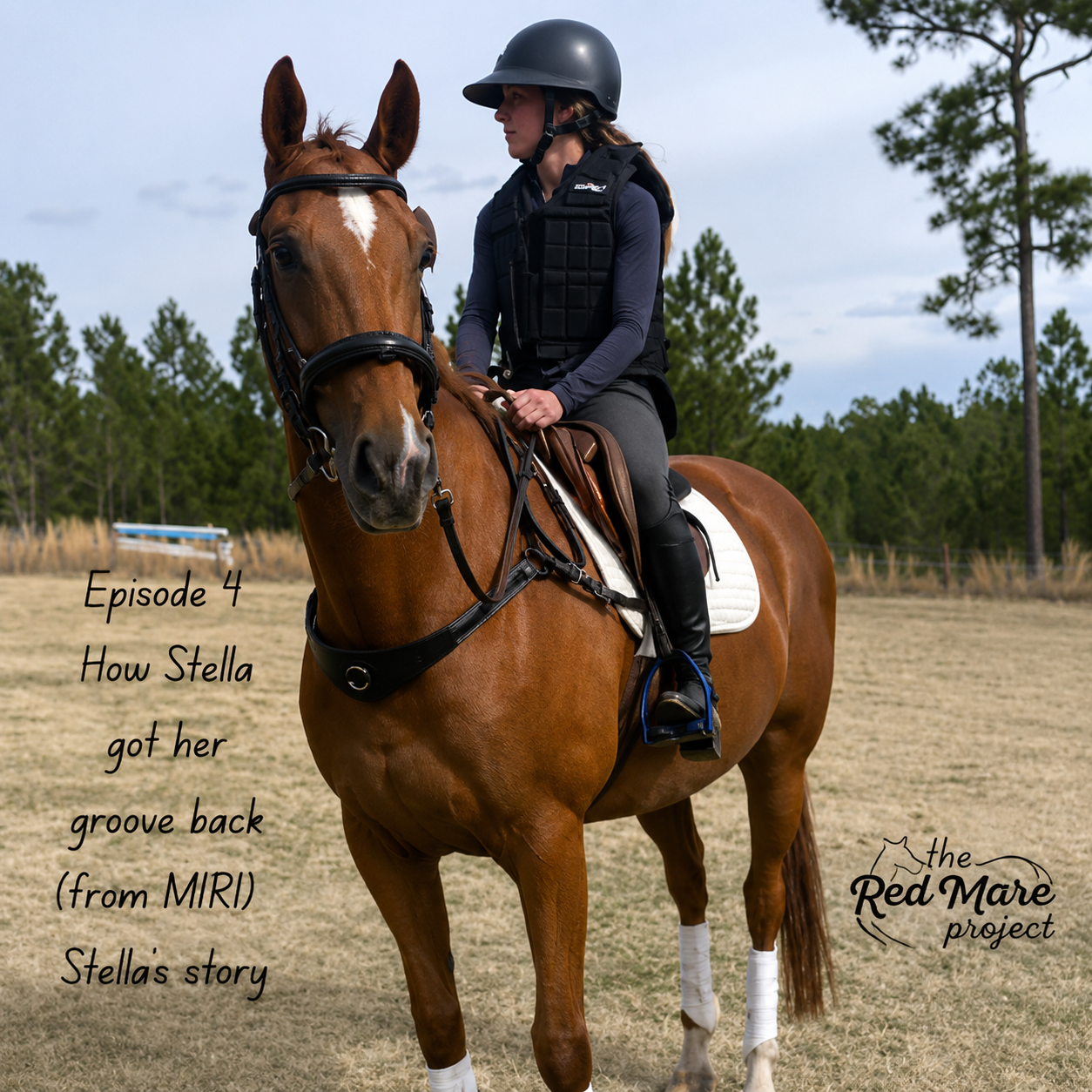
ABOUT THIS EPISODE
Kahlan and Taylor have a raw conversation with trainer and bodyworker, Lexi Freeman Rogers (Healing Intent Equine). Lexi share's her mare's extraordinary origin story, diagnostic journey to Myofibrillar Myopathy (MFM), and management protocols. This episode focuses more on the journey and symptoms, but for more of the science check out Episode 3: MFM is a MTHRFKR. Lexi Freeman Rogers Healing Intent Equine 404-313-9937 Rutledge, GA Dr. Valberg's Muscle Lab https://ker.com/nmdl/ Taylor CL Schouten, MS, APF-I Hoofcare Practitioner Wild Hoof Equine LLC www.wildhoofequine.com Kahlan Ettere Holistic Equine Nutritionist Wise Choice Equine Wellness LLC Check out our website: www.theredmareproject.com Follow along on Facebook: The Red Mare Project Instagram: Wild_Hoof_Equine
EPISODE TRANSCRIPT
— Intro: Welcoming Lexi Freeman & Stella's Story
And this is where we go silent.
This is where we go silent.
Every damn time.
I forget how words work.
Yeah.
Welcome back to another episode.
Today, we welcome Lexi Freeman, a trainer and body worker whose personal mare, Stella, was recently diagnosed with myofibular myopathy.
Lexi takes us through Stella's diagnostic journey and discusses her maintenance routine to help keep her healthy and thriving.
Welcome, Lexi and Stella.
Beauty.
Welcome to The Red Mare Project.
Well, that was easy.
Okay.
Yeah.
That part's getting better.
Like, we're getting better at that part.
Thank God.
I know, for real.
There's so much pause in between.
Do you know what I realized, though?
Every horse, aside from our own, our two, have been red.
Like, every guest has been red.
I know.
Oh, my God.
You're right.
They've all been red.
Hell, yeah, dude.
That's awesome.
It's so on brand.
And this has not been planned.
No.
They've all been red.
Because Stella's a Red Mare.
That's awesome.
But, yeah, that's three for three.
Three red horses.
That's awesome.
I love that.
It's so on brand.
So, I guess, do you want to do another quick rundown of what MFM is, in case some of our viewers haven't, our listeners haven't heard your original episode?
That's probably a good idea.
Okay.
Take it away, Taylor.
Yeah, for, like, a really in-depth, in-detail one.
I think that was episode three.
I think it was.
Correct.
Yep.
Yeah.
Okay.
Episode three.
MFM is a motherfucker.
I actually did not write motherfucker in the title, but I wrote it close enough.
I think I just, like, nixed some vowels.
You know, you did the Fall Out Boy thing when you took out the vowels.
My God.
Is that a Fall Out Boy thing?
Yeah.
Oh, I love Fall Out Boy.
That was...
I need to go get my converse now.
Right there, producer told them their song names were too long.
So they just...
Yeah.
Moving on.
Anyway.
Anyway.
Okay.
So, yeah, if you want a really in-depth explanation of myofabular myopathy, we really go into the weeds in it in the episode three, which is MFM is a motherfucker, and that was my mare story.
But yeah, MFM, it's a muscle myopathy, and pretty much what happens is in the muscle tissue, there is a clumping, if you will, of desmin.
And as the desmin starts to clump up, it stops the muscles from being able to completely relax and completely constrict or contract.
And since they are not able to fully contract and relax, they're essentially weakened.
Yeah, well, you covered it.
I mean, we have a whole episode on it, and it's really personal, so you do a really good job of exploring it.
I'm really excited to see, with Lexi and her horse, do you know her horse's name?
Stella.
Stella, yeah, you've said that a million times.
I'm excited to see what she's doing differently, because as we've learned from other guests, things present so differently.
Like we have this textbook idea, and you have real-world experience of what this mare should, quote, look like.
I'm interested to see if that holds true with her horse.
Yeah.
Yeah.
And I'm sure she and I are probably going to like swap parenting notes on what we do for.
We've got to.
Yeah.
Right.
But it's wild.
I mean, usually, I don't know how old this mare is, but usually the age of Ansa is like eight.
I got one in his fifth year who became symptomatic, and then there's one in his sixth year who started to become symptomatic.
Have they done the testing for it?
The six-year-old...
Hold on.
Horses.
Here we go.
Six to eight.
Yeah.
Okay.
I was right.
Yeah, yeah.
The six-year-old, they did do a muscle biopsy, and his came back abnormal, but that's kind of the tricky thing with MFM for doing a muscle biopsy is that a muscle biopsy is kind of inconclusive if they're a single-digit...
— Muscle Biopsy Limitations & Building the Supplement Protocol
Until there's an actual damage.
That was what I was going to say.
I was going to say, if they have tested for it, even if it's coming up, quote, clean, that may not be the case.
I remember you saying that when we did Leah's episode, it almost needs to be a bad day or in a state of distress when they do the biopsy, otherwise they're not going to necessarily catch it.
Yeah, it's a snapshot.
Yeah, that sucks.
Yeah, and then they do have a hair test for it.
Equiseg has a hair test, but it's- How reliable is that?
It's not.
Okay, so this is my understanding of it, is that it's valid, but it's not peer reviewed.
Okay.
So, you know- I would grain of salt.
Yeah, I mean, okay, so I did the hair test, and I think it was P2 and P4 came back, and- I remember that.
I forgot that was on hair.
Yeah, that was hair, and that kind of- I mean, I was going to do the muscle biopsy anyway, but in my mind, I was like, well, I thought I was supporting science.
If I do feel- Right, right.
But no one asked me.
No one has done anything with this information, so.
I just did it myself, but I don't know if- I don't know if Lexi did the hair test, but yeah, so the muscle biopsy can be done.
It's usually done a little bit later, and that's when you can actually see it.
But that has to be sent off to Dr.
Valberg's lab.
I don't know if any other labs actually look at the tissue.
Do you know?
You may not, but I know that you're like a rabbit-holer.
When was this first discovered?
Like, when was this first described?
Do you know?
Like, how long have we even known about this?
Yeah.
Please hold.
I love when we Google stuff.
Survey says 2017, Dr.
Valberg.
Oh, my gosh.
So this is infancy still.
Fresh, fresh.
Well, that's kind of cool.
We'll get to watch the progression of the science.
Yeah.
And I do think that the hair test and the muscle biopsy will eventually become friends.
Similar to that of the PSSM-1 hair test, like the UC Davis test.
That one's like written in scripture.
Yeah.
That's in stone.
Mm-hmm.
Ian Hanger had on it.
But I do think muscle myopathies are a lot more common than we think.
Oh, I'm sure.
This was.
I saw a staggering statistic about PSSM-1.
I think this is what it was.
And I think it was upwards of like 30% of draft horses.
Have PSSM-1.
Well, actually, the only horses I've ever personally known with it were draft or draft grosses.
Oh, no kidding.
Well, I guess.
I mean, correlation is not causation, but like it's of note.
Yeah, it's pretty on brand.
I don't know that much about it.
I've never personally owned or managed a horse with it.
PSSM-1.
Not that I knew of.
Yeah.
I mean.
Yeah, yeah.
I have a couple on my books.
And one of the big giveaways for any muscle myopathy, if it's not the rider who notices it, although usually some things that kind of start to kick in are like reluctance to go forward, really stiff, almost like laminitic at the start, like they almost start working like they're like their foot sore.
And really difficult to pick up the canner, hard to hold the canner.
But it's the hoof care provider who kind of starts to notice it first because bringing their foot forward on the stand.
Oh, it's probably so hard for them.
Oh, they can't.
Yeah, it's it's nuts.
So do you have to use one of those old people's fans?
The low ones.
I do have one of them and that's really helpful.
I do have one that I'm really kind of curious about what's going to happen with him.
We just got his hair test back and he came back as PSSM-1.
And then I think I see him next week.
And we're putting him on like all the things he's going on like muscle EQ, he's going on Nano E, he's going on I think E03, I believe it is.
— Stella's Supplement Stack: Muscle EQ, Nano-E & E03
Oh, I like it.
Yeah, yeah.
The Mad Barn oil.
Oh, no, the, oh, I may be saying it wrong, the KER-1.
I don't remember what theirs is called, but yeah.
Yeah.
Their Omega Blend product.
Yeah, that one.
Yeah, so he- I don't remember.
You could be right.
I could be mixing them up.
But he's going on all those things.
So I'm kind of curious to see how he does with like no Roebacks and no drugs, nothing like that, just bringing his foot forward because he couldn't, he physically could not even hold his leg up.
He was so stiff.
Oh, yeah.
So Hoof, like if you're kind of curious that your horse may have something going on, like ask how, ask your care provider.
Like, do you have trouble?
They're going to notice everything.
Yeah.
What's going on down there?
You having any trouble?
So you're doing all the work?
Yeah.
Yeah.
Hey.
Welcome.
Hey, you guys.
Hey.
How's it going, Lexi?
Oh, good.
How are you guys?
All right.
Good.
That's why I met you.
Likewise.
Yeah.
All right.
Well, thank you so much for being on the show.
Yeah, no, of course.
Thank you guys for having me.
I appreciate it.
Oh, yeah.
Totally.
Totally.
So just a couple, like, not ground rules, but just to kind of give you the feel.
Yeah.
You can swear.
You can say whatever you want.
That's fantastic.
I was worried about.
No.
Oh, no.
We could never.
Lean in, girl.
Yeah.
Okay.
Thanks, God.
Yeah.
So say whatever you want.
If there's anything that you say that you want edited out, just let us know.
I do all the snips in.
So solid.
But yeah, you guys are better than me.
I don't know how any of this stuff works.
She's so good.
We did not know anything about anything when we started this.
And Taylor, she has done such an amazing job with the editing.
We all were like monkeys.
Like we were sitting in my backyard, begging my husband and my brother to help us understand it.
And once she's got it, she's like a pro.
It's so impressive.
That's awesome.
I'm like a fantastic surgeon.
Yeah.
I don't even understand technology.
I'm just like, I'll click on the link.
I hope this works.
I don't know.
You're good.
I also love the fact that you're in front of a hay bale.
That's- Yeah.
Yeah.
No, I don't think I have enough reception inside.
So I'm just like chilling in my hay barn right now.
Love that.
I hope you don't overheat.
Oh, no.
It's actually kind of nice in here.
It's fine.
Great.
I love that for you.
Awesome.
All right.
So Lexi, why don't you tell us a little bit about you and your professional journey and how that brought you to Stella?
Where do I start?
So obviously, I wanted to be a horse trainer and a professional in the industry for as long as I can remember really.
And I was assistant trainer and for several different folks and working student positions and things like that for a long time before I kind of went out on my own.
And I swear every single horse that has come into my life has had some type of an issue one way or another.
That most people would have been like, you know what, you're just not going to make it.
Let's find something else.
And here I am.
I'm like, no, I can fix it.
Out of girl.
So much to the detriment of my mental health, but it's totally fine.
It's fine.
I do love what I do, but somewhere along the lines, I decided that bodywork really intrigued me.
Amanda Moritz is one of my mentors.
And talking with her, I was like, yeah, I was like, you know, I want to go do this.
And so I decided to go to school to become an equine massage therapist, and then that changed my entire journey with training horses and eventing.
I couldn't look at horses the same way again.
It wasn't, it's horrendous, but it's great at the same time.
And you know, obviously it was, yes, I love the sport of eventing, and I love all the different disciplines, but then it became of like, I looked at a horse as a whole being, because obviously not that I didn't look at them as a living being before, but you start to look at how all these parts are interconnected and like how you can make them better and how, you know, how you can train them better and help other people to understand them.
— Lexi's Journey: From Eventing to Holistic Bodywork
And, you know, I ended up kind of the horse that kind of changed the trajectory of my career was my big graver, Brett Oliver.
And he taught me so much.
And then I think the race track had just taken such a toll on his body that it was just kind of an off and on, off and on, like, we're lame, we're fine, we're lame, we're fine.
And we ended up having this kind of sorry, this kind of backtracks a little bit before we get to Stella.
But it kind of we had had this situation where like Oliver and I had a pretty significant rotational fall at home, just schooling.
And he fractured C6 and I shattered my collarbone.
Lexi, whoa, whoa, whoa.
Yeah, no, it was probably one of the more traumatic things that's ever happened in my professional life.
And somehow he came out of it fine.
And during that three month break that we both had, I took a step back and was like, no, I need to do this right.
Like screw trying to chase some title or the levels or thinking that people weren't going to take me serious if I didn't have an FEI record.
And I kind of backed way off and went as slow as I possibly could, bringing him back.
Unfortunately, he ended up having several more injuries along the way.
And it would just have not been fair to continue to put so much pressure on him.
So after we had the fall, all this to say, someone reached out to me.
I did not know her at all.
She reached out to me through a saddle fitter.
And she sent me a handwritten card that kind of said like, hey, I know where you've been before.
Like I've been there.
Here's a check for a significant amount of money.
I want you to put this toward your education.
And I was like, whoa, I'm sorry.
What?
And she was like, please don't use this for bills.
If you can manage to not do that, use it for lessons.
And I found her on Facebook and we connected.
And she would check in on me all the time and be like, are you okay mentally?
I've crashed a horse before.
Don't listen to other people.
You know what's best for you and your horse.
And we became fast friends and she mentors young professionals because she used to be in the industry.
And when it was kind of clear, Oliver was having a bunch of other problems.
You know, this was like a year down the road.
She was like, hey, I want to help you find something else that you can get back out there on.
And I was like, I can't let you do that.
Like that's no, I can't, I can't accept that.
And she was like, there's no pressure.
Like, let me know when you're ready.
And for a long time, I was like, no, no, no.
And one day I was like, hey, I think I want to find something.
And I, you know, she would like, start, start looking.
She's like, let me help you.
And came upon this horse named Moony, who it was a, I won't get too much into that, but it was a very long saga of like, I got this wonderful horse and she, it turned out that she had equine degenerative minds.
I can't even say it honestly, EDM.
No way.
Yeah.
It was, so yeah, once again, very another traumatic, traumatic portion of my career.
Damn, sis.
But it taught me, yeah, it taught me a lot about listening to horses even more so than Oliver did.
And when we ended up having to put her down, my friend through all of this was like, I'm not going to let you stew on this.
— Losing a Horse & Finding Stella Through a Friend
We're going to find you something else.
Like, this is, like, we're doing this.
And I was like, what is my life right now?
So she set up this whole incredible trip to Ocala, and I tried a bunch of horses, and she was one that, like, I kind of sat on, it wasn't the plan for me to sit on her.
I was there to try another horse.
And she was, they were like, hey, we haven't put her on the market yet.
She's been sitting for a couple of months.
But, like, she has gone through two-star.
And I sat on her, and I was like, I feel totally comfortable on this mare.
And, you know, kind of the kicker for me whenever I try a new horse, if there's a triple set up, and I ask, hey, can I jump through the triple?
It's like a key of like, oh no, I feel comfortable on this horse.
Popped right through the triple.
She was lovely.
And there were, like, a couple of things that ticked me off that I was, like, a little bit of a concern.
You know, she lacked top line.
She was a little weird in the connection.
Like, did not want you to touch her face.
But again, I didn't know her.
But, like, she reminded me so much of Moony.
And that's kind of what started this whole thing.
I was like, this is a sign.
Like, I think this is the one.
And we vetted her and she vetted beautifully.
And I was like, this mare has been, like, has a competition record that spans from her 3-year-old year through her 11-year-old year.
And all her rads are pretty clean.
And she flexed a one on the hind left.
And I was like, done.
Yeah.
Done.
And so we said yes, shipped her up to the farm.
And then that's kind of when the whole saga started.
But that's how I met Stella.
So she was meant to be yours.
Yeah.
I think so.
I think so in a roundabout way.
But it's been a journey since then.
I know you know Taylor, because obviously you have an MFM mare.
But I'm sorry if I'm talking too much.
It's your story.
We love the podcast guests for that reason.
We just want to listen to you.
Yeah.
So basically she shipped up here and she got off the trailer and immediately just settled in.
And as someone who works with problem horses regularly, I was like, are you just already settled?
What is this?
Is this a joke?
And she was just so workman-like and so easy and fit right in.
And her and Oliver kind of became buddies.
And I was like, holy crap, this is amazing.
I was like, all of this like horrible things that have happened have like turned into something so good.
And I gave her some time to like chill.
And when I started her back under saddle here, I was like, oh, this is interesting.
I swear it's like she came here and was like, hey, I know you're going to listen to me.
So let me tell you what's wrong.
And I was like, I was like, I was like, okay, girl.
And I'm like, okay, well, we treated her for ulcers just to be on the safe side.
And like, I was like, we'll be ready to rock and roll.
We'll be competing in a couple of months.
And then it was, you know, we had some saddle fit issues where I was like, okay, she's just really sensitive about the saddle.
Like she's lacking top line.
She's out of shape.
I was like, we'll just, you know, I knew they were totally upfront with me.
They were like, truthfully, this mare's record is crap.
Like, it was super great until she probably was like nine.
And then it kind of went to crap.
Granted, she had switched riders.
She had had some time off for no reason other than that her, her original owner had a big string of horses coming up.
She actually, she's actually from Kentucky Equine Research.
Strangely enough.
Oh, yeah.
She was part of their sport horse programs.
— Stella's Athletic Pedigree & Early Sport Horse Career
And they're like, she's run on a treadmill and everything.
And so like, she competed through preliminary with, with KER.
And so then she had some time off and then a young rider was leasing her.
And that's when the problem started.
So they all assumed it was like a, a horse and rider communication issue.
And then it, you know, young rider maybe was pushing too fast, whatever.
And she just ended up with confidence issues.
She had had a crash cross-country schooling into a ditch and wall.
And so then it was just like everything tanked.
And so I knew that going in and I was like, listen, I'm cool starting back at square one.
Like I haven't competed in forever.
We'll just do it together.
And so I was like, well, let's just get her strong, sort through things.
And my vet agreed, you know, he was like, no, like, I don't think we're dealing with any major issues.
Like, let's just give her some time.
I'm like, we'd have good times and bad times.
And there was some bucking involves.
And the biggest thing was, someday she would be really forward.
And other days I could not get her to move.
Like hardly at all.
It was like pony club kicking some type of like old school horse.
Yeah.
And I was like, this mare is an athlete.
What's happening?
Like, is it a saddle issue?
Yeah.
And I'm like, does she just not like me?
All those thoughts start going through your head of like, yeah, why can't I figure this out?
And she could not pick up the right league canner.
Like it would take me typically five tries to get her to pick up the right league canner.
And but no real lameness issues.
And, you know, obviously like I'm a body worker.
So like I addressed all of that.
She hates chiropractic.
Like we'll try to kill my poor chiropractor, but loves acupuncture.
Really?
Interesting.
Yes.
Very.
Yeah.
Figured that out pretty quick.
She told you.
But, oh, she told us.
All right.
But we were kind of figuring each other out a little bit.
Had some incidences here and there, but nothing crazy.
And I was like, okay, like we're getting somewhere.
And we decided to do the Area 3 Eventing Camp.
This was, I think it was last summer.
So a little over a year ago now.
And I did most of the week with Sarah Cozumflick, who is absolutely incredible.
Helped me kind of figure Stella out a little bit.
And she loved the mare.
And it's a four-day camp.
And like MFM horses, they're like a two to three-day on, one to two-day off type of deal.
Well, this was a four-day camp.
She hauled down, day one was a hack, then three days of going twice a day.
So by day four, she was super stuck in her body for a dressage lesson that morning.
And I was like, I think she's just really tired.
I'll see how she feels for the afternoon ride.
And when I pulled her out that afternoon to go for a handwalk, she just kind of like literally plants at her feet, not like being obstinate, but just plants at her feet.
And she like fell asleep standing there and just zoned out.
And I was like, and I was like, no kiddo, like you're done for the week, like we're not, I'm not gonna make you do anything.
Like we'll go home.
You've been, you've been a champ.
And I get her back home, gave her a few days off.
And then I couldn't get her to move under saddle.
It got worse.
And then the spookiness started.
Then she went off of her food.
And I'm all kind of all around, I was like, are we dealing with ulcers?
Because like she was on Ulcer Guard the whole time we were gone, but maybe she just got super stressed, scoped her, she was pretty riddled.
And it took us like four solid months to get rid of these ulcers.
They wouldn't go away.
Oh my God.
And I was like, I'm beating my head against the wall.
— Hitting a Wall: Unexplained Resistance Under Saddle
And I'm like, what is happening?
And during that time, I was like, I'm going to take you out of regular work.
We'll just, we'll hack for a couple of months, like low stress, easy.
And I'm hacking one day, like we have like 180 acre farm.
And so like we're out in the cow pasture and she's like kind of stuck in her body.
And I'm just chucking in the reins and I'm like, you know, walk on, like we're just, it's a chill day.
And like zero to a hundred, all of a sudden she is bolting out of nowhere for no reason.
And then bucks and I'm like, it's okay, I got this.
And as I'm like, I got this, she drops the shoulder and spins.
Oh, and I'm like flat on my back on red clay.
Oh, and I was like, I legitimately thought I broke my back for a second.
And I was like, what, what the hell?
And I remember I let go of her and I heard her scream and I heard her gallop off.
And I was like, what the fuck was that?
So I sit up and I'm like, okay, I think I'm fine.
And I stand up and she's gone.
Oh my God.
Like nowhere to be found.
And I was like, okay, surely she just galloped back to the barn, like you're inside of the barn.
Sure.
So I call my husband and I'm like, I need you, like where is Stella?
Like she's probably run back to the barn.
Like, you know, we had an issue and he's like, she's not here.
I'm like, what do you mean she didn't run back to the barn?
Like that's like a normal horse thing.
You run back home like you run.
Right.
No, now she's nowhere.
So I'm like sprinting through the cow pasture trying to find her.
She's nowhere on the property.
She ran through an entire fence line of our neighbor's pasture.
Oh my God.
And is standing in the middle of his 20 acre field.
Not grazing, not moving, just standing.
Oh my God.
And then my husband walks up to her and she was like, oh my God, hi dad.
I'm so sorry.
She walks excited. 100% dissociated.
And I was like, okay.
I was like, we're just not going to ride you until the ulcers clear up.
So we waited.
Get the ulcers cleared up and I'm like, okay, I think I have my horse back.
Like we're feeling better.
And then the big kicker was kind of like, peed me off that something really not right is she somehow, I still have no idea what really happened, but she somehow, I don't know if she got tangled in her turnout sheet one night.
I do night turnouts and this was like last fall, I think.
Well, the next morning, I get a call from a share a barn with another trainer and she was like, hey, all of the horses are going like that shit.
And I was like, what do you mean they're going that shit?
Like it's 6 a.m.
So I like run out in my pajamas and the couple of horses inside were screaming bloody murder.
All the horses outside are running.
And Oliver's in his pasture who's like, who's next to Stella and he's like, yo, I don't know what's going on.
And I'm like, okay, there's Oliver, like where's Stella?
And I see her, she wadded up in the middle of the pasture and she's gone.
Oh, she's gone.
Boom.
So she had, yeah, so she run through, it's still dark at this point, she had run through an electric gate, she jumped out of her pasture, jumped into another pasture, ran through the fence out of that one.
And then we lose track of her from there.
Oh, and so it's about an hour and a half of us looking for her all over this 180 acre property.
Meanwhile, there's like 20 something other horses on property that she doesn't stay with.
There's an entire band of brood mares next door that she also doesn't go to.
So I have like five or six people searching for her.
Can't find her.
We've retraced our steps multiple times.
I'm like putting out lost and founds and I'm like, Oh, this is a nightmare.
— The Search for Answers: Lost Posts & Growing Desperation
Oh, my God.
Oh, I was losing it.
So about an hour and a half goes by.
I've driven past the same area in the back of our cow pasture, the furthest away from any horse that you can get.
I've driven past here two to three separate times.
My husband called me and goes, she's in the wood line shaking.
Oh, girlies.
I mean, she had run through a barbed wire.
Well, I think she tried to jump the barbed wire fence, missed, went through it.
She's cut to shreds and she's just standing in the wood line for probably an hour shaking while everyone's looking for her.
I was like, this is not normal.
What do I do?
That's not normal horse behavior, but everyone was like, oh, it was a freak accident.
Like, freak things happened.
She just panicked.
And part of what happened, I found out, which, you know, words to the wise, I don't know if you know what I'm talking about when I say, like, you know, the electric fence gates that are like metal coils?
I don't know that like they stretch across.
Yeah.
I'll never use those again, because those got stuck in her tail and were chasing her.
Oh, my God.
Yeah.
So I won't use those.
So that's kind of why she was running like blindly to begin with.
But we found those on the back of a horse trailer behind the barn.
So she ran by, those got pulled off of her and then she still continued running.
And that's when she ran through the fence and took off to the back 40.
So both my vets were kind of like, maybe it's just her, it was an off thing.
Who knows?
And I was like, okay, so I'm just kind of trying to piece things together.
And she heals from everything and we're back to work.
And at first she came back beautifully.
And then things started going down hill again, spooking, bucking, like going blind, almost having like little mini tie up episodes where she would just shake for really no reason.
And so during that time, I was also working with two client horses who were suspected of having neuromuscular issues.
And I knew what MFM was because I had originally suspected it with my Mooney horse, and it turned out it was not MFM, it was EDM.
And I kept seeing little signs in these other horses where I was like, this is a lot like Stella, like in a lot of different ways.
And so I went to my vet.
I remember calling him one day, she had an absolute meltdown about seeing another horse.
That was it.
She just saw a horse, had a meltdown.
And I called him and I was like, something's really, really wrong.
Like I want to do a muscle biopsy.
And he was like, listen, I don't think these two things are related.
Like I think she just had a moment, maybe she's in heat.
And I was like, no, we're doing a biopsy.
And you know, God bless my friend, you know, who helped me find her, who technically co-owns her with me.
I was like, please don't think I'm crazy.
Like, and she was like, we're far past that.
She was like, if you think this is something we need to do, you tell me like, we'll do it.
And I was like, I do.
And of course I'm terrified that I'm going to be wrong.
And we do the biopsy and my vet texts me one week, it came in like on a Friday.
He texts me on a Saturday morning.
He goes, holy fucking shit, you were right.
It's MFM.
And I was like, I was like, are you shitting me?
And it wasn't like a mild case.
Like it was like, it was legitimate.
What was her rating?
What was, was it like very, like?
So, I don't know if they gave like a rating necessarily.
I can't remember.
I'd have to go back and look at the report, but like it was very clear of like there were Desmond aggregates in that biopsy.
You could actually see it on the picture.
— Confirming the Diagnosis: Seeing It in the Radiographs
So, I was like, okay, this isn't like a false positive or anything.
This is for real.
Yeah.
And what really I thought was interesting is Dr.
Valberg actually on there was like, hey, I'm really interested in this case.
If someone could please update me on how this mare does.
And I was like, oh, this is serious.
Like, this is, this is something.
And so like, of course, like, you know, you know, the biopsy reports, they give you like all these, all, you know, the steps of like, you know, this is the diet change, you know, here's a nutritionist you can contact.
And, you know, here's an exercise program.
And like, it starts with like lunging, LOL.
The mare does it lunge.
We don't lunge.
We don't do circles.
We, no, we don't know.
No, no, like we come unglued and act like a wild animal is attacking us when we lunge.
Um, do you, so when you posted that video, not to cut you off, but when you posted that video of Stella lunging, I have never felt more seen because I thought I just never taught her how to lunge.
And, but she does the same thing.
It's like, she's good.
She'll just literally just like a lesson point jog and then gone.
That I don't know.
Yeah.
Yeah.
And for a while I thought I was crazy.
And I was like, am I, do I just suck it lunging this horse?
What is happening?
And I'm like, I swear to God, I know what I'm doing, but I couldn't figure it out.
And, and forget long lining.
Like I tried long lining again, like last week.
And I was like, never again.
Forget this.
No.
But you know, of course, like I get these biopsy results and I get the report and I'm like, okay, we figured it out.
They say like four to six weeks with a diet change and you'll start to see results.
And I was like, ha, we figured it out.
I'm going to get my horse back.
That was like so far from the truth.
Oh, no.
No, no, no.
It's like it's it's fine.
But like it was probably four months until I really was like, oh, I think this is going to be okay.
Like I think I'm getting my horse back.
And it was very it was very emotional because there were several times like, I'm pretty stubborn, but like, I'll be honest, there were multiple times where I'm like sobbing because I'm like, I am actually scared of my horse because like she can go from zero to a hundred.
Yeah.
And like, as a professional, especially being scared of your own horse is like kind of kind of kills your confidence a little bit.
Yeah.
But like, I've never gotten, I think I've never gotten bucked off of a horse as much as I have her.
Well, she never doesn't maliciously.
Of course, it's never, she just goes blind.
And it was one of those things of I kept telling my husband, I was like, I don't know if I can do this.
Like I legitimately don't know if I can do this.
And God bless, you know, my friend, she was like, if you get to a point where this is too much, she can come stay with me.
She's a brilliant horse woman.
She's like, she can come stay with me.
I'll figure things out.
You take a mental break, do what you need to do.
And I was like, no, I'm going to do this.
Screw that.
I was like, ah.
And so I remember one day I was so frustrated and I'm like in tears saying I can't do this.
And my husband was like, you can and you're going to, like period the end.
He's like, he has such a good feel for the horses.
And he was like, this mare's not done.
Like she's going to be fine.
But like you just basically he looked at me and he was like, whether you realize it or not, he's like, you are putting so much expectation on this mare of like, I have to get her better because we're going to go show.
Like I have to prove everybody that I proved to everybody that I don't suck, that I do know what I'm doing.
— Imposter Syndrome & Proving Herself as a Professional
And he was like, she feels all of that.
And I was like, no, I'm not doing all the right things.
And he was like, okay, no, you're not.
And I was like, oh, like so mad at him.
And then of course, I realize I'm like, as usual, like I hate to admit this publicly, like he's right.
On the record, you know.
And I was like, oh.
And so I kind of looked at her one day and I was like, all right, girl, like I'm going to put on my air vest and we're going to go hack for a month.
Like we're just going to go for a walk, whether it's for 15 minutes before you say I'm done.
Because she would just, you go for a walk and she would just plant her feet and be like, I can't go any further.
And I would try to push her through it.
And so I was like, zero expectations for the next six weeks, like here's what we do.
And so we would walk.
And if she would get to a point where she said I can't go anymore, I'd go, can you just try for five more minutes?
Like what if we just try?
And it got to the point where she was like, okay, as long as you're not going to push me more than that, like I'll try for you.
And a few weeks of that went by and she'd be like, okay, like you can ask me for a little bit more.
Like I trust that you're not going to ask me to canner today or to ask me to do something that scares me.
And so then one day I was like, what if we tried the trot?
And she picked up the trot and trotted very forward, you know, for even just 100 yards.
And then we walked and she was like, oh, like there's no agenda here.
And I remember like giggling.
And I was like, this is fun?
Like, am I having fun riding?
Like, what the hell is this?
And I remember one day my husband, like before, you know, before my husband was kind of like, you've got to stop putting so much pressure on yourself and her.
He had asked me, he was like, do you love this mare?
And I was like, I do, like I love all of them, but like, I don't have a connection with her.
Like I'm just so frustrated all the time.
And I was like, I hate to say that, but like I would jump off a cliff for all of her, but like I don't, it's not that I don't love her, but like I didn't feel that same way.
And we hit about the four or five month mark.
And after doing this, like, you know, six weeks of just hacking and no pressure.
And I remember, I can't remember what exactly happened, but I got so protective over her.
Someone said something and I was like, back off.
That's my mare.
Like, don't say that about her.
I was like, oh yeah.
And I was like, whoa.
And I remember I looked at my husband and I said, I would jump off a cliff for this horse.
Like she has tried so hard for me for the last couple of months.
Like I'm so, I'm going to get like all emotional.
I was like, I was like, I'm just like so fucking proud of her, like for what she's done.
And then, you know, it's just like things started clicking.
And, you know, we did put her on Muscle Relaxers.
And I think she kind of was like, okay, you're doing these things to help me.
And, you know, and I would listen to her if she said, hey, I, you know, I need a diet change.
I wouldn't question and be like, suck it up.
You got to eat what you eat.
What I give you.
I'd be like, okay, what can we do different?
Or if it's, you know, 60 degrees and most horses would be comfortable, she's chilly.
I didn't just say, suck it up, buttercup.
I was like, hey, do you want to back on track sheet?
And you could just kind of see her where she was like, are you listening to me?
And I was like, girl, I got you.
Here's your sweater.
Yeah.
And I was like, girl, I would jump off a cliff for you.
— Building Trust with Stella Despite Setbacks
And granted, we still have ups and downs.
I got bucked off two days ago.
But like, but in a roundabout way, I didn't listen to her about something.
And I was like, sorry, you know?
Yeah.
And I was like, I'm sorry.
But it's just like, it has been such a crazy process of challenging myself to drop all expectations and to not plan.
Like I'm a planner.
Yeah.
There is no planning.
There cannot be an agenda with this mare.
Like, and it challenged me in a way that I haven't been challenged before.
And it pushed me through a lot of trauma with my previous mare, because there were times when bits of Mooney would come out of Stella, and I would just sit in the corner and cry because it scared me that we were going down that road.
And now that we're, I think we are seven, maybe eight months out from the diagnosis now.
And I jumped her for the first time.
You did?
I did.
Hell yeah.
And she, there was no like, normally it would almost feel like there was a parachute behind her, like coming up to a jump where, not that she wanted to stop, but it's like her body was just disconnected.
And then she would just almost, she would break to the trot or come to a walk.
And you were like, well, how do I ride this?
And this time she was dragging me to shit.
And I was like, okay.
And I was like, what is this?
Like, and it was fun.
And I had to tell myself, like, no matter what happens, like regardless, maybe we get back to, you know, maybe we get back to prelim one day.
Maybe we don't.
But whatever happens, like, I'm almost, I'm almost a little bit at peace with it because like, holy crap, like I have a mare that trusts me.
That's a big deal.
That's a big, that's a big deal.
And so it's just been, it's been one hell of a journey, to be honest.
And like I said, I am still very much learning what makes Stella tick and what's going to piss her off.
And I have to regularly apologize to her.
But then we also have conversations of like, yo, okay, what I did, clearly you didn't love, doesn't mean you get to act the way you just acted.
Like, you know, I'm going to listen to you.
You don't, you don't get to blow up at me.
Yeah, you don't have to yell.
Like we've talked about this, but for the most part, she's at a point where instead of just, you know, when something bothers her, instead of her going to immediately to scream and run, it's, hey, mother, you're wrong.
Yeah, like rethink your actions, or like I will run and yell.
Or die.
Pretty much.
So yeah.
Love that.
And a chestnut thoroughbred mare to boot.
So no, she's pretty freaking cool.
The fact that, you know, she wasn't listened to for so many years.
And again, it's no one's fault because like this shit's hard to diagnose and it's still kind of new.
And before, just recently, everyone was like, MFM is not, it's not present in thoroughbreds.
It's not.
What?
Yeah.
Oh, yeah.
The number of people that will say it doesn't occur in thoroughbreds, it's only in warm bloods and Arabian horses, for the most part.
And so, but I'm like, hey, guess what?
Here's one.
Yeah.
You know?
Yeah.
And yeah, so yeah, it's been a, it was interesting and thankfully, like her connections in the past, like I'm in contact with her breeder and her first owner.
And they were all like, holy crap, like thank you for figuring this out for her.
Like that's incredible.
And they were all so supportive and kind about it.
And like that doesn't happen very often in the horse world.
So, I got pretty stupid lucky with that.
But yeah, long story short, not really.
That's kind of the journey with Stella thus far anyway.
Yeah.
Oh, man.
Dude, my heart goes out to you.
Like with the explosive behavior.
— Explosive Behavior & Parallels to Leah's Story
Like, I like...
It sounded like you were talking about Leah.
It's well, because I feel like with MFM, they don't talk about explosive behaviors.
Like, it's just mentioned.
No.
But there's not, like, a discussion of, hey, you could die.
There's...
Yes, it's not ever.
Like, they basically...
They say it's like, oh, the horse is super stiff and sore and doesn't want to go forward, which, yes, I have 100% experience with Stella, but nobody talks about the fact that, like, the horse goes from zero, it's not even zero to 60, it's zero to 100.
Well, and like...
Oh, go ahead.
It's not a typical, like, spook.
It's a panic attack.
It's like, oh, full blown panic dissociating.
They don't care if you live, they don't care if they live.
They're running in terror.
Like, when you said that she saw a horse and it freaked her out, like, that's Leah.
Like, we have that.
Like, if you go back and listen to the other episode, literally, the parallels as someone with, thank God, without an MFM horse, it's like, yeah, those are really specific, specific behaviors that like, yeah, that should be part of the description of the entire state because that's the part that like, people are going to have to deal with and they could get seriously hurt.
Yeah.
No, for sure, I have a friend of mine too that was also, I don't actually don't know, like I obviously was working with a couple of other neuromuscular horses during that kind of time period where I was like suspecting.
But I have a friend whose horse got diagnosed with PSSM too but she's super young and she suspected MFM, it just didn't show up yet.
And I would be chatting with her over messenger and what she was describing to me, like the explosiveness and the anxiety and some of those things.
I was like, there is no way that my horse doesn't have this.
And so if it weren't for her, so like shout out to Anna Sasser for kind of pushing me a little bit to be like, just do the biopsy.
Don't do a diet trial because you'll never actually know.
You need to know for sure.
Just do the biopsy.
Oh my God, if there's one diagnostic thing that I've ever done that I am so glad that I decided to do is that.
Yeah.
Because it was such a definite, yes, here is your issue.
Yes, there might be other issues compounding, but this is your primary migraine problem, that you've got to figure this out.
As long as I keep that in mind, things kind of slowly keep progressing forward, even if we take a step back here and there.
Yeah.
We still keep moving forward, and that's all I can ask for.
Yeah.
Well, I love her.
Yeah.
She sounds so cool.
She is.
So, and when you said that, like, we're talking about, we have the same horse, by the way, but we have the same horse.
That's intriguing.
It's so wild.
We have the same horse, because even, like, when you said, if it's in the 60s and she needs her back on track, like, if it's under 70, like, mine at least has a T-shirt on.
Like, she's got to have something.
Yeah.
And if it's cold rain, forget it.
Can't do it.
Oh, forget it.
Absolutely forget it.
Like, I made the mistake about, I think it was, we had a couple, like, random cold days in August that, like, I wasn't really expecting, where it got down to, like, in the, like, high 50s, low 60s is low.
Yeah.
I didn't think about it, because it was, like, 80 degrees when I turned her out, or maybe something, and so, and she goes out in a flysheet, because Lord knows we can't handle bugs.
Absolutely not.
But I remember I brought her in, and, like, her, she could not extend her right shoulder.
And I, I was like, oh, God, like, what is happening?
And it dawned on me about a week later that she had gotten cold, and it, her right scapula was plastered to her body.
— The Frozen Scapula: A Major Bodywork Discovery
And it took me doing so much fascial work and lasering to get that undone.
So I will never make that mistake again.
I don't know what kind of cat.
There's a cat fight going on above my head, so I'm not really sure what's happening right now.
Our barn cats are having a situation.
I don't know.
It's chaos around here.
That is great.
Then another thing that I have realized is, you can't change too much.
You have to have a discussion about any changes.
Any diet changes has to be a discussion with Stella's.
Any tack changes, there better be a discussion.
I will admit it, I screwed that up about two weeks ago.
I didn't think she loved her current dressage saddle, so we found a new one that I thought she liked.
I mistook how she was going.
I really thought it was like she had some suspension because she was able to lift her back.
In reality, she was compensating, so I continued riding her in it.
I was trying to figure out, okay, is this saddle making you a little bit uncomfortable because you're able to use yourself in a better way, or is it actually not working for you?
And she made it very loud and clear on ride three after I was like, no, no, you're fine.
Just trot forward.
And I could feel her suck back and I was like, I've made a grave error.
And then all of a sudden, I am on the ground and I was like, oh no, no.
I was like, shit.
She says, I don't like it.
She did.
She fricking told me and I was like, motherfucker, you did not have to buck me off again.
Like what the hell?
And this time, she only ran about 100 yards and then she stopped and she looked at me.
And I'm like sprinting towards her and I was like, please don't run away, friend.
Please don't.
I can't do this right now.
And she kind of looked at me and was like, ooh, so sorry I did that to you, but like, this is not going to cut it.
And I was like, I don't like this one, mother.
So I know some people are weird about it, but I have an animal communicator that I've been using for years.
Yeah, great.
She's always spot on.
And so I was a little bit like, okay, second guessing myself on the saddle thing.
So I had an appointment with a niece the other day, and I was like, hey, what's the deal with the saddle, like the Strasoc saddle?
Like, is it like a complete no go?
Does it just need to be tweaked?
And apparently Stella goes, I can't lift my fucking back, and it's pinching my shoulders, I can't handle it.
And I was like, okay, friend, I was like, Anees, can you, yeah, I was like, sorry, Anees, can you just, can you let her know that I will send it back to where it came from?
And Stella just goes, thank fucking God.
I am obsessed with this mare.
I love her.
And I was like, okay.
Oh, she's a queen.
And so I asked Anees, I said, we tried some other ones that day.
I said, can you ask her if she remembers if she liked any of the others?
And she said, it wasn't the one before this one, but it was before, it was like two before.
And I was like, there was only one before this particular saddle.
And Stella was adamant that there was one before that.
And I was like, I was like, wait, I did the only other dressage, I was like, is it the one that I, like her saddle, the one that we normally would ride in?
And she goes, yeah, that one.
And I was like, I didn't think she liked that one.
Like I thought, I honestly thought it was like bothering her shoulders.
And she goes, no, I like that one.
I don't know why you would think that.
Oh.
And I was like, okay.
And so the next ride, I looked at her and I said, hey, I said, you told Denise that you, you like your normal saddle.
— Saddle Fit Breakthrough & Stella's Reaction
I said, we're gonna put this on and try it today.
My God, if she wasn't the happiest little clam caught in cannering around.
And I was like, I was like, okay, friends, you win.
Like, we get it.
I was like, we get it.
I'm sorry, my bad.
And I also asked Anees, you guys might find this funny.
So like, I don't, you might have seen my post, Taylor, about her, her donkey in the cow pasture.
That is like her little like, it just gets her jazzed up and makes her happy before work.
So like, so there's this feral stud donkey that lives out with the cows.
And for some reason, she's obsessed with it.
And so I asked Anees, I said, listen, I said, this is a weird question.
I said, but can you just, I mentioned nothing about what the situation was.
I said, can you ask her what the obsession with the donkey is?
And Anees goes, oh my God, she thinks it's so funny.
Like she thinks it's this precious little feral creature that she can chase and she loves to make it do goofy stuff.
She said it just makes her little heart happy.
And I was like, okay, are you kidding me?
And so she said, oh yeah, it just makes her happy to just like be harassed with this little creature.
To harass it, because that's what she does.
It runs away screaming and she sits there and just like flicks her head at it.
Like this is the best.
And I said, does she want to keep doing that?
And he said, oh, absolutely.
And I said, okay, we'll do that.
No change, no change.
So what did we do before this podcast today?
We went out and we saw her donkey and she was happy as a clam.
Is she harassed the donkey?
That's incredible.
I don't know.
I feel like I'm encouraging bad behavior, but it makes her happy, so I don't care.
I mean, it's fine.
It's fine.
She's having fun.
He's fine.
Yeah, it's fine.
The donkey is fine.
Honestly, he's a menace to society, so he needs somebody to be a menace back.
That's okay.
It's balanced.
Yeah.
That's what I always say.
It's a healthy balance of some sort.
So what was the saddle that she did like the original?
What was that?
My Stuban.
She loves a Stuban.
Okay.
Really?
Okay.
Yep.
She has a custom Stuban jump saddle.
That is the only jump saddle that she actually loves.
And it's Oliver's dressage saddle, and she's happy in it.
So I'm not going to change a damn thing until she tells me otherwise.
But the queen gets what the queen wants.
She has not murdered me yet, so I will oblige.
Yeah, that's her brain, and she's a stupid girl.
That's okay.
And I'm like, I love stupid too, so we'll go with it.
Right.
You know?
Yeah, I won't try to change it.
Oh my God.
So, okay, so we got her tach.
We got all that sorted.
I'm curious what her workout routine is.
What is y'all's schedule?
What works for her?
So I'm still kind of tweaking it a little bit.
So schedule wise, she seems to be a two day on, one day off kind of girl, which what they typically say is three day on, one day off, or sorry, three day on, two days off.
She can handle two days off, but she's happiest with one.
If I give her two days off, we're to the point where she will not be explosive when I bring her back, but she'll be a little bit more subdued and a little bit more stiff.
So right now we'll do kind of like either like a flat day or a jump school, and then we'll do a hack day.
We might do some trotting on our hack day like some trot sets, or we might just go for a long hack.
Then we'll have a day off, then we'll do a flat, then a hack, then a day off.
And then occasionally we'll do like two harder days in a row, followed by a hack day, and then I might give her two days off after that.
And so it kind of fluctuates, but I never ever ever work her more than three days in a row.
— Work Schedule: Never More Than Three Days in a Row
Yeah.
If that happens, like most of the time, she'll plant her feet and be like, you put me back in the stall, like we're not doing this today.
And it's one of those things where you can kind of feel her when she's at the point where like, there is no negotiating.
And so I'm like, you know what, you're right, back to your house.
But then there are still some times where she'll balk a little bit when I get on her and I'm like, hey, you're fine.
Remember, I'm not gonna ask you to do something that you can't do.
So like, bear with me.
And she'll usually be like, okay, that's fair.
And she'll work with me.
Like, we'll meet in the middle somewhere.
But that's kind of that's kind of our current schedule.
When I just play it by ear on how she feels on each day, like what we're going to do the next day.
But she does enjoy her nice, like, easy hack days in between.
I think it just gives her body and brain a little bit of a reset.
But she still keeps moving.
But yeah, that's kind of where we're at currently.
Yeah, I think they're all, it's so interesting to hear, like, all the different schedules.
Because, like, if I need, like, a schooling day, I give her three days off.
Yeah.
Really?
Yeah.
Interesting.
I have another MFM mare on my books who she can't take any days off.
She has to do something early.
Yeah.
So, it's kind of, like, they're all so unique to them.
Yeah.
But I can't ask the same thing each day.
So, like, if we do, like, a training ride, then the next day, I can't, like, we're just gonna walk on the trails.
Yeah.
No questions.
That is something.
So, that was actually something that I learned from the MFM Forum group.
I was having such a hard time with Stella.
Like, she just seemed like she hated working.
And it was a, and I felt so bad asking her to do these things, even though she needed to move, she needed to work, but I was like, I feel horrible because she seems like she hates it.
And they were like, well, what are you doing?
And I was like, well, walktrock hanner, maybe some poles, but like, kind of the same thing as it takes her so long to warm up.
We don't really get to do anything advanced necessarily.
And they were like, you need to vary your work schedule.
Like, she's not going to be able to handle doing the same thing.
Like, her body can't.
And I was like, of course it can't.
Like, why did I not think of that?
And since I added in those hack days, it has been a complete game changer.
And then also trying to figure out what therapies do work for her.
Like, the Beamer, she's one of those, it could be hit or miss, sometimes it works really well for her, sometimes not.
She loves the laser.
But one thing that I really did not think would help her that she loves is the theraplate.
Really?
She hated it at first and now she wants you to crank that thing all the way up.
And it just helps, I think it just helps her body just relax and her to get into like a happy neutral.
Yeah.
So that was something I've just found out in the last maybe six weeks.
So we started incorporating that.
Wow.
And you said she hates chiropractic?
Hates chiropractic.
But acupuncture, which she hates needles.
So you would think she hates acupuncture, but she'll melt.
She falls asleep.
Love acupuncture.
Can she do MagnaWave?
The big pemphichines with the tubes, can she handle that?
So I've never tried it with her because I honestly think she probably couldn't handle it.
But I might be wrong to be honest.
Because she does surprise me on a lot of things, really.
Yeah, she can't tolerate it.
I've been too scared to try it because I do have a love-hate relationship with MagnaWave.
— MagnaWave: A Love-Hate Relationship
And people ask me as a body worker, they're like, Oh, should I have someone come and do MagnaWave?
And I'm like, I do like it depending on the practitioner.
If the practitioner is a body worker, I'm more OK with it because I feel like they know how to use it properly.
Or something along those lines, whereas if someone just bought a MagnaWave and went through the MagnaWave training and then they come out and pulse your horse.
So it makes me a little nervous to recommend it to people sometimes, but that's also just a personal preference of mine.
And so that's kind of why I haven't actually tried it with Stella.
But the Beamer she seems to tolerate, which is still PMF.
Yeah.
It's just a little, I mean, the Beamer is softer.
Mine does really good with it.
I can, I mean, I can cook.
Yeah.
She wears it the whole time I show her.
Yeah, I just cook her.
That's awesome.
She does really good with that.
But I put the big ones on her a couple of times, and she just, too much sauce.
It's strong.
Yeah.
Yeah.
And so, you know, you being, you know, being a trimmer, something that Stella struggles with, and I'll pick your brain on this, she has been struggling with getting shod.
And she's gotten better with the front ends, but she'll do the whole thing where she pulls back, pulls back.
And thankfully, my fair now is very understanding, and I'm like, I promise she is not doing this to be naughty or malicious.
I was like, she just can't balance.
Like, she can't stay comfortable.
And so, I've been trying to, you know, she's on muscle relaxers, and that's not quite enough during fair or stuff.
So, like, what do you do for your mare?
So, that's so wild that you mentioned that.
Well, actually, it's not crazy.
We were just chatting about that.
Like, Hoof Care, we're the ones who notice it.
Yeah.
Like, if the rider doesn't notice it or the trainer, and if it's just little things, like, a lot of times, bringing their foot forward on the stand is a train wreck.
So, like, for mine, coming forward can be really hard for her.
Yep.
Her hinds, it's really hard for her to hold up her hind feet.
And she has the quick slam down.
But I've noticed if I kind of let her cook in the beamer for a little bit and put the leg cuffs over her neck, that seems to help.
Then, maybe, honestly, that is something I haven't done.
Like, I've tried fair plating and I've tried riding her before the fair, so she's nice and warm, and that's helped some.
But I'm wondering maybe letting her cook with the beamer.
That's a really good idea.
Yeah.
And I put the little leg cuffs over her neck, because I'm not sure if it's a stabilizing thing, because I think her hinds, does she do a quick slam down on her feet?
Yes.
It's violent.
Yeah, it's a bit violent, and you better have your feet out of the way.
Yeah.
Those are really rough.
I mean, that's what mine does too, and I always attribute it to that.
It did get better when I put her MFM pellet after you and I spoke about that.
Yeah.
That helped big time.
But I just let her cook, and I just have to just bribe her.
If she says she can't do it, I just have to let her readjust.
Yeah, it's a struggle.
I think it's important.
Obviously, you doing your own mare, you understand, and I think it is important for anybody else out there that might have a horse that struggles, is to find a barrier that is understanding of that and is willing to adjust the way they shoe or adjust the way they hold their limbs to accommodate.
Because I don't know about your mare, but like Stella is one of like, if you get after her, if she's not being malicious and she's just genuinely struggling with something and you get after her, she's going to shut down and she will not be the same horse for several days afterwards.
— Reading Stella's Limits: Malicious vs. Genuinely Struggling
She does not tolerate that at all.
Oh, she holds on to it.
Yeah.
She's also very weird about people palpating her back.
If Josh or my husband or I do it, because I think we're her safe people, she's fine with it.
If a vet or a farrier palpates her back, you can forget it.
That's a stress thing.
She doesn't know that they're not going to cause her pain and listen to her.
You have to earn everything with her.
Oh, you're 100 percent right.
I had a farrier just rub her back, and I saw the look on her face.
She came at me with teeth, and I said, hey, please, please don't do that.
She does not like that.
He got offended and I was like, I'm not trying to offend you.
I said, that is just, she has stranger danger when it comes to her back.
I said, just don't touch her.
I said, no, you can flirt with her.
She likes to be flirted with.
Men can flirt with her.
It's why she loves my husband because of the flirt.
I think it's important, like I said, to understand, even if it seems silly, to understand what makes them uncomfortable and what makes them tick.
And it's just like a human, it's a human with a physical disability or a mental issue of like, if you know something bothers them, you go out of your way, cannot do the thing.
It's not hard.
Yeah, don't tell them, oh, just get over it.
Well, that's how we see it.
And we treat animals like there's something to be controlled and convinced, you know, they just for us.
But yeah, it's crazy that we treat horses that way because they could fit into us.
They're ginormous.
Yes.
And honestly, the fact that more people don't get killed by horses with the way that we treat them sometimes, it blows my mind.
Like, they're so kind, they're such kind creatures.
And, you know, I'm glad Stella ended up with me because, like, I do worry if she had ended up with someone who didn't understand her, that things could have gone bad really quickly.
If somebody would be dead and she probably wouldn't have meant to kill them.
But, bad things would have happened because, like I said, she could be volatile before we did the diet changes and everything.
She was just, I don't think she felt safe in her body.
And I think that's a big thing to understand with these horses of, like, they act out not because they're bad, but because they feel unsafe and uncomfortable in their body.
Just like humans act out if they feel uncomfortable and safe.
And, you know, people will say, oh, don't anthropomorphize horses, but I'm sorry, I'm going to.
They can feel unsafe in their body, yeah.
It's not hard, like, you know, you've seen those people, well, they'll put, like, there's a short video of a girl, like, brushing a flower over a horse's skin.
Yeah.
With the quotes of, like, oh, they can't feel it.
They're, you know, you can hit them with a whip, they can't feel it.
I'm sorry, these motherfuckers are sensitive as hell.
Oh, yeah.
Are you kidding me?
Like, oh, they're so incredibly sensitive, mentally and physically.
Like, how can we expect anything different of them?
Like, yeah, and they should survive in the wild.
If they weren't aware of themselves, we wouldn't have horses because they wouldn't have survived this long as a species.
Exactly.
I want my horses to be aware.
Like, I want them to be a bit sensitive.
And I'm, you know, I'm not in the business of, you know, I'm not in the business of necessarily coddling horses, but I'm also not in the business of making them shut down to their surroundings.
Yeah.
You know, I want a well-adjusted horse, but like, they're gonna spook.
— Well-Adjusted Doesn't Mean Perfect: Normal Horse Behavior
They're gonna get upset about things.
Well, the big thing is, sorry, the big thing is, is then, you know, if they do get upset about something, they can know that like, hey, you're in a safe space.
So like, we can take that, that to the word down to a five.
Yeah, use your words, communicate.
And I think so many trainers and just horsemen in general, these days, they don't take that into consideration.
It's like, you will obey, you will behave, you will be good.
The thing is, with most horses, flooding works.
So they think they're doing something.
Damn, that's heavy.
Holy shit, that's heavy.
That's huge.
I love that you just said that.
Flooding works with most of these horses.
So, you know, that's how you do it.
And it works so frequently that when you have a sensitive Red Mare who needs the extra support and communication, you can blame it on her.
Yes, because she's a Red Mare.
Yeah, it's her fault.
We did everything right.
All the other horses tolerated this just fine.
And she did her fault.
Like, it's only, it's like such a reinforcing way, like self-reinforcing way to handle animals.
Because you do get the results.
And they're like, oh, you know, that horse is fine.
Like he's standing quiet.
He's gone.
He's gone.
It's learned helplessness.
It's gone.
Like, gone.
Learned helplessness.
It is something I see in so many horses that come to my program is learned helplessness, where they're just shut down.
And the second they realize they can be listened to, they start to open up.
And sometimes it comes out as misbehaving.
And a lot of times owners will be like, I don't understand.
They've never been like this.
And I'm like, give it, give it time.
Like we're going to listen this time.
Like they know we're going to listen.
So like, let's do it right.
And it may sometimes it takes a lot longer than owners want it to take, but I'm like, it takes the time it takes.
Like there is no timeline.
We're doing things the right way.
And just like, you know, in an ideal world, I would be out competing preliminary right now with Stella.
But guess what?
If we go beginner novice in the fall, I'll be bloody tickled.
Like I don't care.
Well, when you're having fun, you know?
Yeah.
Yeah.
Like who cares?
And, you know, again, it's changing that narrative too with professionals and any riders, honestly, of like, just because you don't have all of these accolades or you haven't gone, you know, X level doesn't mean that people won't take you seriously because people watch what you do.
People see the horses that you work with.
And that's what I want.
That's what I want people to see me for is that I don't give up on a horse and that I treat them with respect.
I don't want to be known for, oh, well, you know, she came in third at this two stars.
So like, she might be pretty good.
But what's going on behind the scenes?
Will you make the end?
The biggest medal you can win is happy, comfortable, confident horses.
Like, I fucking win.
If I look out, born and your horses are happy and confident and able to express themselves, like that is priceless.
Yeah.
The biggest compliment I feel like I get is, when my vet comes for like vaccines and she's like, God, all of your horses look so good and they seem so happy.
I'm like, oh, I'm like, I'm like, I'm a high for the rest of the day.
I'm like, nothing can break me down.
Oh, man.
But dude, a horse is humbling, man.
Oh, yeah.
This is so humbling, but all the time I'm like, oh, do I really want to do horses anymore?
Then I'm like, then- Horse I do.
One horse like Stella has a breakthrough.
I'm like, horse I do.
What else would I do with my life?
Well, because then you think about everything it took to get to that, and especially with this disease, we actually looked it up right beforehand.
— MFM's Recent Discovery: Founded Only in 2017
It was just founded in 2017.
Yeah.
Yeah.
So this is- Was it really?
Yeah.
I know.
We're only eight years in.
That's crazy.
Yeah.
So- It's funny that you say that because I've thought about this quite a lot of obviously hindsight 2020.
There are a couple of horses that I had eight years ago in for training, that I look back and I'm like, I think it was MSM or PSSM.
I didn't know what that was back then.
We had no idea.
I had no idea and the way I treated that particular horse, because I legitimately thought it had an attitude problem.
Looking back, I was like, well, I'm a dick.
But then you have to be like, no, you're just going to do better going forward.
You do better going forward.
I'm so glad that so much research is being poured into these types of issues, because I think we're going to find out going forward that it's more prevalent than anybody ever imagined.
And I think people recognizing, too, the difference in the spooks.
Like, there's a big difference.
These lights are on.
Like, it's a full-on dissociation, and it's not something that you can train out of them.
You're not talking to anyone.
You'll die.
You'll die.
You're flying a kite.
You'll die.
Yeah.
How to train your dragon.
This is not trainable.
They're just...
Yeah.
No.
And I just thought what you said.
I think about what would happen if someone else had mine.
Like, she probably would have been euthanized at this point.
And I even messaged Lexi, and I'll say this online.
Yeah.
There was a point where I was like, I think I need her to be on drugs just to go out.
I think I need to sedate her just to be in her pack.
She was so dangerous.
So she's going to kill herself or she's going to kill someone.
And I don't think that there's enough emphasis that goes on the behavior and how scary it is.
Because I think people just think it's just spooking, and it's like, no, babe, this is a different beast.
Panic attack.
No, like, oh, a complete panic attack.
Like, one instance comes to mind, and it was the same situation where she saw a neighbor's horse through the woods just standing there and started panicking.
And I thought if I could just, and I was on her, and I thought if I could just get her into the front field where she couldn't see that horse anymore, everything would be okay.
And she never came down from that spook.
It was complete association.
And like, when I tell you for a moment, I was like, I could ride her through this.
And then I very quickly realized, if I do not get off and walk this horse back to the barn, I am going to end up broken.
Like, without a doubt in my mind, I'm going to end up on the ground in an ambulance, because she was so blind at that point.
She did not know where her limbs were.
And like, she's very, she's very like, typically very good on her feet.
Like she knows where she is at all times.
She's not going to put herself in a compromising situation.
But at that moment, I was like, you might go up and over without even meaning to.
So I hopped off and I walked this volatile creature back to the barn and I called it a day.
And it hurt my ego a little bit.
But again, horses like these, they teach you that ego has no place in horses.
Well, it's your ego or your bones.
Yeah.
One's going to break.
You're like, you with the quotes today, you're on it.
I'm writing these down.
I love this so much.
Okay.
I'm so glad you are.
I don't have paper with me, but these are gold.
God bless.
I love it.
One's going to break.
Oh, your ego or your bones.
I'm using that from now on.
— Bone Health, Body Awareness & Riding Philosophy
I'd like to keep my bones.
I do too.
God bless my husband.
Sometimes he talks reasoning to me when I would just be stupid.
I don't think so.
There's so many times where he's like, no, you need to check yourself.
Yeah, I don't care if she didn't finish on a good note.
He's like, she's done.
Be done.
Yeah.
Be done for the day.
I'm like, yeah, you're right.
It doesn't matter.
That's another thing, especially with these horses and so many trainers.
I grew up being taught, end on a good note.
Always end on a good note.
That's bullshit.
Why?
Yes.
Girl, tell me, fucking tell me about it.
Yes.
I don't need to win.
He's my son.
He's my best friend.
Why do I have this thing where I'm like, I have to have the last say?
No, I fucking don't.
Because even if he did the behavior I was looking for real quick, now he's pissed at me and now I'm going to cry on my drive home because my horse is mad at me.
There's a difference between a good note to me is listening, like knowing when to stop and that's so hard.
It is so hard, especially as someone who's a perfectionist too.
It's one of those things where, okay, so you're having a good ride and then all of a sudden, the horse gets anxious and there's no bringing her down after that, and you just feel this need to keep trying.
You're not got, no, you just stop, go for a walk, walk home, tell her she's a good girl, walk home, start over tomorrow.
And that is something that has been a huge lesson I've learned as well.
And I wish more people would realize that I'm like, sometimes just call it a day.
Quit early.
Because it's, yep.
Quit early.
Quit early.
Who cares if you didn't do much?
Well, but that's always the rhetoric of like, we have to make them understand that we're in charge and that they are supposed to do what we want them to do.
Do they know what year it is?
It's 2020.
We don't know what year it is.
Right?
Literally, who cares?
I don't want my horse to, or I don't want my horse.
Yes, they have to know that they have to respect me and respect my space.
But yeah, for my safety and for other people's safety that might be handling my horse.
But you know, it's another thing of like the rhetoric and the language of people saying like, the horse is going to do what you ask it to do, no matter what, like you're going to make it do that, or the horse is going to jump the jump, or they're going to crash through it, like make the horse more scared of you than they are the jump.
And I'm like, no, it's so dumb.
I don't want to go around a cross country horse with my horse thinking, oh God, I'm terrified that my mother is going to beat me.
So like, I'm going to jump all the things.
I want her to be thinking, okay, let's calculate, let's make sure I'm getting to a good spot.
And if my rider puts me in a bad spot, I'm going to save her, or I'm going to make a good decision that saves both of us.
Fear should not be involved, but it just shouldn't.
There's this quote from Buck Brandeman, who basically on this same conversation was like, at some point there's going to be something that is scarier than you are.
Yes.
And then you're going to get hurt.
You're not going to have a horse.
You could die.
Your horse could die.
Your horse could never be sound again.
Like, it is not worth it.
But it's historically like with cowboy horses, I know that that's very different because like, you know, they actually have to do a job that is their life, their livelihood.
But like, we're women.
I don't know about, I mean, Taylor's tall.
I'm five foot two and 125 pounds.
I'm not forcing a horse to do anything.
So I'd rather get there on the same page as the horse and we're both having a good time.
— Partnership Goals: Both Horse & Rider on the Same Page
Yeah.
Like, no, I'm a small person.
Like, she's an, and Stella, she's a big bodied mare.
Like, it's a lot of horse and like, if she wants to buck me off, there's nothing I can do about it.
It's no, I can, I can ride a buck.
Like, I'm pretty good.
Yeah.
I can't stay on that mare.
Yeah.
If she wants me off, she may be going to be on the grounds.
Oh, yeah.
Damn.
So I'm like, I, I want to be her friend and partner in that.
Like, forever stay on her good side.
Yes, for everyone's sake.
And like, it's just, there should not be, there should not be any forcing involved or fear involved.
There should always be, it should be a conversation.
Like a consensual relationship.
Yes.
And yes, there are boundaries and respect in a consensual relationship.
Yes, of course.
You know, and people just have a really hard time wrapping their brains around that.
And that's something that I hope changes in the next several years or at least starts to change.
And I hope we're headed in the right direction.
I think we are.
I mean, the pendulum swings, as far as it went one way, it's going to go the same way, which, you know, I mean, when there's a lot of momentum in a pendulum swing, like, yeah, like we're going to over-correct.
Yes.
It's going to be hard when it gets too far.
It's going to get too crunchy.
But along.
Oh, yeah.
It's super granola.
It's fine.
We're all going to be Oregon moms.
It's fine.
But, you know, there's going to be some good learning along that way.
Like we can.
Yeah.
So, yeah, you know, grab on to what you can along the way before it gets.
Exactly.
You learn as you go, you know?
Yeah.
I had a trainer that used to call me the pendulum child because, you know, I'd do one thing and she'd be like, no, do it the other way.
And I'd go all the way the other way.
And she'd be like, oh, my God, eventually you'll end up in the middle.
And that's kind of how I live my life of like, okay, well, at some point, the momentum is going to stop and we're going to end up in the middle.
And that's where we're going to stay, you know?
Perfect.
It's always a learning curve.
And I think that just helps us grow as horse people, especially when dealing with horses with MFM and just sensitive horses in general, because some are just like people, some are far more sensitive than others.
Yeah.
Oh, yeah.
Well, thank you so much for sharing her story.
Yeah, I feel like a horse to Taylor over again.
You're a really good storyteller too.
Thank you.
Like I was like, I was like, I never don't talk, Lexi.
Like, I never, I was like, I hope I'm not like, I was like, I hope I'm not like talking so much that they can't talk.
So, okay.
No, this is your story.
Yeah.
That's what we want this to be about.
No, thank you for having me.
Do you want to tell people how they can get in touch with you?
Yeah, sure.
So, you can, anybody can get on touch with me through Facebook.
I have a business page, Healing Intent Equine.
If I don't get back to you through there, just contact me through my personal page.
It's Lexi Freeman Rogers.
You can send me a Facebook message or for all I care, text or call me.
Can I get my number or I don't know how that works.
Whatever you want.
We can put it in the show.
Sure.
Yeah, you can do that.
Okay.
That's totally fine.
I'm one of those people like I just always want to help people.
So if anybody has questions or wants to reach out to me, go for it.
I'll try to remember to text people back.
When you're not busy trying to listen to your horse?
Yes, precisely.
For a full-time job.
Yeah, it really is.
Lexi, where in Georgia are you?
I know you're like south of the city.
So I'm in Rutledge.
So we're like 30 minutes from the International Horse Park in Conairs.
— Closing: Location, Resources & Final Thoughts
So not too terribly far.
Oh. I live in kind of the middle of nowhere, but I love it.
Okay. All right. Right on.
Okay. Okay.
Cool. Awesome.
All right. Dude, thank you so much again. We appreciate you.
Yeah, no, of course.
Thank you guys so much for having me.
This was super fun. Thank you.
Yeah, super fun.
So nice to meet you.
Yeah, you too.
All right, girl.
We'll catch up with you later.
Have a good day.
All right.
Y'all have a good rest of your day.
You too.
See ya.
Bye.
Bye.
That was so good.
I love her.
I'm so sad that I'm meeting all these cool people in Georgia as I don't live in Georgia anymore.
Oh, my God.
She's so cool.
It's like the stories are so sane.
Yeah.
That was insane.
Like, I don't know if you saw me, like when she said she saw another horse and panicked, I looked at you and I was like, oh, my God.
I watched you.
That's crazy.
I just, I don't think they say it enough, like how much explosive behavior is a part of it.
And it's a safety issue.
Well, and not only that, if you can identify those explosive, you know, the lights on nobody's home thing, that's a way more helpful thing to tell your vet than their body sore, because that could be so many fucking things, right?
And they're gonna look for those first because we don't obviously know that much about it.
This hasn't been described for that long.
That's not something that you normally would think of, but as soon as those like key phrases, like the lights are on, nobody's home, she's panicking, her spooks are full on dissociative episodes, like, hello, that is the MFN bell.
Like that should be it.
That's not a, oh, maybe they need body work.
Oh, maybe it's just the ulcers.
No, that's like, that's a, that's time.
Don't even argue, just do the fucking biopsy.
Yeah, yeah.
That was nuts when she said that.
Well, I'm glad you guys have each other.
I feel so seen.
Yeah, I can imagine.
Like twins.
And like the 60s with the back on track sheet.
Oh my God.
That's your horse.
Yeah, same thing.
That's crazy.
If you or a friend have a topic, story or case study you want us to cover in an episode, visit our website at theredmareproject.com to leave your submission or email us at redmareproject.gmail.com.
And if you have it, please include a cute picture of the horse we will be discussing so we can make it our Facebook page profile picture.
As a reminder for listeners, this content is for educational purposes only and is not meant to diagnose or treat.
We encourage everyone to do their own research and speak with your veterinarian and care team to make sound decisions for your horse's management.
If you like the podcast, please tell a friend, like, subscribe and follow on all the platforms.
Peace.
NEVER MISS AN EPISODE
Listen on your favorite platform
Subscribe and listen to The Equestrian Podcast wherever you get your podcasts.
