
PODCAST EPISODE
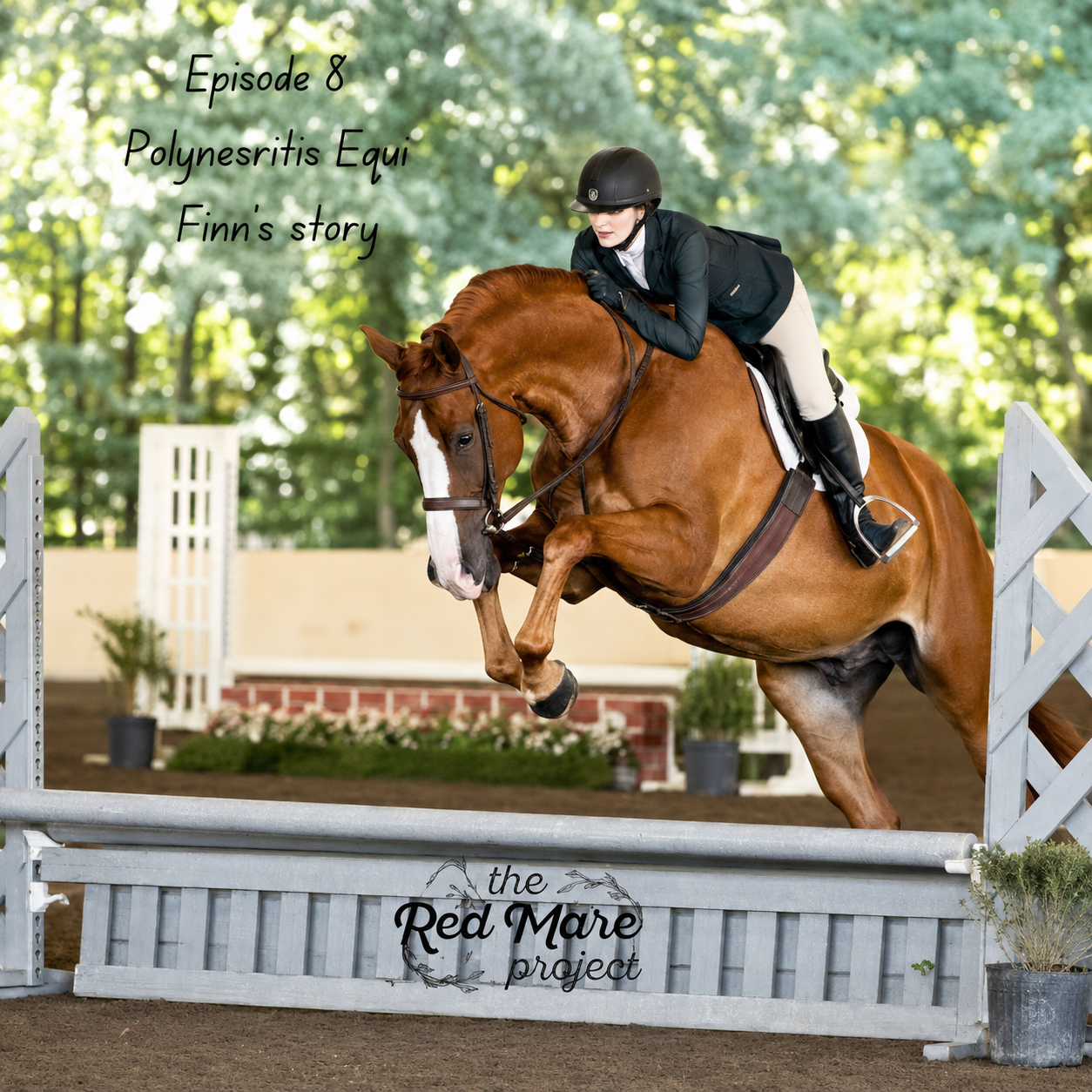
E8: Polyneuritis Equi: Finn's story
September 3, 2025
ABOUT THIS EPISODE
Polyneuritis Equi is a rare neurological disease causing inflammation of the cranial nerves and those of the cauda equina (end of the spinal cord). Kahlan and Taylor speak with Emma Sturtecky about her horse's journey through diagnostics and treatment of this rare disease. Spoiler alert, Finn is sound, happy and thriving today thanks to the joint efforts and Emma and Finn's incredible care team. Resources: pathogenes.com PS PLEASE SPEAK WITH YOUR VET Taylor CL Schouten, MS, APF-I Hoofcare Practitioner Wild Hoof Equine LLC www.wildhoofequine.com Kahlan Ettere Holistic Equine Nutritionist Wise Choice Equine Wellness LLC Check out our website: www.theredmareproject.com Follow along on Facebook: The Red Mare Project Instagram: Wild_Hoof_Equine
EPISODE TRANSCRIPT
— Intro: What Is Polyneuritis Equi & Introducing Emma
Welcome back to another episode.
Today, we have a very special guest on, here to tell us the story of her horse, Finn, and his difficult diagnosis of Polyneuritis equi.
Similar to that of Guillain-Barre syndrome in humans, PNE is an autoimmune pathology that typically affects the hind end and cranial nerves of the horse.
Welcome Emma and Finn.
Welcome to The Red Mare Project.
All right.
So before we have Emma come on, I think we should probably talk a little bit about what Polyneuritis equi is.
Yep.
So a lot of people liken it to Guillain-Barre in humans, and Guillain-Barre, it's an autoimmune condition where the immune system attacks the peripheral nerves, and it causes an ascending paralysis, meaning it starts from the feet and works its way up.
It's really rare.
It's an autoimmune response, and it's usually pretty quick onset.
But the onset is usually triggered by something acute, right?
Like an infection or a vaccine, something that's like a marked injury to the person's immune system.
Yeah.
Yeah, typically.
That's my understanding of it.
Yeah.
So in Polyneritis Equi, if you kind of look at the anatomy of it, it's a thickening of the cauda equana, which is why it's neuritis.
So we're going to get a little nerdy here.
So neuritis is, so itis, inflammation.
Inflammation of?
Inflammation of the nerves, poly meaning many.
So polyneritis meaning inflammation of many nerves.
And it's typically in the cauda equana, which are the nerve roots at the bottom of the spinal cord, which is why it tends to really affect the hind end.
Yeah, those, that presentation that you sent me, the affected part and then the normal nerve branch there, that difference was insane.
Oh, the visuals?
Oh my gosh.
That was, yeah, haunting.
Yeah, wow.
Normally you kind of have to, like with this kind of stuff, you have to like look for it.
I barely glanced at my phone while I played that and I was like, what?
It was, yeah.
That is a different thing altogether.
Yeah, it took me a second at first because it was so different, like.
Yeah, like what even is normal?
But when you were saying the thickening, like that's just so clear.
Yeah, yeah, yeah.
And there are some studies showing that it does cause demyelination, which we won't get too much in that, but the myelin sheath is an encapsulation that's around the axon of the neuron.
Neurons make up nerves and the myelin around the axon is what allows a nerve to fire correctly.
So if there's demyelination or if the myelin sheath gets eroded or if there's something that happens to it, you can't get from point A to point B very clearly.
There's a kink in the wire.
When it comes to humans though, what I'm so curious about though is in the human world, which would be Guillain-Barre or the more chronic version, which is chronic inflammatory demyelinating cholineropathy, that's usually diagnosed with a spinal tap.
And I saw a little bit of reading that you can do that for PNE.
But it seems like they're leaning a bit more on that ELISA blood test with this.
Yeah.
And I want to know more about that because, like, that, first of all, that's an expensive test.
But, like, I don't actually know what they're looking for in that test.
ELISA?
Yeah.
Yeah.
It was above my head, too.
I just, phew.
Well, ELISA is just a methodology.
Oh.
Well, this is your world.
You talk.
I listen.
That's just, like, that's not, like, when you say ELISA test, that doesn't mean, like, CMP.
— ELISA Testing, Blood Work & Autoimmune Basics
Like, that's not, as far as I understand it, as my experience of blood goes, like, it's not a marker in itself.
Okay.
It's a way of doing a test.
So I'm actually interested in looking more into that research website that you had sent me, the pathogens, because I want to read the actual sample report.
Okay.
Yeah.
Like, what markers are they testing?
It sounds like, you know what?
I'm just going to look it up.
Yeah.
Do it right now.
Yeah.
It was, like, protein 2 was one of them.
But I know they have to rule out EHV.
They have to rule out EPM.
But when they rule out EPM, they can't really rule it out because it may be...
Part of it.
It may be part of it.
And you may have a positive, whether that's a high positive or not, it may be present.
And I mean...
Yeah, that's true.
That's true.
Like, to me, that's not really a rule out.
I think what they do is they match it with very particular symptoms, like on the clinical presentation.
So, I think if those labs match the clinical presentation, then Bob's your uncle.
Yeah.
Yeah, we need to get a doctor on to talk about this.
Yeah, we'll get a doctor on.
Because I have a lot of questions.
Okay, I think that...
I think...
I would imagine...
I guess I can't make that assumption.
I wonder if we're having a higher volume of this kind of disease state in horses.
I think that's a fair thing.
I mean, granted, I'm bringing...
I'm saying this from a very biased standpoint.
And we'll do...
I mean, just for listeners.
So my husband has been on...
I'm going to call it a wellness journey, because we don't say the word sick, because it gives it power, and we don't do that.
So we are on a wellness journey that is neurologically based.
I'm going to say that.
He was originally diagnosed with Guillain-Barre, but that was incorrect.
So this is all very close to home.
But after being in this world for as long as we have been, I think that there is a lot of weird neuroitis, and I say it that way because I'm breaking them apart.
There's a lot more out there than we think.
And it sounds like it's coming up more and more.
Right?
Like maybe one of those things like E coli, we all have it.
But who's going to be bothered?
Where's the imbalance that's going to cause it to flare or be a problem in your system where otherwise it would be sleeping?
I wonder if it's something like that.
And if so, what is the trigger?
Is it because we're over-vaccinating?
Is it because of the way we eat?
Is it because of what we're exposed to chemically, like environmental toxins?
That's what I want to know in the horse world.
Like, does it have to do with breeding in horses?
Are different horses with different confirmations going to present differently?
I mean, those are all really good thoughts.
And I mean, it's- Answer my questions, Taylor.
I'll say this.
I ask them like, oh, you know the answer.
And I'm like, okay, I'm trying.
And you know.
I mean, honestly, I mean, all those things are affecting us as a species.
Why wouldn't it affect them as well?
They're domesticated just like we are.
And in a lot of ways, they're way more sensitive.
Yeah.
Well, because we can't sit down and tell them like, listen, this is what's happening.
We can't really do that.
We can do that to humans, but it goes only so far.
But I think a lot of the way that we exist as species is not appropriate.
— Nervous System Overload: Modern Horses & Immune Disease
And that's an unnecessary tax on the nervous system.
And it's manifesting in these different ways.
And it can't combat those toxins that just exist in the world.
It's like what you're saying.
Yeah, our immune systems are collectively freaking out.
Yeah.
So we get weird stuff.
We get weird stuff.
But you know what?
With weird stuff comes people like you who want to do the weird research.
So hopefully, at least this episode will be helpful to someone.
Yeah.
Yeah.
Should we go over just a little bit what the more textbook presentation looks like, just so folks can have a picture?
I'd love to.
Yes, I would love to.
Okay.
Just so there's like, you know, folks can have an idea of what to look for.
Yeah.
Okay.
So they follow what's called a four dice scale, and in order to qualify for a diagnosis, you need to have four of the following, in addition to the labs that you were just talking about, the ELISA.
Okay.
So weakness of the tail, and the way that it was seen is that it's like there's no tone in the tail.
Like when horses walk, they usually have it up a little bit.
This one is just flat.
It's like sloppy, like almost like they don't have control over it.
Loss of sensation around the anus.
They might actually have some dribbling of the urine, or an inability to retain urine, or they do the opposite and just retain it.
So much worse.
Yeah.
Yeah.
Or they retain feces as well because there's rectal dysfunction.
The face stuff was very interesting to me.
I mean, yeah, but it makes sense with the cranial nerves.
Yeah.
Yeah.
So they would have...
So cranial nerve neuropathy.
So there was a video that I saw where Yvette was just doing a test on the face, where they were just like running his finger down the cheek, and she did nothing.
He didn't know anything.
This horse almost looked like he had like Bill's palsy, where there was a facial droop.
So when I was looking at it yesterday, one of the first resources that came up was something calling it Horner syndrome.
Oh, what's that?
Like, so a Horner's, that's a Horner's palsy look.
Okay.
Is what a Horner's response looks like.
Okay.
So I didn't read that because that was a people thing.
Oh, oh, okay.
But I want to know more about that.
Like, are we talking like inability to chew level palsy, or like with that one horse, I mean, they could just about touch him in the eyeball and he didn't move.
Like, he just had no response to anything like around here and here and all the way down his cheek.
Like, that's terrifying.
Because what if a horse, like, I'm thinking about all the scary things I've seen with horses.
What if they, you know, get a piece of hay that had a branch in it or something and they don't know, and they've got this wound in their mouth that you don't know until it abscesses or kills them.
Yeah.
And they're not going to...
Yeah, that's so scary.
Yeah.
Or, like, biting their tongue.
I don't...
Yeah.
I don't know if it extends that far.
I'm not, I'm not sure.
And then an ear droop was another one, too.
So there was a, like, a head-on visual of a horse's face, and one ear was erecting, the other one was just eeyore.
Floppy.
Yeah.
Yeah.
And I thought that was really kind of wild.
Yeah, they could just, like, kind of flap it around, like, like it was not a living thing.
Yeah.
So I think the cranial nerve stuff is not essential.
I think the main presentation is hind and...
— PNE Symptoms: Hind End Neuropathy & Cranial Nerve Signs
Symptoms.
Neuropathy, yeah.
And more so, like, incontinence kind of issues.
And for me...
Yeah, there was a big focus on the urine scalding.
In that one presentation that you sent, there was a big focus on the urine scalding, which, I mean, that can lead to so many other issues, especially with retention of the urine.
I mean, if you're not, if you don't live with your horses or you don't have a very astute barn manager where you're boarding them, that could kill them faster than anything else.
Retaining?
Oh, wow.
And, like, that's the scariest thing to me.
Thinking at UTIs, right?
Absolutely.
I've never thought about that.
It's not common, because for male horses, that's a long way for bacteria to go.
But if urine is just sitting there and sitting there and sitting there, like, that can do permanent damage on the kidneys.
Like, that can lead to acute kidney injury.
And if you have a horse who's not feeling the pain in that area, or doesn't have control over it, you're not going to know until it's really bad, and then potentially they are, like, dealing with a sepsis episode.
I mean, obviously, I'm, like, I'm, you know, rabbit trailing into the worst possible things I could think of that would happen.
Yeah.
Like, there's just so many questions.
Like, how is this going to look?
You know, I haven't met Emma yet.
I don't know what her story sounds like.
I know her horse is alive, so that's the good news.
Yeah.
But I don't, like, I don't know anything about this.
I've never met a horse that was diagnosed with this.
But as we talk about it, I'm thinking about all the horses that probably had this.
I, okay, so every single horse that I've met that had a, quote, successful Lyme treatment, they still are not normal.
Oh.
So, and I do know that certain things trigger them.
Depending, I mean, depending on the horse, like, I've seen diet changes trigger them, stress, you know, they don't trailer well, all these different things, like these things that are mildly stressful to horses, but in a horse that's compromised, they just can't handle it.
It triggers another flair and people call it an EPM flair when they've been treated.
Well, that makes me...
That's just my experience.
That makes you think.
Yeah, so I'm really interested.
I'm really interested to see, like, what the treatment protocol is for this in particular, because I don't know if hers was viral triggered or bacterially triggered or anything.
Like, I have no idea.
So I'm really excited to get into it.
And I'm also, I'm already, like, my mind is already blown.
Yeah, this is a big one.
All right.
She's ready to go for the Zoom.
Let's jump in.
Yes, I can hear you.
I see something just popped up.
Okay there.
Can you hear me okay?
Yes.
Hi, it's so nice to meet you.
So nice to meet you as well.
Thank you for having me.
Oh my gosh.
Thank you so much for coming.
Well, welcome.
Do you want to tell us a little bit about yourself and your horse?
Yeah.
So my name is Emma and I have a Hennevarian gelding named Finn and he came into my life back in 2020 as a three coming four-year-old and the whole reason I actually got him was because my mare that was a thoroughbred, she had done the adult hunters with me for years and she was just getting ready to step down in her career.
She was having some soundness issues so I was looking for my next hunter and I had actually gone down to Florida and tried a bunch of horses and vetted one and he didn't pass so we ended up coming back up to Ohio and he was basically right in our backyard.
— Emma's Background & Finding Finn in Florida
So yeah, so he was not broke yet so when I went to go look at him, we just watched him lunge and they sent him over a couple of jumps on the lunge line and the second I saw this horse jump, I knew he was the one.
He just had a lot of talent and just the coolest personality.
So that is how he came into my life and I've had him, I guess, for five years now.
I can't even believe it's been five years.
Yeah, it really does fly.
It's crazy to think how long I've had my horse, but 2020 was actually a long time ago, so.
It really was.
All right, so he's like, he's nine now, then?
Yes, yep.
He's nine, okay.
And then, so you do the hunters.
So are you an adult amateur?
I am, yes.
I rode professionally for, I guess, it was about a year when I was getting my master's degree.
And once I finished that, I decided, I want to go back to being an amateur.
I want to just enjoy my horses.
And because I have a degree outside of horses, so I figured I want to do my thing as a tax analyst and support the horses and just go back to being an amateur and just enjoying my horses from an amateur side of things.
So I reinstated that.
And yeah, I've been, we're showing as an amateur for the last few years again.
That's really, that's awesome.
That's incredible that you went pro in grad school.
Like that's the process.
That's pretty intense.
Wow.
It was a lot, but it was really fun.
I gained a lot of knowledge through it and just kind of seeing things from a different perspective of kind of being, doing the juniors and I did the children's hunger, but being a junior and then going to professional line, going back to being on the amateur side, like it was just a really cool opportunity to see a lot of different things from a different perspective.
So I thought that was really interesting being able to do that.
And yeah, that's really cool.
Excellent.
So you guys were up in Ohio, you said, and then so now you are in, you're in Rome, Georgia area?
Is that where you are?
I'm actually, I'm in the Chickamauga area.
My horses were being boarded in Rome for about a year while we were finishing our barn, but they just came home in July.
So they're home with me now and it was a long road to get them home.
Building a barn has been, it's been exciting, but it has been very stressful.
But it was worth it.
It turned out beautiful and they're super happy and nothing beats going down to do night check in pajamas.
Like, that is fun.
I feel that.
Good for you.
Yeah, that's awesome.
Excellent.
Yeah.
So we wanted to hear a little bit more about Finn's story with Polyneuritis Equi.
And I know that's probably like a huge story.
So I guess, however, you want to start introducing that.
Yeah.
So when I got Finn, like I said, he was not broke out yet.
And I ended up leaving him with his breeder for about a month.
I think it was a month, month and a half.
And they broke him out for me and they just did the most fabulous job with this horse.
Like he just had the best personality.
And he was so well balanced as a young horse.
And I wrote on the IHSA team in college, like I've written a lot of different horses and unbiased, but he was just the most balanced baby I have ever sat on.
And he was just such a cool horse, like nothing bothered him, just such an easy, simple young horse.
— Finn Arrives: Easy Young Horse with Big Promise
And I brought him back after they did the initial breaking out and put some miles on him.
And when he came to me, he started out fantastic and just took everything in stride and had no issues.
And then I'd say probably about like six months later, I started having some issues where he was just tripping and just became kind of spooky.
And like he didn't want people touching him, like especially people he didn't know.
Like every time I'd have someone come to like either do bodywork or the vet, like they would go to touch him and it would almost look like he was just like climbing up, just cringing at like the sight of anyone even touching him.
Really?
And so he took a pretty good stumble with me.
And so I had the vet come out and just wanted like a once-over done on him to make sure like everything was good because tripping is just not normal.
Especially like even though he was a young horse, like it just didn't feel like a young horse trying to figure out his feet, especially when he previously had been so like sure of himself and just so confident and to see him kind of take that step back was just a red flag to me.
So at this point I had the vet come out and they did some x-rays on his feet because his heels were starting to under run slightly and he was barefoot.
He had really great feet.
Nothing showed up on his pre-purchase that was out of the ordinary.
Like his angles all looked good.
And when we did these x-rays, he was slightly negative palmar angle.
I'd say a little more on the neutral side.
So at this point, we didn't want to be super aggressive.
So we went back to the farrier and just said, you know, get a little more aggressive with your trim, but we're not going to do pads.
We're not going to do shoes.
Let's just try to slowly bring him back and kind of rehab his feet a little bit.
So we started doing that.
And about six months later, it was just we were going the opposite direction.
He was just getting more negative in his feet.
And he started to develop a resistance under saddle where he just didn't want to go forward.
And I had so many people telling me, it's just a young horse being a young horse.
And I just knew deep down, it was not a young horse being a young horse.
Something was bothering him.
And he started doing this thing where I would ask for a trot and he would kind of hop like he was going into the canner.
And probably 10 minutes in, like once you kind of got that initial trot or maybe even the second trot, he would just trot off fine again, like nothing was wrong.
But when he would just start out in the beginning, it was so, he was so resistant and he became very spooky.
And so we did a trial over Nididine just because ulcers is always your first thought.
And he did have some big changes, changing farms and grain and hay.
And he just, he made no change.
It just nothing we were doing was really helping him at the time.
So we got a little bit more aggressive and we threw shoes on him with some pads.
And at that point, he just became so choppy in his stride.
It just, we were just going backwards.
And the poor horse, he was trying so hard to try to show me something was wrong.
And he was never aggressive about showing me like that he was in pain.
He just, he had these weird things that were just not normal for him.
— First Red Flags: Behavior Changes & Shoeing Issues
And so we, we were messing with shoes.
And then unfortunately, I was leaving Ohio.
So I had moved to Florida and we had a different ferrier pickup at the time.
So we started messing with some shoes again.
And I now just having a new ferrier with a different method and style.
It just nothing was fixing it.
It was just everything we were doing was making it worse.
And like the biggest thing for me that I felt was like the weight of the shoe really made a difference for him, which kind of sounds crazy because the difference between aluminum and steel, I feel like is not that big.
But he is for him, I guess.
Yeah, it was for him.
Can I ask, was he tripping up front or was he tripping behind?
Up front.
He never had any issues behind.
This was all up front.
So yeah, this is all my questions are out the window now, Emma, because I was not expecting you to say that.
The first time you said that he took a tumble, it sounded like it was in the front.
Yeah, and he actually had gone down to his knees and came back up.
So he never truly fell, but it was a big enough tumble, he went down to his knees and his knee was a little puffy.
So that was why I was like, let's just get the vet out because this tripping is not right.
And now we have a little bit of a knee.
I just want to make sure everything was good.
And when you guys did RADS, I just kind of watched over it.
Was he negative behind or a front?
This was all up front.
Did you radiograph his hinds?
You know what, I don't think at the time, so originally when we did the pre-purchase, we did.
But I don't think the first time I had that vet out, once I had him at the farm, I don't think we did do hinds.
And I think because most of it was up front and he wasn't showing any lameness anywhere, it was just that chirping up front.
So I think at the time, my vet just figured, let's just do fronts because that's where it was coming from.
Did your farrier at the time make any notations about anything weird going on on his hinds during this time, or just just his fronts?
He did not.
Really?
Yes.
And the changes up front were so small that to the eye, you would never pick it up.
I mean, as a farrier, you probably would.
But for an amateur owner, I never picked up the changes to look like where it was like, one day he had super high heels and then the next day it was like super under run.
It was never like that.
The changes were so small that the average amateur owner would probably never pick them up.
So, yeah, this is not exactly the conversation I thought we were going to have.
You're like really throwing me for a loop right now.
Which, like, I guess when you think about it, it makes sense.
But I thought that everything was going to be, you know, it was going to be more of an obvious hind end issue for obvious reasons.
It was more of that, like, did you have any problems with the rush or managing to keep his feet clean?
Did he have a hard time picking up his feet for the barrier?
Were there any?
Yeah, none of that.
He, I mean, literally the only thing that started out in the beginning was the tripping and just being very, like, touchy and then that little bit of resistance under saddle.
I mean, I never had any signs of showing any sort of resistance on the ground with, like, picking things up or looking uneven anywhere.
All of his muscles, like, muscles looked great.
— Muscle Atrophy Absent, But Something Isn't Right
Like, there was no atrophy anywhere.
It was strictly just in behavior.
Okay, so then, how did we get here?
Because I was picturing it, like, I was prepared to ask very different questions, and now, like, this is falling apart before my eyes.
I'm blown away by how this is presenting, and I'm really impressed with you as an owner.
You keep calling yourself an amateur owner.
Girl, you're doing much better than a lot of people who've had horses for 30 years.
You listening to him so closely and really being his advocate, that's not, that's not an amateur thing to do.
So, give yourself a little bit of credit on his behalf.
So, after the puffy knee, what, what was your next step?
Like, how did we get here?
So, once we started messing with the feet some more, and we put the shoes on, we just kept trying to change things with the feet.
And Micah just kept telling me this isn't feet related.
Like, I do think the feet had a piece in it because at this point, we did have a negative palmar angle.
And I think the shoeing packages that he had on just were not helping that situation.
But he ended up having more of this resistance once I moved to Florida.
And it was just, it was getting worse.
Like, he just really was shutting down in that first initial picking up the trot.
And it just, it wasn't worth pushing.
He was telling me something was wrong.
So I had another vet come out and got a second opinion.
And I was very fortunate because the vet that was in Ohio was still staying in touch with me.
And so I kind of had the best of both worlds, having two heads together to try to figure this out.
And he just that same choppy stride resistance.
So this vet kind of looked more towards the shoulder area, because I started feeling at this point, almost like the right front shoulder couldn't swing forward.
And it was never true, like lameness.
Like you, I feel like most people probably wouldn't realize that he was having that forward swing, like resistance at first because he just, he didn't look off.
It was just, it just felt like, yeah, it just felt like it couldn't swing forward as much.
And I could really feel it when I was riding.
So this vet went and really dug into that right front shoulder.
And he did thermal scans, which again, nothing came back significant with that.
X-rays, he was also a podiatrist.
So it was cool having that aspect of being able to, yeah, have that second opinion of someone that specializes in feet.
And same thing, nothing.
I mean, his feet weren't any better, but they weren't any worse.
And they just, they were kind of staying consistent with pads and shoes.
A little wedge was kind of keeping him happy with his feet.
And so he ended up injecting the bursa in the shoulder.
And he came back, no change with that.
So then we looked at the neck, because again, like that tripping, the first thing you want to go to is neck.
And again, no significant findings on that.
He had some swelling in his neck, which I'm sure was all related to compensating at this point.
Yeah.
And so nothing came back crazy with that.
When you say swelling, what do you mean?
What was swollen?
So it was in between the vertebrae, there was some slight effusion.
So it wasn't anything crazy.
He didn't really have any massive arthritic changes.
But of course, my brain goes to like, oh my gosh, wobblers, because there was tripping, and we have some swelling in the neck.
— Ruling Out Wobblers, Injections & Chasing Answers
But nothing came back with injecting that.
We tried injecting a few spaces in the neck, like that didn't make a change at all.
But then we tried going into the brachial plexus of that shoulder.
And that made no change either.
So then we kind of just took a whole different approach.
And after injecting these few areas with no success, my vet at the time was like, let's just test for EPM and Lyme's, because he thought that it was really strange that this horse was so sensitive to touch.
And I've never experienced that before in a horse.
Was he getting more trippy as you're doing these diagnostics, as you're like doing the detective work?
Was he getting more trippy or more thrushy?
Did he lose weight?
Was he like, were you seeing anything that would make you think it was a degeneration?
No, he was not.
The tripping, I would say, actually almost got a little bit better, because I was doing a lot of in-hand work, which I think was helping with just kind of supporting the muscles.
Sure.
And again, at this point, there was still no atrophy in any of his muscles.
He was just kind of plateauing, like nothing was really getting worse, nothing was really getting better.
And he, yeah, just nothing really showed up that was out of the ordinary to be like, this is degenerative or anything really joint related, even at this point.
So were those injections, steroid injections, or did you guys do biologics?
No, they were all steroid.
So is there any consideration that, even though these were localized steroids, that they could still have, like, an immune-suppressing response for it?
No, because at this point, we do not even think that anything out of the ordinary, like, that this could be polyneuritis.
At this point, we all just thought it was an injury somewhere that we just couldn't pinpoint.
And so that's why this vet finally was like, let's take a totally different approach and test for EPM and LIMES.
And that's probably a vet question.
But I guess what I'm trying to ask is like, because usually prednisone or any type of steroid is used for these autoimmune issues, I don't know if maybe doing that series of injections kind of facilitated that plateau that you guys were hitting.
I don't know.
Yeah, it could have been.
It could have been because to my point exactly, so once we tested for EPM, we tested for LIMES.
So the crazy thing that came back.
So with EPM, he only tested slightly positive.
It was nothing off the charts, and at that point, we decided to treat just because he had a slight positive.
And my vet at the time was like, this couldn't even just be an exposure amount.
It was so small.
But the weird thing that came back with the LIMES disease was he tested positive for the antibodies only.
Because with the LIMES test, there's three areas that it comes back with, and it's been a while since I've looked at the results, but one is for antibodies, and then the other is to tell if it's chronic or not.
Correct.
Yeah.
He only tested positive for antibodies.
His breeder probably thought I was crazy because I reached out to her and I'm like, you didn't happen to do some vaccine for LIMES, because there are people that give the blood vaccine for LIMES disease.
Yeah.
It can trigger this, I think it's OSPA, I guess the one that's on it.
Yeah.
Which is the one I used.
— Positive EHV-1 Test & Narrowing Down the Diagnosis
That's what he tested positive for.
It was small too.
It was like equivocal, I think is what they came back with.
We decided, let's do minocycline and actually, I think started with doxycycline and he had no response really.
Then we went for minocycline, which now after I had done a bunch of research, even in people, I guess a lot of people don't respond to doxy, it's the minocycline that they really get the response from.
Yeah.
So to your point, he was plateauing where he was functional.
He was getting a little bit better and he was trying and he was comfortable enough to do a little bit of work.
The second that we would come off of it, because I think it was a 30-day supply, within two weeks, he was back to feeling like crap again.
He was getting lethargic then.
I would find him lying down a lot in his stall.
He was lying down in the pasture.
He was just really like blah.
He wasn't himself.
For a young horse, you especially don't want to see that.
You want to see a young horse just having a good time out in the field and he's out there lying down.
So he would get a little bit better, but the second he'd come off of it, it would go back again.
We even went to the point where we had IV Oxy-Tetracycline and that again helped a little bit.
Then it was like he would just go back again.
Same thing with the EPM meds.
We did in Marquis and Rebalance and he did a cycle of that.
The beginning stages of that, it was rough.
The vet said they can have a die-off period.
Well, I don't know if he was having a die-off period or if it just wasn't working, but it was really rough in the beginning taking those meds.
And same thing got a little better and got worse.
And so we ended up getting him at a good place.
And I had found a trainer who I am forever grateful for because she had very strong backgrounds in biomechanics.
And she came along and not only does she just validate what I was feeling, because I had so many people telling me, it's just a baby who was being a baby.
And just finding excuses for why he was feeling and doing things that he was doing.
So this trainer that came in, she was just phenomenal because she was able to pinpoint and be like, I know exactly what you're feeling.
And she had such a great knowledge on the horse that she would be able to sit there and be like, he's not landing right in his foot this way.
And she would be able to do the farrier best.
And so the farrier was tweaking things that was actually starting to help a little bit.
So she kind of came in and started taking a hold of everything and kind of helping push me in the right direction.
And she found the saddle.
So we ended up finding out the saddle was making a big difference for him.
He is a pretty big horse.
We ended up finding out that he is a bit of a hoop tree because he is that wide.
So we found that I had tried probably 50 saddles.
I probably spent more money in shipping saddles than I did actually paying for the saddle.
Yeah, I feel that.
We were trying to find the saddle that worked for him.
And we found that a regular jumping saddle was cutting too far forward onto his scapula and just any slightest bit of pressure on that right front scapula.
So we finally found a saddle.
We had a custom saddle made that basically was a dressage panel that had a jumper flap over the top of it.
So I had a pretty good idea that what was going on was happening in the shoulder.
— Shoulder Suspicion, Dressage Saddle & Gradual Improvement
So then he was starting to get better because we were riding him in the dressage saddle.
And he was on it all.
I'm looking on it now.
There were all these anti-inflammatories that was helping mask some of the issues he was having.
And when I had turned him out and he had laid down like he normally does and rolled.
And as he got back up, his leg went under the metal fence and he lacerated it down to the bone.
And at first, I was like, it didn't bleed at first for like the first 30, I mean, I saw the whole thing happen.
And at first it was not bleeding.
So I'm like, oh, we're good.
Then I saw the blood squirting out and I'm like, wait, it was squirting?
Was it actually squirting?
It was squirting out.
Did he have an artery?
He did not.
I got so lucky.
So I called, I was down in Florida at the time.
And I call and I'm like, I have a horse that lacerated his leg, like someone needs to come out here.
Now?
And yeah, I was like, now?
And so the vet that was there on call was like, you know, based off of what you're telling me, I think you should just put them on the trailer.
And of course, this darn horse did not want to load.
We got a lot of hurt.
A lot of load?
So I have a standing wrap on it.
I like cleaned it the best I could, put a standing wrap on it.
After like 45 minutes, we finally get him on the trailer and I take him to Palm Beach Equine.
And they x-rayed, they ultrasounded, they did where they call it distending of the joint where they, I guess, pump like air into it and take an x-ray to make sure like a joint wasn't touched.
This horse missed every internal structure by millimeters.
And they sutured him up.
He had staples at the end of it, like it healed.
It's just a fresh wound.
Yep.
And so I got so lucky.
He was a good dad.
They told me I could take him home that day, but I was like, you know, honestly, because this needs like really wrapped up and like he just needs to be really calm.
I'm like, let's just keep him here for a couple of days.
So he ended up coming home and he had some time off.
And then we put him back into work again and kind of the same thing.
He was just like holding like steady.
The saddle was really making a difference for him.
He was just kind of starting to feel a little bit better.
We threw him on BCAA, which was my trainer's recommendation.
That made a huge difference for him because he was starting out kind of stiff and he would work out of it.
So we were thinking, could this be muscular?
So we kind of just put on hold like any injections because nothing was working and none of these medications were really working.
We were going on and off the Lyme's treatment.
And so then a couple months later, he ended up laying, he was laying in a stall one night and I guess morning and he went to go get up.
And we had a CBS barn being in Florida.
So it was like a cinder block barn.
And our doors, our Dutch doors were like a very heavy metal.
This was somehow you leaned against the Dutch door, trying to get up and slid his leg in between a concrete and the Dutch door and was pinned for like 45 minutes.
For now, it was horrible.
And I had to pull, I don't know how I even got this door open.
Yeah, I went to mom's strength.
That's mom's strength.
And I got the door open and same thing, I was like panicking because I'm like, there's no cuts, but like the second you know something's wrong.
— Finn Goes Down Again: A New Crisis Erupts
Yes, something was wrong.
He was lame on this one.
He was never lame with the laceration.
He was lame.
He was actually panting in his stall because he was in so much pain.
And so I had the vet out again and he went through the whole like x-rays, all ultrasound, all of that.
He ended up not being fine.
Wow.
My gosh.
It was just massive bruising.
And so at this point, because I had just massive amounts of that fills up, I was like, I'm going to submit this as a claim for insurance.
So this is why we have it.
It's for major medical issues like this.
So I contacted my insurance agent, which I'm sure was like again, because I did this for the last time.
So this is now the second or third claim I've opened on this horse for having just like injury after injury.
And I told her what was going on.
And she's like, you know, I have this wonderful vet.
She's down in Loxahatchee.
And she's like, she would just be great to have as a second opinion.
And she's like, this is just not normal that he's having all these injuries, which totally agree.
I mean, most people don't have any major injuries like this.
And I was lucky, unlucky enough to have two.
And so, we have this fed out.
And I remember I was with my family on a Sunday when she called me to set up the appointment.
And she, I was on the phone with her for probably an hour and a half, just explaining his entire story.
Cause now we're going on four years of this.
Something after something.
Yeah, something after something and just no one being able to identify any major issues or really get anywhere.
So she, after talking to her, she pretty much hit the nail on the head and she, she said, you know, I think you're worse as polio, right?
And so I had no clue what this is.
Okay.
So she's a psychic.
Yes.
She is the most impressive person.
And I remember hanging up and having, I had so much hope at this point because she was like, this is fixable.
She kept telling me this is fixable.
And she, of course she told me, do not Google this, but what am I doing?
Anything medical, I am the first to Google because I always, I always run off of the assumption like you prepare for the worst, but hope for the best.
And so I wanted to know what this was that we were potentially dealing with.
So I had called my trainer and I was like, this is what she thinks it is.
Like, here's what we're going to do.
She's coming out.
She's, we're going to go download the route of this and see what happens.
So she came out and she was like, the reason why your horse is having all these injuries is because of polyureitis, which I never even put two and two together.
He used to always get cast.
And I thought it was just because he was a big horse and a regular size stall.
And it was all because of this polyureitis.
And this is where when you ask, like, did he have any high-dense stuff?
Not really.
But like looking back, that is a high-dense stuff.
It was kind of a high-dense stuff, yeah, a high-dense.
Because he was having a hard time getting up.
And so he, she did the blood test.
And she did, she sent it off to pathogens with Dr.
Ellison.
And as far as I'm aware, she's the only one that does the polyureitis testing.
Yeah, yeah.
And just she, it's amazing how much, like, backlash she gets for, like, her lab with, like, a lot of people just don't want to use her.
— Dr. Divers & the Pathogenes Lab: Controversial but Crucial
And this vet had done research with her and just really liked it.
And I'm so grateful that she was using pathogens, because we used that as a way to determine he had polyureitis.
And then one of the really cool things that she did was she actually took, like, a blunt, like, end of, like, pair of scissors.
They're not like the sharp kind, but, like, you know, like a surgical cutting kind.
And she ran it down the side of his, like, tail on his hind end.
And he had no reaction.
And she said, This is polynoreitis.
And he had no definition in the tail.
Like, you would lift it up, and you could just lift his tail up.
Which, like, I had no clue that was a thing.
A test to do.
And I'm not going back there lifting my horse's tail level.
What's happening to me?
So, like, no.
Tone.
Is that what you're saying?
Right.
Yeah.
There was no tone to it.
So, that was another thing.
So, we sent the blood work off, and he came back and had it.
So, we did NeuroQuel, which is lavamisole.
And we gave him, it was a big tablet that I just fed to him in his brain.
And I will, I still remember very vividly, the day or two days later, I pulled him out to luncheon for the first time just to see where we were at.
And I remember holding my breath because I was just so optimistic that, like, we finally had some answers.
And I remember putting him on the lunch line and, like, just being so ecstatic because he was the soundest he had ever looked in his entire life.
And just two days of being on the medication, like, it made that much of a difference.
Wow.
And the spooking was gone.
He didn't care about being touched anymore.
Like, all these weird things.
I'm going to cry.
I'm going to cry.
Weird.
In two days, it wasn't even like this took time.
Like, two days, all these symptoms started going away.
And my, I remember my trainer coming out, and she was like, this is like, she was just as happy as I was.
And like, having someone so supportive that like validated me since day one, and just rode it all out with me throughout this time was so huge.
I'm like, she was just equally as happy.
And I kid you not, like, it was just this horse went from like having these baby moments of like, just not really doing a whole lot because we weren't pushing him to going and jumping three foot courses.
Like, within a year, we were horse shelling.
And he just made huge improvements.
And like, we still were in the saddle because to this day, anything that touches that shoulder, like he obviously has nerve damage there.
It's the trigger.
And yep.
And so anything that presses on that, like it's sensitive.
But I know now like he went through two weeks of treatment and then he kind of got like where I just didn't feel like he was quite right again.
So we ended up putting him back on the medication for, it was like every other day for another two weeks.
And he was great.
So then he came off of meds entirely.
And then during that time, I actually moved to Georgia.
So I ended up course showing him when he moved here.
And then I can't even remember what exactly triggered him.
He kind of had like that little bit of like, things were starting to make him spooky again.
And like the right shoulder didn't feel quite right.
So at this point I knew he just needed to go back on medication.
And every time he goes back on medication when he has what I call like a flare up, this medication just takes him back to feeling great, being normal.
— Finding the Right Medication: Flare-Ups & Breakthroughs
And yeah, I mean, I had the horse again that I purchased because the horse that I got was just he was amazing.
I mean, I had no complaints.
Like his breeder did such a phenomenal job putting the foundation on him and just breeding a great horse.
I mean, he really truly was a phenomenal horse since the day that I got him.
And just having him back on like going through that treatment and being on the Lavanosal just gave me back my horse again and he was amazing.
He was awesome.
So now, just so you just gave me like happy chills, but to bring it back to like before, he had been through a lot of different drugs.
He had.
So I imagine like building up his gut and his nutrition, you know, that's my bread and butter.
That's the thing I care most about.
Yeah.
That was probably like another expense, another like hurdle.
Do you feel like anything that you did before, like with the cyclines, do you feel like that had any long-term effect on him?
Are you doing any feed-throughs now, like vitamin E or Lion's Mane to help?
Just manage symptoms when he's not on medication?
Yes.
So the biggest thing for him, I took him off of all grain.
He is not getting any commercial grain.
Right now, he gets a Timothy pellet and he's on Mad Barns.
Nidhi, I think that's how you pronounce it.
He does not get any excess sugars.
I get tested hay.
I have gone through a complete diet overhaul because whether or not the sugars really played a huge difference for him, I just didn't want anything inflammatory in his diet period.
I didn't want anything feeding into it.
I know it's super important to have their gut healthy, so I just didn't want any of that extra stuff.
He went on a complete diet overhaul.
I do give him vitamin E.
He gets 4,000 IUs extra a day.
Awesome.
He gets chia seeds, salt.
I went through a complete diet overhaul because I knew what I was feeding was not helping him.
Yeah.
So- It's the year.
Yes.
Wow, that's awesome.
I do all this.
I mean, it was a struggle because when this all happened, when Esther was switching mover in Florida, it was easy because in the sense of like, I was able to feed him what I wanted.
Finding tested hay in Florida is really hard because you just can't buy large quantities unless you're feeding a big barn and you can buy a semi truck full.
But I was getting hay delivered every week.
So for me, that part was really challenging.
But now bringing him back to my own farm here, in Georgia, that's where I've been able to get the tested hay.
And I have just completely revamped everything to really feed the way that I want to feed him and want him eating.
I love that for you.
I am so happy to hear you say that.
That's awesome.
That's like, you just said you don't know how much difference the sugar in his diet is actually making.
A lot, girl.
Like you were doing so much for him and listening to him so well.
How are his feet now?
So that's the scary thing.
I just did this scary, scary thing and pulled off shoes off of him.
So I knew over the last couple of years.
You're in the right club.
Yeah, I know.
I knew over the last couple of years, like his shoeing, we were keeping him like, okay.
And when I say okay, like it was, he was functioning, but it was not optimal.
Like he just, I know his feet were not where they wanted to be, where I wanted them to be.
— Pulling the Shoes: Starting the Barefoot Journey
And so I ended up pulling his shoes off just a few weeks ago.
This all just started a few weeks ago for me.
And we pulled him out of steel.
And he is in cloud boots right now.
And we're hoping in the next couple of weeks, he's going to get his first set of composite shoes.
So I was so excited.
He had made such big improvements.
His heels are finally starting to like not be so under run.
His rug's not so prolapsed.
Like he is just, it's like taking his shoes off have been like another puzzle piece that I was missing in all of this, because now his body is like, it's starting to even out because we realized like after we started treating him, he did have some muscle atrophy in that right shoulder.
So now that's starting to like still back in.
He's had some body work in conjunction with it.
So he's just getting the whole treatment and it's kind of just putting everything in its place.
So it's been a really kind of woman who needs to have horses.
That's awesome.
We're so happy to hear you say all of that.
That's like such a nice wrap up to something that feels really, really scary.
I mean, you did the Googling, you get it.
But yeah, it was scary though, because when you're on the hunter jumper circuit, there is like, and I'm sure in other disciplines too, but like specifically for me in the hunter jumper world, it's like so taboo to pull shoes off.
And I don't understand why, because like, and every horse is different.
Some horses can go in shoes, some horses can't.
But like, it was, I just felt like it was so wrong leaving him and the setup that he was in.
And I just like, I just needed that, I just needed the push to get him out of it.
And like, a lot of it was just doing a lot of research to figure out what we can do in place of it, because I know pulling shoes off and not doing anything was not the right answer.
Like he obviously needed the cloud boots.
I do think like he'll need composites for a while, but just having the confidence to do it has been huge.
And like I have a friend now that's like Kelly.
She's just fantastic.
Shout out Kelly.
Kelly's a good friend.
She's wonderful.
You're in good hands.
Yeah.
She's been great because she like, talk about someone that just also like validates me.
Like she just supports and she's just so supportive.
And like she's equally as excited as I am.
And like finding those people that are truly passionate about like wanting to help you get the best horse you can is just, it's so key.
It's so key.
I mean, the amount of like just people that would just kind of try to make excuses for Thangie.
Like I said, like Thangie's a baby doing baby things.
Like if I kept following that and kept pushing him, I wouldn't have the horse I have today.
No, and you could potentially get very hurt.
Yeah, exactly.
He could have fallen on you.
He already did hurt himself twice.
Like good for you for persevering.
Because I know that that journey, I've been on it.
And it is so hard to feel like you don't have support.
So good for you for finding your people and doing the right by your horse.
Like I feel like we can end with a happy ending for something that I wasn't sure how this was gonna go.
So like, thank you so much for sharing your story.
I can't wait to see the picture you choose for the profile picture on Facebook.
Yes, I will make sure it's a good one.
— First Show Back: A Major Milestone for Emma & Finn
I always like to share her show picture because like that was a big milestone for me because I had taken him off the farm a couple of times like in between his having good moments.
But like I didn't really get the chance to show him and I just, for him, it was taking him really slow.
I never wanted to push this horse past what he felt comfortable doing because he just, he was very talented and he had a great personality and I didn't want to ruin that.
So this past summer, I guess last summer, I was able to actually horse show him for the first time and I got the best picture that I just, I love.
That's the picture for everyone.
Yeah, send it to us.
We can't wait.
I think it needs to be a goofy picture to show his goofy personality.
We can do a collage.
We can do all of it.
We can do both.
We can do a lot.
Yeah.
We can do it.
Taylor knows how to do that.
I don't, but.
I'll do my best.
I can't wait.
That's awesome.
Thank you so much for sharing your story.
Taylor, did you have any more questions?
I feel like we could go on forever.
I feel like you do still have so many questions, though, because he didn't match the typical presentation, and that's where I'm so put up.
Yeah, and that's the thing, too.
A lot of this polynoreitis, more horses have it than most people realize, because a lot of the time, it's EPM that starts, and then it's this autoimmune response, and these horses get polynoreitis after it.
I never will know what triggered his.
Because I'm sure it was EPM at some point that probably caused the polynoreitis.
I'll never know what caused it.
But for him, he was a natural typical case, because most times with EPM, it's a lot of hind end stuff.
He just, aside from having the issues getting up, he was never laying behind, and he just didn't have issues behind, he did that right front shoulder.
And so for him, it was a weird case.
And I just, I'll never truly understand why his presented the way that it did, but I mean, it was very strange.
I mean, like even in humans, though, Guillain-Barre and CIDP, which, so CIDP is chronic inflammatory demyelinating polyneuropathy.
So it's kind of like the slow burn, more like insidious Guillain-Barre.
And Guillain-Barre is more, it's an autoimmune.
Acute.
Yeah, yeah, yeah.
So Guillain-Barre is more of an autoimmune attack where you have ascending, so it starts in the feet, paralysis that works its way up.
And they liken PNE to GBS.
And lately, I don't know, there's just been some...
It's not that.
That's not, yeah.
But it's, I don't know.
I mean, I could parse it out.
I have a lot of personal connections with that world and we'll do a whole other episode on that.
But that's just, it's so interesting.
Like, he didn't have any of the, like, the bladder.
He didn't have any incontinence or anything like that?
No, nothing.
And like, the crazy thing is, is like, sometimes I kind of question because, like, in the beginning, I could really feel him leaning into his left front, which is that negative pulmonary angle.
And like, I kind of question, you know, like, did the polyureitis cause that, like, high, low and negative pulmonary angle to begin with?
Because now that we've kind of gotten that polyureitis under, like, under wraps and that we know how to fix it at this point, now that I've done the feet thing and we're trying to get his feet balanced, it's like, I'm really curious to see what another year will bring with him, because will we even notice he has any feet issues at that point?
— Managing PNE Long-Term: Diet, Feet & Ongoing Care
That's, I kind of assumed that when you first were saying about his negative pulmonary angle, I kind of assumed that that was a symptom and you were getting ready to tell us that.
Like, it just sounds like he was a lot quieter about it than even other horses.
And this can be a pretty quiet disease.
So, I don't know, the whole thing is a little confusing, but obviously you have a good end to your story.
That's awesome.
I mean, that's really what matters, but.
Yeah, and it'll left with lots of questions.
I know.
No, I mean, it's just crazy.
The amount of knowledge that's being put out there now, like even four years ago, there's a Facebook group for EPM Horses.
And that's probably the best resource that I found for Polyneuritis, where they're actually having the discussion.
But like even four years ago, I don't remember that being part of that Facebook group.
So I'm solely relying on the vet.
And like now, now I can, I know his symptoms, now I know how to treat.
I mean, and I'm part of that group too.
Yeah.
That's the one I sent you this morning, Taylor.
Oh, okay.
Okay.
Yeah, they've got the good resources on there.
I don't have an EPM horse or a Polyneuritis horse or any kind of Neuritis horse I just have in the past.
And I think it's interesting.
I'm interested to see in like five, 10 years where this is and how much more we know.
Me too.
And if we'll change things in their young management, like how we vaccinate horses, how we feed horses as babies to see, I'm interested to see if there's a connection there.
Yeah.
Well, and that's the other thing.
And too, that I found out the hard way also, vaccines, the spring something and the spring vaccines for him, triggers a flare up.
So now I know I just put them on Lavamisole the week before and the week after.
And I just, I know to treat him, but fall vaccines, he's completely fine.
And so I try to do bare minimum.
Obviously, he's a show horse.
So leaving the farm, there are certain things like I feel comfortable with him having.
But it's like, I mean, that's just, that is one thing that I know was a trigger for him.
I don't understand the connection between spring versus fall.
Yeah, that's curious.
Yeah, I mean, I know it's like, I think one of them, I think it's a three-way or six-way.
I just follow my vet recommend.
Yeah.
I know that there's more in the spring.
So it's something in that vaccine that triggers him for some reason.
I wonder if he did them one at a time, if it would be less assault on his immune system.
So we've tried that and we're breaking it up, and it doesn't really make that big of a difference for him.
So I keep him together and I just treat him, so I'm not putting him through it twice.
Yeah.
I was going to say, because if that doesn't work, then he's just uncomfortable for longer.
Yeah, exactly.
I would love to know what specific part of that vaccine, because like I said, fall, he has no problems.
So it's something in that spring vaccine that seems to trigger him.
Now I know and I treat and it's fine, but yeah, I know a lot of people that just they have the same thing, that the vaccines trigger.
So they don't take their horses anywhere.
So they just they don't treat, they don't vaccinate for them.
So and that's great.
— Show Horse Life & Balancing Competitive Goals with Health
So if you can get away with doing that, like that's fantastic.
But like I said, being a show horse and leaving the farm, there's just certain things that I do for him, more comfortable with him having.
But it is a very strange correlation.
And I wish that I had more knowledge on it.
And I wish someone would do research on it.
Because there's just so little research about polyurethane and it's just the amount of forces that have it that we probably don't know is a lot.
Yeah.
I mean, the same in humans though.
Like there's so many humans that have like neurological, there's some type of pathology going on, but it's so insidious that they can just kind of keep functioning.
But that's actually kind of interesting that vaccines, he's still, I don't want to say like allowed to get vaccinated.
But I feel like if a human has Guillain-Barre, it would be contraindicated, like hardline.
Yeah, never again, never again.
So, but I mean, like you said, like there's not a lot of research on it.
It's still, you know, not saying it's nebulous, but it's still kind of this foreign entity, but.
Yeah, it's a work in progress.
Yeah, it is.
For sure.
Yeah, anyway that I can inform people about Polymeritis, like I am all about, like I am, I've never been the one that's been like hush, hush about my horse and his history, because I want to help other people and it needs to be out there.
Because like I said, there's so many horses that have this, that people think are probably having a relapse of EPM.
Literally, it's Polymeritis.
Because that's the biggest thing that they're saying is what causes Polymeritis.
That's what the most research has been pointed to.
I'd be curious to know if Lyme's disease, if that could trigger Polymeritis or other myrosis in the bacteria.
Yeah.
Like he didn't get sick or anything before the first big trip.
He wasn't sick.
Did he get vaccines right before that, do we say?
No.
No, we have no clue what triggered any of this.
It was like just one day he started tripping and that was just where it all started.
So it could be something as small as another horse he was exposed to was a little sick.
Yeah, like it could be anything.
It could be anything, right?
I mean, and he was to say too that when he came to my farm, like he didn't get exposed to EPM and that's where it started.
I mean, I didn't even know he had polyanitis for years after the first symptoms came on.
So it's like there are things that I will never be able to have answers to.
But I'm glad that I have a good end result and that we found something that works for him and that I'm able to sound and happy.
But yeah, I mean, it was just, it was a long process.
It really was.
And the emotions that comes with it, I mean, it's a rollercoaster.
Absolutely.
It really is.
Wow.
Emma, thank you so much for sharing.
This is a lot.
Thank you.
Thank you.
Like I'm a little, like my brain is blown right now.
It is a lot.
Yeah.
It is truly a lot.
Yeah.
All right.
Well, we wish you guys all the best.
My brain is still brapping about it.
I don't know what I'm talking about.
Yeah.
Because I had such a picture of what you were going to say and what we were expecting.
Yep.
And now I'm like, well, this is a different beast, but.
Yes.
Thank you for sharing.
Of course.
Thank you so much for having me.
And I hope that this helps somebody else diagnose their horse that has things that they can't figure out.
— Hope for Other Owners: Finn's Story as a Diagnostic Map
So, absolutely.
Cheers to that.
That's the goal.
All right.
Thanks, girl.
Have a great night.
Thanks, you too.
Bye.
That was so good.
Whoa.
Holy shit.
That was so good.
That was so good.
And I have more questions than answers.
OK, we're going to keep wrapping.
That was nuts.
Yeah, that was crazy.
You need to scroll through that Facebook page for real.
I need to.
I need to, because now I'm like, I feel like I know so many horses that.
Uh-huh.
I hate this.
I hate.
This is like the worst part of learning new things is all the horses that flash behind your eyes that you think you could have helped or now you're thinking of that this could be it and you know how to help them and it's too late and, uh.
Geez, Lisa.
So what was the name of the drug that she put them on?
Lavamisol.
Is that something that you turned into?
Uh-huh, yeah.
You beautiful witch.
I don't know.
I just know a very little bit about a very lot of stuff.
I have so many feelings about EPM.
Yeah, same.
It's the same like Lyme.
Right?
Although, I did have a friend of mine, I would love to have her on too.
Her horse was diagnosed with chronic Lyme, and his main symptom was severe spookiness, and he couldn't be touched.
If the wind hit him, he would lose his mind.
Oh, same.
He would lose his mind, similar to what she was saying about touch.
Yeah, it's just everything is too much.
He's way over sensitized.
I've had, at my own job, I had patients like that, with Lyme patients that were just like, everything was too much.
Wow.
Huh.
I mean, I think it's...
I'm going to ask my Lyme expert about Lidansol for people and see if there's any other research that we could glean any information from.
I think that's a good idea.
I think I'm just really hung up on the nuances that did not fit the bill, and that just is such a...
Mm, I don't even know the word for it.
But, like, we get so stuck on just looking at textbook diagnostic criteria.
Yeah.
Well, hell, I mean, you overlooked that Leah had ulcers when she...
Yeah.
When everything else, you know, you tested for everything else.
I overlooked the fact that my horse's foot could just hurt, you know, like, and I have the exact same itis, you know?
Like, if I was going to the worst case, we always do that.
Like, we think it's going to look a certain way, but they're such big, complex creatures.
It could be so many things, and they don't have the language to tell us.
So, like, we're the ones without the words, because they're trying, and we're trying to listen, and it may not look how we think it should, but especially with something like this, there's not enough research to know.
And when she was talking about negative primer angles, you know, it's great that he was balanced as a baby, but, like, as you were saying about GBS being an ascending, his first issue that she ever had with this otherwise perfect horse was his feet weren't quite right.
Yeah.
Yeah, so it was ascending.
Yeah, it wasn't necessarily unsound but he was getting cast like he didn't have great control of the lower half of him and his feet weren't great.
Like he wasn't landing in an ideal way because he probably had neuropathy in his feet.
Yeah.
I mean, I don't know.
I'm not him, but, like, if you work backwards, it does make sense.
It's just obviously not something you would think of first.
You'd be like, oh, my horse has negative palmar angles.
— Hope for Other Owners: Finn's Story as a Diagnostic Map
So, absolutely.
Cheers to that.
That's the goal.
All right.
Thanks, girl.
Have a great night.
Thanks, you too.
Bye.
That was so good.
Whoa.
Holy shit.
That was so good.
That was so good.
And I have more questions than answers.
OK, we're going to keep wrapping.
That was nuts.
Yeah, that was crazy.
You need to scroll through that Facebook page for real.
I need to.
I need to, because now I'm like, I feel like I know so many horses that.
Uh-huh.
I hate this.
I hate.
This is like the worst part of learning new things is all the horses that flash behind your eyes that you think you could have helped or now you're thinking of that this could be it and you know how to help them and it's too late and, uh.
Geez, Lisa.
So what was the name of the drug that she put them on?
Lavamisol.
Is that something that you turned into?
Uh-huh, yeah.
You beautiful witch.
I don't know.
I just know a very little bit about a very lot of stuff.
I have so many feelings about EPM.
Yeah, same.
It's the same like Lyme.
Right?
Although, I did have a friend of mine, I would love to have her on too.
Her horse was diagnosed with chronic Lyme, and his main symptom was severe spookiness, and he couldn't be touched.
If the wind hit him, he would lose his mind.
Oh, same.
He would lose his mind, similar to what she was saying about touch.
Yeah, it's just everything is too much.
He's way over sensitized.
I've had, at my own job, I had patients like that, with Lyme patients that were just like, everything was too much.
Wow.
Huh.
I mean, I think it's...
I'm going to ask my Lyme expert about Lidansol for people and see if there's any other research that we could glean any information from.
I think that's a good idea.
I think I'm just really hung up on the nuances that did not fit the bill, and that just is such a...
Mm, I don't even know the word for it.
But, like, we get so stuck on just looking at textbook diagnostic criteria.
Yeah.
Well, hell, I mean, you overlooked that Leah had ulcers when she...
Yeah.
When everything else, you know, you tested for everything else.
I overlooked the fact that my horse's foot could just hurt, you know, like, and I have the exact same itis, you know?
Like, if I was going to the worst case, we always do that.
Like, we think it's going to look a certain way, but they're such big, complex creatures.
It could be so many things, and they don't have the language to tell us.
So, like, we're the ones without the words, because they're trying, and we're trying to listen, and it may not look how we think it should, but especially with something like this, there's not enough research to know.
And when she was talking about negative primer angles, you know, it's great that he was balanced as a baby, but, like, as you were saying about GBS being an ascending, his first issue that she ever had with this otherwise perfect horse was his feet weren't quite right.
Yeah.
Yeah, so it was ascending.
Yeah, it wasn't necessarily unsound but he was getting cast like he didn't have great control of the lower half of him and his feet weren't great.
Like he wasn't landing in an ideal way because he probably had neuropathy in his feet.
Yeah.
I mean, I don't know.
I'm not him, but, like, if you work backwards, it does make sense.
It's just obviously not something you would think of first.
You'd be like, oh, my horse has negative palmar angles.
NEVER MISS AN EPISODE
Listen on your favorite platform
Subscribe and listen to The Equestrian Podcast wherever you get your podcasts.
