
PODCAST EPISODE
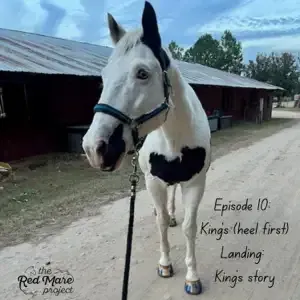
E10: King's (heel first) landing: King's story
October 12, 2025
About This Episode
Join your hosts, Taylor and Kahlan for another candid conversation, this time featuring Sara Hathaway of 4 Hooves Hoofcare and The Stables at Yellow Creek. Sara is a full-time Hoofcare Provider , boarding and rehab facility owner, boot fitter AND fabulous friend. She’s also generous enough to host a variety of educational clinics for owners and professionals. Join the girls for a chat all about Sara‘s journey into navicular rehab of her own horse, King, and how that fueled her passion for professional rehabilitation and management. For a more in-depth look at what “navicular “is and how we rehab it, travel back to earlier episode “Heel Pain Heartache: Lokis story”. Make sure to check out links for Sara’s services down below. Oh, and don’t forget your snacks 😉 Sara's practice: https://4hooveshoofcare.com/ Sara's farm and rehab: https://www.thestablesatyellowcreek.com/ Cheers! Taylor CL Schouten, MS, APF-I Hoofcare Practitioner Wild Hoof Equine LLC www.wildhoofequine.com Kahlan Ettere Holistic Equine Nutritionist Wise Choice Equine Wellness LLC Check out our website: www.theredmareproject.com Follow along on Facebook: The Red Mare Project Instagram: Wild_Hoof_Equine
EPISODE TRANSCRIPT
- Intro: Welcoming Sara Hathaway & King’s Story
Okay, welcome back to a very special episode, where we will be welcoming one of our closest friends and favorite people on the planet, Sara Hathaway. Sara is here to tell us all about her journey with her personal horse, King, and then how that leads into her explosive career in hoof care today. Welcome, Sara and King.
Welcome to The Red Mare Project.
This episode focuses more so on Sara and King's story through navicular disease. For more information on anatomy, science, and pathology of navicular disease, check out episode 3, Heel Pain Heartache, Loki's Story. Enjoy.
We're here. She's here.
She's here.
Wait, where'd she go?
I'm here.
She's here.
So pretty.
Come back.
It just came on. It popped up and said, Google Link would like to track your motion and fitness. I was like, fuck that.
Mind your business. No, I know.
What the fuck?
You're so rude.
You don't need to know my fitness.
Dude, thank you so much.
Can you hear me okay?
Oh, yeah.
Yeah, actually, yeah. Okay.
Thank you so much for doing this. This is going to be a good one.
Yeah.
I'm so excited.
I'm excited. How are you? How's Houston?
It's actually so awesome. Good. Yeah.
I miss you. I miss Taylor. I miss my people in Georgia, but Houston's pretty sick.
Good.
And it's so hot, which I love. Okay.
That's good. It's so hot.
It's like 105 degrees every day. It's awesome.
Well, good. I'm glad. How are you?
I saw your cute posts with you and Eric riding.
I know. We rode horses today.
I love that. Yeah, we did good.
That was great.
It started pouring down rain on us. I'm like, it's fine. We're having fun.
Shut up, we're riding. It's so funny.
It was good.
So, okay. Let's get started. So, you've heard the show before, yeah?
Yes. Okay. So, just a couple rules.
You can swear as much as you want. Cool. We love it.
And if there's anything that you want taken out, like after the fact, you're like, scratch that from the record, just let me know and I can cut it. So, yeah, we can, I can snip, snap, snip, snap, whatever you need. Okay.
Yeah.
Cool.
Yeah. All right, Sara, why don't you tell us a little bit about yourself and what you do?
My name is Sara Hathaway. I own 4 Hooves Hoofcare. I'm a hoof care provider in Northeast Georgia.
I cover pretty much anywhere from Alpharetta to Athens, and I do barefoot trimming, Goulon and composite shoes, and hoof boot fittings. I'm a dealer for Easy Care, Renegade boots, Scoop boots, and Cavallo boots. I also own The Stables at Yellow Creek, which is a boarding facility in Murrayville, Georgia.
We do traditional pasture board, and then we also have a track system for people that want a more natural way of keeping their horse, or they have a horse that's in need of hoof or lameness rehab.
Perfect. So, do you want to start with telling us a little bit about how King came to you? Let's go back to the origin story.
- Sara’s Background and King’s Origin Story
Oh, wow. I was 14 or 15, I think. And I have ridden horses my whole life.
And I came out of the womb on a Western saddle, and all we did was Western trail riding kind of stuff. And then when I was a teenager, I wanted to do jumping. I wanted to do hunter jumpers and do more fun things.
And so we found King and drove up to Tennessee to try him, and we bought him and brought him home. And we did hunter jumpers for like four years throughout high school.
Really?
And then, yeah.
Oh, cool.
We never did anything like serious. It was just like local Rolling Hill shows. But I mean, yeah, we did.
I always got like a Western vibe from him.
Jumped all the way up to three whole feet.
Oh, yeah.
So and then he just went to college with me, and he was just my, he's been just my therapist, my listener ever since. So, and now he's 24 and a half. He's 24 and a half, and he's just, just the best.
He's just the chick for Lake Owl.
He's my chick for Lake Owl, 100%.
So we want to definitely get into your practices and everything that you do. So there's going to be like a couple sections of how we break this up. So we'll talk about King, and then we want to talk about you, and then we want to talk about your farm.
Okay. Yeah.
So King's story, when did things kind of start to go a little south? Because his thing, he was diagnosed with, what was it called?
Nivecular. Nivecular disease, degeneration syndrome, whatever. Nivecular.
What's funny is he, so I brought him to college with me, and there was, I think when I was like a junior, there was a segment of time where I was like, I was like, I think he's lame, he feels lame.
And I'd ask all my friends, I'm like, is he lame? Does he look lame?
They're like, no, he's not lame. I'm like, he feels lame. Like, he's not lame.
- Early Signs of Lameness
You're crazy.
I feel Kahlan like freaking out right now.
And so I had to like save up money for a couple months, and then I had the vet out to do a lameness exam, and the vet flexed him, and the lameness didn't really change with the flexing.
And so the vet at that time was like, let's do a Butte trial and give him Butte, you know, whatever it was, every day for two weeks or something, and then we'll come back and do a recheck. And he came back and did a recheck.
Same thing. The lameness was pretty much the same. Yep.
No, no change with flexion. And so he was like, I don't really have to tell you, just put him on MSM. And I think the vet, he probably didn't really know, but he was also like this, four girls in college, I'm just going to leave it at this.
MSM is $30 for like three months.
Exactly. So that's, I was like, okay, well, if that's what you say, I guess I'm crazy, and I'll just put him on MSM. And so that's what we did.
And then, and like in college, I didn't ride that much. Like I went out to the barn every day to see him. I had to put sunscreen on him because he has pink skin and he sunburns.
And so I'd go out every day, but I wouldn't necessarily ride. So like, whether he was lame or not, I didn't dive into or really investigate anymore because we weren't riding. And so that I'm pretty sure was the start of all this.
And I don't know in that moment, if he had thrush, but I can almost guarantee you, he probably had deep central sulcus thrush because I had no idea what that was. So no, I never mentioned that during this whole time.
I remember you telling me that.
I digress. So I think this all probably started at that moment, but it never manifested in anything else. Then it was 2019 and I had graduated and I had a big girl job and everything.
I would get on and I would ride and I'm like, he feels lame. Does anybody else think he's lame?
Everyone's like, no, Sara, he's not lame.
- White Line Separation, X-Rays, and Navicular Diagnosis
I'm like, no, something's wrong. That's when I was picking out his feet one day and I noticed that he had white line separation and I was like, what is this? Why does it look like that?
I got obsessed and I googled white line separation and that pulls up all of the really massive resection. The whole foot is cut off and I'm like, oh God, of course, this is why he's lame. His whole foot needs to be cut off.
I had a friend at my barn that I boarded at the time, had the vet coming out to do a lameness check on her horse and so I jumped in on the appointment. Then that's when I thought the appointment was just, I need to get hoof x-rays so that my ferrier knows how much foot to cut off and we can go from there. She came and she took the x-rays and then she took a couple more x- rays.
She took a whole, the full ferrier views and that's when she was like, no, the white line is there.
It was not deep at all. She was like, well, in the navicular bone, this doesn't look so good kind of thing.
She suggested a couple of diet changes because he was very fat, he was very overweight. She asked me, what do you feed him? I said, he gets a whole scoop of sweet feed every day.
Yeah, the big three quart scoop too. You've seen him, he's not skinny.
He's beautiful.
She was like, let's maybe not do that anymore. We'll try and get some weight off of him and then we'll do a recheck. I did that, she came back for the recheck, he wasn't any different, so she did the full nerve block on circles, and it was determined in that moment that this was definitely navicular is where the problem was because he nerve blocked completely sound when she blocked the lower foot.
She told me what it was, I had no idea. I've had horses my whole entire life, but I was shockingly ignorant still with anything beyond just getting on them and riding around the pasture. And so she told me he's got navicular, I had never heard that word before, I did not know what any of that meant.
That's good, actually.
I mean, yeah, good to a degree, but like the discussion was kind of similar to your experience, Kahlan where he has navicular, it's going to get worse, and you should probably be prepared to make a tough decision in the next few months.
Sorry that your horse sucks for you.
I was just like, he's barely even lame. I had to convince you guys he was lame. Now I'm like, let's save up for euthanasia here.
I was like, how did we get here? How did this just happen? I went home that night and I just cried my eyes out.
I was sobbing to my husband, like, she can sit up, I'm going to have to put him down. I was like, so sad. I was like, how did we get here?
Then as everyone dies, I got on Facebook and Google and search what nebicular disease was and there was so much conflicting information. She had mentioned briefly, you could try corrective shoeing. My failure at the time, blessed him, I still love him to this day.
- Researching Navicular, Thrush, and Barefoot Rehab
He was like, you can do the corrective shoeing, but every horse that I've put it on only lasts for a little while and then they get more lame. I was like, well, I don't want that. I had also just gotten married.
We were broke and I was like, I don't really want to pay for shoes. Then I just like, and still, mind you, never yet has anyone said anything about thrush. Stuffed and all this experience.
I get on Google and I'm looking on all these websites and there's so much conflicting information. I'm like, put the shoes on, don't do the shoes, pull the shoes, what causes it, da, da, da. Then I found Pete Ramey's website, and where he goes into great detail with navicular disease.
Then that led me to a lot of information with Dr. Bowker, and then that eventually led me to Alicia Harlow's Facebook group. At the time, it was called Barefoot Method for Navicular. She's changed the title of the group.
What's it called now?
I think Barefoot Transition for Navicular.
She took Method out of it.
Yeah.
I was like, yeah, it's like Barefoot something for Navicular.
Because I want to put a plug in there because that is a fantastic resource.
It is Barefoot Rehab for Navicular.
Rehab, that's what it is now.
I found that group, my Bible.
I went along there, and between that and Pete Raimi's website, I kept seeing all this stuff about Thrush, and it still just didn't flick in my head. And I remember there's that picture on Pete's article, and it shows the hoof pick sitting in the Central Sulcus.
I know exactly what you're talking about.
It didn't occur to me that that was the picture of what it shouldn't look like.
Yep.
And I was looking at it, and I was like, yeah, that's, yeah, he looks just like it.
We're good.
I'm like, that's a Cent, he has a Central Sulcus, that's a Central Sulcus, check. You know, scroll on. It was like, it didn't, it, I didn't register that, like, they're not set with the bad, that, you know, that that was, that was the no.
It didn't, he needed to put like a little X in the corner. Yeah. For it to register in my brain.
And so then I got on Alicia's group and I posted pictures of my horse's feet and I was like, I was like, is there any chance it's just the white line causing him to be lame? And I like posted the pic, or I just post, I posted the x-rays. And Alicia comments on there and I remember her saying something like, I'm about to run into work, so I can, I'll say more about this later, but he definitely has thrush.
And I'm like, how do you know these are x-rays? I'm like, how do you see the thrush? And she's like, no, it's like literally illuminated all around his frog, he's covered in thrush.
Oh wow.
That's crazy.
Yeah.
So then I was like, I was like, okay, go on Google. What is thrush? You know, just like going down, like trying to learn the most basic things that no one had ever told me.
- Boots, Pads, Baby Powder, and Heel-First Landing
Like that's why my biggest thing when I'm talking to owners, I'm like, I literally did not understand what thrush was until I was 23 years old. So, you know, everybody deserves grace. And so then I figured out what thrush was, and then I understood like Toe First Landings.
And I took the slow motion video of him and I uploaded it to the video or uploaded it to the Facebook group. Cause I was like, I don't know what I'm looking at. Like he just looks like he's walking to me.
Is he landing?
Yeah, he's a horse.
I'm like, is he landing how y'all are supposed to? And then now, knowing everything I know now, I look back at the video and I'm like, oh, cause he's just stabbing his toes. I mean, you can, the sand is being flung like three feet in front of him, he's stabbing his toes so hard.
And so, you know, Alicia was the first and only one that was like, if you can just get him to land, heel first and heel, you know, his whole Cottle Hoof, then you can rehab from this. And you don't have to put the Specialty Shoes on it. In fact, those might make it worth it.
You can do this with boots, you can do it yourself. And I'm a very like, if I can do the work and be hands on with it, then I feel like a lot of gratification by being the one to get my hands dirty and do it. And so, and so I did, I bought a pair of hoof boots off of like Facebook Marketplace and it was the old Easy Care Boa boots that had the dial to tighten up those guys.
And so I got the boots on and I took another slow-mo video and I posted it and they're like, that's better, but he's still not heel first. And I still had no idea what I was looking at. And I was like, well, if he's not heel first with the boots that y'all told me to buy, what am I doing wrong?
And they're like, well, maybe he just needs a pad. You gotta add a pad. And you know, the set of pads is like another $20.
And so instead I still worked in corporate at the time. And I went and got a bunch of used mouse pads. And I cut up mouse pads and I put them in his boots.
And so he had two stacks of mouse pads in his boots. And then, and with those mouse pads, I have the video of his very first, like heel first landing. And I was like, I was like, oh my God, he's doing it.
I still don't understand why we want this, but we're doing it. But it's happening, you know?
And you use mouse pads. My girl, that is, I can't tell you how happy that makes me for some reason.
So we did the mouse pads and we did, and then I did just like Kaitlyn with the clouds. I was out every single day and just covering everything in baby powder, his foot, I have another picture of his foot just like caked in baby powder.
I made a paste.
Yeah, I remember you had a sweaty frog paste.
One time you were like, hey, a little less would be fine. It's very pasty in here.
Maybe on the days I'm coming to trim, I cannot see the foot. It's just one matte of white. But I would go out every day and I would cover him in baby powder.
I still didn't fully understand why I needed to, but these people on this Facebook group were telling me that if I do all of these things and I'm not going to have to put him down in a couple of months. And so I'm like, well, by God, I'm going to do it. And so, and I was doing that and I was treating the thrush and the thrush healed super fast and he's laying in heel first.
And, but then everyone kept saying like his toes are too long. Cause I kept the same failure at the time for like six or seven months. And his feet rehabbed really well with the traditional trim that he was getting.
- Learning to Trim and Catching the Hoof-Care Bug
A lot of that being because prior to this experience, I was one of those owners that got my horse trimmed like three times a year.
We won't hold it against you.
You go from never getting trimmed at all to getting trimmed every four weeks, the foot's gonna get better to a certain point. So his foot did better until it sort of like plateaued. And then a lot of people were saying like the toe is too long, the toe is too long.
And that's when I started listening to all of Dr. Bowker's podcasts and Wendy Murdock was doing all of Dr. Bowker's videos and all this stuff. And he talked about getting a rasp and just taking the toe back a little bit every single week. You know, and just rasping from 10 to 2 every single week.
So I bought a rasp off Amazon and I went from 10 to 2 on the toe every single week. And that's, you know, that was the bug. I caught the bug.
It was all uphill from there.
I would rasp his toes every week. And then I was like, if I'm doing this every week, what if, like, why can't I do more? You know, can I do the rest of this?
I was like, how do I learn to do this? And then I looked into PHCP and some of the other barefoot schools and what I could do to just learn to trim my horse myself. As I just, I was like, you know, I was getting like a dopamine rush every single time that I would do anything with him and then he would immediately walk better.
It was like a constant- You become freakishly obsessed.
Yeah, because every week that we'd come out, he was better. I would do like progress videos and progress pictures every Sunday. And it was just like constant being better.
And I was like, how do I make it more better?
Yeah.
And so I told my farrier, I was like, hey, I'm thinking I might learn to just trim him myself. Like, would you be okay with that? He was like, heck yeah, do it.
Go for it. And so I found Ida Hammer and her classes. And I went to- at the time she taught the first two courses of her program, she did them in South Carolina. So I got up and I drove to South Carolina and I took the first two classes. I said, I'm not interested in getting my full certification.
I just want to do the beginner class because I just want to learn to trim my horse. That's it.
Famous last words, right?
Yeah, for real.
And she looks at me and she goes, she goes, for now. And I was like, no, no, no, no, no, just my horse. And so I did.
I learned to trim him and I came back and I was like, I'm going to trim him. And it took me just over two hours to do his first trim because I was so nervous and I like mapped his foot, each one of his feet out perfectly. He has never stood that well for me since then.
- Diet, Ongoing Management, and Stable X-Rays
What a boy. So it was like that first day, he was like, I'll do this for you once and then you better hurry it up. So I did.
And then immediately after I was like, is he going to be lame? Is he going to be crippled? And he just marched out of that concrete aisle barn, heel first.
And I was like, I did it. We're healed.
Amazing.
We have magic powers. Yeah, I know. So then that was like, the rest is history.
And so we've done everything that I ever do with him. And mind you, I should go back and say, Alicia's group also gave me a very big diet come to Jesus as well. So he moved to the anti- inflammatory, forage-based, mineral-balanced diet.
And I was definitely one of the people that was like, but could he still have a little bit of sweet feed? And they're like, no. Stop it.
No, he can't. So, like, I, you know, fixed the diet and everything. And so everything that I do with him and every choice that I make with him is keeping things low-sugar, anti-inflammatory and keeping him heal first.
And I watch his landings every day all the time. And the moment that he's not completely confident, heal first, I'm like, what's wrong? What are you doing?
He's like, I'm walking uphill. I'm like, OK.
No, but I don't like it.
Yeah. So he's just, if we need to go in boots for a little while, we'll go in boots. And every once in a while, there'll be random once in a blue moon that he'll have a bad day.
And he's either just busted a move out in the pasture with his friends a little too hard, or mom waited a couple weeks too late in the spring to start putting his muzzle on. And so his feet hurt.
And then we'll just put boots on for a week, and we'll muzzle for a week, and then he bounces back.
So he's just, he's been, he's taught me a lot for sure. So, and if you look at his x-rays, you'd be like, Ooh, this horse probably is going to be put down soon. And he has no idea what those x- rays look like.
He's got calcification on his DDFT. He's got, I mean, yeah, the, the like couple little vascular channels is nothing compared to he has, he has fragments off of the back of his navicular bone.
Like it's, it looks terrible.
He doesn't know that.
He has no idea. He does not move like a horse. He does not move the way that his x-rays say he should.
That's amazing.
So like all the distortions that can happen to a navicular bone in the disease process, he has them.
Mm-hmm.
Damn.
That's crazy.
That's so, like, I know to you both hoof care professionals, it's like, yeah, duh. But it's just so crazy that a horse cannot reflect their hoof x-rays so much. Oh, I know.
I had multiple people look at mine and they were, everyone was like, they're, they're really not bad. Like, this horse isn't lame. And I'm like, but he fucking is.
Like, what do you, stop, stop it. Like, I almost, it's terrible, but I almost don't want to get x-rays again this year because I'm like, I'm going to obsess over them. But then you look at King and he's just out there living his best life with his black ear and his chick-fil-a pattern being so cute.
Yeah. He looks great. I'll still get his x-rays redone every year, every other year, just to see if anything has progressed or gotten worse.
Really bad.
Yeah. Nothing has changed. He has stayed the same for six and a half years because we've kept his claddle hoof healthy and he's moving comfortably and confidently on his heels.
Nothing is, it's not progressive. It's not degenerative. He's happy.
He's healthy. He's so comfortable.
That's so good.
I think that should be the tagline for this episode.
All right.
It's not degenerative. It's not progressive. He's healthy.
He's happy.
That's it.
I need that painted on my ceiling, behind my eyelids.
- Sensitivity, Fly Boots, Sugar, and the Muzzle
You need to say that to yourself at the mirror.
It's a model. I will. Thank you.
I will.
I'm going to write it on my mirror.
But that's such a good point that you mentioned. He has taught us so much. He even helped me with a case.
I remember I called you a couple months ago and I was just stuck. I have this really complex case that I'm dealing with and we couldn't quite, I don't know, I just needed you. I needed Sara.
You were saying something about how one day, just his fly boots, they were just causing a little bit of irritation to the back of his foot, and that just wrapped everything up for the case that I was working on. We don't think about it in the way that you said it, it's like once it's a high sensitivity area, they will always be so tuned in of any funky stuff that goes on back there.
Yeah, so it was like this past spring, I think, he had his fly boots had rubbed like the back of his heels just a tiny bit, and I got on to ride him, and I was riding him in renegade boots, so they have like the heel captivator that wraps around the heel, and they wrapped around right over where the fly boot had rubbed them, and I didn't think much of it because the heel captivator is super soft and squishy.
And we were just going on a short little ride, and he was a menace the whole ride, and just like throwing his head and like mad when, which was like uncharacteristic of him, because sometimes if he doesn't feel well, his go-to is like, as soon as I get on, and I'm like, all right, let's go, he'll stop and he'll turn around, and he'll bite the toe of my boot and just not let go.
And that's his way of being like, don't you dare kick me.
We're not going to do this today. So he'll do that if he's not feeling well, but this day he went on and then a couple of minutes into the ride, he was just throwing his head and just throwing a tantrum. And I'm like, what is your deal?
Part of me is like, this is awful behavior. And then I'm like, my horse doesn't have awful behavior.
He doesn't do this.
And it didn't register in my mind until we got off and I took the boots off. And I saw that the boots were rubbing the heel rubs. And I was like, he's so, he has like, trauma, really, of having pain in the back of his heels, the back of his foot that he had pain back there today.
And he was like, I can't do it. I can't do this.
He just could not handle any kind of hypersensitivity there.
Because even to this day, if he gets like a small little amount of thrush in any of his frogs, I immediately can see it in how he's walking. Because he's like, it hurts. I can't do it.
So I'm like, it was like surface level on the skin.
It shouldn't have been a big deal, but it was.
But it was on his heel and he was like, and so I put Desitin on everything. I'm like the dad on my Greek wedding that puts Windex on everything. That's me, but with Desitin.
I covered it with Desitin for like a week until they dried up and healed. Then we went on another ride and everything was great and butterflies again. But yeah, I was like, okay.
Sorry, buddy.
I hear you. I'm so loud and clear.
They're so sensitive to those things and even just the sugar sensitivity causing just that little bit inflammation. Kahlan, when they're so sensitive and there's so much stuff going on back there, there's less room for the inflammation.
There's no margin for error.
None. Well, and that's what I had like the biggest aha moment last fall. When Ida came here and gave her class, he had been like he was fine, but he wasn't 100 percent like I could tell he just wasn't totally comfortable and I couldn't figure out I would put boots and pads and stuff and it wasn't making a difference and I couldn't figure out why.
Then she made a comment during her lecture that horses that have navicular changes, but they're also insulin resistant if they have sugar and they start having a little bit of subclinical laminitis, that inflammatory blood flow is now going through those enlarged vascular channels in their navicular bone and so they're going to have pain in that navicular area because of the laminitic symptoms that they're experiencing.
I was like, I was like, oh my God, oh my God, you know, and sure enough, I put the muzzle on him and within two weeks, he was fine.
I need everyone to hear that very clearly because people think we're crazy about the muzzles.
No, I am crazy about the muzzles, but like for good reason, you know.
It makes sense.
So now it's like anytime, God bless him, he's been in the muzzle all year because the grass out there is pretty, it won't die. It won't die. So he's just been in the muzzle all year long because if I try and take it off of them and let him graduate out of it, within a couple of days, he's not moving 100% and I'm like turning tight and just not right.
We put the muzzle on and he goes back to comfort and I'm like, sorry.
I hate it for you.
It makes such a huge difference and it's so nice that you have the program of what keeps him comfortable.
That's so much of it, like figuring out exactly what they want, exactly the trim they want, exactly the package they want, exactly how sensitive they are, if they have any grass sensitivity, like what's their exercise regimen? Should they be ridden more? Should they be ridden less?
Do they just need to walk on their own or do they really need the assistance of exercise and like walking over poles and the biomechanics stuff? It's exhausting. It's great because it's like, you know, it's really empowering when you figure out the program.
But like, yeah, my God.
- Listening to Owners and Building Empathy
Yeah, I mean, it's also one of those things that's like, because I obsess over him because he's, you know, he's my darling child. And I obsess over him and I see him over day. He's the reason why my life is what it is now.
But he's also mine. And so he will tell me things that he doesn't necessarily tell everybody all the time. So like when I'm talking to other owners and they're like, I know this sounds crazy.
And I'm like, it doesn't, it doesn't.
Keep going.
Because you know your horse. Well, the vet says nothing's wrong. I know, but you know your horse.
And so, you know, you should expand on that and investigate further because your horse isn't always going to be the same for everybody. But they're going to be honest with you. And so, like, it's good.
You got to be the one to listen to them.
That's what makes you so good at what you do, though. Like, I cannot, I cannot explain to you how meaningful that was to my personal journey with navicular. Like, you are so empowering to owners.
You said to me, yeah, well, my horse was fucking navicular because he had central sulcus infection his whole life. And I had no idea what that was. You know, you'll figure it out.
Like, you just need to support. And I was like, what, like, it's potentially going to be okay.
I love her.
Yeah. No, Kahlan, in your podcast episode, you said it felt like I slapped you in the face with a tortilla. It did.
Because I, like, I was like, oh dear.
But it was a good thing. The vet is, you know my story with the vet, but she didn't say that word to me. So when you said that to me, I was like, what are you fucking talking about?
That's not true. His foot just hurts. The back of his foot hurts.
Okay, well, that's the same fucking thing. Like, he has bottle hoof pain. I didn't know what that meant.
Just like you didn't know Central Sulcus Infection. Like, it's just gaps in our knowledge and that's how we help each other to like get to what makes it work for them. It's just really empowering that you're able to say that to your clients.
- From One Horse to a Hoof-Care Career
So like, how did you go from, oh my gosh, I did it. I have magic powers. I can trim my own horse to taking clients.
That, I think that was just, I just had caught the bug because I trimmed him and then he didn't grow fast enough for me to trim him every day and I wanted to trim more, you know.
So I was like, I started asking friends if I could trim their horses and then I was like, well, I should probably take the rest of the classes and then I got the certification and then it just went from trimming friends of friends' horses and horses of people I didn't know.
And so then I was like, well, I should probably make it legitimate.
And then I came to my husband, I was like, hey, what would you think about if I quit my job? And I like trimmed horse feet for a living. And he was like, what?
And I like did the math for him and I'm like, no, no, no. Like I can still make money if I do this. And then I don't have to do corporate anymore.
And he was like, if you can make the same money, then I'm not going to argue with you. And so I sat down and I made my spreadsheet and I'm like, all I got to do is this many clients a day and I can do it. And so I set the goal and I worked seven days a week, nights and weekends around the corporate job until I got enough that I could do it.
How long did you juggle both? How long were you doing that for both?
Like four months, six months, I think, from November to April.
So you were just like going to your office job in your blazer with like rasp gashes on your arms?
A hundred percent.
Amazing. Incredible. Yeah.
That's great.
Yeah. Because you built fast, too. You built quick.
I did.
Yeah.
I did. It grew really fast. But I mean, just like, you know, you and I kind of started right around the same time, and there was a huge need.
Like, Casey was the only one.
Yeah.
You know?
Because we came in.
There's just...
Go ahead.
Yeah. I would say there's just so many horses in this area. There really is way more horses than there are hoof care providers.
Yeah. Yeah.
Because we came in. You finished your CERT... Did you say 2020 was it?
2020?
2020, 2021.
2021? Okay. Yeah.
So, yeah, we started... And I apprenticed with Casey in 2020, I want to say. So, yeah, we came on scene, like, about the same time.
Yeah. I just held on to the desk job for a little bit longer. I don't know why.
And you had body work too. Like, you had a bunch of other moving parts.
Oh, yeah. She always does. I always forgot about that.
So, why don't you share a little bit about what you have done with your career? Because it is incredibly impressive, my friend.
Like, with the trimming or with the farm?
Yeah. Well, okay. So, talk about your practice.
Tell us about your practice and then how that evolved into the farm. Let's do that.
Well, I'm now a full-time Hoofcare provider. So, just like Taylor, I do barefoot trimming and glue- on and composite shoes for rehab and performance horses.
It grew. I didn't have a plan for what I wanted it to grow into. I remember one of the first times that I talked to Taylor, she was like, you asked me something about, do you have a particular discipline that you would like to be in or a category that you want your practice to focus on?”
And I was like, horses? Yeah. You know, like, I don't know.
And like, I didn't, I grew up just riding my horse in the backyard. So I didn't really know a lot of formal disciplines to be honest with you. And so I was like, performance would be cool, but I really love rehab.
But also if I only trim donkeys in people's front yard for the rest of forever, I'm cool with that too.
And so, but I just like, I really fell in love with the rehab cases that, and even the cases that people don't realize are rehab, but the ones that are rooted in just like making them healthy in their feet so that their biomechanics can move the way that they're supposed to, having that impact and talking to them about diet as well. And so it just, yeah, I started, I think I finally completed my certification in 2021.
The day that I graduated, I got a phone call from a potential client at the time. And she was like, I have these lesson horses that do eventing, and I think I'm interested in the glue-on shoes. And mind you, I just graduated.
Like I'm still in Illinois. I had learned how to do glue-ons like 30 minutes prior to this phone call.
The glue still hasn't set.
It's still setting. I was like, yes, I do glue-on shoes.
Had a girl.
And bring it on. I got there and I explained to her, I literally just learned how to do them. So I don't actually have any of the stuff to do them, but I do know how if you really do want to do it.
- Rehab Boarding and Farm Facilities
That's awesome.
They're living at the Ritz.
They are.
Yeah.
I'm really pissed off that I moved 900 miles away right when you were ready with the track. I'm really mad about that, but it's fine.
I'm happy for you.
Then within the boarding facility, you also have your rehab. Do you want to talk a little bit about that?
I do. Technically, there's a second track that I want to build eventually. That's going to be like the formal rehab in time.
Instead, I take rehab cases and I just put them on the current track that we have.
The horses can come and we put together a rehab plan for them while they're here, if they're going to need shoes or if they're going to need boots, and what we're going to do with their diet because we bring them in. Board on the track includes a forage-based mineral balance diet that goes along with the hay that I have shipped in from North Carolina that we test. That's low sugar, low starch hay.
We balance everything to it, and all that's included with board.
Then if your horse needs additional host care support with gluonfuse or boots, then we'll talk about that, and I handle it every day if I got one out there in boots right now and I take it off, I do the baby powder, I do all the things to keep them comfortable and do whatever it is that we need to do.
And then we just do like check ins with the owner every week on progress that we're making and what we need to expect moving forward.
That's incredible.
I love that so much. And you've 54 acres, and you have how many pastures for, because you also offer, there's a bunch of pasture board that's set up out there too.
Yeah, so we've got four pasture board pastures that range from like five to eight acres each. Oh, damn. And we've got a trail that goes around the whole property, and we've got a little obstacle course and an arena and a creek that you can ride the horses through.
So King and I, this whole place is designed for King, really. But naturally, King and I don't, we don't enjoy riding in arenas anymore. Like I get bored going in a circle.
He doesn't love going in circles. So I wanted to have a place that offered a lot of other options.
So we have a full obstacle course, some trail obstacles that you can practice with and do groundwork if you want to.
You don't necessarily have to ride your horse to play with your horse here. And we've got trails that walk all around the property. So, you know, there's a variety of things that we can do here to keep the horses happy.
- Clinics and Educational Events
Man, you're living the dream. You're making the dream.
I am. That's awesome.
Oh, that's so good.
Imagine telling your 10-year-old self that.
I know.
That's awesome.
How happy do you think she would be, 10-year-old Sara?
I think she'd be super happy. She'd probably be like, I still don't know.
I don't know what it means, but sounds fine.
If I could go back and tell 10-year-old Sara to just treat the thrush, then maybe everything would be different.
But don't tell her that, then.
It's fine.
No, because it wouldn't be happening. Man. So another part, too, you do host quite a few clinics at the farm as well, which is awesome.
There's a couple coming up. There's one in December, and there's one next month in November, too, right?
There's one in November for graduates, graduates of Ida Hammer's program. We're going to do like a gluon shoe, like advanced gluon shoe skills kind of class for people that are just starting to offer gluons and want to, you know, because, you know, when you first start gluons, it's hard. It's chaos, and it's a lot of money, and you kind of feel alone, and you know, what am I doing wrong?
A lot of that kind of stuff. So it's sort of just a class for everyone to get together and troubleshoot things together and learn some tips and tricks and stuff that we've come up with. And then in December, I think it's December 5th, the first Saturday in December, is I will be teaching Ida Hammers Exploring the Equine Hoof course.
So it's like a intro course for owners and any, I'm truly a healthcare practitioners, owners, body workers, any horse enthusiast should come to this class, cause we'll talk about just the basic anatomy of hooves and things that all owners should know.
We're gonna talk about thrush in great detail and other like just distortions and deviations that you might see when there's owners that are like, I don't know what it is about his foot, but I feel like something's not right.
We're gonna talk about what that something probably is and what it means and why it's there, what you can do about it, you know?
So I have a friend that I'm gonna send to you.
Send them all. It's gonna be a super fun, super fun class. We hosted it last year with Ida.
And so this year I'll be teaching it. And then we're actually gonna donate a good bit of the profits back to her because she's been a full-time caretaker for her better half while she battles cancer lately, so she's not been able to work. So we're gonna host the class and then donate some of the money back.
So we're hoping we get a big crowd.
That's so admirable.
You hear that, everybody?
I'll be there. And we're gonna Skype in, Kayla.
Yay.
I'll be in a different country, but I will Skype in.
It's okay. We'll show your face in the video.
Oh, yeah.
We've got the second building that's the class, it's the rehab barn slash classroom. And so it's been a great place to host a couple of clinics. And I really hope I want to host a lot more next year.
- Sara’s Navicular Case Checklist
I want to try and at least host one clinic per quarter. And not just, it doesn't have to be like Hoofcare-based clinics. Like we did the Positive Reinforcement one.
Yeah, that was so fun.
With Meg, yeah.
This is fun. It's a fun spot to host clinics and just time for... I like having a room where everybody can learn and no one needs to feel vulnerable, no one needs to feel judged because we're all just here to learn and do better for our horses.
And that's awesome.
Well, and it's really enjoyable there because it's a pretty environment. Like you make it so welcoming. It's all good people that are showing up.
Like it's fun.
Thank you.
Yeah.
It is good vibes over there because I've been over there how many times now. We've done a bunch of just like tremor gatherings.
We've done a bunch of fun stuff. Yeah.
And it's just, it's like second home. Like it's so chill over there. Yeah.
You've done such a great job. It's, oh, I love it.
Thank you.
Yeah. Thank you. So impressive.
Thank you.
What is within your practice? Okay. But what is your step by step if you get to a case that's deemed navicular?
Because I have like weird feelings about the name of it because I feel like it keeps changing.
I was going to say, we've said it a lot of times and it's making me a little nervous.
Yeah.
Yeah. I feel like I don't like it.
I just say back of the foot pain. That's what I go with.
I mean, I'll tell you.
What's your checklist?
At least for me, the word doesn't make me nervous anymore. It doesn't. And I think that will, you'll get better with that because you're going to, you know, the better your horse looks and feels, the less heavy that that word is going to register, I think, to you.
So like when I hear the word that my horse has been diagnosed with navicular, I'm like, okay, and my horse has spots, you know? Yeah, not a big deal. It doesn't define them, you know?
But my, I guess, step by step is my first question is, do you have x-rays? Because I have experienced cases where a horse has been, I guess, labeled as navicular, but x-rays were never taken. And so I'm like, okay, well, technically, that's not true.
Like we can't do that.
Yeah. In a sentence, he'll prove him guilty.
Exactly. So I'll ask for x-rays, we'll look into x-rays or make sure that proper x-rays are taken.
And then if they haven't gotten x-rays taken, then I will advise them to get them taken.
But then I will also sort of like give them a pep talk beforehand and just say like, hey, if they do have navicular changes, you might hear the vets say this, that and the other, tough decision in a couple of months. Don't worry about that. We're going to talk about it later, you know, like don't go home and cry and think everything is over like I did, kind of thing.
And so then we'll get the x-rays and we'll, you know, understand and agree. And then we talk about diet. We talk about brush and talk about whatever it takes to get them landing heel first.
And that's, you know, that's, I mean, really, those are your three steps to success. If you can get them to land heel first and be comfortable and confident heel first, then you're going to have a sound horse. And the navicular is not going to be a problem anymore, as long as they are landing heel first.
So that's, we do whatever it takes, whether that's shoes or pads or boots or hoof armor, or just putting a muzzle on.
Maybe they're just a little fat. So many horses are a little fat.
- X-Rays, Individualized Trims, and Communication
Yeah.
A little.
I feel like, and this might derail things a little bit, but fuck it. I feel like almost navicular rads are on par with kissing spine rads because I don't really give a shit.
It's all movement.
It's all how they're moving their bodies.
It's all, I tell everybody that X-rays are a helpful tool to know more about your horse, but at the same time, it's a two-dimensional image that's attached to a three-dimensional living being. And so the horse gets the final say. My horse's X-rays say that he should probably be dead, and he is very much not, and he is happy and sound.
So, you know, X-rays are important to know, but they don't get the final say. The horse gets the final say.
Yeah. I feel like that's so much, like, specifically with hoof rehab of different kinds, it's what the horse particularly wants. Like, you have to be so good at, as a hoof care provider, like, listening to the little things, like we were talking about earlier with his fly boots, anything can set them off, but also anything can make such a big positive difference too.
Like, for me, just, he's not really truly self-trimming, like he would on a, you know, say a 50-acre track. But if we do a traditional trim, it's too much. So it's just like, they're just particular.
Like, you have to figure out exactly how they like to be treated. It puts a lot of responsibility, not just on the hoof care providers, but the owners to like look at their horse more deeply. And I mean, I don't know, it's like, I don't like to use the word blessing in disguise, but like, that's kind of what I'm trying to convey.
Like, it's almost like a, it's a hidden gem because you end up learning way more than you ever knew you could about your horse and you become so sensitive to them and you become so like aware of their needs. And aware, it's like you're feeling what they're feeling on another level when you have these diagnoses that feel so bleak, you just become so much more sensitive to them.
Yeah, and they are, they can be extra sensitive and it's like the littlest things. Like I think, I said something in the group text at one point. My horse, I, you know, just decided one time like a year ago that I wasn't going to trim his bars.
I was going to leave his bars alone to just see.
Yeah.
Because I had trimmed his bars really nice and pretty the time before that and his foot looked really pretty, but he didn't walk off comfortable on his heels at the barn where Kahlan and I were at the time, which had a nice soft dirt floor. So it should have been no problem, but he wasn't totally confident. I'm like, that's weird.
Maybe I'll do something different next time. And so the next time all I did was just didn't trim his bars and he was 100% confident landing heel first walking off after that. And so like something that small and little can make a difference for them.
And so it's just a matter of like as the hoof care provider taking notes and being conscious of all those things. But then, because I also can get scatterbrained sometimes, I'll tell the owner, I'll say, hey, I did not trim his bars this time and he's walking way more comfortable. So let's, I will say, let's make sure that we don't do that next time.
Yeah.
And that's maybe like, hold me accountable.
Yeah.
Like we're going to make sure that this is what this is what keeps him happy. So that's what we're going to do.
So this sounds dumb, but I'm not a failure. Do you, as the provider, watch them walk off every single time? Like every client or every client that has an issue, do you always watch them walk off every time?
Because that's new to me, having like women like you in my life as opposed to traditional failures.
Like I never, before Taylor had someone watch my horse walk up and walk away every single time. Not just an intro, like, hey, I'm getting to know this horse, like every single time.
I do, I watch the horse walk off every single time. I, I'll admit that I'm guilty that I don't a hundred percent of the time watch them walk up.
Well, sometimes you can't do, yeah.
If I get there and the horse is already like there and waiting for me or something, then you just can't do it. Sometimes I'm guilty and I don't have them. If it's like an active rehab case, I will take them out of the cross ties and walk them.
But otherwise, every time I do watch them walk away after we trimmed.
That's huge. That's made it.
I never had a failure to do that prior. No. I know.
When I read that on all of Pete Ramey's sides, I was like, never in my life.
Watch them walk. They just leave. I don't know.
They just go.
They're busy people, but it's such a big deal. Because again, I'm not a provider, but it's not normal for your horse to walk off in pain after a trim.
No.
I cannot tell you for how many years, for how many dozens and dozens of horses, I thought that was normal for her. It is very much not.
No. It happens. Yeah.
But it's happening for a reason. It's not happening because that's just like cool and fine. Yeah.
No, it's definitely not fine, but it happens and then there's troubleshooting that needs to be done and there's things that need to be communicated because I'll also tell owners, I'll watch them walk off, but that's 60 seconds after the trim. They could still be sore from the trim, 48 to 36 hours. If he shows up sore on Tuesday or Wednesday, I still need you to tell me because it's probably trim related and we can adjust it moving forward.
Having an open line of communication with the owners is critical to keeping a horse happy and comfortable every time you're trimming. I mean, would you agree, Taylor? Oh, yeah.
And I think also going back to like, when we were speaking about the client being able to recognize comfort and the little things like when you said that when you were watching King walk way back before at the start, he would actually shove sand out, he would flick sand. So little things that the client can do to help them recognize little things or another thing like if they're walking on concrete, you can hear them scuff. That's a big one too.
- Movement Quality, Training, and Toe-First Landings
So just like little nuances that we can help clients to be able to recognize those little things. We can see wear patterns, but also it's kind of nice to just know in between. And then also like another part, just bringing in, if this is a horse that is in a training facility, if the trainer is involved, because the way the horse is going and being taught to go is also a huge piece.
And that's why everyone needs to go to Sara's clinic. So they can learn these things.
Yes.
Take notes. Yes, that would be great.
It's going to be a full house. We'll all come.
I hope so. I really hope so.
Oh yeah. But I was listening to, just going back to the movement thing, the quality of movement, Kahlan Port. I've been like blowing up her phone, just like sending her stuff lately.
I've been on this.
I love it.
Okay, good. But just- I love it so much.
But the way that they go, and I'm probably going to get in trouble for a lot of it, but I was listening to a Patrick King podcast a while ago. Do you listen to him at all? No?
He has some really good people on, and he was on with- who was it? I think it was Paul Balasic, who is my trainer's mentor.
And Patrick said something about, you're either working towards engagement or you're working towards an avicular. I was like, oh, damn. Oh.
Oh, shit.
Yeah.
That hits.
Yeah, that hit. And the more I've been looking into things, we do understand that acute injury does happen. Thrust 100 percent is a thing.
I'm still not sold on genetics. I don't know about you. What do you think?
Sara, what's your thoughts on that?
With navicular disease?
Yeah, predisposition for it.
I don't know.
I know. I don't know either.
Yeah, I don't know.
Yeah.
TBD.
Yeah.
But the more like long and low and just throwing them on, dumping them on the forehand and just letting them romp about, they're overloading the sheer forces on the soft tissue and the front limbs. It's disproportionate. And you know, you do that repeatedly, it's going to be consistent trauma.
And over time, acute will just, or chronic will just kind of creep in, and there you go.
Well, yeah, it was, what was it? It was Dr. James Rooney that did the first test where he took a cadaver limb and he, I don't know, put it on a machine and had it land toe first a thousand times.
And he could immediately show the damage, the soft tissue damage that came before the navicular bone damage that showed up because of the toe first landings that that foot was experiencing.
So, I mean, yeah, I think that's a pretty impactful quote from your podcast for sure.
Yeah, that's, I don't even think he meant to like say it. I think it was just something that just kind of like rolled off the tongue and it just like smacked me.
It's like, yeah. And like Taylor and I plan to go way more in depth on this in another episode, but like we're all taught that that's the goal, right? Like we're taught that at least I was, and I've taught plenty of people this, like, oh, your horse is, you know, they've got their head down, they're, you know, just springing along.
Stretching over the back.
Yeah. Yeah. But they're number one, they're not truly stretching over their back.
That's not how that works. But number two, you're just driving them into the ground. Even if it doesn't feel like that, even if it feels that like light and springy, that's very rarely what's actually happening.
Like usually they're just completely strung out. Like you think, oh, you're getting them under themselves and you're allowing them to stretch forward. I know personally, I will be vulnerable and say like, I thought that was a good thing.
And I could easily achieve that with my horse. But now I realize it's because it was easier than him actually picking himself up and landing correctly. And I used to get compliments on it all the time.
Like, he's damn near kicking himself in the chin because he's so relaxed and stretched down.
When really it's because that's all he could do. Like I basically like trained him for the wrong, I'll use the word frame, but like for the wrong movement.
And I look back at old videos, just like you were saying with the sand flinging. I'm like, oh, jab, jab, jab. And it's like, you know, it's hard when the people around you, the professionals around you or your friends or you know, just trusted, your trusted grownups when you're coming up in horses, they're like, that's what you want.
That's the goal. Like that's a relaxed horse that's moving correctly. And then you just do that.
And that's the goal for years and years and years. And I always felt like I could, at the beginning of this navicular journey, when I was trying to convince the people around me to see what I was feeling, just like you, like, you know, everyone says, oh, they're fine. They're fine.
They're, they're literally fine because they're not head bobbing lame. But there's this shortness in the front that you feel that's, like, unmistakable. Like, I may not see it on someone else's horse that's navicular, but I could get on them and tell you, like, oh, shit, like, they're, I can feel that they're toe jabbing with, with my eyes closed up here, with head, like, earmuffs on.
You can just feel it. And on the, on the, like, on a circle and in a corner, like, in a really deep corner, you can, I mean, it almost feels like that bicycle feeling where they're, like, a bicycle that's going to fall over, but they're, like, chopping at the ground. And I'm really excited to get into it with Taylor in another episode, because we have something, something that we have.
It's a whole can of worms.
Yeah.
It's a Costco-sized can of worms. It's awesome.
It is, yeah. But it's just, it's like, how do we, what do we teach instead? You know, like, where do we go from here?
- Asking the Horse and Using the Support Toolbox
We know that we need to stop doing that, but where do we go from here? Like, what are our resources for making sure that, yes, our horse is relaxed and like that, you have that looseness in the front, but make sure that it's true looseness, like teaching people what to look for, but then also what to train instead of that is so hard. And I'm like, it's like, the more you know, the more you realize you don't know.
Oh yeah. I say all the time, I say the more you know, the worse it gets.
Yeah. Oh, Jesus.
That's true.
Ignorance really was bliss.
I know, I know.
Oh, it was such a great time, like 20 years ago. And here we are. Great.
Just eating oats and running in a grassy field and everything was fine.
We fed Clofite and wore lollipop pads and sweet feed, and we were good.
Yeah.
A lot of the, I don't know, I think I don't, I feel incorrect, like, taking credit for a lot of, like, success with cases or progress with cases because I don't necessarily always know the right answer when I go into it. I just ask the horses and I let them tell me. And I'm not afraid to get the wrong answer.
You know, it's very humbling, and I get frustrated when I don't get the right answer. But like, to me, it's like, I've tried in the beginning, because I can be kind of a type A person, and I tried in the beginning to learn all the methods that have like all the rules that you've got to follow. And if you follow step one through 10 and you trim this textbook perfect foot, then everything's going to be perfect.
And that's not how it works.
You know, I'm like, if I trim the textbook perfect trim and the horse likes it, then that's great.
We're all on the same page of this textbook. But most horses, if I go and I trim this foot that looks perfect in a textbook, and they walk off and they don't like it, then the perfect trim is wrong, you know?
And I just have to figure out what's right for that one horse. And I just do stuff until I figure out what's right for that horse. And, you know, so like really, I'm not the one that finds the right answer.
It's the horse that tells me the right answer. So I like, I'm kind of, I don't know, I feel like I'm like cheating.
No, you're not. That is the right answer. Asking the horses is always the right answer.
It's like, I don't, I think I try, there's like, I try to be confident with everything I'm doing because to some degree, I have an idea of what I'm doing. But for the most part, I am just guessing and hoping the horse likes it, you know?
We've come off very confident. Well, thank you. I am not intimidated by people, but when I met you, I was like, oh, this girl knows what the fuck's going on.
Like, I need to behave. Because she knows what's up. Like, she's smarter than me, and I'm scared she knows it.
No, I'm absolutely not.
But you're just like the sweetest, humblest person. You just are a fantastic listener. It's like, I hate when people use the word, like, oh, you're a horse whisperer, because it's like, we should not be whispering.
They're the ones who should be whispering to us. Like, we're the ones who have to learn the language, and you speak horse. Like, it's that simple.
I mean, you can thank my horse for that one, because I think I just...
I do.
I love that guy. Every day I'd ask him, I'm like, are you okay? Are you okay?
He's like, shut up. I'm like, no, I need to know. I need you to tell me.
Use your words, Kate.
But it's just like, even with Loki, Kahlan, when we first started doing stuff with him, and we put shoes on him, you were like, he's good with the shoes, but he just moves better with the clouds, and I'm like, well, then we just go back to the clouds. If that's what he likes better, then that's just what we need to do. Sorry, that's more work on you, that you have to put baby powder in a foot every single day, but that's okay.
We did clouds for probably a year.
Yeah.
That sounds right.
Yeah. Now, he's graduated and we're just in when we ride or when he needs, like you said, if he busts a move too much or in my case, it'll be like if he didn't move enough that week with his friends, because he is in a smaller area, like if I couldn't move him enough, because it's on me, I don't have a track. Stupid Texas.
But I can tell the difference. I'm like, he needs the support. He needs to go back in his boots, not while I'm riding.
So it's just like so much can change day to day, week to week. And season to season. I've noticed his coat got darker.
And so I'm staring at him like, be sound.
Something changed. Don't be crazy.
Don't do anything crazy. It's exhausting, but it's fun. It's fine.
Everything's fine. Everything's fine. It's great.
We're doing great. We're learning. That's what matters.
It's a moving target. And it's one of those things where the finish line is always moving. But we have all these tools in our toolbox on how we can support them.
You guys are my tools in my toolbox.
Y'all are my tools.
You are one for us as well.
I got one of you in each pocket.
Happy to be there.
That's my favorite thing about our group is that I feel like this group of connections that we have, and we've got Kahlan for nutrition and Molly for nutrition, and we've got this circle of body workers that we're all friends with, and the circle of swimmers that we're all friends with, that a lot of us, we all got into this for a reason.
It was to help horses, or it was like me with one particular horse, and so it became a passion, and all of us are so eager and happy to help each other.
There's no ego within these circles that we have, and I don't know how we made it, because you don't hear about it in a lot of other places, but it's a really, really awesome thing.
Yeah, I think we're all so excited. Like Kahlan, when I've got a nutrition question, I don't have to necessarily dive down that wormhole, because I can just ask someone that I know already knows it, is the best thing ever.
We are spoiled.
It's pretty amazing.
We're spoiled. I mean, even five hours ago, Sara, you helped me with that navicular case even, and we just have each other. This is rare.
This is a really awesome.
It's rare, but it's so wonderful. I'm so grateful for it.
Likewise.
Oh, yeah. Oh, yeah. I would be unwell without you guys.
Without the knowledge and support that you guys have provided for me and my son, I would be dead. I would just have melted into a puddle of tears. It just would not have been.
- Success Stories and Hope for Navicular Horses
That's why we say it somehow comes around every episode. That's why we do this, because we want people to feel like they're not alone. Before we had rescheduled, Sara, Taylor and I were talking about more.
This actually went back to the long and low thing. More people need to hear the success stories of navicular especially, because it's such a hopeless diagnosis.
I think the point that you're trying to make, Kahlan, is really important in that you feel like it's valuable to share more success stories that people know, because a lot of what the vets are saying is still very terminal.
So when you slapped me in the face with a tortilla and told me my horse was navicular, I was like, how dare she? But then I was like, okay, this bitch actually knows what the fuck is going on. I should listen to her.
Because you literally were driving up in your silent ass hybrid. You were always behind me and I was like, oh my God, he's right there because her car is so quiet. It's completely silent and you were like, hey.
I was like, hey. You had asked me how it went because you knew I had my appointment and whatever. I immediately was like, she told me, he has a hoof injury.
She doesn't know what it is. There's no use getting an MRI or an ultrasound because you won't be able to see it. If you can, there's nothing you can do about it.
He's going to be lame forever. Your options are donate him to a hospital or pass to arrest him and he's a pet forever. I spent my 48 hours on the floor.
Then you came up to me and I told you that. You were like, oh, yeah, he's navicular. Mine was too.
It'd be like that sometimes. We'll be fine. We'll figure it out.
I was like, what? You zoomed off in your silent car and I was like, what are you doing? What just happened?
Okay, bye.
Literally, what just happened? You're like, all right, see you tomorrow. And I was like, what the fuck?
My horse is navicular?
I didn't say that.
And so then, because you had said that, like, he'd never had steel shoes on. Like, he'd never, and I was always a barefoot girly. And so I didn't, like, there wasn't anything for me to transition, really.
And so I started looking into, like, as soon as I got home that night, I researched navicular as much as I possibly could, and I still do now. And I found Alicia, and I went back to the navicular as not, navicular is not the end of the story or something, whatever. She highlights different people's success stories.
And I have listened to that episode so many fucking times. Because I didn't know that was possible, dude. Like, I get so frustrated because it could have been as easy as, well, you know, have you talked to your farrier about this?
Um, have you considered, but everybody knows about Boots. I knew about Boots. I just didn't know that he'd leave his life.
Yeah. Like, I didn't consider that. I knew he wasn't liminitic.
I knew his feet from the outside looked beautiful. So why would I think about Boots? Like, I don't know.
Like, I don't know. And that's why as many stories as we can, I want to highlight because they all just like every other disease state or issue or biomechanical divergence, they all present differently. Like, Kings came from somewhere different than mine, different than the next horse.
And the treatment plan was different. But the through line is that you just had to listen to him and kind of figure it out. Like, and then there's people that are resources for you and resources for me.
And like, I don't know, it just, I want to scream it from the mountaintops that there is hope for this.
Yeah.
Like, you just got to ride with your husband in the rain and your horse was fine. Like, you just got it, you know?
Yeah.
And, you know, last week I got to go on a trail ride and go chase birds with my horse.
Yay.
And like, I don't know, it's just, I could say it forever.
And you should, and you need to, like, I think it's, it is important for, like, these kind of stories to be told and to be published to give, like, to give owners, to give owners hope and, you know, the chance to think that maybe it doesn't have to be terminal.
But like, I also think that it's important for these stories to be shown and told and talked about with our vets as well. Because, you know, some of them make these diagnoses because it's what they were taught or it's what they've seen.
They've probably seen countless number of horses with terrible navicular x-rays that never did achieve soundness, or they followed all of the rules in the textbook of putting wedge shoes on or whatever steel contraption that needs to be put on only for them to be sound for a little while and then moving forward, you know.
Well, and change nothing else.
And change nothing else. And so it's like, well, we've done all the things that you're, quote unquote, supposed to do, and the horse still ends up lame. So, you know, here I'm talking to my patient's owner and I don't want them to go down the road of spending thousands of dollars on all these shoes when I know that the horse is going to end up lame in the end anyway.
So we might as well just accept him being lame now. You know, and so if it's just as important for owners to know that it's possible and it can be done as much as it is, if not more, for vets to know it too and to see it.
Yeah.
So, I mean, my vet today is still the same vet that told me I'd probably have to put him down.
Yeah.
And she sees him now just living his best life and she takes his x-rays and she's like, these don't look different. And I'm like, heck no, they don't look any different, you know. So like she's, and you know, just that one case and that's not, I don't know how she makes diagnoses with anybody else, you know, out there, but like, just having that one in her mind, she's like, okay, well, obviously he didn't die in three months.
Yeah. That was a good decision to not put him down.
So like, it's just, it's these, these success stories are, I think they're important to share for everybody. So that, you know, everybody knows that it's possible and that there's an option, you know.
It's not progressive. It's not degenerative.
Yes. If you go back in time and talk to crying Sara just after getting that diagnosis, what would you have said to her?
I usually say that that doesn't scare me. I'm not real worried about it. And we can figure out how to make them comfortable.
Perfect.
You know, it's just like I said, like that, as time has gone on that the word nevicular just isn't as heavy to me as it once was, because most of the time we can still figure out a way to make them comfortable. Can they go on to be a training level eventer? Probably, maybe we've got to, you know, do all the steps and all the things it takes to rehab them.
- King Comes Back to Sara
But we can, we can make them comfortable again. It's going to take effort, but we can do it.
And then you drive off in your silent car.
And then I say, okay, bye.
That's the quietest mic draw. Oh, thank you so much, Sara.
Yeah, I should, I want to say one other fun story, and you don't even have to include this in the podcast because I don't care. But when, so I had King, I got King when I was like 14 or 15, and I had him all throughout high school, and I had him all throughout college. And my parents did help me pay for board when I had him in college.
And then when I graduated college, my dad was like, I'm not spending another dime on horses as long as I live. You're an adult and he is your burden. And I had just taken a corporate job that I was going to be traveling 60 percent of the time and I wasn't making that much money.
And so I was like, well, I have to sell him. And so I did, I sold him. I graduated college and I sold him.
And he was so bad for the new owner that I got him back for free.
I wanted to ask you, I wanted to ask you about that. What? I wasn't sure if you wanted to share that?
Because I was like, oh no, he was a devil. Oh yeah. He was absolutely awful.
He wanted his mommy.
He threw her off. She broke ribs. It was bad.
Like she thought that I had drugged him and tricked her into buying this god-awful horse. And she, well, I mean, full circle here. And so she thought that I had drugged him and tricked her and she was going to send him to auction.
And her cousin, bless her cousin, said, you can't send that horse to auction. He's too pretty.
Cause he's got, he's got two blue eyes.
She said, he's too pretty. So she took him and then she found my phone number on his Coggins paper. And she called me, this was a year later.
She called me and asked if I wanted him back. And I was like, I was like, how much do you want for him? And she was like, no, no, no, you just can't take him.
And this was, this was the day before my wedding. And I was like, I was like, listen, I'm getting married tomorrow. So could you just hold on to him for maybe like one more month and then I can come and get him.
And so, and she did, she paid board for him to live in Winder for that month. And then I came and I got him and we've had him ever since.
Sara, I have so much respect for you asking to wait and not postponing your wedding. Cause I'd be like, John, hold on. I just, we have to hold on.
Just stop everything. It'll be real quick. I'm just gonna go pick him up real quick.
I'll wear the dress and then it'll be fine.
- Closing, Services, and Outro
Yeah, it'll be fine.
You just wait here.
Yeah, and stay right there.
No way. Oh, that's so funny.
So yeah, that's hilarious. He wanted his mommy. Well, thank you so much for coming on and talking to us, Sara.
I've missed you so much. It's been really hard to be so far away from my people, but I'm so glad we get to do this.
This was so fun.
Thank you.
Yeah, thanks for coming on, girl.
And if you or anyone you know wants to reach out to Sara for any of her amazing services such as barrier services, she's a hoof care provider, she can do your composites, she can do your boot fitting, she's a dealer. Don't forget, our girl's a dealer. Or track rehab, boarding, just being a really good friend.
She's probably good at braiding. She's got long, beautiful hair. Anything you could possibly dream of.
We'll link everything below and make sure to check out her arm page because she's got some really cool events coming up that you and your friends should be part of.
Come in December. And what was that one called again, Sara?
December 6th, we're hosting Exploring the Equine Hoof.
Be there.
It's the introductory class for all kinds of people.
Beautiful.
Amazing. Thank you. We'll link everything below and make sure to tag you on Facebook.
And then you need to send us my favorite part of this entire project of The Red Mare Project. You need to send us the picture that you want to be on our Facebook page for the week. Okay.
Yay.
Because we always change the picture to highlight our guests.
So many.
I am sure you do. Send us a cute one of you and King because he's so cute.
I will. I will.
Thank you so much, Sara.
No problem.
Love you guys.
Love you. You're hanging up? Oh, shit.
I thought we were doing a fake goodbye.
If you or a friend have a topic, story or case study you want us to cover in an episode, visit our website at the redmareproject.com to leave your submission or email us at redmareproject.gmail.com. If you have it, please include a cute picture of the horse we will be discussing so we can make it our Facebook page profile picture.
As a reminder for listeners, this content is for educational purposes only and is not meant to diagnose or treat. We encourage everyone to do their own research and speak with your veterinarian and care team to make sound decisions for your horse's management. If you like the podcast, please tell a friend, like, subscribe, and follow on all the platforms.
Peace.
NEVER MISS AN EPISODE
Listen on your favorite platform
Subscribe and listen to The Equestrian Podcast wherever you get your podcasts.
