
PODCAST EPISODE
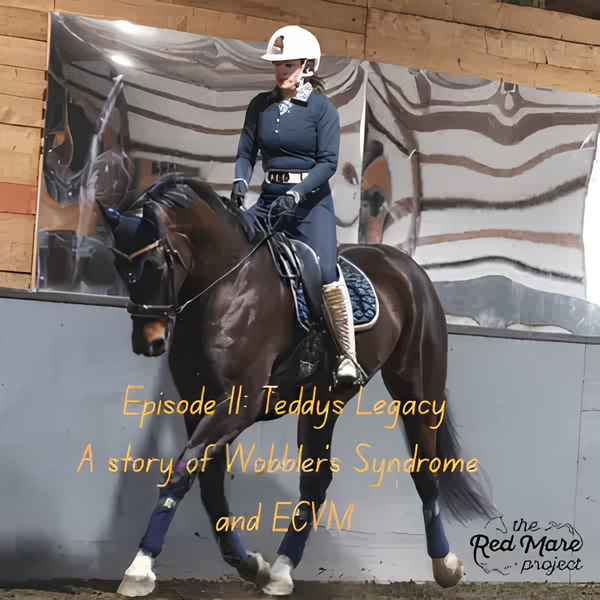
E11: Teddy's Legacy: A story of Wobbler's Syndrome and ECVM
January 8, 2026
ABOUT THIS EPISODE
The girls are back! Starting the year off strong with a true horsewoman, Brianna Navarro. Brianna shares the story of Teddy, his ECVM diagnosis, and his battle with CVSM aka “Wobbler’s Syndrome”. While Teddy’s time with Brianna was brief, he served as a motivator for Brianna to form Teddy’s Legacy. With this foundation, Brianna and her team strive to merge empathy and science to support ECVM and CVSM research, more accessible diagnostics, and support for owners in the depths of answer seeking. Join us to hear all about wobbler’s presentations, causes, diagnostics and what its progression looked like for Teddy. After you listen, make sure to visit Teddys Legacy (linked down below) and spread the good word of this admirable project. Teddy's Legacy: teddyslegacy.org Equus-Soma: https://www.equus-soma.com/ Sharon May Davis (she doesn't have her own website, but if you google her name, her articles and talks will come up) Check out your hosts! Taylor CL Schouten, MS, APF-I www.wildhoofequine.com Kahlan Ettere Wise Choice Equine Wellness LLC www.theredmareproject.com Please always feel free to reach out should you have a story to share or would like for us to cover any particular topics on an episode. Cheers.
EPISODE TRANSCRIPT
— Intro: Welcoming Brianna Navarro & Teddy's Story
That's good.
All right.
Shake it off.
Welcome back to another long-awaited episode of The Red Mare Project.
Today, we have a very special guest, Brianna Navarro.
She's a lifelong equestrian who has bravely shared her late horse's journey through Wobbler syndrome.
While Teddy was only with Brianna for a short while, his impact on her life and the lives of others has been immense.
Thanks to Teddy, Brianna has formed a supportive and educational foundation, Teddy's Legacy.
To honor Teddy and to help owners navigate the diagnosis of this syndrome and all that it entails.
Welcome Brianna and Teddy.
Nailed it.
Welcome to The Red Mare Project.
Oh, go ahead.
It's been running.
I'm just going to cut it.
Okay.
Okay, everybody.
Welcome back.
I know we have a couple housekeeping things before we jump into the meat of the episode.
First of all, I would like to say that Taylor and I are excited to be back.
I won't use the word sorry.
I will not apologize for our absence because we were totally just doing our lives and learning other stuff about horses.
We're not, we're not sorry, but we're glad to be back.
So hopefully you hung in there.
I know my grandma is one of our most reliable listeners.
So, hey nanny, how's it going?
We love, thank you so much for listening.
We really appreciate it.
We've got some really good traction over the past couple of months with emails coming in.
And don't forget, that's always an option.
Send us emails if you have anything you want to talk about or any questions you may have.
We are always happy to hear from you guys.
So next, not as, not as fun.
We are throwing out a trigger warning today because normally I have the really good news that the horse that we're highlighting is alive and has a happy ending.
While this horse has gone to a wonderful cause and we'll be doing a lot of important things in the future, he is no longer with us.
So he's still making great strides in education.
He's just not doing it on this plane of existence.
So just wanted to give that that trigger warning in case anybody needs to click off.
I know sometimes these conversations are too heavy.
So anyway, thank you so much, Taylor.
Take it away.
Okay.
I do want to say, too, we originally came on and started this podcast with us posting stuff every other week.
I think we got a farrier, and we have a nutritionist who also works in the medical space for humans.
We're just going to throw them at you when we get them.
We're working on that horse girl time.
We're going to keep you on your seat.
So you get them when you get them, so be happy.
Take what you can get.
Yeah.
Thanks, Taylor.
Oh, yeah.
So, all right.
So this horse, his name is Teddy, and we're going to have his mom, Brianna, come on here in just a few minutes and kind of tell us his story, which was eight months of just intensity.
But like a true horse girl, she really made limoncello out of lemons, so she was...
That stuff's so good.
I knew you'd like that.
That's another shout out to nanny.
So, she really did do some amazing things, but we'll let her share that part of it.
But what we want to talk about before Brianna comes on is what Teddy was struggling with, just because we don't like our guests to have to explain the why and the what.
We just want them to share the story.
Their story.
Yeah.
So, Teddy was diagnosed with Wobbler syndrome, which is cervical vertebral stenotic myelopathy or CVSM.
And then he was also diagnosed with ECVM, which is equine complex vertebral malformation.
And these guys are some like really, especially ECVM, it's a pretty heavy complex one, so we're not going to go into too much detail about it, because that's kind of a...
That's for a later date, a different story.
But we did want to get a couple of things straight, because the vocabulary is a little confusing.
It's not something that a lot of people know about.
And like Taylor and I were chatting before, you may have heard wobblers, but this is the formal explanation of that term.
Wobblers is used often colloquially to describe any ataxia in the back end.
That is not accurate.
Wobblers, like in vet terms, it is CVSM.
So we're going to go into a little bit, just a quick explanation so that you guys aren't completely lost.
Not to not give you credit, but I know I get lost with these kind of things because anything with this fine is really confusing and complicated.
— ECVM Explained: A Complex & Confusing Condition
And it's super complex and they can't, horses can't point blank, be like, oh, my neck hurts.
So when you do that, it hurts my neck and I'm scared.
It would be so much easier if they could.
It would, yeah.
So, all right, so for wobblers, you may hear us refer to it as CVSM or just wobblers, but, you know, tomato, tomato, they the same.
So wobblers is, it's a neurological disorder that's caused by compression of the spinal cord, which is in the cervical neck.
You might also hear it pronounced cervical, for some of her- Which is always funny.
Yeah, respiratory for respiratory.
Yeah.
But it's a spinal cord compression, and that's usually in the cervical vertebrae.
And it's from a stenotic process.
So it's a compression or a shrinking of where the spinal cord is.
So it's just no room.
So the messages get lost.
It's non-infectious.
It's literally a squishing of the spinal cord by the other spinous processes.
Which feels scarier and it is so causes typically ataxia is in the back end primarily.
That's why they call it wobblers because they do that.
They can do kind of a fishy walk like when a horse has EPM or other infectious reasons for ataxia.
It's similar, but they also, in my experience, they do this.
You can't see what I'm doing with my hand right now.
They'll take their back legs and they kind of tapping.
You know when your horse is really bored and they're pawing, they'll almost paw with their back end.
It's very clear that it's not confident.
It's like they're tapping the ground like, hey, is that where the ground is?
It's still there.
I'm not really sure.
That's really scary, especially on a big horse.
This is not super common.
It is heavily found in thoroughbreds and warm bloods.
Those are not little guys, right?
You have a 1,500-pound horse that doesn't know where its legs are.
That's really scary.
Yeah.
It can present a bit of almost like a hypermetric gait where it's a proprioceptive deficit.
Sometimes you'll see them smacking the ground, seeking that stimulation, which completely aligns with what you're saying about maybe almost...
Some people might say, it looks like string halt, which is what you were saying.
Yeah.
But it's consistent in both legs is the difference.
String halt can often be just one, which is why I think it's silly that we don't look further into it, but I understand that it's scary and it's also a hell of a diagnostic process.
Anything neuro is.
Yeah, that's true.
Yeah, that's what I've seen, the leg tappies.
Yeah.
All right.
So age of onset.
So with wobblers, we can have it show up in the kiddos and the babies, and then it can also show up a little bit later in life.
So Kahlan, do you want to talk about static versus dynamic presentations of that, and babies versus the adolescents?
Sure.
Yeah.
So unfortunately, one of the reasons can be like osteoarthritis, which seems like something that would only happen in older horses, but unfortunately, that's not the case.
It can also be a result of micro traumas.
I think race horses, it can be pretty common.
They're young, they're fed a high carb diet, they're worked extremely hard when they're young.
So that arthritis can set in at a much younger age.
When she's talking about static vs. dynamic compression, something that we both found really interesting was that with dynamic compression, which means the compression only happens in certain movements.
So if the horse is standing there in a neutral spine position, it's not squished.
It's squished at extension or flexion of the neck.
So think kind of like when kissing spine, how those processes come together.
They may not always be together causing pain in neutral, but you see those things happening in ridden work, when horses are expected to do certain movements.
And obviously, carry weight.
Kind of similar in the way you can think about how the horse is moving.
But what we'll often see in the CVSM horses is that as they're younger, the dynamic compression is more common because they're growing.
So stuff is changing, stuff is moving around, especially in the horses, like I said earlier, that are fed super high carb diets young.
— Nutrition, Fast Growth & Skeletal Development in Foals
They're growing really fast.
So bones and muscles and nerves and all the things are growing at different rates and they're growing faster than growth plates can handle.
So that's one of the reasons it happens when they're young.
But when they're young or even when they're older and it's a dynamic compression, as we understand it, they can then get relief from that compression sometimes by putting a foot forward.
So like a classic grazing stance, they have to be in kind of an extreme form of that.
I think when I'm in my car and I want to pop my chest, I have to twist to the side to get that opening, like that relief.
That's what I think of.
Because they're not standing square, that movement offers a little bit of relief to the compression.
Whereas in a static compressed horse, they cannot seek relief in anything.
No, that is the bone has grown in such a way that there is constant compression of the spinal cord.
That seems to be with the older onset horses, which is ages like four to five, if we're understanding what we're reading with this.
When we say older, that just means almost finished cooking horses, not actually older older.
Yeah.
That's such a good way that you explain that though with the dynamic about relating it to kissing spine.
That's 100 percent.
Certain positions, it's going to show up, it's going to zing you.
Which is why I imagine these horses have similar reactions like an MFM horse.
When they're experiencing that muscle pain, they have panic, I don't want to tell you, but that's the trigger.
They may be fine standing in one position, but they put a foot back or they turn their head a certain way.
I would imagine it's a sharp pain because it is the spinal cord.
It probably feels like a nervous pain, a pain that's nervous in origin because it's the spinal cord.
It's not just regular, my back is sore.
It's probably like a zap.
I mean, I don't know.
I haven't asked a horse with CVSM if they have a zap pain, but I would imagine that that's why they get really insecure about their surroundings.
They can become aggressive.
Where you've previously had a really sweet horse and as this thing that they have progresses, their personality changes, which is obviously heartbreaking.
So, the causes.
So, this is the part that's a little, I don't want to say convoluted, but I think there's some holes in that research.
Do you agree?
Yes.
It's not clear.
Yeah.
I mean, there's definitely a genetic disposition, but what I'm going to say is going to be very provocative.
But I feel like if there is a genetic predisposition for anything when it comes to breeding horses with a financial component, it gets a little touchy.
That's a very diplomatic way to say that people will breed horses to have pain if it makes them money.
Just very nice of you, Taylor.
I'm trying, man.
I'm trying.
I'm not a tough nut.
But I do think that there's, we listened to quite a few webinars from a lot of docs.
That root and riddle webinar that I sent you was fantastic.
Oh my gosh, the guy?
Oh, amazing.
I can't remember his name.
His name is Steve.
This man has- He looks like a Steve.
He is, yeah.
He's a PhD and a DVM and he's like, yeah, I'm Steve.
I'm like, yeah, you are.
I'm like, hell yeah, you are.
Go Steve.
He's like 47 years or something of experience and he's incredible.
Yeah, it was so good.
If you really do want like a deep dive into like BASIC surgery and more about wobblers, Root and Riddle has some really great talks.
But he was talking about how there definitely is the genetic predisposition, which makes sense.
I mean, that checks out.
But Kahlan, what you were talking about with rapid growth rates, and then you mentioned something earlier about the excessive caloric intake or mineral imbalances, and that blew my mind.
Yes.
So Taylor and I have been talking about this leading up to this episode for a couple of days, and we keep coming across in the talks that we're listening to, someone will say like, oh, obviously there's a nutrition component, but then they don't explain it.
Anywhere that I've looked, and I know you have the same experience, like, tell me more.
Obviously, my ears prick up when I hear that, like, okay, tell me more.
— Is ECVM Preventable? Diet & Early Management Questions
Is this preventable?
Is this manageable from a young age based on what we fed?
And this article from UC Davis is the only place that I've seen any explanation.
It says, quote, a number of causes including malformation of the vertebral column, osteogendrosis, repetitive microtrauma, and dietary factors such as copper deficiency, excessive zinc, or high carbohydrate ration can result in clinical signs characteristic of CBCM.
They say CBCM, CVSM, there's lots of names.
And that was the only clarification I got.
So obviously, we are people who never shut the hell up about mineral imbalances.
And here's just another place that it shows up as a problem.
Yeah, yeah.
And that's so interesting that it's more of a copper-zinc thing.
I immediately went to calcium-phosphorus.
But obviously, yeah, because of the bones.
Yeah.
So do you have any thoughts on why excessive zinc levels would have anything to do with distorting?
No.
I mean, I...
No.
That's crazy.
Or could it cause...
Because another option is that the channel is not necessarily small, but the soft tissue is enlarged.
Like, it's...
Well, I don't...
I don't know.
I don't know either.
I did hear somewhere in that talk, I want to say, or on one of the webinars that I listened to, that there can be a soft tissue swelling.
And oftentimes, they can treat with a series of corticosteroids.
And that can sometimes really...
That can be resolved, yeah.
Yeah, that can do it.
But that wouldn't really be technically CVSM, right?
Technically, it would be a different diagnosis.
Well, if it's a stenotic process, because I think that's like the hallmark feature of wobblers, is that it's a stenotic process where there is some degree of compression.
So I don't think it matters what gets it to that degree of compression.
As long as there's compression, it qualifies.
I understand.
You see why this is confusing, everybody?
And we haven't even gotten to eCVM, that's...
Oh, that one's... that one will make your ears steam.
That's really confusing.
Oh, you know what else I thought was interesting that may also speak to rapid growth rates in youth, is that male horses are so much a higher risk.
Yeah, it's like 3 to 1 is right.
Yeah, significantly more in male horses.
So I'm wondering if that extra testosterone and then being overfed young, maybe that's why.
I don't know.
It's so interesting.
A lot of questions that I don't know that will have answers too soon, but definitely stuff to learn about.
That's a really cool thought.
I mean, that checks out.
And I saw something too about the role of degenerative joint disease and osteoarthritis in there, because you do have to rule out, well, not necessarily rule out, because I think that's splitting hairs.
If it's OA or osteoarthritis changes, that's participating in it.
But I don't know where this fits in.
This is me just kind of like...
Griffin.
Yeah.
So, Sharon May Davis, who we'll speak more about her in a little bit, but she's the pioneer of, well, one of the pioneers of ECVM research.
So she's done, I believe, over like 500 dissections.
And if you haven't...
Yeah.
She's...
I went to one of hers a couple years ago.
Yeah, yeah.
That's the one you...
Yeah.
And I have never seen someone navigate...
I mean, granted, that was my first dissection, but the way that she worked through and just knows the anatomy, it was poetry.
I've never seen someone just like...
It was like...
It is wildly impressive.
Like her recall of just all these finite muscles, it's just...
How do you keep that in your brain?
And it was so accessible, so accessible.
She had it ready.
And I'm like, I feel like I say, can you hand me the Whatchamacallit seven times a day?
Meanwhile...
Right off the top of my head.
The words you're looking for is rasp.
Yes.
Yes.
That thing.
That thing, yeah.
Anyway, so Sharon May Davis, she does a lot with ECVM.
She published an article recently that talked about the disappearing nuchal lamella.
And so, long story short...
Yeah, explain it to us because that's a heavy paper.
It's a heavy paper.
So, I'm going to do it in like a minute.
So, you have the nuchal ligament, which the way I explain it, it's kind of like, if you look at the San Francisco Bridge, it has those wires that kind of hold things up and support it.
— Cervical Anatomy: The Nuchal Ligament & Spinal Support
So, the nuchal ligament is that supportive wire that runs across the horse, the top, right?
I love that explanation.
Thank you.
I'm trying to keep it simple.
You got it.
Go.
Okay, so it has that nuchal ligament.
Now, that connects to C1 all the way down to C7, yeah?
So, to connect C1 to C7 to the nuchal ligament, there's a sheet, and it's called the nuchal lamella.
And it's just like a...
It's a sheet, yeah.
It's a thin, soft tissue that connects the nuchal ligament from C1 to C7, and the whole point of it is to stabilize the neck.
That's it.
And what Dr.
Davis has found, over time, is that the nuchal lamella is actually...
What's the word?
Like moving back.
Regressing, is that the word?
Receeding, that's the word.
Receeding.
I don't know what you're looking for.
It's all right.
It's receding, so it's supposed to go to C7.
Now it's knocking all the way back, and the connection is ending at C5, sometimes even C4.
So that is essentially destabilizing anything that's not connected to that nucleomella.
And if it's destabilized, that bones are moving more frequently, i.e. more osteoarthritis down there.
Okay, I see.
So I was going to say, like, I was going to say, but don't we often see, I know ECVM is a totally different monster, but CESM higher up in the neck.
I saw C3 to C6 is where they typically do the surgery.
Oh, okay.
I was thinking 3, 4, 5.
But even then, even then, if that lamella is receding that high, I mean, that's a significant portion of the horse.
Yeah.
Man, mammals are crazy to keep together.
I know.
Oh, and check this out.
So donkeys still have C1 to C7 fully connected on the nuchal lamella, which is why, like, if a donkey says no, that's it.
That's, like, that's it.
That explains a lot.
Uh-huh.
That was so interesting.
So, yeah, I guess we'll have to ask, we'll have to ask Brianna where that was on him.
I feel like it was three and four.
I feel like she said three, four.
I think you're right.
Yeah.
I think you're right when we were talking to her earlier.
Yeah, I really, but I could be wrong.
I just feel like there was, I feel like that's right.
Yeah.
Yeah.
I think so.
Stay tuned to find out.
Yeah.
So that can be a piece of it.
All right.
So diagnostics.
So you talked about we'll have like an ITACSIC presentation.
So your vet will come out and do their...
Neuro exam.
Their neuro exam.
You can also do cervical radiographs, although that's kind of hard to do.
My understanding is that's hard to do if you're looking to try and get like images of C7 particularly.
There's too much going on there.
You can't get a clear image.
But also if there's not an arthritic component, that may not be terribly helpful anyway.
That's true.
Yeah, you're right on that.
RADs are not the gold standard here.
We like our CTs, myelography.
Yes.
Yeah.
Steve's got it so much nicer.
Yeah, Steve likes it.
Thanks, Steve.
Also MRIs, too, are incredible.
Yeah, which we respect is not accessible, but this is just part of the thing.
Well, my understanding, too, is that even CTs for these guys, it's also pretty cost-prohibitive because they have to lay them down for it because they have to move their head and their neck in very particular positions so they can get the imaging.
So I think that process is still pretty cost-prohibitive, but I'm not sure.
Not only are you trailering and getting the testing, it's like a full anesthetic process.
They're hung upside down, you know, how they do, and they put their head in there.
Yeah.
It's scary.
Yeah, that's a big deal.
So for management, there's a couple options, but it all depends on the severity of it.
And I think a lot of places will give it a grade level, and if it's past a certain grade, usually that horse will qualify for more of just humane euthanasia or...
Versus surgical intervention.
So you can't, I do think that they try some, for more mild cases, they'll try some more, like, dietary modifications for the babes, NSAIDs, corticosteroids, and like you were talking about, if it's a, if it's a baby, they may, you know, quote unquote, grow out of it.
If it's just like a weird...
Develop out of the compression.
Yeah.
But the surgery, so there's, there's two types.
You have the basket surgery and then endoscopic foraminotomies.
— Surgical Options: Basket Surgery & Endoscopic Foraminotomy
That was good.
That, I really had to practice that one.
That's a hard word.
It was a crapshoot that it was going to come out that good.
Tell us about a foraminotomy, Taylor.
So, a foraminotomy is, this is, this is my very sophisticated way of explaining it, is they pretty much go in and they rotor-router where the excess bone is, so there's less compression.
Love that.
Yeah.
Open her up one time.
And then you have the basket surgery, and this is, this is a wild history on this.
I actually read a lot about basket surgery.
Yeah, you kind of dove in.
You kept sending me stuff, and I was like, yeah, she's really reading about this.
It was for her.
Fascinating.
Well, because, okay, so it was first pioneered in 1977, and then once it started going in the horse world, human doctors picked it up, and they used the same process for human stenosis.
Yep.
And they pretty much just put a tube in there.
That happens a lot in human medicine.
We take what we learn from, like a lot of peptide stuff is taken from testing and use in horses, a lot of performance horses.
And then the doses are sometimes the same, and sometimes they're very different, but it's super common.
Wow.
Yeah, I thought that was super interesting.
But the basket surgery has shown to be very effective.
Well, again, it depends on the severity.
If the horse is a good candidate for it, it has shown to be a pretty good move, and it really relieves the symptoms and greatly improves the quality of life.
I don't know if they return to work.
Again, I think it just depends on the severity.
I've seen, and I, this may be because there is less of an osteo component, like in the young, young, like little babies, that a lot of them do return to...
UC Davis specifically said performance.
Mm, okay.
But that feels generous.
Okay.
Everybody's idea of performance may be different.
Yeah, you're right.
But I think they just mean general writing, like quality of life, like comfort.
Maybe light writing.
I don't know.
That was unclear.
Okay.
I mean, the fact that they use that word gives me hope that there is a...
They do pretty good.
Yeah, yeah.
Because they would have said like pasture sound, if not.
True.
That's true.
Yeah.
So.
They would be more clear about that.
Let me see if I can find exactly what it says.
Oh, this is interesting and speaks to what we were always yapping about.
Okay.
Management for quote controlled growth, including restricted diet, limit protein and carbs, and exercise stall rest may improve CVSM and horses that are younger than one year of age.
When I read that, I'm reading movement means growth.
Same.
That's what I hear from that, and that's obviously from my perspective of constantly thinking about how much a horse needs to move.
But it's interesting and it's so impactful in a young horse's development that we can actually stunt their growth by stall resting them.
Wow.
I mean, that, yeah.
Right.
But then imagine the implications on the other bone structures.
But I guess at that point, it didn't matter.
You got bigger fish to fry at that point.
True, true.
Yeah.
That's very true.
But I'm just, yeah, that's stuck out like, they might as well have written that in all caps.
I didn't.
That's just how I read it.
All right.
So we have wobblers.
So let's do just a little kind of brush over of ECVM if that's even possible to do, but...
I was going to say, yeah, go for it, Taylor.
Oh, Brad.
Three sentences on it.
Great.
You got it.
All right.
So Equine Complex for T-Brol Malformation.
So your heavy hitters on research for that, that's going to be Sharon May Davis.
She has published quite a few things.
Thersa Hendrix also has quite a few things out there.
And so Pam and Diane of Equisoma, those are also, they have their bone room in Aiken, South Carolina.
They do quite a few things.
Now, for ECVM, it's Equine Complex for T-Brol Malformation.
So it's a congenital malformation of pretty, what we found typically, it's C6 to like sometimes the first and second rib.
And it's right there in that little area.
And there can be a series of different types of malformations.
So we won't get into all that because there can be some like transpositions and things like that.
And it gets really, really, it gets pretty complex.
— Wobbler's Grades & Complexity of the Diagnosis
Yeah.
So we'll kind of leave that.
But the big part about it is when you do have all of those different malformations, it changes where muscles, tendons, ligaments, and nerves all lay in the body.
Now, wobblers, or sorry, ECVM can cause, the ECVM and wobblers can coexist.
Yes.
And they can exist independent of each other and together.
But not every horse who has wobblers has ECVM.
Not every horse with ECVM has wobblers.
Have any of these women looked at why they may or may not be coexisting?
Like, you see what I'm asking?
I do, yes.
And I think the reason why is because they're just, I think because wobblers can be acquired, ECVM is congenital.
They're born with it.
Yeah.
And I think that's the distinction.
And also, too, ECVM can be present.
You can have cervical malformations and completely asymptomatic.
Like, same thing with kissing spine.
You can have some rats that are a nightmare, and they're fine.
You never know unless you dissect them.
Yeah.
So oftentimes, it can just be jewelry on the radiograph.
It's not problematic.
Yeah.
And I think, wobblers, the compression, it's like, yes, 100% every time.
Yeah.
The diagnosis of wobblers means there's a problem.
But also, that wouldn't come up accidentally.
So you're not looking for wobblers unless there is ataxia or a reason to look.
You know, that's not something that you'd happen upon on a pre-purchase, right?
Yeah.
Yeah.
But yeah, so for ECVM, there is a radiographic protocol for it.
Not every veterinarian will do it.
I think you kind of have to, I don't want to say be specially trained on it, but I think it's a protocol that you do have to seek out.
But ECVM, a lot of those symptoms, I don't want to say they're similar to wobblers, but there is a lot of overlay.
Yes, but that's anything in the spine, like anything that is any kind of spine or spinal cord involvement is going to have similar issues.
A lot of the big stuff, tripping is a big thing.
So tripping is a big thing in both worlds.
Proprioceptive deficits is a big thing.
In the ECVM world and also in wobblers, difficulty standing for the farrier, which, of course, is very close to home on that one.
And explosive behavior, that exists in both of those worlds, too.
Big explosive behaviors, and it's completely out of nowhere.
Typically untriggered.
Well, to us, it's untriggered.
Oh, I love that you said that.
Damn.
Yeah.
So one thing I thought that was very interesting on one of the Sharon May Davis talks that I sent, that we both listened to.
So she was saying how a lot of the horses, it doesn't necessarily need to be a symmetrical abnormality.
They can be unilateral, like just the left side is going to have weird stuff, and the right side's fine.
So she found that a lot of these horses will have high-low syndrome, and one frog, like completely different feet.
And I do want to see a quote-unquote high-low on an ECVM horse, because I don't necessarily know if it means, like if it does show up in their feet, because it doesn't know if it will show up in their feet.
But she says that the frog will be smaller on the side where the vertebrae is affected.
So if like they have like a bifurcated rib on the left side, that left frog could potentially just be smaller.
Anything that's just because of how they're landing, they're not getting the blood flow that they should?
I would think so.
Yeah.
Yeah.
They're not wanting to reach and have a full extension.
Possible.
I don't know why else.
Yeah.
Also, I'd be curious about if there's a coffin bone size difference, because typically they're pretty- Nerd.
But I thought that made a lot of sense to me, because I have one suspected ECVM horse on my books, but the diagnostics on that is not going to happen, and he does not have high-low.
So just to actually put my hands on a horse where there are some clinical features in the feet, just to kind of see it more.
I wonder if it's more like...
Because there's a pretty big range of where in the spine the issue can be with ECVM, right?
Like, it's not...
I'm pretty sure it's typically C6, C7, and then the first and second rib.
That's really kind of like the...
That's a lot of space.
Oh, yeah, yeah.
But it's usually in that little window.
Yeah, yeah.
But I wonder if the location of the malformation on the spine would be the reason a horse does or does not have this reflected in their feet.
— Hoof Connection: Spinal Malformation Reflected in the Feet
Oh, I see what you're saying.
Excellent question.
I think there's so much variation in it.
I think there's too many combinations.
Right now, I present too many combinations to really put together correlations like that.
Yeah.
Someone will.
Someone smarter than me is going to.
I think it's in the works.
Yeah.
There's some stuff cooking for sure.
Yeah.
But I think the part that's really throwing a lot of people for a loop is that they can have changes radiographically and it's literally just jewelry.
It doesn't do anything.
So it's created two different camps where some folks think that it is, not think, but there's a camp where it's not problematic and it doesn't cause issues, and that the symptoms that these horses are experiencing, it's not.
It's something else or it's not an issue or it's behavioral or whatever.
Yeah.
Yeah.
I see what you're trying to say.
Yeah.
Yeah.
You get it.
Let's see.
Yeah.
I think for ECVM, I know we're going to have some more cases on the actually our ECVM, because this guy, while he had the radiographic changes, his gig was Wobblers.
Yes.
ECVM was not necessarily an afterthought, but it was just something else he had going on.
Yeah.
Yeah.
All right.
Well, I think Bri is actually, she's knocking on the door.
So you're ready?
Let's do it.
All right.
Cool.
I'm here.
Hello.
Welcome.
Thank you.
It's so good to actually see you guys, because I feel like I know you a little bit, because I've been binging your whole podcast.
Oh, thank you.
Yeah, I listen to all of it.
It's wonderful.
I've learned so much.
It's been great.
Thank you.
We're excited to learn from you.
Yes.
Before we jump in, and I know that you said that you've listened to the show, which thank you so much.
We love your support.
Again, you can swear you can say whatever you want to.
If there's anything that you say that you want stricken from the record, the record, like that.
Just say the word and we can scratch it out.
No big deal.
Okay.
But yeah, there's no time limits.
You can, whatever you want, this is your time.
This is your time for you and Teddy.
Cool.
Awesome.
Yeah, thanks for having me.
It's quite the story.
I was writing myself up a little timeline so that I don't forget anything.
It is a novel.
I was like, oh, wow.
I just keep going.
Yeah, it's like never ending.
Well, before we jump into that, why don't we do a little introduction on who you are, Bri?
So tell us a little bit about your background and just your life as a equestrian.
Yeah, sure.
So I have been riding since before I can remember.
I am one of those horse girls that just popped out of the womb, loving horses, and didn't have a horsey family, but just started riding from a really young age and loved it.
I always leased or did lessons.
My parents just couldn't afford to buy me a horse, and so spent a lot of time, put in my hours cleaning stalls and just riding all the horses that no one else wanted to ride, and I think it made me a really good rider.
But actually, Teddy was my first horse that I've ever bought.
So yeah, quite the first horse journey, but yeah, up to that point, I had leased many horses, and I've been riding my whole life, so yeah.
What was, what's your sport?
Dressage.
Cool.
Yeah, and I've done, when I was younger, I did 4H, and I've done a little bit of jumping, a little bit, I've gone cross-country schooling.
I did a little barrel racing on a little paint horse that I rode when I was a kid, and a little bit of everything.
But dressage is a thing that I really fell in love with, and I love the true core of classical dressage, where it's supposed to be good for the horse, and this harmony between horse and rider which I feel like we've maybe gotten away from a little bit modern dressage, but.
Yeah, that's a thing, fortunately.
Well, that's another episode or two.
Yeah, totally.
Where in the world are you?
I think you're in the West Coast?
Yeah, I'm in the Seattle area, just a little bit outside of Seattle.
Cool.
Nice.
Is it freezing there right now?
It is not freezing, but it's cold and it's rainy all the time and muddy.
Yeah.
It's a joy.
We're not going for that.
— Brianna's Background & Finding Teddy
No.
Yeah.
No, I don't think we are either, but we are making it work.
Yeah.
All right.
So you said that Teddy was the first horse that you've bought.
How did you find him?
What made you start wanting to shop?
So I was leasing another horse and just was feeling like I was at a point in my life where I was ready to buy one and so I was going to buy her, but that check didn't go well and so I found myself, I stopped leasing her because I wasn't totally sure what was going on after that check and I didn't want to spend the money to look into that horse I was leasing.
And so I didn't buy her and stopped leasing her and then I was kind of like, what now, you know, and just kind of started looking at what was out there because I had like geared myself up to buy a horse.
And so I started, yeah, yeah, I was ready.
So I started looking and found him on Facebook and you know, he was a reasonable price.
He was super cute.
He is like, he was a handsome horse.
I mean, truly, like when I first met him, I just fell in love because he just, he's got this beautiful, handsome face and big, beautiful eyes and he had this big old forelock and his big old bare feet.
Barefoot?
Yes That was going to be one of our first questions.
You just tapped into so many more questions for us too.
Yes.
Yes, barefoot.
He had really good feet.
So yeah, I just fell in love with him.
Right away, I feel like we just clicked.
I spent a boatload of money on a full pre-purchase exam, full x-rays, and I had a radiologist review everything, and everything checked out.
I mean, he was super, super clean on his pre-purchase exam.
Nothing abnormal in the neuro exam, according to this vet, which I sort of now feel like I wonder, I just wonder if vets are, how do I say this?
I feel like maybe the vet world still needs to sort of like catch up on some of these neurological issues and like learning how to better see them.
You know, like I don't know.
Even on their radar.
Yeah.
And I don't like, they don't all do the neuro exam the same.
Correct.
So I don't know.
Part of me wonders about that whole process.
So anyway, yeah, really good pre-purchase exam.
X-rays were beautiful, except for that he had ECBM, which I did see on the X-rays.
That was like the only black mark on these beautiful X-rays that I spent way too much money on literally X-raying this horse head to toe.
That was the only thing that popped up.
And people on the Internet have like crucified me over that because I fought the horse knowing that he had ECBM.
But in my mind, I did some research.
Like I kind of, we saw that on the X-rays and I kind of went in a way and was like looked into it.
There's this article by Sue Dyson that talks about that it's like not a problem.
And I knew a horse, I know a horse that has ECBM that was competing at Pre-St.
George.
So I'm kind of like, you know, anecdotally I've seen a horse that this wasn't really a problem in.
And then the radiologist that reviewed my x-rays said this wouldn't literally no risk to future athletics is what they put on the radiologist's report.
How old was he?
Five.
He was five when he got him?
Was he off the track?
No, no, he's a Hanoverian.
Whoa.
Wow.
Would you get that stereotyping?
Yeah.
Come on, Taylor.
Don't be.
We were going to ask.
Look at that stereotyping.
Oh, that's why I got so excited when you said he was barefoot, because in my mind...
No, I'm coming into this.
I see.
No, sorry.
No, no barefoot, real red.
So, when you did rads, you said you did a whole slew of them.
I do want to comment the fact that you had a vet who was willing to do the ECVM protocol.
That's pretty cool, because that's kind of slim pickings in our neck of the woods.
Yeah, and that really was...
So, I bought him, basically, like, it's still in my state, but like, it was like a five-hour drive south, like basically at the border with Oregon.
And so, my vet wouldn't travel that far.
So, it was another vet.
But my vet kind of guided me through the whole process.
And she was the one that was like, you need to get the oblique angles on the neck.
And like, yeah, shout out to her because she's...
I love her.
I have the best vet.
Yeah.
What else did you radiograph?
Uh, everything.
Um, neck, back, like, knee.
Literally, literally.
— Teddy's Early Signs: Subtle but There All Along
Feet.
Yeah, everything.
Everything.
And that was the only thing that came up.
Yeah.
All right.
And what...
Do you remember or do you have the report that says, like, what...
Was it like C6?
C set was it...
Like, where...
What was the...
Yeah, C6, C7.
So, he has or had...
It's the...
Gosh, I'm going to forget all the terms.
The tubercles or whatever that are on the vertebrae, he had one on C6 and then, I think, one on C7, I think.
So, he had the transposition of where there's supposed to be two on C6 and none on C7.
He had one, basically, one on each.
Got it.
Okay.
Okay.
Yeah.
And I mean, in your defense, too, it's...
This is such a weird thing to say, but it'll land.
It's...
I feel like a lot of times, it's almost like kissing spine, where, like, you can have a radiograph that's a complete train wreck, and they're completely fine.
And then there's other images where it's, you know, minimal and it's like, oh...
Feel mild.
It's a big problem.
Yeah, it's not horse dependent.
And it's like, you know, I know.
Yeah.
Yeah.
All right.
So you did all the imaging, which is incredible.
And then you got him, where are we in the timeline of this?
What year is it when you got him?
Because this is all recent.
Super recent.
It was in March.
You got him in March?
Whoa.
Yeah.
Yeah.
This whole thing happens over eight months.
Yeah.
Okay.
Between March and October.
So, okay, this is...
You were ready for 2025 to be around dying.
Oh, I'm so ready.
Yeah.
So ready.
Wow.
Okay.
So you're in March, you have this new horse.
What is the...
You took him home.
Yes.
What's next?
Like, did you immediately start seeing things?
Did you, you know, change his food?
It was...
What kind of state was he in?
Did you ride him immediately?
Like, take us to April.
Yeah.
So I brought him home.
He had been living out in a pasture when I bought him and only being ridden like three days a week.
I brought him home and there wasn't an opening at the place that I was planning to take him.
So I had to temporarily bring him somewhere that was not as ideal of a fit.
He was living in a stall and he was only getting three hours of turnout which was supposed to be a month.
It was supposed to be a month and then it turned into four because I was just waiting for a spot to open up at the other barn and it just wasn't happening.
So anyway, I think that was a really hard transition for him.
And knowing what I know now, obviously, I just think it was really hard for him to be stuck in a stall moving.
And then going from three days a week to five days a week under saddle.
I think that was a big thing that sort of trigger a lot of these.
So when I brought him home, there were signs.
Of course, looking back, I see the signs. 2020, the sign sign is 2020.
I know.
And it's hard listening to all of your other episodes too.
I've heard other people say the same thing where it's like, he was five, he was young, he had only been under saddle for a year.
He got started in 2024.
So it was like, he didn't have any training, he didn't have any balance, he didn't have a lot of muscle, he wasn't in great shape.
And so, you know, it's so easy to like, he was tripping and it was like, oh, but like- Oh, he's weak, he's just a baby.
He's just a baby, yeah.
I'm like, I'm gonna go away.
And then, you know, he'd have a hard time like holding his feet, just like to pick his feet.
And I'm like, oh, but like again, I'm like, he's a baby.
So, there was like little signs like that, that we were seeing when I first brought him home.
And then when we started, like, I mean, because he was in full work and like the longer time went on, it was just like worse and worse and worse instead of better.
Because in my mind, I'm like getting stronger and more...
He's getting stronger and more crushing.
Totally, totally.
So, he was like, he was, yeah, tripping a lot.
He had a hard time with the farrier.
He would like slam his feet down.
Like he kind of just had a hard time holding the feet up.
And it's like, I'm like, oh my god, he's so bad.
Like, he's misbehaving.
He won't stand still.
He just, you know, it's just...
But again, he's a baby.
Yeah.
Everything was easy to write off.
So easy to dismiss.
He would canter out of the trot and then trot...
Yeah, canter out of the trot and then like break from the canter.
— Canter Problems, Gate Breaking & Movement Red Flags
Yeah, break gates basically.
He couldn't hold a gate a lot.
Pass his head a lot.
He would stand like with his feet, front feet, like crossed.
Oh.
We were going to ask about his posture, how he stood.
So he crossed just one in front of the other?
Or was it, did it just like rotate?
I would say it rotated and it just was one of those things where like if I would kind of go to bring him in the cross ties and turn him around and then he wouldn't uncross.
Yeah, he just, however he landed, that's where like he would just keep his legs there.
And yeah, didn't really think much of it at the time.
So there was like all these little signs that looking back, I see now, but it just started getting worse and worse and worse.
One of the early things that started happening was I started seeing signs of ulcers and- I was going to ask behaviorally what you were seeing during this time.
Yeah.
Well, so that was one of my first like red flags because I started noticing he was kind of touching around his belly and he had some loose stool.
But I got told, I got reassured, I was told to stop worrying that he didn't have ulcers, there was no way this horse had ulcers and, you know, all these behaviors were just him being a baby and he just needed to learn boundaries.
And I had him scoped anyway because I'm like, I feel like something's going on here.
Smart girl.
Smart.
Sure enough.
Yeah.
Grade three ulcers.
So, started working on treating those.
As we were doing that, he was like getting worse and worse with all these things.
He started tripping a lot more.
The big one was he actually like fell to his knees under saddle and I came off.
I saw that video.
That was a scary video.
Yeah.
Luckily, we both popped back up and we're okay.
Again, it just was like, Oh, you lost your balance real quick.
No one in my life was like, hey, that was weird.
Really bad.
Yeah.
It was just like, oh, again, just baby stuff.
That happened.
We're treating the ulcers.
Then the next thing that happened was he started, and he was not a spooky horse, not at all.
You could throw stuff around him, he didn't care, knock stuff off the walls.
He started exploding and bolting out of nowhere.
It reminded me a lot of some of the MFM things that you guys have talked about.
The panic attacks.
Yeah, when you guys were talking about the blind explosion that happened, it was like that.
It was like no one was home.
It just, he would explode and he was just gone.
And he would do it under saddle.
He would do it on the ground.
He would get away from me.
He bolted under saddle and I came off again.
And so that was the part where I kind of was like, I thought, I'm like, this horse, I bought a horse that's too much for me.
Yeah, he's gonna kill me.
I'm not cut out.
I'm not cut out for a young horse.
Like, this is a mistake.
So I put him in full training.
Put him in full training and just kind of was like, I can't ride this horse.
I need to just like wait.
So I stopped riding him.
We're still working through ulcers.
So he had been on gastro-guard for a month and then I'm still seeing some of the symptoms.
So we did it for another month.
Rescoped.
Raided four ulcers.
Like they got worse.
Yeah.
Yeah.
Oh, shit.
It was crazy.
And I don't know.
Like that's something that I've heard from a lot of people.
I've seen it too.
Yeah.
With issues like that.
So I don't know if there's a connection there, but it feels like we were just trying to fight this, you know, chasing.
Yeah.
Yeah.
Like fight a fire, but someone's pouring gas on it kind of a thing, or it was like the gastro guard was like not enough, not doing anything.
When he was at training, was it at your farm or did you ship him off?
So I had him at this boarding facility this whole time.
And so there was a trainer there.
So was the trainer having the same experiences that you were?
Yes, in the sense that he was still tripping.
He was having trouble holding the gates.
Like he still kind of had all those signs.
But, I mean, again, it was like, I think we all just thought he was just like a young baby, still kind of figuring stuff out.
Yeah.
Was there anything, any questions that the trainer or you would ask under Saddle that were triggering to him?
— Under Saddle Observations: What Triggered Teddy
Like I know you're saying the gates were hard for him, and the transition especially, but like, was there anything, like anything laterally that would cause him to freak out?
Honestly, any contact with the bit, he had a hard time with.
He would toss his head constantly, like constantly.
And the bolting, it was interesting.
It would have been nice if there had been something that was a trigger, but there wasn't.
It was just like, I think sometimes he would just, I didn't know this at the time, but I think it was just like he would sometimes just get a little twinge in his neck, like move a certain way, and it just would like send him.
Well, even just foot forward wrong.
Move a shoulder a little bit too much, and it's like probably a stabbing feeling right there.
Yeah.
So, of course, I have farrier questions.
I have questions about hoof care.
Because one of my first clients, when I first started trimming, was actually he was a weanling and he had wobblers, and he was youth and I shortly after.
But did you notice or did your farrier notice if it was difficulty bringing his foot forward on the stand or having to when he put his leg in between his or her knees, like if there was a difference with that, or I don't know, like any positions that were particularly triggering?
Not that I know of.
I never asked that specific question or noticed it.
Being a different one way or the other, it was really hard.
His right front, I think, was the one that he really had a hard time holding up, which I think was because he had a harder time balancing on the left front, which is also the leg that he would frequently trip on.
That was also the leg that collapsed when he had that fall to his knees.
So I did notice a little bit there in terms of that being hard for him, but I never asked positionally what was hard.
Sometimes a couple of my colleagues have ECVM horses on their books.
I have one and bringing their foot forward on the stand is like that's asking them to move a mountain.
Yeah, it's hard on them.
Yeah.
Was he high-low?
No.
He had great feet.
Okay.
I'm just collecting data.
Yeah.
All right.
So going back to the ulcer, so we re-scoped again, he's grade four.
So what are we doing now?
What's the move?
So I think this kind of brings us to, and this is coming up to the point where I'd had him for about four months at this barn, and I'm like waiting for a place to open up at this other barn where they have like way more turnout.
And but it was just not happening.
And so this was where I was like, when the ulcers got worse, I'm like, I need to get him out of this situation.
Like this is not working.
He needs, being in the stall is not working.
He needs something different.
He needs a different feed schedule because they also went a really long time overnight without food at this barn.
And I think that was kind of causing issues also with the ulcers.
For sure.
Yeah.
So that was where I was like, okay, time to make a change.
And then the other thing was like, I think that also sort of like seeing that he had the worsening ulcers, I'm like, I feel like something is wrong with this horse.
And I feel like I have been saying it and noticing it this whole time.
And no one else is seeing it.
No one else is- They're writing it off.
They're writing it off like he's a baby.
But I'm like, I think something's wrong.
Like I think something's actually wrong, wrong.
And so the day before I moved him out, I made plans to move him to live outside after another barn.
And the day before I did that, I had my vet out for a lameness exam.
And I was like, something's wrong.
Fix it.
Show me what's happening.
I'm gonna find it.
Yeah.
And it flexed beautifully, of course.
Like, it looked great for most of it.
But then it's like, you know, and I think this is also the really hard thing with these neck issues is they look so good one minute.
Like, I mean, he would be like looking fantastic, fantastic.
And then like almost falling on his face, you know?
Did they do a neurological exam?
Yes.
And that was where we started seeing some of the problems.
And she pointed out the how he was standing, how he wouldn't like if like you could sort of place his feet in a weird position and he wouldn't move the foot back.
— Body Exam Findings: Stance, Foot Placement & Proprioception
Like he would just stay there.
Yeah.
Yeah.
So she pointed that out.
He had a really hard time backing up with his head up.
That was like, that was asking him to move him out.
And speaking of moving him out, that was like not possible.
Yeah.
He couldn't do it.
So yeah, the neuro exam, definitely she was like, some things a little funny here, like nothing's wrong with his feet, nothing's wrong with his legs, his like joints look good.
And knowing that he had ECBM, like we kind of talked about it.
And she was like, you could try a Butte trial for a week and see if it helps.
So I did, did nothing.
And so we talked about it some more and she was like, you know, I think I actually said, I was like, should I, do I take him for a CT?
Like should I CT his neck?
He was like, yeah, that's probably not a bad idea.
Yeah, smart, smart.
Yeah, so I moved him to the new barn.
He was living in a pasture outside with another horse and he loved that, loved that.
I mean, that, I think that helped with the ulcers more than any of the other nights and anything else.
Yeah, so that was good.
I did scope him again for ulcers.
This is like third round of scoping and he had still had grade 2, like they were better.
A lot better, yeah.
But still had them and that was starting to, I mean, that was just, I'm like, what do I do now?
I can't get rid of these ulcers.
Then I took him for the CT.
I had to trailer him from where I live in Washington down to Oregon.
That's the closest place they can do the neck CT because they have to actually put them out and hang them upside down, stick them in there to do the neck.
I do think that that process, both the long trailer ride and then also they have to, like I said, hang them and then I think they put their neck in certain positions.
That seemed to make it way worse.
He came back and it seemed like his symptoms were a lot worse.
And I've heard that from other people, too, who have gone through that.
Irritated it, yeah.
Yeah.
But it did give me answers.
So the CT showed that he had pretty severe arthritis, like throughout his whole neck.
And then at C6, C7, he did have spinal cord compression, so which is Wobbler's.
So that was where I got the official Wobbler's diagnosis between my vet.
And then I had another vet come out that actually my insurance sent out, who's awesome.
She's actually studying ECVM.
So she came out.
Wow, that's great.
Yeah, she came out to look at him.
And between the two of them, they diagnosed him as grade three Wobbler's.
What's that?
Out of five, right?
Out of five, yeah.
Yeah.
And grade three is usually like, for my insurance, it was the point where that's where they'll approve a humane euthanasia.
And that's kind of like the point where they start getting to be kind of dangerous because- They can sell all of you.
Yeah.
Yeah.
So I cried for like a week.
Sure.
And then I'm like, okay, what are we going to do?
And I put him on Equiox.
I didn't really see any change in him with that, but it made me feel better, so I don't know.
And then I also tried gabapentin, but it made him way more ataxic.
That's true.
That was like so bad.
So that was a no-go.
Is that a common reaction to gabapentin, for it to kind of backslide like that?
Yeah.
Yeah, it can be.
I think because it's not like a permanent thing, like he didn't permanently stay like that, but it was like when he was on it, because I think it makes them a little, it can just kind of make them a little unstable anyway.
I see.
I see.
Yeah.
Okay.
So he got like real, real wobbly on it.
So yeah, that was just a no go.
We talked about injections.
I talked to a couple of that's about injections, but I think like the thing that I've heard is that horses that have, once they kind of get to a certain level of ataxia, and also a horse with ECVM that in some cases, you can actually make them more unstable with injections.
It also didn't seem like it would be, you know.
It's a bandaid.
It's a bandaid.
Exactly.
So it's like, okay, I thought about that.
There was a part at first when I got this whole diagnosis, my brain was like, okay, we're doing surgery, like, you know, because you want to do everything for your horse.
And so that was my like first reaction.
But then I did consult with a surgeon at UC Davis.
— UC Davis Consult: Surgery Would Be Aspirational, Not Scientific
And he, I can't remember his exact wording, but it was like, he said a surgery would be aspirational, not scientific at all.
Meaning for Teddy's case in particular?
For Teddy's case in particular, yeah.
I think because of the, like, location of where everything was and the severity of it.
It would be more, it would be harder on him than his chances were.
Yes, it'd be like sort of experimental.
Yeah, and you can't help it.
Yeah.
So after I got that email, it was like, ooh, that doesn't sound good.
And I talked to my vet about it.
And it just, at that point, I kind of was like, I think I'm, I think I'm just kind of at this point going to like make his life as good as it can be and see what happens.
You know, and like see how long we can, we can go.
When y'all did the consult for the surgery, what were you guys consulting about doing basket surgery or what surgery in particular?
Yeah, we talked about that and then also the foraminotomy surgery.
But that would only, I think, I think that would only take care of some of the arthritis that he was experiencing.
I don't think that that can fix the spinal cord compression.
Like I don't quote me on that.
I think once in that area where he had the spinal cord compression, it was just not, that wasn't even an option.
Yeah, it would be to do it in a hilted house, but not really.
Yeah, right.
And not fix the whole thing.
Yeah.
And I think with the pharaminoidomies, those are like, my understanding is that very particular cases are candidates for that.
It has to be super accessible.
And I think if, yeah.
Where you said it was, that's not possible.
Yeah.
Yeah.
So you've decided to do palliative care.
Yeah.
Where are we in the timeline right now?
So this was August, that he had the CT.
So yeah, bottom in March.
In July was when I moved him to the new pasture friend, horse friend situation.
August, he had the CT and then it was late August, early September that I was making some decisions about next steps.
Go ahead.
Yeah, at first I tried to keep him in exercise through lunging.
I wasn't obviously riding him anymore because my butt was like, you can't.
That's dangerous.
Yeah, you can't ride this horse.
But I was trying to lunge him just to keep him moving a little bit.
I know that is something that they talk about with ECVM horses, is keeping them strong, trying to keep some muscle on them, not just let them waste away too much because then they don't have the proper muscles to help support the imbalance.
So yeah, I was trying to keep him, or I would do some little walk poles.
At first I tried that.
That was a struggle for him.
And then the lunging just got to the point.
Pretty quickly, I was like, this is not...
He struggled with it so bad.
And the circle was probably so hard.
Yeah.
Like maintaining a circle in one direction was probably worse than the other.
And then you're making him more uneven.
Yeah.
Yeah.
And he's tossing his head and then he's tripping and he'd fall to his knees.
And it got to a point where I'm like, okay, so we're hand walking.
So we switched to hand walking and that was okay for a little bit, but he was tripping a lot.
And then pretty quickly that got to the point.
I mean, like this is all literally happening between, like I said, CT and August.
This was like late August, early September.
I'm like making all these kind of like decisions.
And literally in a matter of weeks, it was like, because I think he got so much worse after the CT.
And then I'm hand walking him, but he was tripping so much.
And then I started kind of being afraid to hand walk him because I'm like, is he going to fall?
Yeah.
Yeah.
Or like fall.
I would try and walk him out.
We have this little like trail loop around our property.
And then I'm like, is he going to fall on the trail?
Like even if it's not on me, and I'm not going to be able to get him up, and then he's out there.
And anyway, so I kind of stopped hand walking him too.
And so then I'm like just grooming him.
And then he started getting really aggressive.
Like even just grooming.
He's like trying to kick me.
He started getting really aggressive with his pasture mate who was like his best friend.
I mean, they were like BFFs immediately.
— Teddy & His Pasture Buddy: Inseparable BFFs
Like they were inseparable.
They would never leave each other's side.
It was like every time you got to the pasture, those two were standing with each other.
And then at this point, he was like hitting his ears, trying to kick him.
One of the biggest signs to me that I was like, yeah, I think I need to put this horse down was he bit a chunk out of his pasture mate's neck, like a full chunk.
And these horses are literally the best of friends.
So that was, I was like, whoa, that was super weird.
That was for real, yeah.
Yeah.
Do you know if anything triggered it?
Did something spook him and then Teddy thought that it was the other guy or did you just find out about that?
I wasn't there.
Oh, okay.
It was like I got to the barn and I was like, oh my God, he doesn't jump on his neck.
It had to have been Teddy biting him because I had seen him pin his ears and snap at him and stuff like that.
For no reason, I mean, just you know, we block it.
He was probably getting so defensive of like, we're so rough with each other.
Even social brewing where they're mutually grooming each other's necks, that probably became completely intolerable.
So I would imagine that he would get super defensive because he knew that if that horse touched him, it could potentially hurt him terribly.
Yes.
Which is totally understandable.
He's, you know, he got the brain of a toddler and he's in pain.
That's the only, like, you can't blame him.
I hate that for the other horse, but you know, what is he supposed to do?
I know.
And then it was kind of, he would both be like really aggressive with him, but then also if you would take that horse out, he would scream bloody murder.
Like, he was so hardbound.
I think it was just he at this point was so, like, insecure.
Like, I think he was kind of in pain and unstable and kind of didn't know where his feet were and was just, like, super insecure.
So there was a point where I went and looked at another pasture retirement place and I, like, thought about it.
But then I was like, just in my mind, I'm thinking about, OK, I'm pretty sure he's still got the ulcers.
Like, those haven't gone away.
He's, like, really aggressive even with his best friend.
How's he going to do in, like, a herd?
With new horses, yeah.
Yeah, with new horses.
And, like, I'm like, OK, I have to transport him there.
Is he going to be OK in the trailer?
What if he falls on the trailer?
What if he falls in the trailer?
Yeah.
It's going into winter, because this was now, like, October.
And I'm like, we're going into winter.
It's going to be snowy.
Is he going to trip and fall in the snow?
Is he going to be OK in the ice?
I just started thinking through all these things.
And then the other, the other thing.
So there was, like, the biting the chunk out of the pasture maid's neck.
And then the other thing that really made me decide to put him down was how he was being with my farrier.
And the last time that I had my farrier come out to do him, he was struggling so bad to stand and, like, ripping, I mean, ripping his foot out and slamming it down.
And there was one moment where I was like, oh, shoot.
Like, he could actually fall on my, I was, like, watching this happen.
And I was like, oh, my God, he's gonna, like, fall on my farrier.
And that was when I was like, this is just, it's time.
You know, and I want him, I'd rather do it now, where he's with his best friend.
And he, like, you know, still has some semblance of, like, inequality of life.
Yeah, yeah.
So that was when I scheduled it for end of October.
I have questions.
Yes, yes, absolutely.
Towards the end of this was so short.
I'm sorry you had to go through, like, this such a traumatic whirlwind.
Yes, when you're first tours, that's awful.
I'm like, I want to give you, like, it's amazing that you're here and I really appreciate you sharing this because I know it's hard.
It may not be something you noticed because it was so quick, but with horses that I've had that are neurological for one reason or another, they all had a hard time maintaining weight until I figured out where they needed to eat.
Yes.
Oh.
Is that something you noticed, like, if he was eating hay?
I don't know if there was grass out there or what, but if he was eating hay, did you notice he was reluctant to eat from a round bale, or did he have to eat on the ground, or could he not eat on the ground?
— Eating Posture, Head Position & Hay Management with CVSM
Was there anything weird there that you noticed that was causing him potentially to not get enough forage and then make the ulcers worse?
That is super interesting and not something that I had thought about.
But he would always eat on the ground.
He would eat his hay on the ground.
But now that you're saying it, he was always a really slow eater, I would describe like a slow eater.
His pastoral son, he was the opposite, always trying to come in and eat all his food.
I had always dismissed that as, again, him just being his nature, but maybe it was a little hard for him to eat off the ground.
I never thought of it.
I don't know a lot of my girls that eat slow.
That's super interesting.
That's a brilliant question.
I never thought of that.
Jot that down.
Oh, thanks, Taylor.
That is genius.
I'll autograph it.
Wow, yeah, I never thought about it.
That's a really good point.
I wonder if that was part of why he was like so, because he would eat a little bit and then stop and pause.
Yeah, I wonder if his neck was bugging him.
That's so interesting.
Probably.
Well, that's obviously contributing to the ulcers if he's not eating enough for each one.
That's obviously a problem.
Also, because I'm coming at this from my experience with neurological horses, did you have a really hard time maintaining a non-infected hoof in the time that you had him?
Because to me, that is now one of the signs of worsening of a horse in that situation.
That's something to monitor.
Not just can they hold their foot up for the farrier, but are you able to hold it up long enough where you can clean them?
Are they stepping correctly?
Are they leaning more in the mud on one side because they're unstable, and now we've got a central sulcus infection that won't go away?
Stuff like that, just based on my own experience of like, that was a turning point for me in a neurological case that I had was like, he'll die of a bone infection from a bone that's so sick before he dies of anything else because I can't get it clean.
Yeah.
That is also a really interesting question.
He did have thrush when I got him, but also here in Washington, like everything has thresh.
It's honey, mud is unavoidable.
It's literally the bane of my existence and I hate it.
He did have some thresh when I got him and I was trying to treat that from the time that I got him and it was a struggle.
Again, because he would always pull his foot out when I'm trying to hold it and do the whole thresh thing, which is like a whole thing and takes a long time.
He was always pulling his foot out and it was really hard for both of us trying to go through that process.
Going into the summer months here, it did clear up, but yeah, that's a really interesting question.
Maybe if I had had him longer, I would have seen that also as a month, but yeah.
But that's a small thing, a lot of with these cases, you're having to notice such small things that can easily be attributed to personality or behavior or environment.
You have to be such a detective with these kind of things that hindsight is 20-20.
I know Taylor, her and I both have the same question.
Can you tell us a little bit about the wear patterns, hoof wear patterns, if he was having anything weird there?
I don't think he was.
He would get a little bit of a chip every now and then, but yeah, I don't remember there being anything unusual.
Would he like square off his toes or anything like that?
No.
Okay, keep going, sorry.
Yeah, no, I don't remember there being anything unusual with that.
I was listening to a talk, Sharon May Davis, and I remember she was talking about on some of her ECBM horses, and I think she was kind of alluding to High Low with this, but she didn't say High Low, but I suspect that's what she was alluding to.
But she would always say that one frog would be much beefier than another in her ECBM horses.
I thought that was very interesting.
I think it's just because of the loading patterns, but to me that speaks to High Low, but obviously they can both exist.
Yeah.
No, I definitely didn't see that, but I could totally see how that would happen because yeah, I mean, they are, and that's I think the thing too about ECBM that we all as a horse industry and vets also have missed up until very recently.
— ECVM in the Horse World: Still Widely Misunderstood
I think we're starting to understand that ECBM causes so many issues through their whole system, because I think historically it's just like, oh, it's just like a little bone malformation and it doesn't seem like it even- They're bad parts and that hurts.
But now everything else hurts and everything's growing weird and now they're growing everywhere.
Yeah.
Totally, because it causes all these things and it's linked to a lot of them have a missing rib or yeah, maybe they have, like you said, one, that's weird, one frog beefier than the other.
But yeah, it causes all like a whole slew of these imbalances through their whole system, and it causes so many problems that I mean, I just don't even think we've started to even scratch the surface.
Yeah.
All the problems that it causes.
Well, it's such a problematic, like it's a very provocative topic.
And unfortunately, we live in a world currently where there's two different camps, where some people think like, okay, well, it's just a radiographic finding, that's fine.
It's a variation of normal.
But the other camp is where we actually live in a world where no, it is a problem.
It is a problem.
So there's, I mean, there's a lot more research going on with it.
And I know Sharon May Davis and the girls at Equisoma, Pam and Diane, they're like, you know, the pioneers of it.
So God bless them.
Keep them safe.
Truly.
Pam is incredible.
She has been just wonderful through this whole process.
She has Teddy's DNA for her study that she's doing.
That was a question.
It's going to be a question.
Bless you.
Bless you.
Because they're trying to confirm that ECVM is genetic and trying to see like what genetic markers maybe there are for ECVM.
And so he's part of that study.
Good for you.
Good for you for being so generous with him.
That's really good stuff.
But I want to go to the bone room so bad.
Yeah.
I have not gone.
I went to a dissection over there and I was by day three.
It was one of Sharon's by day three.
I couldn't even say my name.
I was so braindead.
So I was like the bone room.
I went too much.
We're capped out, but we'll go back.
So all right.
So back to Teddy.
So we're in October.
I think we are, right?
We are?
Okay.
So we're in October.
At this point, we've made the decision, but have you made the call?
That's two levels right there.
Yeah.
I had been talking.
My vet is literally amazing, the most amazing human.
So I had been talking with her this whole time and she really helped guide me through the whole process and making the decision and then scheduling the appointment.
Then the other people that were so amazing through this process were my barn owner and then also the owner of Teddy's pasture mate, Sonny.
So they helped me also make this decision and make a plan and so we did it at the barn and it was beautiful and I know that's weird to say.
No, it's not.
That's not good.
No, Kahlan, I listened to your rent episode also and you said a lot of the same things, right?
That it's like, it's weird to say that, but it was, it was like in here, like I said, in Washington, it just rains all the time and it's muddy and terrible.
And in October, that is like peak, peak rain, rainy Washington season and it had been raining for weeks.
And then the day that we did it, it was like this beautiful sunny day.
We had blue skies and we brought Teddy and Sonny to this little grassy pasture and they just like ate grass.
And I did put Teddy back on the Gabapentin for the last like week or so, just because I'm like, you know, screw it.
I'm like, yeah, whatever, we're just going to feel as good as you can.
Load them up.
Load them up.
Exactly.
So he was feeling real good and like just got all kinds of treats.
And Sunny was there.
And like, my parents were there, the barn owner was there, the barn manager, the guy who like would feed Teddy was there, like in the, he drove the tractor up to like be there.
It was like, it was sweet.
It was super sweet.
It was like everyone there on this beautiful sunny day.
And he just like laid down so gently.
— The Final Decision: A Gentle Send-Off for Teddy
And that's the best.
It was all you could ask for.
Yeah.
Yeah.
And so I don't regret a thing about the timing or making that decision because to me, the worst thing would be like, you know, because I had been debating.
I'm like, is this the right choice?
Should I be putting him in a, should I like inject the neck, put him in a pasture somewhere, like see if he makes it through the winter, you know?
But after that day, I was like, nope.
I thought it was 100% right.
Then you're risking, you're risking a traumatic emergency call versus having his whole family there on this beautiful sunny day.
It's like that's, you couldn't ask for a better day.
That's perfect.
Truly.
Yeah.
Yeah.
And I owe that to him, you know?
For sure.
Of course.
And I think too when like everything lines up like that and it really is just like such a perfect day, I think that's the universe kind of being like, yeah girl, you got it.
Yeah.
Yeah.
Good choice, mama.
Yeah.
Totally.
Yeah.
Yeah.
So this is kind of a tough question.
Where did you do a necropsy or where is he?
I did not.
I did debate the vet that my insurance had sent out the one time who's studying ECBM.
I really wanted to donate his body to her to do a dissection, but it would have required bleeding him out immediately, basically after euthanizing and being at a boarding facility.
They were so nice.
They closed the barn for half a day so that I could do this.
Yeah, it was wonderful, but I'm like, I can't.
They were so nice to me.
I can't be bleeding my horse out in their field.
Yeah.
Yeah.
So, and then the other option was like trailering him to her so that she could do it, but I'm like, no, no, I can't do that.
Yeah.
So, bummed that I couldn't do that.
But yeah, so I just had like a rendering service come get him.
So, I would have donated his body, but the beautiful to me was like that, the time leading up to it.
No, you did what was best for him.
That's all I mean.
You said you owe him that.
Yes.
I had the same experience with Wren.
Like, it would have been great, and I would have loved to do that, but it was not feasible and it would have diminished the quality of life on his very last day, on his wedding.
Yeah.
Yeah.
No way.
So, you did a great job.
That was so respectful that they closed the barn.
That's- I know.
I know.
They're amazing.
People.
Yeah.
Yeah.
People.
Really.
Wow.
Okay.
So, this was November?
November?
This was October 29th.
Yeah.
Wow.
October.
Okay.
Okay.
I have one other question that I keep.
It keeps coming in my head and I'm running away.
Did he ever do any wall sitting?
Wall sitting?
Like kind of scooting his booty up against the wall and- Yeah.
No.
No, he didn't.
He didn't?
Okay.
I was just curious.
I'm sorry.
That was such a horrible segue.
We just talked about something so lovely and peaceful that I'm like- By the way- Symptoms.
Yeah.
No, it's okay.
No.
Yeah, no, never did anything like that.
Okay.
I wonder if that's something that happens more often with a horse that's doing this slow burn.
Maybe.
Teddy was pretty quick, it sounds like.
Yeah.
Yeah, it seems like it.
I mean, I know, like I said, it seemed like he had, there were like signs there, but it seems like it over the eight months that I had him, it was like, I mean, it progressed so fast.
Yeah.
Yeah, that's what I'm saying.
Like there's horses that can live with us for years, especially like if it's, you know, because of an arthritis, like I would think that that would happen more, cause they would have to learn that coping mechanism, right?
He didn't even have a chance, like it was so quick.
That's a good thought.
They would have to like acquire, like get to a point where they had to figure out something just to exist, like wall step.
For relief, yeah.
Yeah, yeah, yeah.
So.
Okay.
Okay.
So now the good part after that tough story, now the good part.
Yes, you've been busy.
Tell us what you've been working on.
Tell us how did this inspire what you're doing now?
Tell us everything.
Yeah.
So I think, well, there was a few things.
So Teddy was part of that.
The one, the study with Equisoma, and then he's part of another study.
He had his CT imaging presented at a vet conference.
Like it was kind of already, people were reaching out to me for these things, like, you know, kind of along the process.
— The Seed of Teddy's Legacy Foundation Is Planted
And I just, so there was that.
I was like, okay, there's, there's a need for research.
Yeah.
And then also through this process, I think like it was also a very fast speed run for me opening my eyes to some of the problems in the industry and how we dismiss a lot of these behavioral signs or, you know, indicators of pain basically as an attitude problem and problems in the dressage world where, you know, I think it's just become so much about looks in dressage.
Modern dressage has become all about these flashy horses that just like look pretty and they've got these like long necks and crazy spider legs.
And we've kind of gone away from like breeding for longevity and soundness.
And so I was sort of having this whole like mental crisis through this whole thing.
Yeah, the sport that I love is like a huge problem.
And there and like, I'm like all these trainers and breeders and judges.
And I was like, my whole life is a lie.
We got a little existential there, didn't it?
Oh, yeah.
Oh, yeah.
Big time.
So, then I was like, people need to learn about this.
Like, who's educating the horse people about all of these things?
And who's supporting people when they're going through a diagnosis like this?
Who's giving horse owners the support to even euthanize their horse?
Like, it is expensive and the diagnostics are expensive.
The CT was like five grand, you know?
Yeah.
And I mean, there's people who can't even get to that point to go get the CT, let alone the steps it would come after.
Injections are expensive or whatever, the medications and all of that.
So, I just felt like there was a need for education, for research, for support.
Support, yeah, like financial support for people.
And yeah, just support in general.
So, through this existential crisis I was having, I was like, I'm going to do it.
You know, I'm like, how hard can it be?
I'm going to do it.
I had a girl.
Classic horse girl, right?
I had a girl.
Make it happen.
We're all Renaissance women.
Yeah, so I'm like, okay, I'm going to start a nonprofit, and I'm just going to do it.
And so, I started Teddy's Legacy, and it's a nonprofit.
Literally, this has just happened over the last month or two, so it's still super new, still sort of getting its legs underneath it, but we have a website that has a lot more information about it.
Your website is beautiful, by the way.
Oh, thank you.
Thank you.
I spent a lot of time on it.
The goal, our goal is to bridge the gap between science and empathy.
So it's about bringing this like scientific research to the horse world and educating people.
But also, like I said, providing support when people do need diagnostics or do you need to make a hard decision.
So we've been raising money.
We just got our federal 501c3 status, which was super exciting.
Congratulations.
Excellent.
Thank you.
That was a big step.
There's just a ton of paperwork.
I have five board members who are awesome.
We're just still working through a lot of the logistics, but I'm really hoping that with 2026, we can start actually doing some of the activities that I want to do.
I've had some people reach out to me wanting to do some clinics and educational opportunities like that.
I have some vets that I'm super excited that I'm going to be collaborating with to do some research type things.
Then I really want to do my first grant funded CT in 2026.
Bless you.
Yeah.
Pay for someone's CT.
Man, girl, you do not mess around.
I'm like, I know.
Crazy people.
Yeah.
Got to do it.
Your motivation and sense of it.
Oh, truly.
Yeah.
So here's your red carpet.
How can we find you?
How can we donate?
How do we help you?
What can we do to support you?
Yeah.
Yeah.
Thank you.
Yeah.
The website has a ton of info.
We've got social media on all the social medias, so you can find us there.
I think spreading the word is really helpful right now, just because it's still just getting started, so helping spread the word is really helpful.
There is a way to donate through the website, and so that's obviously always helpful.
Then also, we're just looking into some more of these research-type opportunities or people to donate their time to teach a class or something that we can help raise some money that way.
— Foundation Growth: Research, Education & Raising Funds
So any of those kinds of things, people can reach out and we'll see if it's something that we can work with.
Yeah, I will definitely be participating in any educational opportunity.
You got us and lots of other people who are like-minded.
So that's amazing.
Thank you.
That's so nice of you.
You're very impressive.
Thank you so much for teaching us because this is a big topic.
I can't wait to see how it blossoms with everybody else's unfortunate experiences turning into educational content.
Yeah.
And there's been, I mean, the number of people that have reached out to me through social media.
Like they find my videos and they're like, oh my gosh, I went through the same thing.
Like my horse has wobblers, my horse has ECVM or actually a lot of people have reached out to me saying, I think my horse has these things and then they go get the CT or they go, like, you know, get the VET exam and it's been really amazing connecting with those people.
Sad to me that there's so many people going through this and having these problems.
But I think that that just points to this like bigger problem in the horse industry, which is exactly what I'm trying to solve.
Yeah.
Shine a light on the cockroaches of the horses.
Yes, exactly.
Attagirl.
Man.
This is, I even remember, I texted, like right after, Bri, right after I messaged you.
And this is just to kind of like, you are being heard.
I messaged one of our friends and said, yeah, we're having, you know, Brianna Navarro coming on.
Or no, I didn't even say your name first.
I said, there's this girl who had a horse with wobblers, then she created this foundation to educate people.
And she wrote back, oh, my God, is this Brianna Navarro?
And I was like, oh, my God, yes.
And she's like, she donated like the second you guys launched.
She had a CVM horse.
Yeah.
You're in Georgia.
You're in Georgia.
You're here.
Yeah.
Sharing that.
That's awesome.
Oh, yeah.
But I mean, you're so right.
Like there's so much that's going on in the industry and in so many of the sports.
And I think a lot of the breeding needs a lot of education.
And there's a, I mean, you know, we're breeding a lot of hypermobility.
I'm going to try and say that as PC as I can.
And, you know, you don't really see a lot of back movers these days.
There's more.
So it's and it's coming out.
And I think there was a good bit of bottlenecking that happened with the breeding.
And yeah, there's, yeah.
So here we are now and no one's having a good time.
Yeah.
Yeah.
But you're like the judging is all it's it's very distorted.
But yeah, yeah, it's a problem.
And on all sides, you know, I think everyone just sort of has some accountability in it.
Like every every step of the industry, the breeder is the judges, the writers, the trainers, the owners, like everyone, I think we all need to just sort of take some accountability to educate ourselves.
And I admit, you know, I mean, like I said, this was sort of my awakening, this whole process.
I there's horses that literally like just earlier this year, I guess last year, now that it's the first day of 2026.
But yeah, like early 2025 that I would like watch these videos.
And I'm like, oh, my gosh, what an amazing horse.
And then now I watch those videos and I'm like, man, you know, I'm like, what was I, how did I not see this?
You're going to get a lot of that.
And you're going to have a flood of horses that you've known in your life.
And you're going to go, oh, my God, what did I ride that horse?
Or, oh, my gosh, I wonder if it was this.
Oh, my gosh, I wonder if it was that.
I have that all the time, all the time still.
And it sucks, but it holds us accountable.
Totally, totally.
Are there any, like, particular resources?
Like, for current, I know you're building a database, like, all this great stuff for resources.
But at present, are there any, like, ECVM or Wobblers resources that you really clung to going through this that you think might help some folks at present?
I wish there were.
I think there's a lot of misinformation out there.
I will say the Facebook groups are pretty good.
Yeah.
There's a couple of Facebook groups.
There's an ECVM support Facebook group and also a Wobbler support Facebook group.
And that was how I connected with Pam from Equisoma, which they're awesome, also plug for them.
— Equus-Soma Partnership & Teddy's 3D Spine Model
Yeah, they're great.
They made a little 3D model of Teddy's spine, which was really helpful to help me understand what ECVM was, and what his neck looks like.
So yeah, they're awesome.
They're a great resource and the Facebook groups, because people talk a lot about their experiences and things like that.
But yeah, I think the literature, like the scientific literature right now, surrounding ECVM is not good.
Where it should be.
Yeah.
Yeah, we got some work to do.
We got some work to do.
Yeah.
I mean, I was even going through, I did a lot of reading on the basket surgery, which is so interesting.
The basket surgery was originally formulated for horses, and then they took the same out protocol, and that's what they use on humans, which I think is pretty crazy.
It is crazy.
But it was- It's still on horses?
It did.
Interesting.
Yes, ma'am.
Yeah, I know that.
But I couldn't quite figure out, there was a lot of, it didn't make sense.
It said that it was pioneered in 1977, but then it kept saying that the first one was on Seattle Slew, in 2000.
Well, yeah, Seattle Slew in year 2000.
So I guess, so I couldn't quite find if there were more before him, because that's like, what, 23 year difference.
So, but he had it when he was 26.
If I'm understanding what I was reading, he was 26, and he had wobblers, so they did the basket surgery, so they could keep, they did it so they could keep breeding him.
Oh, my God.
I'm just going to say that.
I'm going to leave it there.
Leave that there.
And I read that, Jesus Christ.
I mean, at that point, he's 26, he's already bred so many, like, you know, what's done is done, but for him, I suspect it was like, you know, he's 26, there's probably just, you know, degenerative joint disease that was probably contributing to it, but still in the same token, like, maybe take a beat, like half-alt and check it out.
Half-alt.
Yes.
Half-alting doesn't make you money, Taylor.
It doesn't, but it keeps me alive.
Or hair down.
It keeps us.
Yeah.
Yeah.
Yeah, I'm swinging half-alt.
Yes.
Yeah.
But, I mean, that was really interesting about that.
That definitely stopped me in my tracks for a bit.
And then the other surgery, that is the hardest word for me to say, ferumenotomy.
Ferumenotomy.
Yeah.
The F1.
Yeah, the F1.
Yeah, yeah.
Have you been, is there, are they having success with that?
In some cases, I think it's really dependent on the horse.
And then the only thing that I will say about that surgery is, I've seen, there's people in my area that have done that.
And it's like, it looks like this miraculous thing.
And the horse is great for like a year and then tanks.
So, anecdotally, I haven't seen the best results.
But I mean, I'm sure it works great for some horses.
And I just think it's really dependent on what is causing their problems and like where in the neck it is.
So, one positive note to sort of end on is that I did get another horse.
You did?
I wanted to ask, but I didn't want to be resentimental.
No, I did.
I did.
He's not a warm blood.
I am like a little traumatized, I think, or a little bit warm blood.
So, I did get Gypsy Banner.
Oh, wow.
Yeah.
He was at my barn and like often this back pasture not being ridden.
And he had really bad sweet itch.
And I like I saw him back there.
I wasn't riding Teddy.
And I'm like, can I ride that one?
And he was owned by the barn owner.
And she was like, you can't like he's not he doesn't he's like super green.
And he like bolt in the canter.
Yeah.
And I was like, put me on him, like coach.
And I just like fell in love with him.
I just totally fell in love with him.
And I think he's like, so different from Teddy.
And, you know, obviously, like not a warm blood, like wasn't a dressage horse.
But yeah, I love him.
And he's, it just, it worked out super well.
And I'm, so I still get to be at the same barn.
And he moved in with Sonny, which was Teddy's pasture mate.
So, yes, very like full circle.
Yeah, I love that.
What's his name?
Zephyr.
Oh, that's a good name.
That's a good name.
I've known two Zephyrs and they were good men.
They were good men.
Yeah.
Good.
Yes.
That bodes well.
Wow.
Well, I'm trying to think of any, like, other wrap-up stuff.
— Closing: Wrap-Up, Resources & Final Reflections
This has been absolutely incredible.
Yeah.
Thank you so much for your time and being so generous.
And this is so fresh.
I'm really...
You're a badass, girl.
Thank you.
Oh, thank you.
No, thank you.
I've learned a lot from your podcasts, and you guys are awesome, too.
You guys are doing it, too.
Like, look at us.
Same in the world together.
Horseroll is just doing the thing.
Hell, yeah.
And it's the year of the horse, so...
It's the year of the horse.
I don't know which one.
I keep telling people, I don't know which horse it is.
I know which one I don't want it to be or, you know, a series of...
We'll make sure to link resources for your foundation down below.
And don't forget to send us your favorite picture of Teddy for the page, okay?
Yeah, we'll do.
Very important, important stuff.
And actually, can you say...
Because I know a lot of people don't read the description.
Can you just say what your website is just so folks can get to it?
Oh, yes, teddyslegacy.org.
Oh, I thought it would be...
Okay, that easy, .org.
Yes, okay.
Perfect.
Thank you very much.
Cool.
All right.
All right.
Thank you, guys.
Bye, girl.
That was so fun.
That was good.
I like her.
That was really good.
I like her a lot, and that was clean.
Oh, she's on fire.
I want to talk to her more.
Man, I have so many horses I'm thinking about right now.
Me, too.
I have so many, and it's...
Me, too.
I should probably, because we're still recording.
I'm going to say this.
If your horse slams their foot down, please stop panicking, but do investigate.
Do investigate.
Do investigate.
Investigate everything.
Just be aware of it.
Just consider it.
And it doesn't necessarily mean that it is that.
It can be a behavioral thing.
Behaviors do exist.
But, you know, if it's perpetual and it's consistent and then there's, like, a danger factor, maybe take a peek.
If you or a friend have a topic, story or case study you want us to cover in an episode, visit our website at theredmareproject.com to leave your submission, or email us at redmareproject.gmail.com.
And if you have it, please include a cute picture of the horse we will be discussing so we can make it our Facebook page profile picture.
As a reminder for listeners, this content is for educational purposes only and is not meant to diagnose or treat.
We encourage everyone to do their own research and speak with your veterinarian and care team to make sound decisions for your horse's management.
If you like the podcast, please tell a friend, like, subscribe and follow on all the platforms.
Peace.
NEVER MISS AN EPISODE
Listen on your favorite platform
Subscribe and listen to The Equestrian Podcast wherever you get your podcasts.
