
PODCAST EPISODE
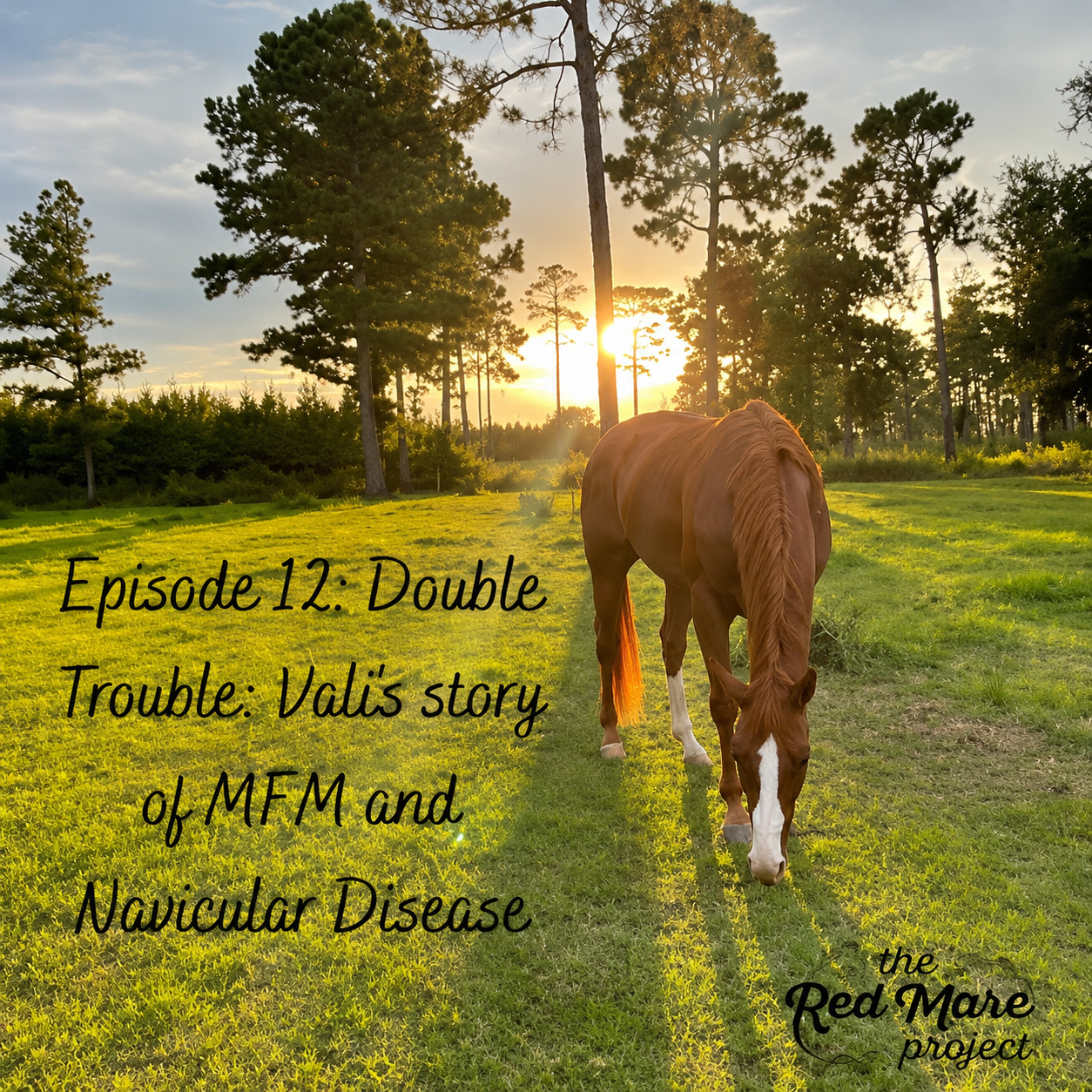
E12: Double Trouble: Vali's story of MFM and Navicular Disease
January 29, 2026
About This Episode
Join your hosts, Taylor and Kahlan, this time for a double trouble episode where Dr. Amy Reynolds shares the story of her own red mare, Vali. Vali’s story is one of both navicular disease AND Myofibrillar Myopathy, two pathologies that hit very close to home for your hosts. Dr. Reynolds gives a raw account of Vali’s 6-year journey to diagnostic success and serves as an inspiring reminder to listen to your horse when you know something isn’t right. Bonus, Dr. Reynolds shares insights from a recently attended conference where the muscle queen herself, Dr. Valberg, gave a series of talks on MFM and Vitamin E. Take notes, this is straight from the source. For more information on navicular disease, check out episodes 3 (Loki’s story and deep dive into navicular) and 10 (King’s story), and for more information on MFM, check out episodes 4 (Leah’s story and deep dive into MFM) and 9 (Stella’s story). Email us with your interesting stories. Your horse may be able to help another. redmareproject@gmail.com Taylor CL Schouten, MS, APF-I Hoofcare Practitioner Wild Hoof Equine LLC www.wildhoofequine.com Kahlan Ettere Holistic Equine Nutritionist Wise Choice Equine Wellness LLC
Check out our website: www.theredmareproject.com
Follow along on Facebook: The Red Mare Project
Instagram: Wild_Hoof_Equine
EPISODE TRANSCRIPT
— Welcome: Introducing Dr. Amy Reynolds & Vali
Welcome back to another episode of The Red Mare Project.
Today, we welcome Dr.
Amy Reynolds and her horse, Vali, to our collection of red mares.
Amy reached out to us via email and is a friend of a recent guest.
Vali's story is one of both nubicular disease and MFM, both of which hit close to home for Taylor and I.
For more information on both of these disease processes, travel back to episode 3, Loki's story for nubicular disease, and episode 4, MFM is a motherfucker, Leah's story.
There are additional stories on both of these diseases in McHugh, so be sure to check those out.
Welcome to The Red Mare Project.
When you told me about her, I didn't realize that this horse had both.
Of our least favorite things on the planet.
I'm just thinking we're jumping into another MFM episode and then you mentioned nubicular.
I think I said something like, if our two children had a child.
This is it.
Yeah.
If me and you had a baby, it's this horse.
I'm really excited to hear.
It bodes well for us that she's red.
She.
Yeah.
It's a mare.
Okay.
That's what I thought.
Okay.
That's what I thought.
That really works out.
I know.
Also, I usually were really conscientious about providing a trigger warning for the state of the horse before we go into the story.
I actually, we really don't know too much about this mare.
No, that's fine.
I think she emailed us and was just supportive of the show, wanted to share her story in some capacity.
Because we are open to that.
If you guys have a story you want to share about a weird experience with your horse, like medically, training wise, behaviorally, anything that has been impactful that you think the community would learn from or be able to help other people not go through that same situation, that's why we have that email.
That's all we use it for.
But I think it was just reaching out to commiserate and say she was a fan and see if she could come on and tell her story.
So I'm excited to hear it.
So navicular disease and MFM, we have two really thorough episodes that go over navicular disease and MFM.
So navicular disease, that's going to be Loki's story, episode three.
And then we also have another episode, which is Sarah Hathaway came on and told us about King.
He is also a navicular case.
So both of those are going to be good references.
And then for MFM, which is your myofibular myopathy, that's going to be episode four.
That's my mare story, Leah.
And then we have another Red Mare, Stella, who is also an MFM story.
So we're two for two.
We're collecting them.
That's really the whole point, though.
Like, that's kind of the vision is that we can have like a database.
Like, you can run a search.
Eventually, we're going to get enough of a collection.
Yeah.
And you just run a search and you're like, I want to hear stories about MFM.
And you get all of them show up.
You want to see stories about ECVM and they all show up.
Like.
Well, that was the thing, like, when I first started going through this with Loki, that was the thing that kept me from pulling my eyelashes out, was the resources of like, oh, this success story, oh, this presented this way and this horse is okay and sound.
And that's really what kept me going, trying to figure out how to help invest and that this isn't, a lot of these disease states are not a pill for everything.
It's not a clear-cut thing.
And a lot of people are having the same experiences of like, that's not listening to them or there's not a clear-cut treatment path for these things.
And hearing multiple stories from different horses, different people has made a huge difference, I know, to me personally.
So we're just going to keep doing it.
Yeah.
Yeah.
Also, everybody, I guess trigger warning is appropriate.
Taylor and I have both been sick of the dogs for weeks.
— Catching Up & Apologizing for Sick Voices
So we sound like we've been smoking for 60 years.
And please excuse us if we're coughing.
I've been sick.
I've been coughing for three weeks now.
So I sincerely apologize.
That's very fair.
Yeah.
I kind of feel like I've been sitting at a slot machine for...
Yeah.
I can feel it coming.
That's why I had to get the trigger warning.
Yeah.
I don't know if that's a gross cough.
Hang tight with us.
All right.
Hey.
How's it going?
Good.
How are you guys?
Good.
Welcome.
Welcome.
Yeah.
It's nice to meet you, see you, all that good stuff.
Likewise.
Hey, you guys doing okay with the storm rolling in?
So far, so good.
I think for us anyways, it's supposed to be like later this afternoon or evening, I guess.
So we'll see.
What about you guys?
I mean, we're the same thing.
I guess some of our friends were saying that it was snowing just an hour north of where we are this morning.
Oh, shoot.
And I was like, it's not here.
Yeah, not here.
Not yet anyways.
Hopefully, it stays that way.
Are you in Georgia?
Yes.
So I'm in Madison, Georgia.
So like pretty close to Athens.
Okay.
Yeah.
Cool.
So we're supposed to get all the ice and stuff like that.
I don't know.
We'll see.
It's you never know in Georgia.
It could be exactly or it could be people stranded on the highway.
Yeah, exactly.
So hopefully not that one.
But as long as the horses are good, everything's fine.
Yes, I know.
I just got them all tucked in their stalls and like, just don't be stupid.
Stay warm.
Yeah, that's the best you can know for.
Yeah, we have three horses on our property, which has been like a dream come true.
But also, you know, very stressful in situations like this because it's like, well, we got what we got and that's it.
So well, but you know what?
It's better than wondering if you're going to be able to get out of the house to go take care of her.
Sure.
That's so true.
That's yeah, it's actually really comforting that they're right here.
And I can just like make sure that they're all, you know, in one piece.
Listen, they may not always be comfortable, but as long as they're safe and everyone's no one has a broken leg and exactly years have frozen off, we're fine.
Yeah, exactly.
We're not asking for a lot here.
We're just like, yeah.
Cool.
So tell us a little bit about yourself.
Oh, actually, before that, Taylor always gives this disclaimer, but I don't know if you've heard in our other episodes, you can swear, you can curse, you can say whatever you want.
If there's something that you want stricken from the record, just let us know and we can chop it all up.
Taylor's a pro.
Perfect.
Sounds good.
Cool.
Let's see.
Where do I start?
I grew up riding maybe started when I was eight, I don't know, started on barrels, which was fun.
Then decided I wanted to do some hunter jumper stuff, did that.
Worked at a rescue for a while and got my first horse there, and then just did just a bunch of random stuff with her.
Then I am a small animal vet, so I think I've been talking to Taylor a little bit about that stuff.
It's been a really cool journey to have that in my pocket.
But through vet school, I still rode, still had my horse, but didn't do anything showing-wise.
Yeah, just continued the small animal world of things.
Then my horse that I had grown up with and had for 13 years died tragically and then was looking for something to fill my horse girl void.
You can't not have a horse as a horse girl if you've had one.
So that's how I met Vali and then the rest is kind of this, her whole journey starts there.
But yeah, that's kind of about me.
Do I just jump right into the whole Vali situation or?
Yeah, absolutely.
However, you want to do it.
Yeah, cool.
Yeah, Facebook.
Okay.
The classic Facebook situation.
— How They Met: A Facebook Connection After Tragedy
It was kind of one of those things where I was just like panicking a little bit because I was like, well, I lost my horse pretty tragically.
She was in like a, I guess, trailering accident, getting on the trailer.
She flipped and hit her head and yeah, it was horrible.
Yeah.
I was not in a good place, but I was like, I need a horse to get me right again.
Yeah.
I had looked at a couple of horses online.
I didn't have a trainer at the time because I had just graduated vet school and I was in a new spot and so didn't have a trainer yet, but I had a lot of friends who were horsey enough to help me out.
I found this horse on Facebook that was pretty close to me.
I loved her description, her personality, all that stuff.
So I went to go see her and she was pretty fresh off the track.
She had been off the track for just a couple of months and been with let down and then with this girl.
I went to go see her and in typical Vali fashion, she had pulled a shoe earlier that day, but I was like, well, it's the only time it can come out, so I'm still going to go take a look.
I just like instant connection with her.
She was so just sweet and calm, had a great personality.
Like I said, pretty freshly off the track, she's a Red Mare.
I was expecting a lot of fire, and she does have that, but she was also super calm.
We were out in the arena, her current owner was riding her, and I was watching, and the sprinkler system went off in the middle, and she was just like, oh, this is fine.
I was like, okay, this is a good sign.
Good test.
Yeah, good test.
It was one of those human-sized sprinklers, and there was a big delivery getting dropped off.
There was a lot of going on, a lot going on.
So I was like, okay, she checks some boxes.
And then because she hadn't not had a shoe on, I was like, well, I need to come back and see her, make sure she's sound.
So I went back and I saw her and she looked really good.
I did, honestly, a very modified PPE, had a friend go through RADS and any quine friends.
And she was like, she flexed like a one positive on one of her hinds.
But I was like, well, you're off the track.
So that's, you know, yeah, yeah.
So I ended up doing a trial with her.
The girl was really, really great.
She allowed me to take her off for a trial.
And I was like, after like a week of the trial, I was like, no, we're good.
We can cancel the trial.
I'll just go ahead and buy her.
And so I mean, I finished the trial, but like knew I was going to buy her.
And then she, I moved her down to South Georgia, which is where I went right after vet school.
And had her there for, I had her at like a temporary place there for a while, and she adjusted right away.
She fit in beautifully.
She was just like a dream, you know, hauling her down there.
She was so good.
She was like, oh, I've been here my whole life, no worries.
I was like, oh, this is so good.
And so I started working with her, and the girl that I had gotten her from was super honest, and I really appreciate that.
And she was like, listen, she's been really good in everything I've done, but I have not cantered her under saddle, which, you know, maybe that was my fault for buying this horse.
But she, I was like, no, that's great.
Yeah.
Yeah.
And I was like, you know, I wanted a green horse.
I wanted a project horse.
So I was like, no worries.
On the lunch line, she was like clearly very happy in a canner.
So I was like, that's, you know, we're fine.
So we start, I started riding her in a little bit of a, like it wasn't an arena.
It was just like in a field until I could get her to a place with a more like confined area.
Because again, I had just moved down to South Georgia, like didn't really have a boarding place or anything, didn't have a trainer.
— Early Days: No Barn, No Trainer, Riding in a Field
So I was riding her in a field.
She was super good.
Trotting was beautiful.
I would get off and I would lunch her and I was like, okay, I think, I think we're ready to, you know, canner under saddle.
And so we started doing that and she was honestly at first, super good, super sound.
Like she seemed like she loved it.
She could never quite get her leads.
Her leads were always really hard.
And, but I was like, you know, you're straight from the track.
That's not a big, I don't feel like that's a big deal.
And she also like, wasn't very smooth in the canter.
You know, what I felt like she looked like, it didn't translate to what she felt like.
She felt like she was just flailing her legs all over the place.
And, you know, it makes sense.
But at the time, she, you know, I was just thinking she's super green.
She's super out of shape.
She was off the track, but she was off the track right after COVID.
So she really was pretty out of shape because, you know, during COVID, they just kind of let them go.
A lot of them that they knew weren't going to go back.
So she was pretty out of shape.
So, you know, that's okay.
So, anyways, didn't really think much of it until she started getting really super spooky and she would bolt every time I asked for the canter.
And I was like, oh, this is not great.
Because again, we're not riding in an enclosed area.
We're just in the wild.
So that was a little terrifying.
Yeah.
Question about her canter, though.
Like you said, it kind of felt like she was flailing.
Did she have like a paddle or was it more of like a trollop?
Like, could she at least hold like the left lead?
She couldn't hold any lead.
She could.
So interestingly, she could get her right lead.
She couldn't get her left lead.
Oh, yeah, which is like total opposite of what it should be.
But she could.
Yeah, it was just like the wildest thing.
And it got worse and worse as I would.
She got more in shape, which again, didn't really track.
But I was like, well, I don't know.
You're still figuring things out.
Yeah, balance is a key piece.
So it would make sense to get rid of on that.
Yeah.
Yeah.
And again, we're like in a field.
We're not in any kind of good footing.
So I was just like, it's easy to write off.
Yeah.
But yeah, it was literally just looked like she, she I mean, it didn't have any organized look to the gate.
Sure.
And then if she did get a lead, she would fall out pretty quickly.
She would just kind of always run into it.
And then she would just pick whatever lead she landed on.
And then she would hold it for a couple of strides and fall out.
So super inconsistent.
Yeah.
And how old is she at this point?
I think six.
Yeah, she's six at this point.
Oh, wow.
And how old is she today?
Today, she's technically 11, but yeah, she'll be 11 in like April.
Oh, wow.
Okay.
So she started showing symptoms at six.
Yeah.
And we've been on this journey for a while now.
And, you know, it's just to back up, the reason that she was let go from the tracker or off the track was because of COVID.
But they had a disclaimer that she maybe had some EPM signs and they did treat her for EPM on the track.
So like now, you know, ding, ding, ding.
But her neuro exam was fine at the time.
They were like, yeah, we treated her.
And, you know, titers for EPM are weird anyways.
I was like, maybe, who knows if she actually had EPM.
But yeah, it makes me wonder if she even had signs way before that.
Yeah.
Yeah.
So she starts bolting at the canner pretty like consistently every time.
And so we kind of just start working with that, going back to the basics of that.
And I just thought, again, we're in a field, she's a young horse.
We moved to a different barn that has a little bit of a better area to ride in, but she can still get back to the barn from where we're riding pretty easily.
— New Barn, New Setup & First Behavioral Red Flags
Like she can just go through the open space to get back to the barn.
So one, the like big trigger in my scaling back at her training was one time we were riding.
And she went to the canner, actually did a pretty good, you know, lap to the one side.
I said, okay, that's good.
We'll go to the other side.
And then we lost all of our marbles.
And yeah, she ran back to the barn, which normal horse thing to do, but she wasn't running to like her friends.
She was more where the food was or anything.
She was running to...
It was like a big garage, and there was like a tractor and a jeep in the garage and a really low ceiling.
So we were running towards this from the like arena area to the barn, and I had absolutely zero control.
She had no control.
Like I could tell again in the canter that we were just flailing everywhere.
And so I was like, I could feel myself kind of start to fall.
I was like, this is where I decide, do I fall?
Do I bail?
Yeah.
Or do I like run into the barn and maybe decapitate myself?
I don't know what's gonna happen here.
So we ended up, I ended up bailing.
She ends up going, like she stops just short of this garage area.
And I was like, oh, that's really bad.
I ended up actually breaking my ankle.
Oh, damn.
Yeah.
Not ideal.
Not ideal.
But it was like, okay, well, this is not normal horse stuff anymore.
This is not normal green horse stuff.
Even if she was a spooky horse, which she really hadn't been.
And it's been several months since I bought her at this point, that this is not normal.
And so, kind of took a step back, because obviously she needed to do something else than what I was doing.
I couldn't ride actually because of my ankle, which was a good thing at the time, because I didn't need to be riding this horse.
And then I took her to a trainer to kind of get her, you know, started again, just maybe start from scratch.
I did a ton of ground work with her, like every work, show, or video in the world that existed, we were doing it, which was honestly good bonding for us.
And it was fun.
And I was sitting out there on my knee scooter, and we were going around, which was super, super fun.
But yeah, and so she, we did that for like, I don't know, two months or so, and then just went back to the beginning and just went back.
I started her under saddle, like basically she hadn't been started anymore because the trainers that we were working with, I was just kind of going back and forth and mostly just working on like confidence building, things like that, not anything under saddle.
So we went back to saddle.
Oh, and actually at this time too, we did like a full workup, full lameness workup, full did x-rays of anything that we can x-ray because again, just not really a normal response.
And everything came back to normal as it does.
So started to slowly kind of get back into things.
And she was doing pretty well, but again, we were starting so slow.
And we started, I would kind of hand walk her a lot.
I would do a ton of groundwork still, but then slowly get on a undersaddle and things were going pretty well.
And we had this more confined area to ride that was closable, so we couldn't bolt out.
But it was a pretty small area.
So she had to make pretty tight circles to do what we needed to do.
So I would kind of warm her up outside and then take her in there to do more confined things, more refined things, I guess.
And then a couple months go by, we're doing pretty well, honestly.
And then she freaks out again.
And this time, instead of bolting, we have, we're no longer bolting, but we are still spooky.
We, I asked her to get on the bit a little bit more at the trot, and she just says nope, and goes all the way up and flips back.
— The Bit Refusal: Vali Says No & Flips Back
Oh shit.
Yeah.
Big shit.
Yeah.
Oh man.
So, it was like one of those moments where you're just like, what, what happened?
What do I do?
Yeah.
What happened?
Like, what now?
Yeah.
So, I panic.
I'm at my house because we had this area built at our house where she was at the time, and thankfully I had my Apple Watch on, so big shout out for riding with your Apple Watch, because I just like was stuck under my horse and like called my husband, and I was like, please come outside.
Hold the phone.
She was down just on top of you?
Yeah.
It's all really blurry, but I do remember that she just stopped flipped, went up flipped.
She lands one way and I land the other, but my legs are still caught under her, and she is laying legs towards me, so I am under her with my legs under her, and her legs are in my face.
Hoof is close to the face.
Yeah.
Oh my gosh.
Yeah.
And you just made a phone call.
Yeah.
And I just was like, I can't reach my phone because my phone is stuck under my horse, which is terrible.
Were you guys okay?
Did you get hurt or was this just a freak act?
Yeah.
You're good.
Somehow, we were both fine, and it was one of those things, because she was facing me, I could see her face and her eyes were as big as saucers, and she was like, oh my god, and I had the same feeling.
We were just like, oh fuck, what do we do because I think it's bad.
Do you know what to do?
Do you know what to do?
Yeah.
She was like, mom?
I was like, I have a girl.
Holy shit.
Thank god you guys were okay.
Yeah.
It was really scary, and it was just one of those things where I think she fell kind of perfectly on her back and inside, and then I fell under her, like on my back and then under her where, and thankfully she was with it enough, either that or she couldn't move.
I'm not really sure which to not get up while I was right under her.
Like strike the ground and shoot up.
Yeah.
Because all I could think was like, if you move your feet, I will probably die.
Yeah.
Yeah.
Angels.
So, yeah, honestly, somebody was looking out for both of us because that was a bad situation.
But yeah, thankfully I was able to like scoot out under her, get to the other side of the fence and like coax her up that way.
Because I was like, I don't know what kind of mental state she's going to be in right now.
I need to not be that close to you.
And she got up and so I went in there, checked her out, she was fine, like totally fine, walked her around.
I'm again, I'm like super traumatized because of my last horse who like died flipping over.
Yeah.
But I was fine.
I did go like everything checked out.
I still to this day, like there's an area of my calf that I can't feel any skin or anything.
Okay, so we've got some nerve stuff potentially.
Some definite stuff.
Yeah, but everything was fine.
But that was like our definite come to Jesus moment that like this, I cannot ride this horse until I figure out what's going on because that was basically really no warning at all.
Like we were just trucking along and then we were absolutely not trucking along.
And so that was pretty scary obviously, and she was really scared from it too.
And after that, she did not want to go anywhere near this like arena that we had built.
She didn't want to go.
Even to just go in and sit, she was like so on edge.
So yeah, it was really sad and really scary.
And everyone was telling me to put her down and just stop doing what we're doing.
And it's like, well, I can't put her down.
She's fine otherwise.
She was very happy in the pasture.
At this point, she's a six-year-old horse and nothing else was wrong.
So it's like, well, I can't do that, but everything else is fine on your workup.
— Ruling Things Out: Different Trainer, Saddle, Setup
So it's like, maybe we just need a different trainer, a different setup, a different saddle.
I don't know.
So coincidentally, at that time, we were moving anyways.
So I'm from North Georgia.
So all my people were in North Georgia, and that's where we were kind of moving back to.
So I was like, well, just give her the time off until we get moved, we get settled, we're going to a training barn up there to board anyways.
So let's just chill.
So we did that.
She was fine.
She was super healthy, happy.
We did a bunch of groundwork stuff, just getting confident, realizing that you're not going to die if you step in the arena.
I mean, she was back to herself decently quickly as far as that goes.
So then we get to where this next trainer, we're doing a board and train situation, because we got to figure something out.
And I actually didn't know this trainer, but we just clicked on the phone.
She seemed like a really good eventing trainer, and we seemed like it was going to be good.
So I take her there, let her settle in.
She again settles in really well.
She's on full posture board there, but her diet's quite a bit different.
But I'm like, sure, just whatever diet that you have in your program is fine.
Because I mean, it was a good diet, but looking back now for Vali, it was a terrible diet, knowing what I know now.
And she did so bad at this part.
I couldn't get on her, the trainer couldn't get on her.
She was so explosive that if I were walking her, I would always have to have her out, stretch for me because I never knew if she was going to bolt and run over me.
And it was just like nothing made sense.
I could do so much work with her and she was just fine and then not fine.
And at that time too, she was starting to show some forelimb lameness pretty significantly and so we were like, gosh.
And so again, the conversation of like, do we being told to you guys, I don't really want to, but I also can't ride this horse.
The trainer, not her fault at all, but she was like, I can't train this horse.
Understandably, she's dangerous.
And so I was like, okay, well, she had been at this barn.
We tried it for like probably three months and it just nothing was getting better.
She was getting more lame.
She was getting more explosive.
So we moved to just a kind of cheaper barn with no trainer, but just a big old pasture.
So at this point, again, don't really know what's going on.
I put her back on her feeding routine that she had been at my house.
She starts getting a little bit less explosive at the new barn.
It's a super calm barn.
There's kids there.
They have a really small lesson program, but it's super, super chill.
She really liked it.
So she starts calming down a little bit.
Her forelimb lameness starts to go away.
I start to think maybe I can try to get on her again.
So I do.
Yeah.
What was she eating at your place?
What were you feeding her?
So she was on neutrino, creforce fuel, and like alfalfa cubes, and beet pulp, and stuff like that.
And then just a bunch of hay, a bunch of coastal hay, honestly.
More starch and sugar.
Yeah.
And at this other place, she had been on a really, really high fat diet.
Yeah.
They're just- And they don't like it.
So her body was like, oh my God, I can't.
Yeah.
But she's a thoroughbred, and had so many other thoroughbreds, and they all looked great, and they were doing great.
And I was like, I don't see the problem.
Yeah.
Surely it's not the fat.
Of course.
Why would you think that?
I mean, yeah.
Yeah.
So yeah.
So it was now that I think about it now, I'm like, oh, it's amazing how fast you went back to yourself on your old diet.
But now it makes sense.
But during this time that you've moved her to this calm barn, you said her forlornliness also started to go away.
— Diet Clues: Starch, Sugar & Behavior Connections
Yeah.
But she was eating quite a bit of starch and sugar.
Yeah.
But you're like, you got a little balancing act going here.
Yeah.
And I think a lot of it, I don't, we've also had, because we moved, we had some different failures, because you move barns and you change failures.
And I had a failure that I liked when I lived in North Georgia previously, but he had since retired.
And so I was like, you know, trying to find the right failure kind of game too.
So I think that was also part of it, because this horse is a Houdini for pulling shoes.
So she would, you know, pull shoes, be lame, be explosive, pull another shoe.
And so, yeah, I think some of it was died.
I think some of it was shooing.
I think there was a lot of stuff going on there, because that part comes back later.
Okay.
Stay tuned.
But yeah, she starts going again pretty well.
Like, okay, we're actually safe.
We're riding.
We're doing things.
This is good.
Things are happening.
Everything's, she's going really well.
We start cantering again, actually going well.
We're not spooking.
We're not vaulting.
Things are going great.
So she stays at this barn and I'm like, oh, maybe she just really likes a calm barn.
I don't really know.
I have nothing else to go off.
And so I start kind of taking some lessons with just a local trainer and kind of just getting back into our routine.
And the more we start working, the more lame her lameness is coming back.
So, yeah, she would be progressively more lame.
And then it would just be one of those waxing waning where it's so annoying because you just never know what you're going to find.
And I would go out on luncheon and be like, oh, she looks great.
And then I'd hop on and she'd be lame and or vice versa.
Or, you know, I guess in the other hand, I'd go out on luncheon and she'd be, you know, super lame.
And it just didn't really make sense.
It was weird.
Did a bunch of rads, did a bunch of lameness stuff, injected some stuff.
And then they basically came up with it's navicular, which in my mind, I was like, it doesn't, I don't know.
Yeah.
And, you know, there were navicular changes because I small animal that I don't do anything with my own horses.
All the equine vets were coming out and, you know, there were navicular changes, but just, you know, yeah.
What changes from what?
Like if there's not a baseline, right?
Yeah.
Yeah.
Well, we did have baseline rads from when I bought her.
But I mean, yeah, yeah.
So I did, I did at least get those.
So were there changes from the baseline to this check in?
There were.
Yeah.
Oh, okay.
Yeah.
So I mean, it was like, okay.
That's something, but was the lameness, was the forelimb lameness bilateral?
No, it was just front left.
Left.
Yep.
And I mean, her feet looked like trash.
And she's kind of, since I had had her, she always had kind of trash feet, even though, you know, I tried all the things.
And we did find barriers that we really liked.
But she just couldn't hold a shoe on her darn foot.
The left one?
Yeah.
Well, either one, really.
Especially the left one.
She would rotate.
Yeah, that was a rotating thing.
So, yeah, super fun.
But yeah, so they said, no, vehicular.
And yeah, I don't know.
It just didn't fit.
But I was like, well, I don't really have anything else to go off of.
And I guess that would make sense if she's been super heel sore the whole time and she's just really ouchy in her feet.
And maybe that's what's going on.
Yeah.
Yeah.
So we put her in wedges because that's what you do.
And this poor horse, we put the wedges on and she just stood there after he got done.
And I was like, I don't like that.
She liked it.
Yeah.
I mean, the poor thing, like she was just like, she couldn't move.
He was like, just, just like walk her a couple of steps.
— Just Walk Her: Early Lameness Observations
She would.
I mean, getting Ms.
Mare to take a step was like, I had to like drag her and yeah.
So I was like, I don't, I don't think this is good.
This is not it.
Not it.
It was on the mark.
Was she high-low?
No.
No.
Okay.
No.
She's really flat-footed.
Okay.
So like no concavity.
Was she, does she have low angles?
Yes.
Yeah.
She did.
Okay.
Is it?
Oh, go ahead.
Go ahead.
Well, I was just going to say, it kind of fit, kind of didn't fit.
Like it kind of, she was really low, like had really low heels, had low angles, kind of just uneven.
Like the smushed pancake feet that we're all envisioning?
Yeah.
Yeah.
Yeah.
You know what they look like.
Yeah.
Those are fun.
And she had been, I mean, she had had shoes on for a while.
She had been doing pretty well in them, but we just couldn't get her feet to look good.
And yeah, so she couldn't walk in the wedges.
Obviously, that's not going to work.
And so then it's like probably not navicular if you're not getting a response from that.
But I honestly don't know much about feet.
So what was the degree wedge?
Do you remember?
Probably a three.
He did start her in a pretty high wedge.
It was like a two degree.
A two degree?
So, you know, maybe that was just...
So in my mind, I was like, well, maybe that was just too much, too fast.
There's so many different schools of thought on wedges.
Like, sometimes they just...
They put too much torque on the suspensory.
And then I read somewhere too that, not to derail this, but I read somewhere too that it actually takes upwards of 16 degrees of elevation...
Oh, wow... .to actually provide the relief that we're seeking.
Wow, 15 is ridiculous.
Yeah, I have to remember where I heard that or where I read it.
I listened to a lot of webinars, but I heard that, and I was like, well, that's curious, because I feel like anytime I've...
Because only a couple of times I've actually put a wedge on a horse that's, quote unquote, navicular, and they hate it.
Yeah, they don't like them.
So I don't know why that's like...
Yeah, Loki, he told me, fuck no.
But they just don't like them.
So I don't know why the text might go to.
But anyway, I digress.
Carry on.
No.
Yeah.
I mean, it is kind of interesting, because the more that I have dove it...
Because when you have your own stuff, you research it.
And so the more that I've dove into the navicular stuff, and I was digging through all my vet school notes, and going through all these things online, trying to figure it out, and what I found is what is navicular?
And when you say navicular, what most people are calling navicular is very much not navicular.
And then...
Yeah.
Which I'm sure you know, Taylor, that the treatment is so...
Yeah, the wedges...
Most horses hate wedges, I have found in my research.
I don't know if that's true or not.
I thought it's just the people who are frustrated with it.
No, it's not a one-size-fits-all situation.
Yeah.
It's one of those things.
You have to find your horse's perfect outfit and perfect routine, and perfect this, perfect that.
And things could change, and as they get better, things need to change.
There's no...
There actually is a handbook that's helpful, but there's no rulebook for the life of a navicular.
Yeah.
Yeah.
For sure.
Yeah.
Yeah.
But it's not a great diagnosis to get at the same...
Even though there's a lot of things that you can try and do, it's not a great thing to hear your horse has a navicular, and also doesn't respond to the shoes that they're supposed to respond to.
Yeah.
So at this point, I was like, well, I don't know, we're probably done because she can't wear these, obviously, she can't move.
She can't be barefoot because she's super sore barefoot, but she also can't keep a shoe on.
She's super heel sore.
— Heel Soreness & Navicular Bone Changes Found
She does have these changes in her navicular bone that are probably definitely really painful.
I don't know what to do.
So I actually ended up, we did inject her in a navicular just for why not.
We did.
Yeah.
Check the box.
The bursa?
We didn't do the bursa actually.
Not the bursa.
No, wait, we did the coffin bone first, or the coffin bone, but I guess joint, yeah.
Yeah, I know what you're saying.
Yeah.
That didn't do much.
Then we did do the bursa.
Yeah.
Okay.
It did help.
I will say it did help.
It didn't help.
We were like, if the response that we want to get, you'll see a huge difference.
Yeah.
It was like, well, yeah, maybe.
I don't know.
You're still lame.
So we're not going to do anything.
You can just hang out in pasture and be happy and sort of outgy.
And yeah, I mean, her shoeing was fine, but again, she still had a pancake foot and nothing was helping.
And yeah, the injections didn't do much.
So I went rogue and I pulled her shoes and I was like, well, we're going to try this barefoot situation.
Stick it to the mail.
Yep, yep.
I think everyone, my farrier was like, that's not a good idea.
He's like, well, I don't know what else to do.
We're going to find out.
Yeah, yeah.
And so we bought like every boot that they make on the market, because I was like, I don't know what's going to work, but we're going to try one of them.
One of them is bound to.
What did she like?
She liked the clouds okay, but oh gosh, I'm totally blanking on the name.
What's the other big, cushy one?
The soft rides?
The easy.
Easy care.
That's the soft rides, right?
The easy care soft rides.
So the soft rides, those are the ones that are, they're likened to a cloud.
They're also a rehab, but those are the ones that have the frog support in there?
Yes.
Those guys?
She did like those.
No, she did.
I think I've had one horse on my books that's ever liked soft rides.
Yeah.
And it's really, they're really annoying because they do have the frog support, so you have to get them like just right on their feet and they slide around a ton, but yeah, those are her favorite.
Also, it's expensive.
Good for you.
Oh yeah, of course.
Why not?
But we did have the Cavalos and we had the clouds, but we just kind of like got them, traded them away and had a backup pair for them.
That's just the story of an avicular.
Yeah.
And I thought I was like, oh yeah, this is going to be a game changer.
We're going to have this thoroughbred with these terrible feet and switch to a different farrier who, I mean, my farrier at the time, I do think is a very good farrier, but maybe not for a barefoot situation.
So switch to someone who predominantly did barefoot grooming.
Did do shoes too, but like to keep everything barefoot if we could.
And still was like, I don't know if this qualifies as a barefoot if we can, but sure, we'll try.
So we kept her in the boots for a little while.
And she did actually do okay, better than I thought she would.
She got to the point where she could be sound in the boots.
But if you took the boots off, she would be sore, which does, I mean, that's fair.
She hadn't had him off for that long.
She'd been in shoes for a while, so that was fair, I thought.
But I thought maybe we were getting somewhere good.
So I ended up getting the vet back out just to see if we saw any changes in her rads, because it had been a couple months since we had them and hadn't injected things.
And the rads looked about the same, but I mean, that's fair.
The damage isn't going to go away, and if it is, it's not going to go away quickly.
But there was no new damage, which was good.
And so I was like, okay, well, you're pretty sound, as long as you're wearing boots.
And then she loves her scoop boots to actually ride in.
Yay.
Yeah, she loves.
— Boot Choices: Finding What Works for Vali's Feet
My heart says a boot of choice.
We love the sandals.
It's a strappy sandal.
Yes.
Yes.
They love them.
A little flip-flop situation.
Well, and it's great because when you change the color of the straps, if you have someone who is throwing them, you can get the neon pink ones or yellow ones, and then you can find your boots.
So smart.
Yeah.
I actually haven't thought of that.
It's a great idea.
Especially if you're going on a long trail ride or somewhere you're not familiar with.
Yeah.
Just get the neon ones, trust me.
Nice.
Yeah.
Because I'm like, oh no, I'm just going to get black.
No, neon ones.
Get the neon ones.
Yeah.
So she loves to scoot boots.
So and actually at this point, we had weaned kind of off the soft rides because she didn't quite need that much support anymore.
So she was in the scoop boots most of the time, which I honestly, I was like, I don't think I should put her out in the pasture in these, but she needs something in the pasture.
So we would kind of rotate if we would put her out in the pasture or not with the boots on.
If it was like softer ground, we would take them off and then she'd take them off when she came inside, that kind of thing.
But she liked them, so we kept them on most of the time.
Perfect.
I don't know, do y'all keep your boots on your horses?
It depends on what the horse says, and it depends on where you are in the journey.
Yeah.
You did great.
That's the answer.
It depends.
We're winging it, definitely winging it.
That's the answer.
Yeah.
So yeah, so this is like probably a year from her navicular diagnosis at this point, and now she's grown out a decent amount of hoof, not pulling shoes all the time.
She's like in her soft, or sorry, in her scoot boots, we're doing some things under saddle again because she's doing well with that still.
And anytime I would do groundwork with her, she was pretty sound.
So I'm like, okay, we're going to try this whole training situation again.
So I find another trainer who I love, and I took her there, you know, she, it was, again, a board and train situation.
And she took one look at her and she was like, you're going to have to put shoes on her.
And I was like, oh, we worked so hard.
And she was like, yeah, but she's still pretty sore.
Which granted, if you looked at the horse and you didn't know the horse before, yeah, she was pretty, she still looks pretty sore.
But in my mind, I was like, no, we did so much.
But she was, I mean, she was right.
She was too sore to do anything in training.
So we ended up doing gluons.
Which did work.
It did work.
Yeah.
So that was a good compromise.
Because I was like, if I have to nail something into this versus Huff Again, we're both going to die.
Yeah, that's not going to happen.
I so want to know who you're working with, but I don't want you to have to say it on the line.
So I'm going to ask you afterwards.
Yeah, no, you're fine.
But I mean, it wasn't even like, it wasn't like you have to put shoes on your horse, because I probably made this sound bad.
It wasn't like that.
It was like, she's too sore to do the work that you need in the boots and like what you're doing.
And like, that's true.
So, yeah, and I think she was just like, oh no, another, I want to say like crazy, very fun person who's like not willing to listen to any.
You could say, you know, we know who we are.
Yeah, I do fall into that camp now.
I'm like anything, you know.
Yeah, but some horses truly do need things on their feet.
And that's what she is.
And she did do so much better once we put those glue-ons on.
Cool.
And I was like, well, yeah, I guess you are correct there.
Cool.
Yeah, so she ended up going into training full on, but still was not really doing so well once she got more into...
— Full Training Program: Still Struggling with Hard Work
Hard stuff... .doing things.
Yeah, she could walk and trot all day.
But she couldn't, when we start adding the canter, when we started trying to get her more on the bed or just doing things over 10 minutes, she would start not wanting to participate.
And once the trainer felt like she was sound enough to start doing more, she would try to push her more as she should have.
And she was just like, I just can't get this horse to feel comfortable.
And I don't know what it is.
So we had another vet come out who was really well known in the area and did a lameness and didn't really find anything, just thought she was still sore in the front.
So we did like an NSAID trial for a while.
Didn't do anything, did the gluons, didn't really do anything.
She was still being just not great.
And so then she had a freak out moment with the trainer and she did this whole situation where she was like dropped to canner and that was a elicited a bolt to stop, to spin, to all these things.
So we were like, ah, something, yeah, not good.
But the trainer, like love her.
She is still one of my very good friends in this journey.
And she was like, we're going to keep, we're going to figure it out.
Like we're not going to give up on her.
We had sculpture for ulcers, but it had been a while.
So that was on the list.
Her teeth had just got done.
We were like, we're going to just figure it out.
She had been getting like chiro and acupuncture this whole time, but we were like, maybe she just needs some more.
I don't know.
So we tried to do all those things.
We ended up not even having to scope her because the trainer was working with her on the ground and she had a little tie up episode.
I say a little tie up, it was a very big tie up.
Yeah.
You're just trying to be cool about it.
Yeah.
Just casual with it.
Yeah.
This poor horse.
So now this is like, I've had this horse for three years now and we've been going through all these things.
She's never had anything like this happen before, but obviously, she has not been a sound, doing well horse for most of the time I've had her.
So the trainer calls me at work and she's like, hey, don't freak out.
Everything's fine.
I have that coming out, but your horse is tied up.
I was like, oh, okay.
What was she doing with her beforehand?
Not like in an accusatory way, but was she lunging?
No, no, no.
What was the trigger?
Yeah.
She was lunging her.
It was a week after this explosive episode had happened, and she was just going back to the beginning again.
So she was on the ground with her and Vali was just really in her head, really upset.
So she was just trying to let her run on the lunge, let her just get it out kind of thing.
And so I guess she had been working with her for not even that long.
I think it was like 20 minutes, but she was so worked up that she was just going around and around running.
She was just like, wow.
Yeah.
And so, yeah, she, I guess, just kind of stood there and started trembling and then couldn't move.
And it was, I had honestly never seen a horse really tie up.
I hadn't seen like very mild tie up episodes, but I had never seen one where they cannot move.
So thankfully, it was the end of the day.
I was leaving work anyways.
I went out there and I get out there and she, the poor thing is just like standing there, like kind of parked out, like can't get comfortable, can't get comfortable.
Yeah.
And she's just trembling and like sweating.
And the trainer is so good.
She's sitting there with her.
She had got her vet team out.
She's just like, I'm so, so sorry.
I don't, you know, I, you know, I was like, it's not your fault.
You didn't make that eye up.
You know, you were just doing your job.
But she felt so bad.
So we had her fully worked up.
— Full Workup & Hours of Diagnostic Testing
And I mean, I think she's been tied up for like over an hour now.
Whoa.
Oh, man.
Yeah.
Like it was bad.
I mean, she could, she got to the point where we could move her into the barn, at least so she could move, but she was still like, could not really move.
And until she got fluids into her, she really couldn't move much.
So we were like, oh no, this is bad.
But it kind of in a way was a huge blessing because it really highlighted what was going on.
And if she hadn't tied up, I still honestly don't know that I would know what was wrong with her.
Even though horses with MFM don't typically tie up or it's something that we don't really see.
That was going to be my question.
Yeah.
I have not heard that, obviously Taylor knows more about this because she has dealt with it herself, but I didn't know that that was a hallmark.
The one thing I'm seeing is MFM horses don't appreciate being lunged.
Yeah.
I think it was just because it was a perfect storm for her, because she had been used to full turnout, and at this barn, she was half in, half out, so she was in a stall way more than she had been the whole time I'd had her, which I didn't think was a problem at the time for a healthy horse, that wouldn't be a problem.
So that was a change.
Her diet was largely the same, but she had had a little bit different, hey, some changes there.
Also, she was just in a new place, so she was not really relaxed like she had been.
So she had been with this trainer for a month, and she was still not really settled in, like she had been previously to all the other barns, she was settled in really fast.
This place, she just couldn't get settled in.
And so I think it was just the perfect storm of like, enough had changed in her world, and then the trainer had pulled her out from her stall, and was going to train her as you do.
And I think she was just standing there, and then she was freaking out, and so she went from standing to running, and I think her muscles were just like, hang on.
Yeah, we can't.
And also, she had had this go on for so long, and had no idea.
And so I think the poor horse probably just has such terrible muscle damage that, yeah.
So this is such a stupid question, but I'm having a brain fart.
They can tie up without having a muscle myopathy.
Yeah, for sure.
Okay.
For sure, yeah.
And so the vet that came out was like, oh, well, I wouldn't worry about it, you know, probably just, I usually give them one tie up episode and, you know, if I never do it again, they're fine.
Yeah.
So just like, uh, exercise and do the strength.
Yeah.
But me and the trainer were like, oh, but we know what we know.
And I don't think- You're not normal.
She's not normal.
Yeah.
So, yeah, I mean, it was just like a weird thing, but it was almost like the universe was like, you've been trying really hard to figure out what was going on.
Here's your sign.
Here's your sign.
Yeah.
So that started the investigative process into like a muscle thing.
We didn't know what it was going to be.
So that's not exactly a quick little blood test.
So what was the next step there, diagnostically?
Yeah.
So I'm like, maybe didn't do what I was supposed to do in that I had spent a ton of money in training.
I had spent a ton of money at the vet.
You know, this was an emergency call, had a huge bill from that, had a huge bills previously.
And so I was not in a place financially where I could do a much biopsy.
And so I just kind of, at that point, it was obviously she didn't need to be in training anymore because we can't, I mean, that was not going anywhere.
Yeah.
Yeah.
So I took her home, did a diet and exercise trial just to see if I could figure out what was going on because me and the trainer were really like, she is super knowledgeable and she knew a lot about muscle disorders, which was super helpful because I did not.
— Diet & Exercise Trial: Searching for the Real Cause
And so she was like, well, it could be MFM, but MFM is more of a warm blood thing and she's a thoroughbred.
So like probably not.
But she had another client, I think whose horse had had MFM.
And so she was like, it does kind of seem very similar.
So maybe, but we were like, or it's a PSSM2 of some sort.
That's what it looks like up to this point, except for the spooking.
Right.
Exactly.
Yeah.
And so the diets are close for those two, which I know you all know, but not the same.
For the PSSM2 versus MFM?
Yeah.
What actually would be the difference then?
Because, yeah, what do you do for PSSM2?
I'm pretty sure it's low starch.
It's the big difference.
Don't quote me on that.
It's been a while since I've looked.
I do think it's low starch.
You know what?
That sounds right.
Because when, Taylor, you were first starting your detective work with Leah, we looked at different...
Like, at first, you were like, maybe it's PSSM, and we kind of started diving.
And that was the big difference that threw me off when I heard about her MFM diet.
I was like, I was always thinking low starch, low starch, low sugar.
And you were like, well, actually, it needs to be higher.
Yeah.
And then P1 needs high fat.
Yes.
And so it's not high fat.
It is still low fat.
Or well, it's actually low fat.
For PSM1?
I think it's PSM2.
Okay.
I was saying for one, I was bringing that to the conversation pointlessly.
Yeah.
Yeah.
Sure.
I mean, why not?
Why not?
Yeah.
Yeah.
Yeah.
So I mean, at this point, if you don't have a muscle map, you're like, well, here's like five things that could be.
So we're going to do some trial and error here and see what happens.
So I chose the PSSM2 diet, which was, yeah, I'm pretty sure it was low starch.
It didn't make her worse?
And it didn't make her worse, but it didn't make her that much better either.
But the big thing that I did is changed her exercise routine.
And so I would do the really long warmups.
And so that I think was the key of like, didn't make it worse, but didn't really make it better kind of thing.
As we changed the, did the warmup thing.
So she wasn't, I did a couple months of that diet, didn't really help.
So then I was like, sure, well, let's try the MFM diet.
I still don't have money for a muscle biopsy.
And you're telling me, okay, let's try it.
She was going great in her glue on shoes.
So we were like, sure, yeah, let's do it.
Yeah, glue on.
So she started to do really well in the MFM diet.
And I was like, okay, maybe we're going, getting somewhere.
So I contacted the nutritionist that works with KER, just to kind of make sure I was on the right path with the MFM diet.
And so I said, okay, I'm going to try this diet for 30 days, see how she does.
And if she improves, I'm going to get a biopsy because I just want to know.
And she was like, well, actually, her Dr.
Valberg, which I have since confirmed, that if she's doing well in the MFM diet to include the MFM pellets, that's very important.
That's your diagnosis.
You don't need to do a biopsy.
No, wow.
Yeah, yeah.
So I was like, oh, sweet.
Did you do it anyway?
No, I actually didn't.
I just try and want to, but honestly, the difference was so big after putting in the MFM pellets.
But I was like, whoa, I don't know that I need to do it.
At that point, I then knew that she needed to exercise pretty much, not the on-off situation, but she needed to be in work for her to be comfortable.
So I was like, well, I don't really want to give her a couple of weeks off, even though the biopsy is pretty minimally invasive, they still need to take some time off to recover.
So I was like, well, if she's doing well, I don't know that I need it.
— Considering a Muscle Biopsy: To Know the Degree of MFM
So I actually, I don't have a biopsy on her and I do kind of want one because I would like to know the degree of damage.
But I know I've told Taylor that I was just at a conference with Dr.
Valberg and I did ask her, if you have clients, one that don't want to do a biopsy or I haven't.
Yeah, she did say she was like, just try a month of the or a box, a container of the MFM pellets and that's your diagnosis.
That's your answer.
Yeah.
Wow.
Yeah.
So kind of game changing because it's so much less invasive.
I think Taylor, I remember from your episode, your Mare's first biopsy was negative, right?
Yeah.
Yeah.
First one came back kind of and then I just didn't take no for an answer because.
Yeah.
And so we did it again and the second one caught it.
Yeah.
Yeah.
And so she was saying too that like it's super common if they're under, I think it's six, if they're a young horse for it to come back negative.
Yeah.
And so she was like, you know, Vali was over that age at that time, but it's still a negative biopsy does not mean that we don't have MFM.
Yeah.
So she said, but if they don't respond to the MFM pellets, then they probably don't have MFM.
Wow.
I wonder if she has like a formal, what would be really supportive of that?
Because I feel like that's so objective of like better versus not better.
Like if there should be some type of measure to kind of really.
Yeah, that's true.
Did spookiness get better?
Like how is their recovery?
Like, can you, do you still have to do like the super long warm up?
Like our warm up is now, we go right to work.
We walk once around, we go right to work.
Yeah.
Interesting.
And this is new.
It's actually so interesting.
This is the three months, last three months.
Okay.
Yeah.
Right into it.
No, that's.
Yeah.
Well, it's so interesting because it's such a, yeah, there's no scale.
Like, I mean, for her, it was she isn't spooky at all anymore.
We weren't scaling at that time.
That was different.
Yeah.
We aren't trying to off ourselves on trying to off me.
I mean, it's pretty obvious difference.
It was a huge difference.
I mean, like the first initial switch of the diet, what just the diet alone was a pretty decent difference.
Like she was not lame.
She was not explosive.
She was still pretty hot, but she was, but that's, I mean, that's okay.
But she was still a little bit spooky, but she was not trying to kill us.
She was kind of spooky, which is, that was fine.
I was fine with that.
And then we put her on the MFM pellets, which to be fair, I did avoid for a little while because they're expensive.
And I was like, let me just see if the diet works first.
Yeah.
Yeah.
Yeah.
And then, and we did like the vitamin E and the nano, you know, the QMC and Q10 and tried that.
And yeah, just nothing.
So she got a little bit better.
So she was not spooky.
She could canter.
She still struggled with her legs, but she could canter, which was huge.
And then we added the MFM pellets.
And like in probably two weeks, I mean, not spooky at all.
She can canter beautifully.
Like, it is insane because this horse is pretty out of shape because she's not been in consistent.
Ever.
Ever.
And with being on the MFM pellets, she feels, I mean, she canters like a dream.
It's beautiful.
She's in a rhythm.
I mean, she still struggles with that left lead, which we're doing a lot of body work for.
And I think it's just because, one, she's weak, and two, she probably does have a good degree of muscle damage from just, you know, life up until now.
Yeah.
But it was such an obvious difference to me that the first time I cantered her after being on the MFM pellets for a couple of weeks and being like, okay, we're going to try this and see if it works.
I literally started crying because I was like, this horse can canter.
— A Breakthrough Moment: She Can Canter Again
Like, she's never, she's not flailing.
She knows what she can canter.
It's beautiful.
She didn't bolt.
She actually enjoyed it.
She, you know, put her head down and got into it.
I was like, this is a miracle.
So how long has she been on the MFM hella and the diet now?
We're on, I think, a month or...
Oh, this is fresh.
That is fresh.
Yeah, this is fresh.
I bet she'll pick up that left lead.
I bet she'll be able to get that soon.
Yeah.
I'm also thinking that was her navicular side.
Yes.
Yes.
So true.
And they need a lot of convincing that it's not going to hurt.
That's such a good point.
Especially like a smart mare like that.
Like she's going to need to be convinced that she can use her body on that side.
For sure.
Yeah.
And that's such a huge part of MFM too.
Well, I mean, I guess anything where they hurt is you have to tell them like, I know it's okay, I promise it's not going to hurt this time, even though I didn't know it was going to hurt before, and I didn't tell him before.
And so it's been such a hard thing because we, I mean, again, this poor mare has been, I've been trying to get her better for a couple of years.
And I was never pushing her that hard, but I'm sure for her, it was hard enough where she really hurt.
And I think the explosions were obviously when she's tipped the iceberg and it hurts too much for her to do anything.
And I think probably there was so much pain before that, that I didn't even realize.
And she was just such a stoic horse, as thoroughbreds tend to be that, well, and horses in general are pretty stoic creatures.
That, yeah, I mean, it's been so hard to, I think, convince her to be able to use her body.
And so I think, yeah, like you were saying, Kahlan, the more that she realizes like, oh, it's actually okay, it's not going to hurt her.
I now have her in Polyflex shoes, which are the Gluons, which has been also like the most game changing thing for her.
All of those guys.
Back up a couple months, she was doing really, oh, they're cool composite shoes.
They're expensive.
Yeah, that's the downside.
I don't know why that's like, because I think I actually remember looking at them a while back and then I was like, there's no way I can get clients to go with these, but they're really, really good.
They work so well.
I mean, I don't honestly, I...
Just use them.
If you raise them, do it.
Yeah.
I mean, well, these things.
Yeah.
Yeah.
I remember the orange shirt first came out and I was like, oh, yeah.
Because she had been on just like straight metal glue-ons.
Oh, okay, okay.
Yeah, and they were okay, but she started getting kind of outgy again.
She was now going well, muscularly, her muscles were working well and she was going okay, but she would just take some off steps.
I was like, yeah, I think we can do better.
We tried a couple of different types of glue-ons and I actually listened to another podcast.
It was like, I think it's just called The Hoof Podcast or something, which was an awesome podcast and they talked about different composite shoes and they mentioned which Polyflex and the guy who developed them, I guess, worked a ton with thoroughbreds and he basically made them for, on the track thoroughbreds, but also does a lot of them for off the track.
And so he, for a while, was the only guy in the country doing them.
And then he basically, you know, taught other ferriers how to do them and, you know, now sold them in.
So now any ferrier can buy them.
But they're, I love them.
So I don't know if anyone has a thoroughbred that you can't quite get right.
Highly recommend.
Yeah, they're good shoes.
They're, they're pretty cool.
Wow.
Okay.
So she's going in those now.
That's awesome.
— Vali Today: Progress & Gratitude
Yeah.
Yeah.
I don't even know why that came up, but.
I mean, I was going to ask anyway what she was wearing.
Yeah.
I really, I really, really wanted to keep her barefoot.
I really did.
I have all my other horses barefoot, but it just, it wasn't in the cards for her.
She can do it.
You just got to give them what they want.
I'm a barefooter.
I'm a trimmer.
My horse is in a full set with wedges.
So.
There you go.
Yeah.
So, you know, you just, you got to do what makes them comfortable.
Yeah.
Yeah.
And it's, I know it's like, it's so expensive, but honestly, the way I see it, like we haven't come this far just to come this far.
Yes.
You know what I mean?
Exactly.
And that's, that's how I am too.
And like it took, it took every ounce of meat, to like try to avoid the MFM pellets.
And like, I tried to do everything else, but, and it's just, they need it.
You gotta just do it.
Just do it.
Yeah.
And honestly, I probably would have saved a lot of money in like fat bills because I, maybe wouldn't have had so many rats.
You can think of it as insurance for yourself.
You're less likely to get hurt and that's worth a lot.
For sure.
That's a really good point.
Yeah, for sure.
And I mean, so yeah, I mean, there was no scale or anything, but I mean, anyone who knew anything about horses could take one look at this horse and be like, oh.
That's definitely it.
That's a drastic difference.
Yeah.
Yeah.
So I mean, we have not been on this situation for long, but she's doing so well that I, this is the best she's ever been doing.
Don't touch anything.
Don't touch anything.
Yeah.
I made the horrible mistake of trying to change her diet.
And just a little bit, I have her on alfalfa cubes and I tried to change them to pellets and I just thought that would make my life a little bit easier.
She said, no, thank you.
That was a bad idea.
So it is not about making your life easy.
That needs to let her know.
That's gone.
Yeah, that's been gone for a while.
Yeah.
Why would I get anything easier?
So what's on her menu?
What does she eat?
She eats Purina Strategy as her base grain.
And then she eats beet pulp, just plain old beet pulp, alfalfa cubes, and then orchard hay.
And she gets Ferrier's Formula and just like the tiniest bit of flax because I just think she needs some seasoning.
Something.
Yes.
Seasoning.
Yeah.
And then she gets the vitamin, the Nano E and the Q10, CoQ10 and the MFM pellets.
And I do have her on Methogarbamol.
I don't know.
I could probably stop, but I'm too scared too.
So we're just going to keep her on that for a while.
I will say.
Oh, go ahead.
Go ahead, Kahlan.
No, you go ahead, go ahead.
I was actually, I'm going to put Lexi on blast with this.
So Lexi came on with Stella and she had her mare on that, on the Robaxin and stayed on it.
And I put mine on Mag ReStore, the Performance Dequine Nutrition Mag ReStore.
Yeah.
Because I called the owner of the company.
That's a whole other conversation.
But she said, just put her on four scoops a day, which is the loading dose.
She said, leave her on the loading dose, which I was like, audible goal, but okay.
Yeah.
And it made a world of difference.
Her body just feels so much better.
And I mentioned it to Lexi too, because anytime I get like a little tidbit of like, oh, this worked, I just, I post it on the PSSM or the MFM forum.
Yeah.
And she saw that and she, I guess, you know, took a page out of the book and she took Stella off of the Rabaxin and put her on the Mag ReStore and it worked.
Really?
Yeah, she gets to leave the show off.
Yeah.
Yeah.
I should probably try because actually, Lexi has been like a godsend through this whole thing.
I, I've texted her all the time and I'm like, please help.
What do you think?
And she's been so good and she's helped me so much with Vali and you know, Lexi is just like this calming presence for all forces.
— Lexi's Calming Presence & Bodywork Support
And so whenever she comes to help me with Vali, it's just, it's been super helpful.
But she did tell me about the Mag ReStore.
So I started her on it like a week ago.
So yeah, maybe I need to, I don't know.
I'm probably too scared to take her off the Robaxxin for a while, but maybe we can tone it down a little bit.
Because it would be nice to get her off that, you know, just for her purposes.
But she said four scoops.
I spoke to the owner of the company.
I'm at that stage in life where if I have questions, I just call the CEO.
I'm like, I'm sorry.
I love that.
You need to be straight.
Give me the answers.
I called her.
Her name is Carla.
She's awesome.
She's like, yeah, give her four scoops a day, five if you need to, or if she's really stressed, give her six.
I was like, I think she's going to push herself.
That's so much that I promise you it's going to work.
So far, she's staying.
Yeah.
Yeah, because I have her on that because that's the loading dose.
So maybe we'll never stop that.
Interesting.
Yeah.
The weather has been so terrible here.
I was in Florida for a conference this weekend, so I haven't even gotten on her since she started it.
So I don't know how she'll do, but I should do it in the cold.
I know Taylor's horse has an entire wardrobe of different outfits because she's not waterproof.
She doesn't like the cold.
She doesn't like the hot.
Yeah.
What's going on with that?
I hate the cold.
Yeah, she hates the cold too.
Yeah.
We were doing so well when we had that warm spell a couple weeks ago and it was not that bad out at night.
Even it was like 50s, we were doing great.
But yeah, now that it's cold again, she, the poor thing.
She, I just had Lexi out for some bodywork like two days ago, and she feels so good.
Like just touching her, she feels like a horse shed.
But I have a feeling in the next, when it's as it's really cold right now, it's just going to like tense up because yeah, she has the whole wardrobe too.
She can't get wet.
She can't get cold.
If she gets cold, it's I could tell instantly, like I did try to do some groundwork with her just for like a quick little something this afternoon.
And she was like, I don't really want to try it.
I think I'm just going to walk.
All right, that's fine.
But it's been, yeah, it's been cold.
So yeah, it's the cold part.
I don't, I haven't figured out.
I have an electric blanket that I ordered for her that I just like throw over, like literally like a person electric blanket.
Oh my God, that's the best.
Yeah, Kahlan had both of her jaws dropped at the same time.
That's nice.
I wish I could like keep it, I don't keep it on her because I'm just, I don't want it to like short circuit and catch on fire.
Of course, yeah.
She does really, I think that's, she does seem to really like that.
Do you ever do like beamer with her?
I know Taylor's horse really likes to cook under there, it helps her relax.
I don't have access to one and I really wish I did.
I might see if I can borrow Lexi's or rent Lexi's.
Lexi has one, yeah.
Shout out Lexi, maybe if you're.
She's on the store.
Yeah.
So I would love to try her on one because I think she would do really well because she, I mean, she responds so well to bodywork.
That horse loves her bodywork.
She loves Kyra, she loves acupuncture.
I think she would love a beamer.
I think she would, she does like laser too.
I have tried to, we have a cold laser at work and she does seem to like that.
But yeah, that's super nice.
Super nice to have access to that.
But yeah, I haven't really tried many other of the modalities just because I don't have access to them and I'm interested in what she would do.
But so yeah, maybe we'll get a beamer and see what she does.
— MagnaWave Coils: Too Much Stimulation for Vali
I will say the PEMF, the MagnaWave with the big coils, that is like way too much, at least for mine.
Interesting.
Yeah, at least for mine.
She just, I remember she just stood there.
She was like, can you make this stop?
Like, it's just way too much.
Yeah, so.
That's good to know, yeah.
Yeah, because she is so sensitive.
I wonder if it would be for her too.
Because like, I mean, if you just go over her, you know, trigger points in her muscles so lightly, it's like, yeah, this is a lot.
So yeah, she probably would feel the same way.
Yeah.
I mean, it's been really interesting to see, and the Facebook groups have been super helpful.
Like I saw, I think it was you, Taylor, that posted about the earplugs.
Oh, you are the best.
The best.
When I first started working with her and she was showing her explosive spookiness, I tried the earplugs and then I kind of, she loved them.
She did great with them.
And I forgot that they existed until I saw your post and I was like, oh my gosh, the earplugs.
And yeah, she's not really spooky anymore, but she still has her moments and the earplugs like night.
She's like, I don't care about anything.
It's great.
And it sounds weird because like they're not, I mean, mine too, she's not an inherently, like she doesn't care about stuff, but it's just like, just remove that one sense.
It just, yeah.
And whenever she's in the trailer, she wears them too.
Oh, that's such a good idea.
Yeah.
I haven't trailer her since I figured out what's going on with her.
And I'm a little scared too, because I would like to, because she is at the point where we can start actually doing things with training, which has been like the first time ever.
So I want to get her like honestly out to Lexi and see if we can do some things.
But yeah, I do fear the trailer situation a little bit.
Not to, not to fuel that, but that is our nemesis right now.
That's, yeah.
She does not.
I mean, in like, she loads fine.
She just does not travel.
And one thing, this is, going back to Kahlan, what you said about like, we get no comfort in any of this.
We just, easy, just fuck it.
It's never happening again.
So I recently learned that my horse prefers a straight load versus a slant.
And for some reason, that is like all the difference in the world.
So, interesting.
So I'm so excited that I get to now save up for a new trailer because fucking everything doesn't work for her.
So, it's unfortunate for you.
I feel like these horses are like whatever you would like, what can be the easiest for you, we're going to pick the opposite.
Listen, my horse will only not try to jump out the window in a trailer if there's absolutely nothing in the trailer.
He's not tied and he can stand backwards.
I, okay.
Yeah, we need to do whatever works, I guess, you know, they have their own agendas and their own way of seeing the world and it's much smarter than I will ever be.
So whatever they want.
Truly, I know it too.
So Amy, you were at a conference with the Dr.
Valberg last weekend.
Can you like, okay, can you give us like the biggest, I don't know, what would you take away from that?
I know, like, you texted me when we were there and I was like, God, I love her.
I was just like, so excited.
So I also was talking to Lexi again, because she was out there for her bodywork the other day.
And I was like, I was so excited when I found out she was speaking at this conference.
So there's this conference, it's called VMX Veterinary Meeting and Expo, and it's for all things vet med.
So they have a lot of equine lectures, but it's mostly small animal stuff.
So I always like to peruse the equine lectures because for my obviously, obviously.
And so a lot of them were things I didn't need to know about, like I would just call my equine vets.
— Discovering Dr. Valberg Would Be at the Conference
But then I saw that Dr.
Valberg was going to be there and I was like, this is the best thing ever.
And she is amazing.
She's so smart.
So smart.
And so the first three lectures on the day that she was going to be there were about like identifying muscular diseases, what they are.
And then she had a specific talk about MFM, which was so cool for me.
Because there are so many podcasts and there's so many sources of information about MFM, but all the horses are similar enough, but different enough too.
And so it was really cool to hear her talk about it because she's the queen of MFM.
And she has done so much research on it.
And she even admittedly said that she still has so much to learn.
So, gosh, I think the biggest thing for me was just, I guess, honestly, what she said about the diagnosis was that the biopsy is really, it is helpful.
And it's really helpful for her to see the degree of muscle damage.
But if you have clients or you personally, or your horse just isn't, biopsy is not in the cards.
It's not out of, it's an attainable diagnosis still.
And just hearing her say that, because again, I had kind of just been winging it and tried that on my own.
And her nutritionist, which I felt kind of comfortable with, but to hear her say that, like, you can just try the MFM pellets and they will work or they won't.
And if they do, then yeah, that was a huge thing for me.
And the cases that she was going through were super interesting to look at, because she talked about, you know, from all the whole workups that they had previously, and then what kind of triggered the MFM diagnosis.
And they were all the same.
They were all, you know, nothing was working, all trouble in the canner, all, you know, otherwise pretty sound, but, you know, nothing quite right.
And so she would actually take these horses into her program and her students would work with them and ride them and kind of see the differences.
And yeah, all these horses just progressively got to where they wouldn't want to get on the bit.
They couldn't canner.
A lot of her horses would, that she had would talk about the spookiness, but would also just like stop and not do anything, which Vali would, she would always for the most part push through.
But yeah, like the horses that she had would just, nope.
The pony stop.
Yeah, the pony stop.
Yeah.
And so it was, it was cool to see.
And then she would put them on the diet and the pellets and like she would have the videos progress and just, I mean, beautiful, huge game changing changes.
And she did break it down into the science-y part of it.
And she had a lot of images of the muscle fibers, which was super cool to me.
She had the muscles are basically made up of these things called Z-discs, which are, should be lined up kind of like a quilt.
They're basically squares, and all the lines in the square should line up nice and even.
And in an MFM horse, instead of having these nice lined up perfect lines and squares, it basically looks like someone took a paintbrush and just water-colored smeared them.
And that image was crazy to me because there was absolutely no organization of the muscles.
It's amazing these horses can do anything because their muscles are not put together correctly at all.
So that was really fascinating.
Yeah, I mean, there were so many things that she talked about.
And then I did talk to her briefly afterwards and I asked her some questions.
And it's just so much that we don't know and that she doesn't know.
And I know, like Taylor, you had mentioned the spooky thing.
And she basically just said that these horses are so muscle sore all the time, and they're so achy all the time.
— Dr. Valberg's Insight: Chronic Muscle Soreness in MFM
And then we ask them to do something that fires their muscles and they get to a point where they're just like, I can't do it, I absolutely can't, yeah.
And like their muscles are just already at the point of giving up almost all the time.
And then they just go into absolute flight mode.
So that was interesting.
Geez.
There's just so much.
She's just such a wealth of information.
Yeah.
And the interesting takeaway too was vitamin E, she also had a lecture about vitamin E.
Vali had had like a massive nosebleed a couple of days ago, which we got our scope, we got a whole thing's work, whole work up, everything was fine.
Turns out too much vitamin E can cause nosebleeds, so just a tough pair.
How much have you given her?
Honestly, just 5,000 IU, so like normal amount, but I think she just didn't need that much.
Lucky you.
Yeah, I guess, honestly, I'm not mad about it.
Yeah.
Okay, so why?
You know, I'll be honest, she just kind of like briefly put it on the slide, and it was a picture of a horse with a gushing nosebleed, and I was like, what?
Oh my gosh, that's my horse.
And I like blanked out, and I heard her say that too much of a vitamin E, what we thought was pretty benign, can actually cause nosebleeds, and then she explained why, but I was freaking out internally, I didn't listen, so.
I don't know why.
Respect, respect, we get it.
But yeah, fun fact, if your horse ever has a nosebleed, and they're on like a freeze- Backloaded vitamin E.
Maybe, maybe, no key.
Maybe work them up still, make sure they're not doing anything bad, but.
Well, I need to know why.
I'm gonna find out.
I know, I, yeah.
Yeah, it has something to do with a breakdown in something that the vitamin E.
Sure, sure, sure.
Yeah, I don't remember, I'm very sorry.
Hey, no, that's fine.
That's something to look into, this, appreciate the insight.
Yeah.
So, I mean, I guess important to check their vitamin E levels, even if you think they should just be on a boatload, yeah.
The one thing that I do really want to know more about, and I think Dr.
Valberg does too, because I even asked you to ask her, like, what is this going to look like?
What's the end game?
Like, you know, because some horses, they start having symptoms, young, young, young.
Mine didn't show up till later, but actually in retrospect, I think she was symptomatic probably at, like, 12.
But it just was a slow burn for her.
But, like, what just, what does it look like?
What's it going to look like?
Are we just going to try and keep these horses?
Because I think about this all the time.
Like, is the spookiness, is that going to be my metric?
Like, is it going to be a point where I can't keep her safe anymore?
I can't keep her, people who handle her?
Like, I don't know.
Like, what do you think?
I think it's so hard, because I don't think she knows.
I don't think anybody knows, because it is such a new diagnosis, and she really doesn't have, I mean, she has a lot of success stories.
She does have a lot of horses that are like going Grand Prix and doing great.
But she did say she's had a lot of horses that have had to retire too.
So it's just, it's so hermetic.
Yeah.
And I think a lot of it depends on the degree of damage they have at the time of diagnosis, and how much they can only regain what has not previously been damaged basically.
So I think a lot of that, if they, what they're doing in their career beforehand.
So she did say one component that kind of is a marker for these horses is that is either trauma or too much concussive work at a young age.
So definitely track horses, re-horses, checks that bill.
So I think, yeah, I think there's so many factors that she just has still finding out.
So that's when she was like, make sure everyone that you know that has MFM pellets, is on MFM pellets, please fills out that survey, because that's what she's trying to figure out next, is what does it look like for these horses.
— The MFM Pellets Survey: Help Dr. Valberg's Research
She sent out that email like two or three days ago, I think.
Yes, yes.
Yeah.
So I have to fill it out.
She really, yeah.
Yes, ma'am.
And I think, yeah, please.
For her.
Yeah, I think it's just going to be one of those things that like the horses that, I mean, there are a lot of horses that were older at the time of diagnosis, but she has a lot of young horses that she's trying to follow now.
And I think it'll just be following those horses to see.
But then again, if they're younger when they're diagnosed, they're probably going to have a better outcome.
So a lot of, I don't know.
A lot of it depends and we'll see.
Yeah, which I hate that answer.
But actually, hold on.
If they are younger and then, because if it's a progressive disease, if they're diagnosed younger, does that mean that if the diet is right, it's going to restrict the potential damage to the muscles?
I think from what I understand about it, yes, but not completely.
So I mean, it will progress, I think, but I think the sooner you get them on that low-fat diet to reduce the oxidative stress and then, or at least modified fat.
But I think the biggest thing is to get them on those MFM pellets to introduce that acetylcysteine because they just can't eat it, and so if they don't have it, their muscles are just deteriorating.
But I don't think you can give them enough of it.
I think you could feed them a whole bucket a day and it just wouldn't be enough to prevent all the damage from happening, I think.
Okay.
Makes sense.
Just the way that it works, I mean, they need so much acetylcysteine to do what their muscles need to do.
I think through the diet, you can only supplement so much that it's just going to- Yeah.
So that's a good point.
So the younger that they're diagnosed, the quicker we can treat them and probably the less damage at the time of diagnosis.
But yeah, they do have this for longer.
But then, you wonder, how long have these horses that we're diagnosing now, how long have they actually had this disease before someone picked up on it?
And how many horses have we completely dismissed on and euthanized or just retired or- Bread.
Or bread, yes.
Oh my gosh.
The number of people that also told me to make Vali a brood mare, and I was like, why would anyone breed this mare?
But I think a lot of people do.
Yeah.
Well, they think that's how they make a horse work for them.
So when they're not rentable, it's all financial and people are doing the best they can with the information they have.
Sure.
Yeah, totally.
Yeah.
That was super valuable.
Thank you for sharing that.
Thank you for sharing what you learned.
It was kind of, we got a sneak peek from a professional's point of view.
Yeah.
It worked out that she was there.
Yeah, it worked out perfectly because we were going to do the podcast, like we were going to record this a week before, and then we had to reschedule, and it worked out all aligned because it worked out perfectly.
I didn't even know Dr.
Valberg was going to be there until the weekend, or the week before.
So yeah, it was just- Oh, you must have been itching.
Oh, I was so excited.
I was like, I have to get down there.
I was with all my coworkers who are all small animal people, and they first of all don't really understand what's going on with my horse.
They have heard of MFM, but that's it.
Second of all, they have no idea the amount of- she's like a superhero to me, Dr.
Valberg is.
That was like, they were like, okay, go have fun at your horse lectures.
We don't understand.
— Closing: Recognizing the Signs, Yes, Yes, Yes
I got to go.
I mean, I was just sitting in those lectures, looking at her videos and going through the signs and being like, yes, yes, yes.
I just wanted to cry because finally, this is still pretty new to me, like her diagnosis and everything, and every time I hear something that's along the same lines, I just want to cry because it's so, we worked with this for so long and this poor horse had this for so long, and no one picked up on it, honestly.
If she hadn't tied up, we'd probably still be like, what's wrong with it?
Yeah, and I told my equine vets here that I'm really suspicious of MFM, and they were like, no, thoroughbreds don't get that.
Why do they keep saying that?
Yeah.
Well, yeah.
And I did ask Dr.
Valberg back too.
I was like, why does everyone say that thoroughbreds don't get it?
Because Stella, Lexi's horse has it, Vali has it, and I know there are others.
There's lots of others.
But it's not genetic in thoroughbreds that we know of.
I'm sure it is.
But it hasn't been proven, so.
But I think that's because all thoroughbreds are inherently related to each other.
So it's like, I think proving anything genetic would be really tough.
It's probably not worth the money.
Yeah.
To put into a tree.
Yeah.
Everyone goes back to, all the way back to Secretariat and then everyone's got a lot of the same ancestors.
And so I think it would take a lot to prove.
But then again, they're all also under this intensive training at a really young age.
So like that is a factor too.
But yeah, yeah.
Dr.
Valberg was like, yeah, we are starting to see it more in thoroughbreds because of these things, but nobody catches it in thoroughbreds.
So they'll write it off as something else so they don't do the testing or, you know.
Yeah.
And it's really sad because there's a, I'm sure a ton of undiagnosed MFM thoroughbreds out there.
Oh, totally.
I'm sure.
Yeah.
Yeah.
Damn.
I'm going to pause.
Yes, ma'am.
I, oh yeah.
We need to wrap up because I have to go deal with my, it's starting to freeze here and I need to go.
Oh yeah.
My horse is 30 minutes away and he's about to be alone on a property.
So I have to go deal with him.
Oh, definitely.
Yes.
Do that.
That's very important.
Unpaused.
So thank you so much for sharing that.
Like we really appreciate it.
I like to wrap up with my favorite part, which is send us a picture of your horse.
We're always collecting pictures of our road mares that we have on.
So we're so excited to see yours.
Thank you so much for reaching out.
I think a lot of people forget that that is a good resource for us.
If you want your story shared, please email us, please reach out.
We want to highlight as many stories as possible so that people have their resources and hey, you never know sometimes you'll get a doctor on.
Thank you so much for having me.
It was really fun and yeah, thank you for caring about all of these horses' stories.
It's a super cool podcast that you guys are doing.
Thank you.
Thank you for the support.
Bye, friends.
All right.
Thanks, guys.
Bye.
Thank you.
Bye.
If you or a friend have a topic, story, or case study you want us to cover in an episode, visit our website at the redmareproject.com to leave your submission or email us at redmareproject.gmail.com.
If you have it, please include a cute picture of the horse we will be discussing so we can make it our Facebook page profile picture.
As a reminder for listeners, this content is for educational purposes only and is not meant to diagnose or treat.
We encourage everyone to do their own research and speak with your veterinarian and care team to make sound decisions for your horse's management.
If you like the podcast, please tell a friend, like, subscribe, and follow on all the platforms.
Peace.
NEVER MISS AN EPISODE
Listen on your favorite platform
Subscribe and listen to The Equestrian Podcast wherever you get your podcasts.
