
PODCAST EPISODE
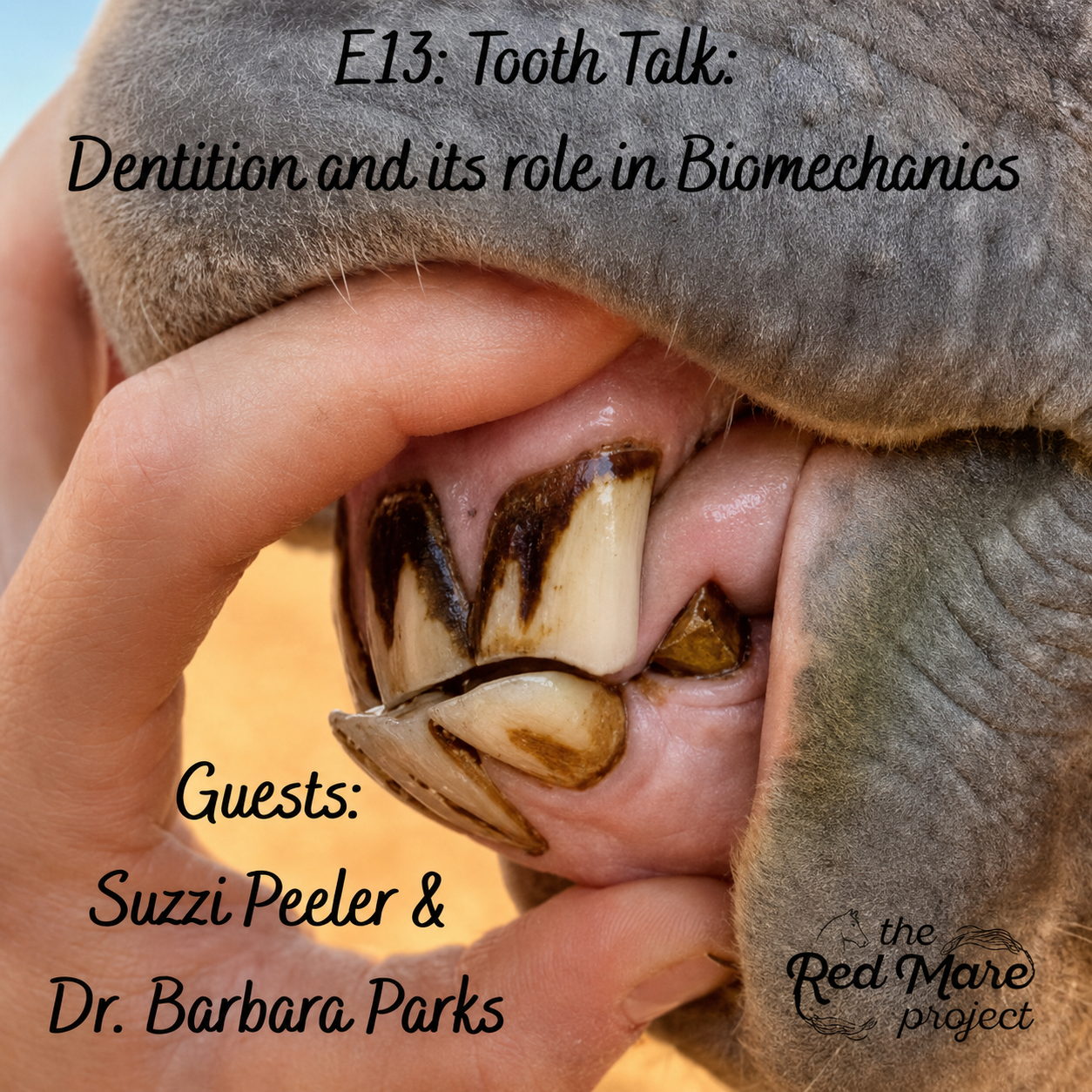
E13: Tooth Talk: Dentition and it's role in Biomechanics
March 3, 2026
About This Episode
NEW PR REACHED! This episode features the MOST red mares we’ve had on so far! Today, the girls have two INCREDIBLE guests on the show. Dr. Barbra Parks and Suzzi Peeler take us through a fun and educational conversation about the impact of equine dentition on biomechanics. Dr. Barbara Parks, PT, DPT, CEPT, CTRI, CEMT, of Imagine Equine Services, has partnered with Neuromuscular Dentist extraordinaire, Suzzi Peeler, to create a comprehensive approach to equine functionality. Their partnership offers educational classes for equestrians of all levels, and of course, in their daily practices with clients. These two amazing gals have a big conversation ahead so buckle in, get ready to learn and as always, grab some snacks. Dr. Barbara Parks: https://www.drbarbaraparks.com/ *Find their online classes here on Dr. Parks’ website! Suzzi Peeler: suzzipeelerequineservices@gmail.com Email us with your interesting stories. Your horse may be able to help another. redmareproject@gmail.com Taylor CL Schouten, MS, APF-I Hoofcare Practitioner Wild Hoof Equine LLC www.wildhoofequine.com Kahlan Ettere Holistic Equine Nutrition Wise Choice Equine Wellness LLC
Check out our website: www.theredmareproject.com
Follow along on Facebook: The Red Mare Project
Instagram: Wild_Hoof_Equine
EPISODE TRANSCRIPT
— Welcome: Introducing Suzzi Peeler & Dr. Barbra Parks
Welcome back to another episode of The Red Mare Project.
Today, we have neuromuscular dentist, Suzzi Peeler, and horse and rider, PT, Barbra Parks.
They'll be covering everything from tooth to tail and the never-ending cycle of biomechanics and the goal of functional movement for our horses.
Welcome to The Red Mare Project.
Hi, friends.
How are we doing?
You guys sound really good.
Just like out of your...
Do we sound good?
Yeah.
It's just my laptop speakers.
I was worried it was going to sound horrible.
No, it's not bad at all.
Is it from NASA?
I feel that.
My laptop?
Yeah, it sounds really good.
It's a shitty iMac.
Well, it works.
I love Taylor.
I'm here.
So why don't we do introductions and take your time with them.
It could be either personal or professional or what you're working on now.
I don't know how you guys know each other.
Like, go nuts.
Okay.
Hi, I'm Suzzi and I am a Neuromuscular Dentist, Horse Dentist.
I have been doing this for about 10 years and before that, I was an elementary school music teacher for 14 years.
I didn't know that.
I left my job, but I had always had a regular dentist for my horses and I wasn't into it.
It was just nice to check the box and move on.
I had a friend that asked if I would like to try a new kind of dentistry.
I still do everything this friend suggests because she's amazing.
So I was like, yeah.
Instead of having the dentist come to me, I trailer there, we had a group.
There were two things that really struck me about the experience.
The first was I have a mini and everything's always a thing with the mini or can be.
I had a really nice vet, a really nice dentist, but everything always was a thing.
Was he going to try to get away?
You always want to honor your animal, but you're always like, just be good, Seth.
You also want to honor the professional that's there to work on them.
So she got there, she rubbed him, she got on her knees, she got the sedation, and it was all of a sudden, I was like, you're doing this?
It could be like this.
Nothing.
Yeah, everything was calm.
Nothing was a thing.
And so that like the first minute I was like, and then my heart horse, Storm, he had two missing upper incisors.
So I had been told multiple times, incisors are the front teeth.
Incisors don't matter, you float the back teeth.
Incisors are, you know, just is a gimmick because you can see them.
So people want to take your money to say that you need to do something with them, but you don't.
Well, I had a horse who had two missing upper incisors, so let me say they are always important, but for him, it was life changing.
Like it, I can't, it was at, he lived longer because I switched to a different kind of dentistry, for sure.
He died with amazing teeth.
And so she explained to me why they were important and also all of a sudden, I could get a left lead, like after the dental that I never, we just never did, which was fine.
I just loved him.
We just went straight, you know, but that was- Leads don't matter when you're going in a straight line.
But like, so there, it was multiple reasons.
Also, this woman was a mom, like she was a mom like me.
And so, I just thought everything was cool.
And I came home that day and my husband was holding our six-month-old.
We had a three-year-old and a six-month-old at the time.
And I was like, oh, and we had just gotten our masters in education.
So we were in debt.
Cool.
So I came home and I was like, I want to be a horse dentist.
And he's like, could we sleep through the night first?
And I was like, yeah.
In the morning, I'm going to want to be a horse dentist.
So good thing teachers don't make a lot of money in Tennessee.
So the idea of an extra income was enticing.
So I started learning about it and I went to dentistry school and it really just kind of happened that I found the thing that I was born to do.
Like everything I learned about it.
I loved everything I learned.
Like I love learning about teeth, but then I like, maybe I wanted to like go into bodywork, but no, not really.
I just want to learn about it and apply it to my dentistry.
So I just kind of got lucky that I happened to find the thing that gets me super excited and I get to make an income doing it, which is like even better, but I just am lucky that I found my passion.
— Finding Their Passion: Careers That Excite Them
Yeah, and.
Awesome.
And it's Barbra.
Okay, your turn.
So I'm Barbra Parks.
I'm an equine physical therapist and I like thinking about how I ended up here, like along the Andering Road.
But I went to college, like not really knowing what I wanted to do with my life, like probably a lot of folks do.
I was an econ major and a French major.
So similar to what I do now.
But I got out of college, I'm working an office job doing like data analysis, sitting in an office and I was like, this is not working for me.
It's not what I see myself doing for the rest of my life.
So I started volunteering at a therapeutic riding barn.
I've always been a horse obsessed person.
So that just felt like a good way to get horses back in my life, which introduced me to hippotherapy, which is like physical therapy for usually little kiddos with developmental disabilities and stuff like that, where they ride the horse and that is a PT or OT or speech or whatever.
So that got me thinking about physical therapy.
And so I just graduated, I had just moved out, and then I moved back in with my parents and went back to school.
I got all my course credits that I needed to then be able to apply to PT school.
And started that thinking I was going to work with kids, and try to do hippotherapy, which I still think is fantastic.
But when I was in school, we had just a random guest lecturer come in, who did canine PT.
And she introduced me to the idea that you could even be a PT for animals, like had that had never crossed my radar before.
And it just like kind of all fell into place really naturally.
I went to Belmont in Nashville, and the program to like be animal rehab certified is at UT in Knoxville, which is two and a half hours down the road.
So it just like all of those pieces, once I found that as an option, just kind of fell into place really naturally and easily, which is just amazing.
And told me I finally found the right path that I was supposed to be on.
And then that was 2018 when I graduated, and I finished that rehab program as I was still a student, because I was so obsessed with it.
And here we are now.
So I guess that kind of segues us into how I met Suzzi.
We just happened to live right down the road from each other, but we met even before that happened, because I was looking for a dentist.
I have a mare who is very sensitive.
I have her because she was too sensitive for everyone else, and she can be kind of dangerous.
And, you know, I was like, what am I going to do?
It's hard to sedate her.
She's not going to want a dental done, but I had been told of this mystical name, Suzzi, who did such a great job and was so good with them.
And so, Suzzi came out and did the dentals all night, two horses at the time, it was two.
And you were able to do Penny's whole dental with just a tube of dorm gel.
And it was beautiful.
And, like, you talking about what your experience was like with the woman, they introduced you to dentistry.
Like, that's what I felt like watching Suzzi work with Penny that first time.
And I was like, oh, perfect.
Okay, so they're my dentists now is what I want.
Yeah Because I also had had weird experiences with other dentistry professionals in the past.
Like, horse's mouth was all bloodied up by the time the procedure was over.
I'm like, that doesn't seem right.
And people are telling you it's normal.
Or, you know, they were just in and out in five minutes.
And like, well, that doesn't really seem right either.
And Suzzi was so careful and conscientious and like, explains everything so nicely.
Plus the horsemanship side of it, that it was such a calm and peaceful experience, without them being so drugged up that their head is on the floor.
Like, it just was really nice.
And so it just like started a beautiful friendship and collaboration between the two of us from there.
Penny was cool for us to like start a relationship with because she, sometimes it's a yes and sometimes it's a no.
And so I, it's always important to me to honor the no.
I just, I love something that like they are gonna like really.
Like I, I love something that I know.
— When Knowledge Isn't Appreciated by Other Horse People
Yeah.
Most people in horses don't appreciate, like like that's not fair either because the way that you do it, they do like it.
Like I watch them get softer and more relaxed and feel it and be like, oh, actually that is great.
Like through the process.
That's a very good point.
But yes, you know, like at first they're like, ugh, what the heck is this gross?
Yeah.
But because you're patient and give them the opportunity to experience it and take a break and try again.
And they're able to enjoy it more because Penny hasn't said no to you since we've been doing it.
Well, no, but you remember when she had the fox tail.
So there was one time that she did.
She did, but it was so cool because like looking, Barbara and I just looked at each other and usually, you know, you have the pressure of like getting it done.
And we both were like, yeah, we need to stop.
Like we need to hear her and like we'll try another time, you know, and we tried another time and it was fine, you know.
But so it was really cool meeting Barbara because just, and this was before you were like doing all of your positive reinforcement stuff, it was just our hearts both heard her and we both just knew like we need to stop.
Like getting this done is not what's important right now.
It's not like the humanity.
Yeah.
And so that was cool.
And then over, you know, for the next few years, I just think we had more and more mutual clients.
And so, you know, it's neat because we can, you know, she'd be like, what did you find in the mouth?
And I'd be like, well, this.
And she's like, well, that makes total sense.
Or, you know, and then she moved.
Yeah.
Like five minutes down the road.
And I had a party.
I was so excited.
That's awesome.
That's so cool.
Yeah.
That was my same experience with Suzzi.
It was like, I walked away.
I don't know if you remember, you have a million people.
I walked away crying because I was like, oh my God, she listened to my horse.
And he was able to have a conversation with her and say no and say yes.
And she gives them time to think about, like to feel the change that she just made and then go, okay, yeah, I'm ready for more.
Or, oh, I need a break.
That's unfortunately so uncommon in the horse world.
It totally is.
And it's very lucky to have a hoof trimmer that trims that way, a dentist that works that way, and that's how I try to approach all my PT stuff.
So yeah, we're lucky in our little pocket in Dixit, Tennessee.
Oh my God.
Yeah, of all places.
I know, so random.
The Avengers.
That's how you call it, The Avengers.
Well then, okay, so since you guys have known each other, we'll probably jump into this a little bit more at the end, but y'all have built some pretty awesome classes together, and you guys are becoming this pretty awesome team.
So do you want to talk about your classes maybe a little bit?
Sure.
Do you want to or you want me to?
Yeah.
Okay.
You sound like us.
Yeah.
So let's see, it all started because we did a presentation for a conference.
Yeah.
That kind of started the idea.
And so what our base level idea was, first of all, we need to tell people that neuromuscular dentistry is a thing, and then how it works, why it works, and then also tie in how all of these things Suzzi's seeing and trying to improve in the mouth, how that plays out in the rest of the body, what the owner can see, and how you would expect to see your horse change after the balance.
So we did that presentation for the conference, going through all those, we picked main categories of imbalances and showed some pictures and all this stuff, and we were like, that would make a really great online class.
So we could get that out to more people.
So we started with the first one, and then we've also added a second one that kind of goes beyond those basic imbalances, and also talks more about proprioception and balance, and how alignment of the jaw might impact more broadly the way you interact with the world, and all those different balance systems that we kind of take for granted moving around.
So it's nice because I, like, Barbra does a really lovely job.
She's just so smart, and she explains the body and biomechanics really well.
— Their Partnership: How Suzzi & Barbra's Work Connects
Like, I learned, we moved that too far, and she'll say something, I'm like, really?
And she's like, Suzzi, I've seen it every time.
I'm like, well, there's a lot of information.
It's amazing.
You're amazing.
I'm like, really?
It does that.
But so it's nice because I get to talk about specifics in the tea.
I can say, this restriction in the jaw equates to this biomechanically in the rest of the body.
But then Barbara can really explain, show, prove it, kind of.
So it's not like mad, it's like real stuff, like good science.
Yeah.
And it's really cool because we can just hang out at my house and do the stuff.
Because we're five minutes down the road, we were able to do a series of dental balances where we took before photos of their posture, and then Suzzi did the balance and then we immediately, or the day after, took after photos and could prove again all that changed was the dental balance.
Nothing else has changed because it's only been 24 hours, and show what changed just because of whatever primary issue that Suzzi found.
So that was super cool.
I find too, or we find that it's hard to teach people about teeth because you don't really see them.
With feet, they're there in front of you.
The hooves are there.
Not that we know, like I don't.
Anyway, slow down, Suzzi.
Just because you can see it doesn't mean you understand it.
Yeah.
At least like you can see the hoofs.
Like people don't know that there are enamel folds throughout the molars, or the cheek teeth, the premolars and molars, and that's the grinding surface that their teeth don't look like ours, and there's a reason for it.
But it can be like such an outside concept.
So this class was nice because it gives some solid information for horse owners and horse professionals to have an understanding equine dentition, and then how the dentition is going to affect range of motion and the mandible and the TMJ, and then therefore the rest of the body.
So it's kind of hard to go straight to the last thing when people don't...
Not everybody even knows that horses have hipster dot teeth, which means they have a large amount of reserve crown like up in their gum.
So people say all the time that horses' teeth grow continuously.
They do not.
They do not.
They have a finite amount.
So the teeth erupt because there's only a certain amount, and once you're out, you're out.
So that's a bit, that's not a normal thing that people know or the amount of text or think about.
Like that doesn't come out.
Yeah.
And so when you think of like, if you just want to say like, well, how your horse chews or like their teeth is going to affect their ability to engage their hind end, then it's like, but then if you explain that if their jaw has forward and backward restriction, then there's going to be tension in the pole.
Then they're going to have this posture, which then makes it hard to engage the hind end.
You have to kind of get it in the beginning, and understanding of how important the teeth are, and how they're different from ours, and then it can make more sense.
Our big dream goal is that enough people understand that this matters.
You don't have to understand exactly why everything works the way it does, or how to fix it, or whatever, but to just be aware of this being a very important factor.
If you're noticing issues in your horse, and it's like not getting better with your training regimen, or the bodywork isn't sticking like you would think it otherwise should, to know to even look to the teeth as a potential root cause, because we just see so many folks spinning their wheels trying to solve problems.
And if the mouth is the root cause, and that's not being addressed, we can never fix the rest of it.
We might band-aid it together for a little while, but it's not really gonna work.
So just getting the word out that this is even a thing that needs to be on your radar, like I'm kind of the starting point, which is crazy, but it's really, really important.
And I think it's gonna change the horse world for the better going forward, more people knowing.
Yeah, also, it's not like I, you know, I'm not trying to be everybody's dentist, you know, like we're not doing this for me to get more clients.
— Education Over Sales: Why They're Not Chasing Clients
So it's like, how do we educate horse owners to find it?
And you know, and you don't wanna, and truly you don't have to be a neuromuscular dentist, you have to give a good dental, you know, like, so horse owners just need the power to have the ability and amount of understanding to know what kind of questions to ask when they're thinking of hiring a dentist.
And you know, if a horse owner can have some education about it, then they can find, you know, the dentist that's going to work for them.
Yeah, yeah.
So that actually brings us into my first question, if you guys are cool.
You just said, you know, not everybody needs to be a neuromuscular dentist to do a good dental, but how do we, like, what are we looking for?
What, I just moved, and you were the last person who touched my horse's mouth.
I'm now almost 900 miles away from you.
What do I do to make sure, like, what do I ask?
How do I, I know that neuromuscular dentistry is different, and I know that you're different, but how do I go through the world?
How would an owner go through the world and pick out someone they can trust without having a traumatic time and just knowing that they're going to do a good job?
Okay, I love this question.
Okay, are we ready?
Let's go.
Okay, I'm just going to start talking.
Please, that's how we do it.
Addressing incisors is key.
So questions like, do you address incisors?
Angle of the, I'm going to call them cheek teeth, or we can call them molars.
Technically, they're pre-molars and molars, and I don't like just saying molars because it's accurate.
So cheek teeth are the back ones.
So it's imperative that you have proper angle to the cheek teeth.
As we know, if you look at the head of a horse, their mandible or their jaw is more narrow than their maxilla.
So when their teeth fit together, the upper teeth sit not all the way.
Because I know people can't see us.
So the cheek teeth, the uppers just sit a bit outside the lowers.
They do still touch, but they kind of come in contact.
Like have-sees.
Yeah.
Yeah.
The technical term.
Thank you.
So understanding that that's how they fit together, if you have, they have to have angle for proper range of motion in chewing.
Flat and smooth used to be something that, like, it's not said as much anymore, but it really makes me cringe because it's like the opposite of what you want with teeth.
So anyway, back to you, like, looking for a dentist, asking about how do you maintain proper angle of the cheek teeth?
No.
You have a guard dog.
So that's a biggie.
So what I explained to people is like, sharp edging occurs cheek side on the uppers, right?
So if you have a molar arcade that is meant to be angled, and then you just adjust part of it, you know, you're flattening that angle.
So what you need to do is then adjust the rest of it to restore.
So just asking them about molar table angles or, you know, something like that.
You want to make sure that your dentist knows how important that is.
Another would be, so for me, the horsemanship part of it is very personal and the listening.
And so I know, you know, your heart is going to kind of guide you, anybody, you know, with the kind of practitioner that's going to resonate with them.
But I know you, I mean, I'm not worried about you advocating for your horse.
I'm sure you're going to do a great job.
But if somebody, the colloquial, Colloquial, you know.
If somebody was a little nervous about advocating for their horse, they could say something like, I would like my horse to get some breaks with the speculum shut.
Is that something you're willing to do?
Something like that.
And if you have the opportunity to observe someone working before you hire them, I'll say the kinds of things that I would kind of look for if I were observing without even having to necessarily ask, because that might help some people be able to gather information in a way they're able to fool with too.
Like what Suzzi is saying about breaks is huge, because a lot of folks put the horse in the speculum and hang their head from the thingy, and it stays there for 30 minutes.
No change.
And for me, as a PT, like that makes me cringe, because it's so much pressure on their pull, it's so much pressure on their job being open.
— Pressure on the Poll & TMJ: A PT's Perspective
And that one, like if you've ever been to the dentist and they crank your mouth open with that thing and they don't give you breaks, it's horrible.
You get really sore from it afterward.
Yeah.
And like, okay, they're sedated, they're tolerating it in the moment, but tomorrow they're going to be reallying insolent.
We don't need to eat 16 hours a day.
Yeah, exactly.
We don't need to be chewing all the time.
Fair point.
So, I would love to see them be given breaks, and I love to see them not hold the horse's head really high up.
Like, Suzzi will get low and work on them.
And so, like, that's the kind of stuff I would really like to see from a horsemanship perspective.
And you'll also just from observing, get a feel for how does this person navigate the situation when the horse doesn't react in a perfectly compliant manner.
Because if they're backing up or they're avoiding, you know, is this person giving them a break and, like, taking a step back?
Or is this person, like, yanking on the rope and pushing them back, you know, doing stuff that maybe doesn't feel so great to us?
So that kind of observational, even if you don't know anything about what they're doing in the mouth, I think will give folks a really good gut feeling.
Do you want your heart to have an experience?
Yeah, and then you can know from that, like, is this even worth asking further questions of this person?
And then you can start asking, like, next, do you work on the incisors?
Do you address the angle of inclination of the molar arcade?
And if someone gives you a blank stare, they don't even know what those words mean, like, that's not your person.
Yeah, I have a good one.
Or to get defensive, find another person.
At what are your goals in the mouth?
Yeah, that I think covers everything there.
I like that.
Because they should bring up angle and proper support.
This gives me one more observational thing that I meant to say earlier, too.
Thank you.
Do they assess range of motion of the jaw before and after their dental?
Because that's...
Yeah, that feels like the bare minimum.
It doesn't happen.
They're not checking that stuff.
Yeah.
No, I've seen it.
And someone should.
So, that should be a goal.
That should be the goal.
That's really smart, though, Barbra, because honestly, I have used vets most of my life, and they kind of...
I knew it wasn't the experience I wanted for my horse, and I had one or two experiences that I recognized were like, oh, this is how it's supposed to look, but that wasn't always accessible to me because of schedule or money or time or whatever distance of where this person operates from.
But I, before Suzzi, the two dentals before, there was a big dentist day at the barn.
Obviously, I'm not going to name names or say anything, but I watched this person work on four or five horses ahead of mine, and I was like, wrap it up, we're done.
Yeah.
I'm putting him back.
Because obviously, like you said...
Good for you for doing that because it's hard.
It's not.
I mean, it can be.
It can be for people.
I respect that.
You take the cap off it.
It's very big.
I respect that.
Thank you.
He is, my horse is exceptionally good at saying, mom, yes or mom, no.
He looks to me for guidance and if I break that...
He's a clear communicator.
He's a clear communicator.
I understand that.
Sometimes it feels like when you're at the bar with your girlfriend and you can have a whole conversation without saying a word, I often feel like that with him and it's so funny.
Because I literally feel like he's my gal pal.
I love that.
It's so easy to watch.
It's not easy, but it's more comfortable, like you said, to watch and just like, how would I feel if that were my horse in their hands right now?
And if it doesn't feel a resounding yes, if it's not a hell yes, then it's a fuck no.
Yeah, and it's important because I just end up with so many brand new horse owners.
And this is why I say it's so hard to say no.
They end up swept up into what everybody else is doing at the bar, or what somebody else has told them is the right way to do.
— Following the Crowd: Barn Culture & Gut Feelings Ignored
And they have this nagging gut feeling that it's not right, they don't like it.
But because the group around them is telling them this is how it's done, and that this is just normal, it's just a thing they have to deal with, they ignore that gut feeling and they chug along.
So just letting everybody know that if you do get a yucky gut feeling, it's okay to listen to that, and you should.
Even if you're brand new and you feel like you don't know enough to be the one making those decisions, your gut is gonna tell you the right thing.
I cannot tell you how many appointments, like when it's a first-time client.
When it's over, they're like, oh my God, all right, I didn't sleep last night.
Okay.
I've been planning this all week.
And then they're like, that was so much easier than I thought it was gonna be.
And I'm like, that shouldn't be it.
I can't live like that.
I'm like, no, this is like, this needs to be good.
Like, it's all chill.
Well, this is the vibe.
If it's not traumatic, then it can be trust building.
Yeah.
And that's what we all- Write that down.
That's what we all want from our horses.
Yeah.
Taylor, you look like you were gonna say something, Taylor.
No, I said, write that down.
That was really good.
What you just said.
Oh, maybe you paused.
Okay, you paused.
No, I was like, damn, that was insightful.
That was good.
Yeah.
I don't know how I do.
I don't know how I do.
But actually, I do want to circle back to what Barbara was talking about with the range of motion in the jaw.
This might be something that we can empower owners to do.
Is there ways that owners are able to assess their horse's jaw and dentition from the outside?
If a client is thinking like, I think we're due, so-and-so assess them and said, they look fine, but your spidey sense is telling you, like, I think we need to do this.
Like, a lot of times, I'll have clients just do little baby shifts of the low jaw just to kind of feel, or even just assessing, oh, the muscles were just with their eyes.
Temporal.
Thank you so much.
Talk to me.
Taylor, it makes me feel good that you forgot a word, because I feel like, right?
Oh, my God.
Last time, and someone, Taylor was talking, and they were saying what amazing word she was using, and then I said something, and they were like, see, this girl does it, like she talks like to the kindergartners, like Taylor, I'm not understanding anything you're saying.
Well, you were a teacher.
Taylor always has the big words, so nerds, all right.
They're all written down for reference.
They're not stored.
All right, so owner evaluating, yes ma'am.
So the temporals are a big one.
Those are the forehead muscles that are under the forelock.
So pick up the forelock and look at them.
What you want is muscling that is, I can't think of the word, that makes sense with the rest of the body.
What's the word?
Okay, you want the muscle bulk size to be proportional.
That's the word.
What are the rest of their muscles?
So a big beefed up stallion might have big temporal muscles, but that might be normal because he's a big beefed up testosterone-filled monster.
Testosterone and pony.
Yes, but your little backyard horse, it's not really fit or doing anything.
If they had big beefed up temporal muscles and the rest of their body is just soft, that would be weird.
Yeah.
So Tennessee walkers typically are going to be much flatter than a quarter horse.
So you want the muscling to make sense, but also you want it symmetrical.
So you want both temporals to be the same size.
Also, when you are looking at them, if you can get down and look up their nose towards the temporals, that's a nice way to get a visual of like a size difference.
So that's a good one.
It can be tricky to- so we had another presentation when we were doing this.
When I was teaching body workers how to check range of motion, I thought it was going to be like easy peasy, but there's a lot of things to it.
But you can't check range of motion of the mandible or the jaw.
If the teeth aren't together, and a lot of horses like to stick their tongue in between their teeth, then you have to get the tongue out of the way, but then you have to get the mandible up to the- you have to get the teeth together, tongue out of the way, teeth together, but then they want to move their head.
— Tongue Position, Jaw Restriction & Dental Mechanics
So there's a lot of parts to getting the teeth together and checking range of motion that I take for granted because I do it all the time.
And then it was kind of humbling to teach these women that work with their hands on horses.
Yeah, all the steps.
Yeah.
So I guess what I am saying there is if getting the teeth together and checking range of motion is tricky for a horse owner, that's okay.
You're not alone.
But if you can make sure that the tongue is not in between the teeth, if you can get the teeth together, it's less invasive if you can just use your fingers and kind of touch the incisors, so you can feel how the teeth are coming together.
So there are, you know, we kind of have alluded to, but if you don't mind, I'm just going to kind of like give like three main categories that restrictions and.
Okay, wait, that's why I want to do that, but I want to finish this train of thoughts forever.
Because Taylor, that's why I need her.
But I want the owners to lose track of them.
Thank you.
Because that's why we work well together.
I love it.
Don't lose that.
Okay, well, I got mine.
Three things.
Should you keep talking or fill in this hand?
So if you can peel your horses' lips apart without them being upset about that, it's pretty easy to look and see how their jaw is resting just when they're hanging out, like snoozing in the paddock.
And if their upper and lower jaws are not coming together evenly, that's important information.
Like sometimes you'll see the lower jaw just hanging off to the left or right and the teeth don't line up evenly.
Like that's probably a dental restriction and you can often see that.
But Suzzi also mentioned if your horse doesn't love you, opening their lips and looking in there, you can just take your hand and kind of slide, like if you take your thumb and your pointer finger in like a U shape and just slide it up on their incisors, you can kind of feel if those teeth are meeting evenly or if one off to one side or the other.
So that's really important and you can also look for hooks on the incisors like that's a place you can very easily see.
And if you're seeing a hook, like something is not going to go through.
Oh, yeah, it's like a 100 percent.
That so hooks on the incisors are, so if you are looking at like the corner incisors, in the way that they come together, the line of like their occlusal surface, which is like the chewing surface, you want that for the most part pointing up towards the TMJ, which is like, yeah, right up above their eye.
Yeah, you want that line pointing towards their eye, I guess is a very easy way.
Yeah.
So then that way, you know, if that line is not straight, a hook is going to be where it starts going there and then takes a dip.
So that's a good thing to look for.
Yeah, I guess, Taylor, I feel good.
So another thing that I noticed...
Oh, wait, Taylor's person.
Oh, am I...
You're back, no, you're back.
I thought out, I thought?
Okay.
So another thing you'll see too, and Suzzi, you may have been getting to this because one of the first things I look at when I get to a new client is their incisors and I'll play around a little bit with their range of motion because oftentimes, dental patterns will...
Well, not oftentimes, all the time.
Dental patterns will always match before patterns every single time.
And what I'll notice sometimes, it's like the front half of the incisor has a little like, almost like a hanging chad, if you will, dare I say.
Oh.
Have you, does that make sense?
A what?
Like it hangs off, like there's like...
Yeah, it's like a little ledge that hangs over.
Yeah.
And I'll notice that.
So there's, and sometimes there'll be like, you know, little ripples in there too and it's just, you know, they have a banjo mouth, if you call.
But I'll notice sometimes that the front of the incisor will extend beyond and almost hook over the bottom jaw.
Is there a name for that when it's not just like a complete hook but it's like the front half of the incisor?
So there's not necessarily a name for it.
I know exactly what you're talking.
— Anterior-Posterior Jaw Range of Motion Explained
Yeah.
But that is, it's an anterior-posterior range of motion of the jaw restriction.
So the mandible is not coming forward when they're putting their head down and it's not being addressed.
Yes.
So horses can have people like an overjet where the top incisors do come in front.
But what you don't want is that like hanging over portion because that says that there's restriction.
So no, there's not like a name for that.
It just shows that they're restricted in the forward and backward range of motion in their jaw.
Oh, and if you see that, they for sure have other stuff going on further down that you can't see.
Oh, it matches.
Well, that makes sense because where patterns match, they're patterns.
That's repeatable.
Yeah.
The incisors are nice to look at because they are an indicator of what you'll find in the back when you can't look in the back.
So the other thing you said, what did you you said like they kind of are, you used a great word to- Ripples.
I say it like when they kind of like puzzle piece together, like the incisors are not going to slide.
Yeah.
Yeah, that's it.
They're not going to slide against each other because they're kind of getting caught.
That's a clear indication of lateral restriction.
So that because they're not wearing here.
So you gave two examples of definite restrictions in the mandible just from observing incisors.
Look how well this segued into where Suzzi was already going.
With our three main categories.
Three main.
Thanks, girls.
Our friend.
So shamelessly was like, whatever you were going to talk about.
Yeah.
It's perfect.
All right.
So three main things.
So let's talk about the first one is, before I start and I'm not getting off topic, that before I start, we need to understand that horses have hips that on teeth that continually erupt.
And it's very important to know that they wear their teeth as they chew.
If you can just picture like two nail files that are are rubbing, you know, striking against each other, that so they need to be gritty, they need to have texture and they are going to wear as they chew.
So if there is not full supported biomechanical range of motion in the jaw, they are not going to fully wear their teeth, therefore their jaw is going to get restricted.
So horses, so this is just like they're domestic, this is part of it.
Nobody's perfect, they cannot be perfect all the time, you know, so that's why I have a job, right?
Yay.
So, so there we go.
So that's why these restrictions occur, is because there are excessive, like enamel folds on their teeth that need to be addressed, that are restricting range of motion of the mandible, which is the main thing.
So three things.
First one is restriction in the forward and backward range of motion in their jaw.
So unlike us, horses need to be able to put their head down, have their mandible come forward and chew.
They need to be able to bring their head up where there's height and have their mandible come back a little bit and chew.
And they need to have their head up, mandible slide back even more and chew.
So us, we have husps on our teeth.
So if we put our head down, our jaw comes forward, our teeth don't fit together anymore.
We can't chew that way.
They should.
As we all put our heads down.
Yeah, if you're driving, be careful.
So their teeth are meant to just be able to cut and grind their food, whatever the position of their mandible.
So forward and backward restriction is going to show up.
And you'll see the hooks on the corner incisors.
You'll see that little ledge on the front of the upper incisors that you were talking about, Taylor.
In the back of the mouth, you might have excessive transverse ridging.
That's like kind of speed bumps along the molar arcades.
So you think about, then the molars are more like ours.
They only fit together a certain way.
Or you might have a wave in the back of the mouth, which is, it takes up the body of the tooth.
But again, teeth are only fitting together a certain way.
Or you might have hooks, which are typically on the front of the uppers and the back of the lower.
So again, mandibles being held back.
Barbra, do you want to give some basics of what you would find in the body and mobility?
— Mobility Basics: What Barbra Looks for in the Body
And that is the restriction?
Yeah.
So if they cannot move the jaw, lower jaw forwards and backwards, they're going to be kind of stuck there and stuck through the pole, which is going to make it very difficult for them to lift their back, engage their hindquarters, step underneath of themselves.
So they're...
Uh-oh.
You'll often see them travel with their head up like draft.
Oh, am I frozen?
Yeah.
No, you're back.
Everyone thought.
But can you go back to...
Everyone thought out.
Can you go back to where they can't lift up their backs?
That was good stuff.
Yeah.
Okay.
So they'll struggle to lift their back and they'll struggle to engage their hindquarters and step underneath of themselves.
So jaw is restricted, A and P forward and backward, body is restricted forward and backward.
So you'll often see them go around with like draft laminateck way up high and their drop in a dropped back and in their hind and kind of like trailing out behind of them.
Yeah.
And so if you're working with a horse that carries himself that way naturally and you're doing exercises in bodywork and whatever to try to help them use themselves better, and it's not working, it might be because they cannot get the jaw position needed to be able to maintain that whole body posture.
So this is- Taylor's having thoughts.
I know.
They all disconnected.
Well, okay, so I went to a dissection two weeks ago, a whole horse dissection, and we did this in both of them.
The first one I did was with Cheramie Davis, and then the second one that we did was with Trinity.
Amazing.
If you can ever do a dissection, go for it.
And we did in both of the dissections, we put a cavicin on, and we did it with it loose.
So we had the cavicin on loosely, and then we went to the hind limb, and you had to physically move the hind limb as full-worn bastard as you can to feel the range of motion.
My favorite thing.
That's so amazing.
And then you crank that cavicin down, and then you ride like a really mean asshole, and then you go and you move that hind limb again, and the restriction goes down to, like, what would you say, like, 40 to 50% decrease in movement?
Yeah.
Wow.
Yeah.
So, and you'll see a difference to just laying a noseband on compared to naked, which is also mind-blowing.
Yep.
Yeah, that's crazy.
So, then that really, I mean, that just kind of all came together with that, because it can be, even if you have nice tack, and even if you were going bitless, or you have very kind hands, if there's still a dental restriction, you're still pissing in the wind.
You're still swimming upstream.
Yeah.
So, that just all kind of clicked right there, too.
Like, it's, cheers.
Love that.
Yeah.
But yeah, because we blocked the tongue and everything, too.
Like, if you put a bit in, and then you, even without a cavis, and you lock down the tongue, that tongue restriction is still going to have that same degree of restriction on the hind end.
Have you found that, too?
I wish everyone could experience that moment, and feel it, and see it with your own eyes, because it's hard to believe how big of a change there is until you experience it.
Yeah.
And it's...
Well, and with a dissected horse, this sounds maybe graphic, there's no behavioral...
You can't blame it on behavior.
You can't blame it on how they're doing it.
It's just harsh.
They're being difficult.
They don't like it.
They're dead.
They physically can or cannot do this thing.
Either their body will or will not allow them to do it.
That's simple.
That's huge.
My soapbox is that any behavior, quote unquote, behavior that you run into, it always has a reason.
And it's usually because they cannot do it or they're struggling to do it or they don't understand.
Like, you think it sounds so easy that the horse should be able to do this.
Everybody's horse can do it.
And then you're like, oh, the bit was putting pressure on their tongue.
They couldn't do it.
Behavior always has a reason behind it.
This is, I'm having a really hard time this episode, because as we're talking, I just keep thinking of more things.
I keep thinking of more questions.
We're going to be here all day.
OK, so I feel like we covered a lot.
— Recapping Restrictions: Two More to Cover
We have restrictions.
I have two more.
Two more, OK.
There's so much.
We'll never be done.
OK.
Next one.
This one's a little easier.
Well, less difficult for me.
Yeah.
Sharp.
So lateral restriction.
Side to side range of motion in the jaw.
Taylor, I really love how you cut.
People don't think enough about those little, like, when you look at the incisors.
I can't remember the word you used.
Hey, everybody, you can just rewind it.
Oh, ridges.
Pro tip.
Yeah, the little ridges on the incisors.
So that is just clear-cut evidence.
If the front teeth look like they just fit together a certain way, they're laterally restricted.
Another thing that you could know is, like, if the line of, like, the occlusal line where their teeth come together, using the word, is not straight and it's, like, angled or, like, slanted, you're going to be prone to a lateral restriction as well.
In the back of the mouth, that's the part that, you know, it's the sharp edges, the sharp points that everybody is worried about.
So, laterally, what happens to the body, Barbara?
Yeah, if they're restricted laterally in the mouth, they're restricted laterally in body.
So, it's pretty straightforward, which is great.
Whoa, I wonder what's up, I'm not sure.
You're going to see them struggle to bend, and likely going to struggle to bend worse on one side than the other, depending on which side of their jaw is more restricted.
So, if you're turning your head to the left, your jaw needs to slide to the right to make that happen for us and for horses.
So, you guys can try that at home and see how that feels.
If you clench your teeth and then try to turn your head, see if it feels like you can turn your head as far.
And the horses is the same.
Yeah.
So, if their mandible cannot slide, they can't turn.
And so, they might brace in the turn, they might like be heavy on the bit in a turn, they might drop their shoulder, things like that.
They won't have good rib cage mobility on the circle.
Like, you might feel things like that.
So, yeah.
That one's the easiest one.
Yeah, that's the easiest one.
Yeah.
And one thing to add to about the incisor slants.
Every single high-low horse that I have or that I've met has an incisor slant.
Every single one.
And I can't fix it.
I love that you bring up the hoof side because it does mirror very, very clearly if you're looking for it.
Every time.
Every single one.
And I'll tell them, like, I can do only so much, but if you don't get the incisors addressed, I mean...
And you can't always fix an incisor slant, and you can't always fix a high-low.
And a lot of that might come from some weird stuff going on in their spine or something.
Like, that might be the root cause of that, just genetic difference in their anatomy.
So, therefore, our job as custodians of these animals is to help them manage those asymmetries to prevent it from becoming a big mess.
Like, you're going to address high-low to help keep them functional and sound.
Suzzi's going to prevent that slant from becoming a hellacious restriction.
So, they can maintain maximum range of motion, maintain maximum function, and deal with the cards that they've been dealt.
Yeah.
I love that you said it, because when you look at a slant, I mean, some horses, it shouldn't be there.
But a lot of times, it could be a twist in the pre-maxilla.
So, you don't necessarily fix everything.
You restore range of motion for a properly supported mastication.
So, lots of slants when I work on them, they're not necessarily gone, but range of motion is restored.
And just because they have a slant doesn't...
We can just do routine dentals.
Once you get the range of motion restored, then you can maintain the mouth in its imperfect.
And of course, that depends on when you meet that patient for the first time too, right?
Like if you're dealing with a two-year-old with high, low and a slanty mouth, like you might be able to make a lot of a horse change versus you meet this horse and they're 25, and now we're really just trying to help them stay comfortable and anywhere in between of that too.
Yeah, I think those are, it's a perfect example of like, I always say like we're not creating a Hollywood mouth, we're creating a functional mouth.
— Functional Mouth vs. Hollywood Mouth Philosophy
Like it doesn't have to look perfect to our eye to be functional and working for the horse.
Yeah.
Cladcore 3 is, Sarah's a music teacher.
Diminished inclination.
So angle, it's kind of what I was talking, it just circles back to what I was talking about before, where if the focus of a dental is only on sharp edging, then you're in a dangerous position to flatten the upper molar arcade that needs to be angled.
It has a less black and white effect, yet it's the most profound and the most important, and it trumps everything else.
And can you go ahead and make the statement that diminished inclination is pretty much always, or is it always, a manmade problem?
We can say often.
It's almost always a manmade problem.
Same word.
Yeah, keep going, keep going.
You can't stop on that.
Well, anatomically, they're not built with flat upper molar arcades.
They are built with angle.
I wish we could have a visual for our listeners, but if you have a sharp edge on one side of a molar, and that's the only piece you address, you just remove that sharp edge, now you've flattened that molar angle, because we've taken that sharp point down.
And so if you don't then address the side of the tooth that didn't have the sharp point to restore the angle, then you will over time just flatten that molar arcade out.
And so I think that happens a lot because folks are focused on reducing sharp edging and not focused on restoring functional range of motion to the mouth.
And so they miss that piece and they're not restoring the angle and over time.
Instead of having nice teeth that fit together the way they're supposed to at the angle, they have two flat rows of teeth that like now the T and J alignment is totally fucked and the rest of the body is a scientific diagnosis.
So have you all noticed any digestion issues with horses that have imbalances like that?
Because step one of digestion is chewing, right?
So yeah, that's a great question.
Great.
They will water in insane ways too.
Like, Suzzi's seen some really weird examples of horses.
Like the way they adapt to try to chew starts to look really dysfunctional sometimes.
Yeah.
As far as digestion, like, I don't know if I've put those if I have an information data set to like say that happens, but theoretically, it for sure makes sense.
Yeah.
Yes.
Great fecal water.
Oh yeah.
That's a thing.
That's a thing.
Let's pay attention to that and see if that's correlating.
Look at the front and then look at the back.
That makes sense.
I do have clients that have good teeth that have that issue as well.
Because we know of a lot of problems.
That could be from so many things.
It's a vague symptom, but yeah.
Yeah.
Yeah.
Also, I think it's important.
We had a horse that we both work with that was presenting with AP restriction, forward and backward range of motion, but it was just his angles were diminished.
So he was holding so after I had seen a different dentist, not long prior, was correct, quote unquote, correct.
Yeah.
I didn't need that.
And then, yeah.
And then, the nation was diminished.
Yeah.
And we couldn't even get, I mean, it was just the first step, you know, because it's all a process.
And his mandible went just immediately after the dental, like, came nice and forward.
So the diminished inclination, they just hold so much tension.
Nothing's right.
So there's so much focus on holding it all together.
The articular disc in the TMJ is in a compensatory position.
Everything is kind of like in survival mode.
They clench their teeth a lot, like the knee of this horse that you were talking about.
When I went to assess his jaw range of motion before Suzzi did his dental, he would just clench and toss his head.
He didn't want me touching him or trying to move things.
Then after the dental, things just slid and were easy.
They will just live their lives with their jaw clenched.
Same.
Because the TMJ, and I don't know if anybody has ever had TMJ pain before, but it is the kind of pain that makes you want to die.
It's so frustrating.
We, as humans, can drink through a straw, or just not eat that day, or eat soft foods.
— Why Horses Can't Compensate Like Humans Can
We're only eating a few meals a day.
It's much more manageable for us versus our horses who are chewing constantly all day long, more than having to wear a bit and a bridle and ride around with their jaw feeling so horrible.
The symptoms throughout their body that you can see from that are just very widespread and could really be anything depending on how the compensation pattern came out for that horse, but just generally angry and tight and guarded and locked down, however that presents.
Yeah.
Those are the three.
Yeah.
Yay.
Thank you.
I want to change my questions.
Taylor and I gave ourselves six questions total we were going to ask.
I want to change my questions.
Has edited in real time.
Yeah.
Or I would like to ask questions.
I want two questions, but both may be controversial, so potential for cut.
Great.
Is it ever appropriate to balance a horse's mouth or possible to balance a horse's mouth with electrical equipment?
Yes.
I love that question because I don't use power.
I get the phrase, power tools are the worst, right?
Don't you hate power tools?
Yeah.
That goes back to when you're looking for a dentist.
What are your goals in the mouth?
There's a dentist that comes through here that uses power and he does power and hand.
I love the angles.
I love following his work.
The angles he leaves with the horses is really lovely.
The texture of the teeth might not be my absolute favorite, but it's close.
Do they get smoothed too much?
It takes away some texture.
Yeah, in general, that's a big fear with power.
Easier to accidentally overflow with power tools.
But if you're doing it well and mindfully, you can also do it well.
Yeah.
I followed this dentist and he does great work.
So I have a lot of fun feeling his work.
Also, I think it is important because as a hand floater, I get lumped in with all hand floaters.
And they are not create like, so again, what's the goal of the practitioner?
Because hand floaters, I followed a million that diminish angle and don't address insiders.
So long answer is yes.
It's more about understanding the balance as opposed to just saying you're doing it by hand.
Yeah, I think it'll almost be the same thing as like, I mean, I trim with an angle grinder.
So I think it's more so like the hands that are using the tools, like a- That's true.
And my horse loves the grinder.
Yeah, we're so grateful.
And it saves your body.
Yeah.
Which is important sometimes.
Yeah.
Just sometimes.
These are hard jobs, hard jobs.
Can I ask me another question?
Because they're kind of both, not necessarily controversial, but could potentially lead somewhere.
Do you, in a positive way or a negative way, see more imbalances or correct angles with horses that live certain lives?
Oh, good question.
You, so, yes.
So, part of what I was going to say later with one of the questions, it's part of this, but no, that's perfect.
So, living like a horse is the easiest way to maintain a healthy everything, right?
But like a mouth, for sure.
I went to a client yesterday and she's been a client for a long time, and her horse's mouths were, like we had work to do, but we did six-month balances and we got imbalanced.
And now I went out yesterday and I had not been there in two and a half years and her horses are doing great.
Like, it was the appropriate time.
They, so they live like horses, their diet's good, they are emotionally well, you know, so like they, so like, yes, lifestyle.
What was the question?
Lifestyle is important, right?
Is that right?
Yeah, essentially.
The role of lifestyle on dentition.
Yeah.
Depending on what the lifestyle is like.
No, but this, go.
This is great because it's like, as they're caretakers, we are providing what nature cannot because they're domesticated.
So, the hoof wear is not ideal because they're not getting enough movement.
The farrier needs to come and provide that additional wear for the hooves.
The teeth are not grinding because the horse doesn't have hay all day.
They're more prone to creating food problems.
Yeah, only eating soft grass and they never have anything abrasive.
Then the dentist is going to probably need to provide additional balancing wear because the horse is not doing it themselves.
— Stall Life & the Need for Additional Dental Balancing
The horse stands in a stall all day.
They're not moving.
Their body is tense.
Their other issues are causing...
Because the body can cause issues in the mouth, the mouth can cause issues in the body.
It goes both ways.
The more they can be out moving, living, life, being braided in a way that is supportive of their body and not breaking them down, all of those things, the less work, hopefully, you have to do at the dentist or the ferry or the body worker or whoever.
I think that's easy to say, yes, it matters a great deal.
Yeah, the best, because it's like, why are there dentists in general?
Movement, they don't get near the movement that they would if they were feral and living and foraging for food and walking miles upon miles a day.
And then the other thing is they're not chewing the rough forage that they would, that would be doing my job.
So basically getting as close to that is helpful.
And not to say that nature is always perfect, but we can.
Yeah, I mean, walking is good for everybody.
Just moving your feet.
Good for all of us, though.
Yeah, I mean, it is helpful, but I think like Barbara said, knowing that even for their own good, if they need to have restriction movement or whatever, just supporting that and understanding that you're just gonna need to give them a little extra support is our job.
Mm-hmm, got it.
I just had an interesting thought.
So, about movement and having the freedom of their jaws to move, long-term muzzle wearing?
Yeah, that's a good question, isn't it?
Right.
Because, and sometimes this goes back to the, maybe your horse has to be stalled.
Sometimes we have to make decisions for our horses in their best interests that might save them from one problem and create a bit of another problem.
I don't know if I've seen major issues from horses wearing muzzles.
I don't, like, have you seen that with their teeth?
Unless they are biting at them, wearing down.
Yeah, it's rare.
Their poles get sore sometimes from wearing them.
Oh, that makes sense.
But I would rather have a sore pole than die of laminitis.
Like, yeah, same thing.
So it's a trade-off, and I'd rather you wear the muzzle.
But we just know that we have to provide a little support to keep them comfortable with that.
I tell people the same.
I'm like, it is necessary to keep them healthy, and then we will deal with the rest.
But in general, it's even rare for them to have excessive wear on their incisors from it, lots of times.
And haynets, too, is a thing people get worried about.
And my herd eats from haynets almost exclusively.
And Suzzi's never told me she was worried about their incisors being excessively worn or anything.
Probably.
I always heard that, like, a horse will wear their teeth down to nothing.
You're going to have, you know, with a haynet.
But that was also, I've never heard that from someone who wasn't a very, like, an old philosophy type person.
Yeah, someone who probably hasn't really used haynets.
Yes.
In their management.
Someone who hasn't used haynets, had a lower quality of hay, maybe didn't have their horse's teeth checked, they didn't have body workers out, they just, you know, put whatever bit that their grandpa used.
Those are the kind of people I've heard that from, that type of horsemanship.
So maybe there's some merit to that, I don't know.
I think, I have seen, like, there used to be a metal grate.
That you would hold it over.
Right.
You know, and I think, so I think maybe hay nets, I don't know what they were like when that grandpa said that the teeth were going to be down for nothing, but hay nets at this point are, like, there's a standard now.
So, and again, you know.
Lips a lot from a hay net.
Yeah, watch, they're good.
Teeth sometimes, but a lot of lips, so.
So, this might be a cool way to segue into, this is a double whammy question, but looking at body compensations and also just jaw restrictions in horses with EOTRH and cribbers, that came to mind when we were talking about hay nets.
Oh, many more questions.
Yeah.
That's the two part, because I'm curious what their teeth would look like from the cribbers.
And then, yeah, read my mind, take over the question.
Can we, I have to separate them.
— EOTRH: A Rare but Serious Dental Condition
I have never had, I've had, I've seen one horse with EOTRH, and I only saw him one time.
He had a ton of other problems.
So, I don't know if I can speak to a pattern of body issues with those guys, but do you want to talk a little bit about what that is and how owners could recognize it sooner rather than later?
So, it's yucky.
It also sucks.
Really, really broad, though, like, it's really, so first of all, I'm not a veterinarian, and so that can only be diagnosed by images of the teeth.
So, I'm hesitating because it's still newer as far as research goes and treatment goes.
Again, because I really like to stay in my lane, as you can say.
So, I don't overstep, but so as far as...
The other thing is as it progresses, it's painful.
And that is an issue.
When I notice indicate...
So, I don't really want to like give indicators of UTRH, especially if I don't have visuals, like there are subtle nice...
There's even a Facebook group, I think, that has some really solid information and people can put pictures of their horses incisors.
Because, like I even had someone send me pictures of their horses incisors and it had EOTRH and Foxtail.
And so the conversation was confusing between me and her and the vet of like, what was being discussed, you know.
So I guess, let's go, let's start with EOTRH and the fact that it is painful.
So pain with chewing is going to create tension, which is going to create body compensation, right?
So if they are actively in pain while they're chewing, or if they cannot like bite with their incisors, like if they couldn't like bite a carrot off with their incisors, but it's too painful, that's something that might clue you in to be talking to your vet about assessing for EOTRH.
I'll explain what it is because I just googled it to make sure I say the words right.
It's equine odontoclastic tooth resorption and hypercementosis.
So what that means for everybody who has no idea what those words mean, because they're huge and confusing, is it's basically the roots of the teeth are being resorbed back into the body and they start to break off.
So the teeth are not stable in the head anymore, which is painful.
So then the hypercementosis part is like they are, so the root is resorbing going away and then it is actively producing too much cementum to try to lock that tooth back in.
And then, and so teeth are made of three parts, enamel, cementum and dentin.
So cementum is like we're trying to get that to, so you will, an indicator that you might want to look at could be that some like bulging, if you are, you know, to me, it almost looks like there's like fingers under the gum.
There's lots of good pictures if you Google.
Yeah, I can't.
Are they looking incisors?
I think you could, like there's the beginning parts of it.
Also, so horses kind of naturally have like a washing machine effect when they chew, that keeps their teeth clean.
They, if they are not, if they're compensating because they are in pain, then that washing machine effect doesn't happen.
So you might see like flak or like tartar or some kind on the front.
So it's often, it's normal to see on like canines, but you might see it up by the gum line on the fronts of their incisors.
But again, like people can tend to really freak out over EOTRH.
And so I don't want anyone to like go and see like a speck on their horses too.
You can be like, oh god, I don't have it.
Common thing.
Like I said, I've seen one horse with it.
And then I haven't seen, well, I haven't seen a lot of males.
I used to like, but I haven't seen a lot of it.
I've seen one.
We're all googling images right now.
Yeah, it's pretty horrific.
Oftentimes, you, the vet obviously becomes point of contact with if you suspect this, like they're going to diagnose it and they're going to be the ones to help you manage it beyond just routine balancing.
But like they will pull the teeth a lot of times, the painful teeth.
At a certain point, they'll pull them and horses can manage pretty well that way.
So anybody listening, it's not a death sentence.
It's gross and it's yucky, but it's not.
There's a possible charge.
Oh, man, I need your internet.
— Treatment Options & Internet Connection Hiccups
Oh, sorry.
Anyway, there's a treatment by a vet, Dr.
Hyde, that is used as well, that is showing some good results.
Oh, no, I'm upset.
I don't have to build it.
Yeah, I'm trying to find it.
And just give me one moment.
Well, and I remember, Suzzi, if I can distract you, I remember I asked you about that a while ago, when I was actually one of the times I rode along with you.
And I'm trying to remember what my question was about, like, oftentimes you might see, and this may be overstepping, so tell me if I should cut this out.
But I remember you would say, like, if you saw it in a horse, like, little baby indicators of it, but the horse was already, like, late 20s, by the time it would become an issue, the horse would already kind of, I guess you would gently say, like, age out of it being a problem.
Yeah.
Yes.
There, it's definitely, like, every...
That's why, especially, like, if we don't have an opportunity to, like, show pictures in the podcast and think, like, it's very...
I'm hesitant to talk too much about it because there is a huge amount of variety in, like, initial indicators to, like, whoa, those need to go.
And it probably progresses quite differently, depending on the horse, in terms of, like, speed of decline in tooth quality.
It...
Absolutely.
So, like, every horse is different.
I've had horses that show, like, the beginning signs of it.
And, like, seven years later, it's not very different.
Yeah.
It's a little different.
And then I've had other, any others, like, with... in conjunction with the vet, you know?
Of course, of course.
And then I've had others that, like, within that time, they had their incisors needed to go.
So, it's just a very...
It's a spectrum.
Yes.
And then, just another example of supporting a horse with something that we can't fix.
We just, now, our job as caregivers is to help them cope with something that they have to cope with, which might be not having incisors anymore.
So, change your feeding practices a little bit, and, you know, support them however it ends up showing in their body, because it could depend widely, I think.
Yeah.
Are you still trying to pull this?
I think I found it.
I'm just touching a lot of things on my iPad.
I'll speak to cribbers.
Yes.
Yeah.
So, this is happening.
So, cribbing is awful, and I feel for anyone dealing with cribbers, I have one that lives here with me.
It is challenging, and it's upsetting for the owners and the caregivers and the people maintaining the property.
I get it.
But, yes, they can have excessive wear on their incisors from the cribbing, depending on how much they're cribbing and what they're cribbing on.
So, therefore, generally, my recommendation for folks with cribbers and what I try to do here, because as much as I try, you cannot always stop them from cribbing, even if you provide them with the best possible living scenario.
Like, sometimes it's just too deep in there.
If you can provide them something safe to crib on that is not metal, ideally, like, something that's not going to wear their teeth too, too much, that is safe, that you don't mind them tearing up.
Like, if you can provide that for them and give them that outlet, that's really the best thing we could do.
Yes, it's going to cause tension in their pole and in their neck and in their chest and in the rest of their body as a result.
And then our job is to help them manage that, so that doesn't spiral out of control and become a massive issue.
But yeah, cribbing, once it starts, it was our fault it started, right?
Like, somebody along the way did that horse a disservice and...
This is how they cope.
This is how they cope.
And so now, whoever we are now in stewardship of that animal, our job is to help them not need to crib hopefully as much, provide them outlets for it when they do, and support them through it.
Can I have an example of a safe cribbing material?
Yeah, like, wooden stuff is generally kind of nice, but it will eventually, they'll eat through it eventually, and then you replace it.
And ideally, maybe not your fence and maybe not your barn.
And you can find something that you're okay with them using.
My guy here cribs on the metal round pin panels.
— Cribbing, Stall Mats & Managing Stable Vices
And I am so upset that that's what he's chosen as his spot.
But you could cover the area with a stall mat or something.
Rubbery might help make that less awful.
He thankfully is not cribbing so often anymore that I'm not as worried about excessive wear from the amount of cribbing that he's doing on the metal round pin panels.
But that would be an example of non-ideal, but it's what's in my yard.
So that's how he does it.
You do the best you can, unfortunately, with these guys.
It's hard.
It's really hard.
For dentition with cribbing, I put cribbers in two categories.
Are they chewing?
Are they a wood chew?
Are they chewing or are they wind sucking?
Wind sucking is where they put their incisors on something and they put, that's going to affect the body a lot more than it affects the teeth.
So often, it doesn't really do much damage to their teeth.
Yeah, it does to the body and then the teeth, which then will affect the teeth in a different way, not just wearing the incisors.
Then the other one is like, are they chewing on things?
So that's when they're going to have, like, you know, worn away incisors from it.
And with that, it's just, as a dentist, you remove what's causing restriction and you restore a range of motion.
And if they have less incisors, that's, you know, their choice.
What happens?
You're both frozen.
Oh, your back hurts.
Oh, you froze too.
But you know what?
Every time that you've been, that someone's been frozen, at least on my end, I can still hear you.
Yeah.
Oh, perfect.
Yeah.
Yeah.
So they should still be in the recording.
Yeah, yeah.
You're just like, we just look really cute for a minute.
Yeah.
Earlier, Suzzi, you got stuck like this.
It was really cute.
That's awesome.
Okay.
I think we're about wrapped up with our questions.
Maybe we have one more, Taylor.
Hold on.
Hold on.
Listen, guys.
The Celsius hit like 30 minutes ago, so.
She's going.
She's ready.
Yeah.
Okay.
So this actually kind of speaks a little bit to, well, maybe not to the Cripper part, but hypodontia and horses that, I call them banjo mouths because they are just missing.
Teeth congenitally.
What do you do with that?
Or like if you have, for example, one incisor missing and there's like opposing forces in the mouth.
Or a tooth broken, it had to be pulled out at some point and there's like a missing spot.
Yeah.
Great question.
Suzzi has the answer.
Yeah.
Not a big deal.
The whole bowl is proper, full biomechanical range of motion of the mandible for mastication.
We also know that they wear their teeth as they chew, which means if you have a tooth missing, the opportunity for the opposing tooth to hyper erupt is there.
Now, with a mouth that's set up properly, they are going to have a large range of motion in their mandible because they put their head down, their mandible slides forward.
Basically, if you can keep the range of motion optimal in the mouth, then you have a lot less work to do on that specific tooth.
So we have two options here.
One is I see a mouth that has a hyper erupted tooth, and then we need to address that, or there's a mouth that's been working, and then a tooth that has to be pulled.
So then we know that we have to stay on top of that situation.
I have horses that have been fine with like annual maintenance dentals once we get that hyper erupted tooth in the same line as the rest of the tooth, and then just by maintaining range of motion of the mandible, the horse does their own homework when they're chewing.
So with horses that don't have teeth that are all coming together perfectly, it's just you want to stay on top of it more.
So that horse would have shorter intervals of dentistry to make sure that they're not getting restricted, and just that the mouth is working, maintains the ability to work.
Okay.
So it's actually more simple than it sounds, I think, because it's not the Hollywood smile, it's function.
So can, what is restricting the range of motion, make sure that it, of the mandible, and make sure that we don't have, that we take care of that.
Yeah.
Yeah.
I think if you're providing appropriate maintenance care, it's very manageable.
Yes.
What you see pictures on the internet of, like these terrible cases where, that no one's looked in this horse's mouth for a decade, and the one tooth now, like the lower tooth fits firmly in the slot between these two upper teeth, and it's like a two-henged log.
— Neglected Mouths: Extreme Cases Seen Online
That's really bad, and that's going to cause restriction in the range of motion.
But if we're maintaining and we are doing appropriate care, then that shouldn't get to that point.
It's important to note that age of the horse that doesn't have an opposing tooth is a big deal.
Younger horses, their teeth erupt much faster, so things can get out of control fast, you know?
So if I really had a horse that has no... some of their teeth have no opposing tooth, you're doing the job.
You're responsible for doing the job that they can't.
So they would need dentals very, very often to keep those teeth from hyper erupting.
Interesting.
Yeah.
Okay.
I mean, that makes sense.
That makes sense.
Yeah.
And that even kind of made me think a little bit.
Suzzi, I may have actually asked you this a little bit ago.
I was listening to...
Thomas Teske did a talk a while back, and he was talking about, like, TMJ and pole pain.
And he was saying how...
I guess if you don't address the incisors...
This is a little, like, off the beaten path.
But if you don't address the incisors, you only address the molars, the incisors will continue to erupt.
And he was talking about, like, the presence of pole pain and parrot mouth in older horses.
So he was explaining how when we continue to go after the molars, but not the incisors, horses have to push more with their... to, like, close their mouths so they actually chew.
And by pushing more on their molars, it pushes their incisors out.
Is that correct?
Yeah, so, like, long in the tooth should not be a thing.
Okay.
You know, like, you say, like, oh, they're long in the tooth because they're old.
We'll stop it.
No.
So, exactly.
So what, you know, their incisors kind of are, I mean, this, here's just some regular terms, straight up and down, kind of, like, how they come together, right?
And then they do, they start kind of coming out.
Parrot Mouth, Taylor, I get picky with words.
So Parrot Mouth technically refers to, like, their incisors not meeting.
But what he's talking is these incisors are getting longer and they're getting, that angle is getting pushed out, correct?
Yes, ma'am.
Yeah.
Yeah.
Yeah.
So, yeah.
And so there's a lot of compression on those incisors.
And they're way too long.
Absolutely.
So we want them to stay, you know, more, more closely to, like, what they look like when they're 5, 6, 7, 8.
Yeah.
So you shouldn't- Also the 7-year-old hook is not- Man, I've had people tell me that at age 7 or 12, there's a normal hook that appears on the advisors with all the horses and it's normal and it's not anything that needs to be addressed.
And that is not true.
I refuse to believe it.
It's not true.
I had an old man tell me that.
Like, your horse has a hook.
He's like, it's supposed to.
I heard it.
An older vet, but it's, it's- Eye-catching bullshit.
An old scary man, like, overall.
Yeah, it's not normal.
Don't fall for the lies.
That's crazy.
Oh, my God.
Okay.
So, if they are long in the tooth because of that process, is this something that we can mitigate to release that tension on the incisors?
Like, can we, like, turn time back and fix that?
So, no, but we're not turning time back, but what you want, but by addressing incisors.
So, old, we're talking about older horses.
Older horses, you can relieve that pressure.
You know, you can address the incisors so that you can relieve the pressure, but you're not going to change that angle back, but you can absolutely make them more comfortable.
And keep it from getting...
Yes.
Don't leave it.
Take away the pressure and then keep them in a maintenance place where they're happy.
Yeah.
Yes.
I have to pee.
Go to the bathroom.
It's okay.
You're excused.
Get a hall pass.
Thanks.
May I?
Okay.
Oh my gosh.
I still have so many questions.
Hold on.
Are you guys good?
We're great.
Yes.
Your question scare me because you're going to ask something and I'm going to be like, I don't know.
No, you do know.
You do know the answer.
You do know the answer.
If you don't know, that's okay.
— Googling Together: Filling in the Knowledge Gaps
Exactly.
We have Google Machine right here.
So technically, we should not be able to age horses just by their incisors.
I don't know if that's true.
Because there are a few other indicators, right?
Like there's the, not that I know that that's super accurate, but like there's the groove and then there's the way the little cups look on the tooth surface.
Yeah.
So you just want to, so really, if you have an understanding that you're aging the teeth and not the horse and that often they go together.
But not always.
Right.
Then you can, you just age the teeth.
So like, but you also want to look at multiple things.
So when I, when I'm asked to age a horse, so the occlusal surface of the incisors and the markings on them, that's like number one, I think.
The galvanes groove is on the side of the corner that I use to prove myself right.
But if it doesn't say I'm right, I disprove it.
It's very unreliable.
Like even on the same horse, it can be different on each side.
But it could be just, it's another piece of the puzzle.
But could it be using like the teeth now looking long and angled as a part of that aging?
Absolutely, yes.
And then quality of the molars and are they showing any signs of expiration?
So those are things as well.
So you can, but whenever I'm asked to age a horse, that's over like, cause they're super easy to age like when they're younger.
Really easy because they're baby teeth.
I mean, it's kind of cut and dry, but when they're older, I just let it be known just to make sure that you understand I'm aging the teeth and the teeth say this.
We're not aging the horse.
I've had horses that have looked a lot older than they actually were from their incisors.
And then, their molars were really lovely.
And then, asking a few more questions, turns out they were in a major neglect situation for quite a long time.
So they wore their own incisors down just trying to find food.
So it's just as long as we understand that we are aging how old the tooth is, appears.
Yeah.
Then, yes, use it.
OK.
Important distinction.
Can we talk about club feet and what you guys see in the body and in the mouth?
Sure.
Here, I'll start.
Do you have a mouth thing, or do you want me to, yeah?
OK.
Lead us off.
Well, I had one client the other day who, she's a club, and she's a baby.
Well, not a baby.
She's maybe like six.
And the owner pointed out her forehead muscles, because I can't remember the fancy name that you said earlier, Suzzi.
The corals.
One was highly overdeveloped, and the other one was not.
And I thought that was very interesting.
She was less developed on the clubby side.
So take that and run with it.
Go.
Yeah.
So club feet are really interesting, and high-low in general, really interesting.
And the question always comes back to, why did they end up that way?
And I don't know that we always know genetics and maybe something in their lifestyle, but sometimes it just is how they are.
And so they're going to be asymmetrical because every step they take is asymmetrical, unless they're symmetrically clubfooted, which doesn't really happen all that often.
But like, so how that then presents depends on how bad the clubfoot is, how well it's being managed, how form following function.
So if we can get them more functional and they're comfortable on that foot, and they can take an even stride, and they are landing normally, we can help mitigate some of the changes that we might see downstream in other parts of their body, if they can use that whole limb somewhat normally.
If it's so dysfunctional that now they're moving really asymmetrically all the time, we're going to see worse compensations through the body.
So the question is, how well are we managing it?
How bad is it just in general?
And then I'm sure if we're moving asymmetrically, you're going to see asymmetrical mouth wearing as well.
I just, yeah, I think it comes down to like everything affects everything else.
And it becomes like this really confusing spiral of things that are happening and like where's the root?
Yeah, a lot of time.
Okay, I don't know if we want to like go deep down this rabbit hole, but I'm just going to mention it.
Like I've been paying a lot of attention to ECVM lately because I have a horse here that has it.
— ECVM & Its Link to High-Low Hoof Patterns
And if they have ECVM, they're like almost certainly going to be high low.
And if they're high low because they have ECVM, like we're not fixing that.
That just is.
And that sucks and we're going to manage it.
But like it's because their spine is wrong.
And so then their body adapts to that asymmetry in their spine.
Like their anatomy is wrong.
And so we just have to help them deal with that.
And so they might have ugly asymmetrical feet that never quite match and that's okay.
We just help them manage.
And the goal becomes, can we keep them functional, comfortable, able to use the body that they have?
Huh.
I think- Taylor's having thoughts.
There's steam coming out of my ears.
That's amazing.
Yeah, that horse with the asymmetric tempurals, she needs to get the teeth done.
I'm working on it, don't worry.
You need to put that out there.
Oh, yeah.
No, I'm working on it.
But also, I think it's a whole idea of the teeth affect the body, the body affects the teeth, everything and the feet, like it's all movement, right?
Restricted movement restricts other movement, which restricts wear of the hoof or the mouth, though.
Yeah.
When in doubt, just focus on that.
But if we zoom in to our little specialties, which is important, we should do that.
We also have to zoom back out and look at the horse, big picture as a whole, and are they functional?
Can they do the things horses are supposed to do?
Can they move?
Can they put their head down and head up and eat and do the thing?
Can they do those things?
And is what we're doing in our little specialty supportive of full function, and if that's what we're doing, we're on the right track.
And if we're hitting a brick wall with what we're trying to do, then can we find the other professional who can fix the piece that maybe we haven't addressed yet?
Like, that's why we all have to work together as a team and zoom in and zoom back out and zoom in and zoom back out and help the whole horse.
Damn.
Collect the Avengers.
That was my job again.
That was a nice little bow.
That was good.
I've stepped on that soapbox a time or two before.
Yeah, sounds like it.
Sounds like it.
So I feel like now is a good time to, maybe you guys want to pick a case study that kind of highlights?
Sure.
Your collaborative efforts.
Well, why does Taylor sound like an alien?
Sounds like a robot.
I know.
It won't show up on the recording.
It does that sometimes.
I don't know.
I don't understand.
Am I back?
What's he saying?
So funny.
I wish it was an alien voice.
I can hear it.
Well, she can turn on monster voice.
We have a mixer that has it.
She has it.
Did it work?
No?
Am I back to normal?
No.
No, Taylor.
I can't think about anything but that.
Okay, wait.
We have a case study, though.
We have a good case.
We have several.
Of course, trying to think who we want to talk about.
Can we talk about Forrest when you did it last time?
Because that's a very straightforward but also clear case.
Do you want me to just do it or start us off, I mean?
Yeah, because his dental was basic.
Yeah.
The cool thing, so I'll say Forrest is Barbara's horse, and so I've been doing him for quite a while.
It's always we're at maintenance, but he does tend to get a certain restriction.
So what we struggle with in general is that going to the left is hard, and getting a left-lead canter is very hard.
So that has been a pattern for his whole life.
He has asymmetrical feet.
He's a little bit high-low.
He had really bad feet.
They're a lot better, but that's just stuff that now he's ATE.
We deal with the repercussions of the mistakes I made in the past.
So what I was noticing is that he was getting harder and harder going left.
And I'm like, perfect.
It's time for Suzzi to come out and we're going to do his posture before and afters and do the dental.
And important to note that this was a maintenance dental.
But when we looked in his mouth, standing at rest, his jaw was sitting off to the side.
So he couldn't go left.
It was stuck to the left.
It couldn't go right.
So at rest, we could see that in his insizers.
Just open his mouth and see it.
And I took a picture looking over his back.
— Spinal Bend & Reading Posture from the Mounting Block
If I stood up on a mounting block and looked at his back, he was stuck in a bend.
And I might have my lefts and rights mixed up, but I'm going to keep going with the direction that I've chosen.
Yeah, that's a little bit.
He's stuck right in the side.
We get, right.
And his temporal muscles were also asymmetrically developing.
Like, the one side was hypertrophy.
It was bigger than the other.
And so Suzzi did the dental balance and found all the matching restriction.
Like, his jaw was just kind of restricted off to the side.
Nothing crazy, but enough that it was impacting his whole body.
And then the next day, I went out and took after photos, and he could stand straight.
And even his temporal muscles were already looking more normal.
Like, he had let go of some of that tension in the big one.
And immediately after the dental, he could hold his jaw square.
But what was so cool, and why I love my horse so much, because he's a perfect angel man, is during the dental, he was stretching himself into a left bend.
Like, he was working through that.
During the dental, as Suzzi was restoring motion to his mouth, which again speaks how cool Suzzi is, that she creates an opportunity within her dental balance, that he had the time to process, that he felt safe enough to, like, work through that and knew he had the time to do it.
And it was just, it was freaking cool.
Yeah, that's really cool.
Yeah.
Yeah, that process was time.
And that's a really good...
And he hates having his teeth done.
And he's gotten better and better, because he gets that opportunity.
He, and I think it's a really lovely example of, like, he was maintenance, but it was already affecting his body.
It wasn't big stuff.
It was just, he was ready.
Because he has other stuff, like, the teeth aren't the root of his problem, but that was, like, the rest of his asymmetrical body, like, caused this restriction to start to form in the mouth.
But as that restriction got significant enough, like, now he's kind of locked in a little bit more, and it was becoming a bigger problem.
Yeah, exactly.
And so what about the one with the lab?
So, Barbara had a client, Ali had a client in for training.
And I had done the teeth.
A young horse.
Yeah.
Yeah.
And I had done the teeth within a year, like eight months ago or something.
And Barbara, Barbara's really lovely at understanding how everything affects everything and not just being like, well, they don't want to do it.
She's like, I think there's a tooth thing going on here.
And her owner was like, well, we just, She was just done.
She was just done.
Like eight months ago.
But she also, she was young.
And, oh man, all right, hold on.
She was young and, oh, they had made, Amanda had made big changes in her feet.
Last year.
Both asymmetry that they were really working hard on getting.
Yeah.
And so while her teeth had always been kind of regular, they were, they had kind of finished a transition in her feet.
And then therefore, like I, she needed another dental.
So because, you know, the range of motion in her body is changing, and so we need to, we needed to support it with the dental.
So that was an interesting point.
And how I noticed that something was wrong.
So I was starting her, her under saddle stuff.
So I was leaning on her and reaching over and like feeding her hay pellets.
So she had to turn her neck around pretty far to reach my hand.
And that was going well.
And then it kind of stopped going well.
Like she wasn't really wanting to reach around.
And she was getting a little bit grumpy and fidgety about it.
And I was like, that's weird.
And then one day I went to get on her and she just launched me into oblivion, which came out of nowhere.
And I was like, that's so weird.
Like, you're doing so good.
Why did you do that?
And it's because her teeth were needed to be done.
She was having a lateral restriction.
She was struggling to bend and it was making her uncomfortable.
And we just reached a tipping point where she was like, you're not listening lady.
I said, this doesn't feel good.
This horse also came to me with a bolting problem.
So she just like referred it to the old thing.
But it was a bad thing.
— Unexpected Reactions: When the Horse Tells You Something
It was just a big reaction that I wasn't expecting.
Well, that's kind of like, that goes back to the classic example of like, your horse isn't giving you a hard time.
They're having a hard time.
And Suzzi did the teeth.
And immediately next time I worked with her, we were back to normal.
Sorry about that, thanks.
But yeah, and like, it was interesting too, because I had done her teeth a few times, so I kind of knew what to expect in her mouth.
And her mouth was a bit different than I had, than it had been in the past, because her feet had changed.
Her feet was changed.
She was being, doing more stuff, training her eyes, and she had done her, she moved to my house.
A lot of changes in this horse's life.
Plus young horse teeth erupt faster, changes happen faster.
So, yeah, that was a good one, Taylor.
Yeah, I think, no.
You guys make it sound so simple.
Wow.
So simple.
Especially when you can just call through the mouth.
Yeah, yeah.
Which is right down the road, just have her come fix your problem.
It's great.
I recommend everyone find one, just like this.
Yeah, you've kind of made it simple for me now.
Because now I'm like, I am- It can be that simple.
Yeah.
Well, also recognizing that most people have way more constraints than Suzzi and I did.
Well, it helps, I think, that you do a really good job of understanding what's needed for the floors, where it takes you less time.
Sure.
Well, I've made the mistakes already, and I've learned from most of them, hopefully.
That's why I always tell people, ask me how I know.
I still, yeah, I'm already on the ground, so I didn't learn that lesson quite fast enough.
But I didn't blame her for it.
I knew it was something I missed, right?
Of course.
Yeah.
That's funny.
Red carpet?
Yeah, red carpet.
Okay, go for it.
Okay.
So this one camera, have you guys seen Hot Ones?
No.
It's a YouTube show where this adorable bald man has celebrities on and they eat progressively hotter wings.
That's what you're talking about.
You said, okay, it's time to roll out the red carpet for Barbara and Suzzi, this camera, this camera, this camera.
Tell everyone what you're working on.
That's how we like to wrap up.
I didn't know you guys were working on a class or did you do it on them?
Alice, red carpet is roll out.
Yeah, the classes exist and they are on my website.
Thanks.
They are great.
Barbara, how do people find you?
Yeah.
The course website is imagineequineeducation.com.
That's where you can find the classes.
Suzzi and I have two classes together.
The one is Equine Dental Connection is the first one that goes over the basics, and those case studies we talked about where we did the before and dental and after are all in that.
You can watch Suzzi do the whole dental.
It's very cool.
I'm a little biased, but it's very cool.
Then the second one is the neurobiomechanics of equine dentition, and that's for our super nerds.
Love it.
Please join us there.
We talk more about body awareness, proprioception, balance, and how the dentition and the TMJ impact all of that.
Stuff with your horses.
Yeah, I think the dental connection one, it's a big class, but I think it has everything that horse owners need to educate themselves, to empower themselves.
It has more than you need to empower yourself.
It has some video, there's the videos of me showing people how to check range of motion.
But it really just gives all the information for a horse owner or a professional.
We wanted it to be accessible for horse owners, but also enough that if you're a professional, it's not too basic for you, it's still going to provide you value with a lot of stuff that you'd need to be better at whatever you do and know how to refer out more, really.
And then the other one is really, is for the super nerds, but.
Yeah, I will be doing that one.
Yeah, as soon as possible.
I will be doing that, yes.
One for me, please.
I have a little bundle, I think, where you can buy them together and save a little money.
So, you know.
Basically, it's free.
Yeah, that's the thing.
If you bundle it, basically, you didn't spend any money.
It's fine.
All right, and we can put a- That's awesome, we'll, yeah.
Oh, we'll put a plug down.
We'll link them.
— Closing: Resources, Show Notes & Where to Find Them
Yeah, we'll link that down in the show notes, too.
And then, we'll, Barbra, we'll put your website up there, too.
Suzzi, how do people get in touch with you if they want to reach out?
How do people get in touch with you?
They email her.
They email Taylor.
That's what they do.
Yeah, what can I say?
They email Taylor.
Anti-technology over here.
I am learning.
I do Google Sheets now.
I taught my husband how to do Google Sheets.
Our girl's on fire.
She knows what she's doing.
I need you to look at my Dropbox.
For me, I thought email is email.
Suzzi Peeler Equine Services at Gmail, and it's Suzzi, S-U-Z-Z-I.
Cool.
Oh, Peeler, P-E-E-L-E-R.
Excellent.
Okay.
Yeah.
We'll put all the links back there.
You can access me through Barbra's website instead.
Talk to Barbra.
Talk to Taylor.
It's pretty easy to find.
If you look up The Horse PT on any of social media things, you'll find me, and I can pitch you into such a Suzi of you meter.
Cool.
Perfect.
Okay.
Well, everybody needs a Suzi, and everyone needs Barbra.
Is there anything that you want to leave listeners with?
Like, just something that's been sitting heavy on your heart, or something that has been a theme lately?
I like what you said, Barbra, about listening to your gut.
Never stop learning.
Or it can feel really overwhelming to people, the amount that as a horse owner, once you start learning, and then you realize all the gaps in your learning, and then you're like, I have to know so much to advocate appropriately for my horse.
It can feel so overwhelming.
I just want to speak to that a little bit, and I understand that it feels overwhelming, but you do not have to be the ultimate expert in all of the things.
If you can just get a baseline understanding of most of the things, and start to build your network, the Internet is really a pain in the ass, but it's also really good for this stuff.
You can start to build your network when you don't have folks local to you, because I'm super lucky that I have a really great group of professionals locally.
Not everybody has that, or you haven't found those people yet, and that can feel super overwhelming.
So don't get overwhelmed, and start to find your people online, find what feels good to you, learn what you can, fill in the gaps as you can.
Every little bit that you add is going to be beneficial.
You don't have to know it all tomorrow, and your horses are going to appreciate you for trying.
And you don't have to know everything, you just have to know people that know different things than you know.
One of the leashes.
That, like, you just have to know other people that know other things.
And I don't know, when I went to dental school, I was like, I'm not going to have any friends, I'm just a mom and a teacher.
And so I would just say that, like, believe in yourselves, people, like, do it, learn it, and know it, and then you're going to know more than you did, and that's powerful.
Yes.
Well, I said, look for the happy horses.
Give yourself grace.
I'm doing that all the time.
Yeah, look for the happy horses and talk to their owners.
Yeah, that's what I do.
Yeah, those are your friends, yeah.
See the folks that you want to be doing what they're doing, and it feels good.
Yeah.
Yeah.
That's super valuable.
Thanks, guys.
Super fun.
Super fun.
I think a lot of people are going to benefit tremendously from it, which means that a lot of horses are going to benefit tremendously from it.
So that's the goal.
We love that.
Stay the Avengers.
Amen.
If you or a friend have a topic, story, or case study you want us to cover in an episode, visit our website at theredmareproject.com to leave your submission or email us at redmareproject.gmail.com.
And if you have it, please include a cute picture of the horse we will be discussing so we can make it our Facebook page profile picture.
As a reminder for listeners, this content is for educational purposes only and is not meant to diagnose or treat.
We encourage everyone to do their own research and speak with your veterinarian and care team to make sound decisions for your horse's management.
If you like the podcast, please tell a friend, like, subscribe, and follow on all the platforms.
Peace.
NEVER MISS AN EPISODE
Listen on your favorite platform
Subscribe and listen to The Equestrian Podcast wherever you get your podcasts.
