
PODCAST EPISODE
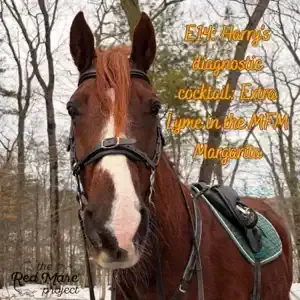
E14: Harry’s diagnostic cocktail: Extra Lyme in the MFM Margarita
March 20, 2026
ABOUT THIS EPISODE
Join Taylor and Kahlan as they chat with their new friend, Vanessa Cote, about her darling morgan, Harry. Vanessa emailed us a robust list of diagnoses and afflictions that she has been strategically managing for Harry, ranging from kissing spine and MFM to chronic Lyme disease. Join us as we unpack Vanessa’s strategies on listening to Harry, keeping him comfortable and happy, and how the journey unfolded. Lyme resources and information: Dr. Martha Faraday: https://4oaksequine.com/ Dr. Joyce Harman: https://harmanyequine.com/ Email us with your interesting stories. Your horse may be able to help another. redmareproject@gmail.com Taylor CL Schouten, MS, APF-I Hoofcare Practitioner Wild Hoof Equine LLC www.wildhoofequine.com Kahlan Ettere Holistic Equine Nutrition Wise Choice Equine Wellness LLC Check out our website: www.theredmareproject.com Follow along on Facebook: The Red Mare Project Instagram: Wild_Hoof_Equine
EPISODE TRANSCRIPT
— Welcome: Introducing Vanessa Cote & Harry the Morgan
Welcome back to another episode.
Today's guest is our new friend Vanessa and her mighty Morgan, Harry.
Vanessa reached out to our email with quite the story to tell.
You know how we always say we become experts in whatever our force's ailment is?
Well, in order to avoid any spoilers, let's just say Vanessa has had to become very well informed.
Not only has she had to learn about muscle myopathy, but she's also had to do detected work to chase down mystery, lameness, and tick-borne illness.
Welcome Vanessa and Harry.
Welcome to The Red Mare Project.
This is exciting.
This is our very first total stranger that's emailed us just from being a listener.
We don't know this person.
We've never met her.
We're not mutual friends.
Like she just found our website or found the podcast and emailed us and it's a doozy.
She understood the assignment.
She saw what we were doing and she said, I got a story for you and dude, it is a list.
This poor little buddy has a bit of a list.
Start with the list and just kind of go from there?
Yeah, let's just run through the list and then we can...
Some of the stuff, luckily, are things that we've already spoken about in great detail so we can tell you guys some episodes to refer back to and then other stuff will give you just little insights on.
So, the first thing that Mr.
Harry comes to us with is severe kissing spine, yikes, but luckily, we have a very extensive episode on that, which is episode two, Kissing Spine Goodbye, so check that out if you want to know a little bit more about kissing spine.
Then we have, he also comes with extensive side bone in both front feet.
Which, okay, we have like two different experiences with side bone because you're a health care professional.
I'm just someone who's seen it.
I've only ever seen it in like retired, like, okay.
I've only ever seen it be a problem in barrel horses.
So, I don't know how many horses I've come across in my life that have it, and it's not a problem and it's never been an issue, but I'm not the one doing, I'm not the one upside down, seeing their, from the knee down.
Well, it makes sense that you would see it in a barrel horse just because the way that they dig in and turn, if there's gonna be any torsion or any movement, that's when it's gonna show up because they really have to dig in.
I've seen, and anytime I've seen it, I've seen it be a real problem, but I know for the most part, it's not a problem until it's a problem.
Can you explain from a farrier's perspective a little bit more of what that means?
Yeah.
So, well, first off, let's explain what side bone is.
So side bone, it's calcification of the lateral cartilages or the ungular cartilages in the hoof capsule.
And the ungular cartilages, they pretty much just provide shock absorption, just one of the many things that are shock absorbing in the foot.
But typically, it's caused from excessive concussion.
So if you're riding on really hard ground or just excessive concussion, it can pretty much just calcify it.
But other things that can lead to it would be poor hoof conformation or unbalanced hoof care.
And when I say poor hoof conformation, meaning that there's an imbalance in the limb, there's an imbalance in the foot, and one side, either medial or lateral, is going to be, it just gets more wear.
So it's going to calcify and harden up.
And typically, like what Kahlan was saying, like it's not a problem unless it becomes excessive.
I've seen it kind of like really become a problem if it's extreme or if it fractures.
Like if it, like the calcified structure like cracks off and now is like a floating irritant.
Mm-hmm, yeah.
And that can be very uncomfortable.
But I would think with things like, so like excessive concussion, I'm thinking jumping.
So, but with those horses, unless they have another reason to have an x-ray, you may not even know that it's there until it's a problem.
Like you may not even, unless someone's really good about getting like yearly rads, that's probably even gonna come up.
Hundred percent.
I mean, sometimes you can palpate it and you can feel it just, you know, upon palpation.
Yeah, you just feel it.
But like you said, like if they're not taking rads and they're not problematic, a lot of people just won't know that their horse has it.
But them, that's kind of scary because I'm like them.
They have it and then you're not gonna stop the thing that is the concussive sport or the concussive behavior.
So you're just kind of making it worse if you don't know about it until it.
Yeah.
Could be a concussive sport.
I mean, yeah, yeah.
It can be consistent, but a lot of times like they can experience a period in their life where they're living on really hard terrain and there's a lot of concussion and they get it from that one incident in their life.
— Navicular in Morgans: Terrain, Concussion & Breed Predisposition
And then going forward, you know, it's like that was something that happened at that period in their life, but afterwards they're not experiencing concussive courses.
So it's not gonna exasperate.
Do you find, this is like totally maybe out of left field, but do you see that more in Mustangs?
Um, that's a really good question.
The ones that I have, no, it's a good question.
I think I have one, two, I have three Mustangs on my books, and none of them, can I really feel it?
I haven't been able to palpate for it, and I don't have radiographs on them.
No, no, no, I lied.
I have radiographs.
I have lateral views of one of them.
But you probably wouldn't be able to see it.
Laterally, right?
If it's extremely bad.
So, can't vouch for that for those guys, but that's a damn good question.
I mean, it feels like it makes sense.
Yeah, yeah.
But yeah, usually, side bone isn't a problem unless it's until it's a problem.
But we'll see what's going on here with Harry, because like we were saying, if it's not a problem, usually it's not mentioned, and this one is mentioned.
So he probably had some kind of...
I mean, we know he had some kind of something else, because we're only number two on the list.
Yeah.
The list keeps going.
So this one, Taylor really should speak on it because she's the expert, but he also has an MFM diagnosis, which if you are unsure, you have questions about muscle myopathies, we've got not one, but three episodes.
Three.
On MFM, specifically.
Episode four is Taylor's horse, Leah.
Episode nine is Stella.
Episode 12 is Valley.
Stella, obviously, Leah is my favorite because she's my niece, but Stella is one of my favorite episodes that we've done so far.
That was a fun one.
It was fun.
Stella's a cool horse.
Definitely go listen to that.
For Valley's too, which was so great, that was Dr.
Amy Reynolds and she just came on.
I think her episode was recorded a week after she saw Dr.
Valberg speak in person.
Yes.
She hit us with, say, fresh knowledge, which was outstanding.
Yeah, that was fun.
That was really good.
Harry's got, so far, just to catch back up, we got Kissing Spine, Sidebone, MFM, and then the next thing we got, the first word is mysterious, hind end lameness, which, damn, that can speak to anything.
Literally anything.
Yeah.
So, but I'm interested to see, like, if he's got extensive side bone in the front, was he having some kind of, like, in general, like hoof care problems that led her to, like, I wonder if those are connected, but specifically, she, in her email, said that it wasn't resolved with specialized diet or injections.
So, it really is kind of a mystery.
And I know that, you know, hind end lameness is really hard because it can be a lot of different things, and it's really hard to see.
Like, I have a much easier time seeing the front end lameness.
Yeah.
And do you know what?
I think another thing, too, and we can all relate to this, especially professionals, I can make any horse lame if I look at them long enough.
Oh, God, yeah.
They're all lame.
Every one of them, they're broken somewhere.
It's so devastating.
I'll have people ask me to, like, watch them go, and I'm like, if you do it enough, if you walk and trot them for me more than five minutes, I'm gonna make them lame in my head, so just cut me off.
Yeah, truly.
Like, don't ask me.
If you want me to say yes, I can find something, but if you want me to say no...
It's not the same way.
Is he blink weird?
Is he holding his tail weird?
Oh, it's probably this.
Oh, is his pelvis...
I can't.
I know, I know.
So don't look at him for too long.
But yeah, so mysterious hide and lameness with this one.
And I'm curious if it's not rotating, but if it alternates.
Transient.
That's the word.
Yeah.
I'm curious if it's transient.
The next one is Your World.
Well, this, a spoiler for the next thing on the list.
I'm not surprised by this at all.
This one, she specifically mentions chronic hindgut issues, which is like, okay, yeah, and water is wet.
You have a horse that's constantly been in pain, tense muscles all the time.
And then our next bullet down in the list is that he deals with chronic Lyme.
I know chronic Lyme is one of the treatments, the main treatment, is a hell of a lot of antibiotics.
And we're not talking like five to seven days, we're talking every time they have a trigger, it's usually a month of hardcore antibiotics.
So they go scorched earth on these horses.
And obviously it's going to have hindgut issues because every single time he's on, and I know that MFM horses love ulcers.
— Hindgut Issues, Ulcers & Why MFM Horses Collect Problems
They hoard them.
Because everything hurts all the time, everything's hurting.
So I'm interested to see what his personality is like, because if I were this horse, I'd be a bitch.
I mean, it's such a, I mean, this Venn diagram of diagnostics, this poor buddy, it's not a Venn diagram, it's a damn circle.
Because all these can feed into each other.
And we'll talk a little bit more about Lyme in just a moment.
But like severe kissing spine, MFM, these guys are going to feed into each other.
And just like what you were saying about like having to go on DOCSY for the Lyme, that's going to piss off their gut, which is also going to create a positive feedback loop with the MFM and then the body pain.
And so this is, this is a, it sounds like he needs a hot bath and like a colostrum or something like that every day, once a day.
He needs that just to be comfortable.
Like his poor horse has so much going on here.
So to move on to the chronic Lyme, we cannot speak as vets on this.
It is something that if you have any suspicion of, or you see any list of certain symptoms, which we'll get into, it's definitely worth looking into, asking your vet if that's a possibility.
I know that some people, some medical professionals, will say, you know, we're in North Georgia.
Pretend I'm still there.
I'm in North Georgia right now.
I'm teleporting.
Some people will say that's not possible because tick-borne illness is in common and they don't carry Lyme in this part of the country.
That's straight up not true.
If it's, you know, it is more common in the Northeast because deer ticks are more prevalent and then they, you know, it spreads and spreads and spreads and spreads.
But it's not unheard of in the Southeast at all.
I mean, think about, picture the Southeast people.
It's wet.
There's deciduous trees.
There's lots of places for these critters to live.
And especially if you have a dark hair horse, you're not going to see it necessarily.
That's a lot of body to look over every single time you go out into the woods or go out anywhere where there's trees.
Like I know I've gone trail riding in North Georgia and come back with so many ticks on me.
Yeah.
You want to shave your head.
So it's not unheard of.
Taylor and I both, she actually introduced me recently to Martha Faraday, who is a total cool nerd lady.
Is she a DBM?
No, she actually has a very interesting past.
So she has a PhD.
She used to do, I believe, like pathology work in human labs.
So she's...
I feel like...
I want to represent her correctly.
You keep going and I'll chime in with what her official training is.
You're good.
Yeah.
She's got a really cool, we can link it below.
Her website is super informative, super sciency, kind of heavy science, and covers a lot of different...
She covers different viruses and bacterial illness in horses, but she is a Lyme expert.
Then the other one is Joyce Harman.
So we've got kind of the hardcore science nerd, and then also the science hippie, Joyce Harman, with Harmony Equine.
Her last name is Harmony, H-A-R-M-A-N, and her website is Harmony Equine, like Harmony, like in Harmony, but it's spelled like her last name.
And she is so freaking cool.
She has a store, she's got blog posts, she's got articles, she's got research.
She's so cool.
She's kind of like every horse girl's first dip into the hippie wellness world for horses.
She's a really good resource.
She not only understands the traditional treatment, I don't want to say traditional, but the allopathic approach to treating Lyme.
But she also includes a lot more holistic treatments and methodologies to keep these horses thriving even with the diagnosis.
Because Lyme is not something that you can be like, okay, I'm cured.
So those bacteria are in there.
And usually, I know with people, when you're ripping those bacteria out of their little cells, they're trying to take down the whole creature with them.
Yeah.
I picture every single Lyme bacteria, and there's many.
So we don't know exactly what he has.
We probably won't find that out, because the testing is not that advanced for horses.
I picture them like individual little bugs with their own little personalities inside each of my horses' blood cells.
Yeah.
And they will throw a temper tantrum on their way out, which can cause a whole rash of symptoms in the horse, aside from their Lyme symptoms.
So, it's like, it's just kind of, it's the circle again.
It's kind of tough, but we definitely encourage everybody to look up those two people in particular, because they have a pretty well-rounded approach to explaining this.
And Joyce Harman specifically, we can't talk enough about her.
— Lyme Resources: Dr. Joyce Harman & Holistic Approaches
She's wonderful.
Oh, yeah.
We do have...
Oh, do you want to talk a little bit about possible symptoms for horses with Lyme?
Yeah, yeah.
Let's do that.
But I did want to like answer the question that I scurried off to seek the answer for.
So Martha Faraday, she's a PhD, she's a scientist, but I believe her degree is in biology, I believe.
Oh, cool.
But she did a lot with working in path labs and things like that.
So she really understands labs.
She really understands just all things physiology.
And what's really cool about Joyce Harman and Martha Faraday both, they both also have a very particular liking of Lyme and EPM.
So these guys, and they take a very similar approach on how they can like holistically support the horse through nutrition and lifestyle.
So these are going to be your main girls.
Yeah, super cool.
And lots of content.
Like those, let's say it's rich with stuff.
Yeah.
And they have lots of webinars out as well.
So if you really want to get into like, you know, into the trenches with the diagnostics, that's going to be beyond the scope of this episode.
But check out the webinars that those ladies have posted because they are elite.
Yeah, just good learning.
Yeah.
Okay.
So you asked about symptoms.
Let's go over symptoms.
So Lyme symptoms in general can start off with full body stiffness and or lameness and more than one leg.
Shifting or intermittent lameness, leg shifting, muscle tenderness, especially sore back, lethargy.
Which sounds like?
Oh, the kissing spine.
And MFM.
Oh, and MFM.
Yeah.
And hindgut pain.
Yeah.
Yeah, exactly.
Yeah.
Lethargy and fatigue, sensitivity to cold, stiffness, skin sensitivity, weight loss, change in behaviors, a horse becoming spooky or withdrawn will not go forward, resist changing gates, will not pick up one lead, and then poor or inconsistent performance.
Which all of these, and this is why it's diagnostics is so, like, I feel like the finish line just constantly shifts around on us.
All of this can look like ulcers.
All of this can look like MFM.
All this can look like kissing spine.
All this could look like a Marenheat.
Oh, yeah.
Ask me how I know the last one.
Or all of them.
Yeah, for real.
Yeah, actually.
Well, I'm wondering, like I'm excited, curious, I shouldn't say excited.
I'm curious to see how this is going to unfold timeline-wise because that would be, obviously, we have like 2020 hindsight.
We're seeing the diagnoses after they happen, but I'm trying to picture if I'm this person, if I'm this horse owner, you're going to try to diagnose certain things as certain symptoms come up.
So like, did we, oh, she also has on here eyesight issues, which, you know, I don't know, we're going to get it a little bit more into that.
But that's just one little sprinkle on top there of the cocktail of craziness that he's going on.
So yeah, I think like for diagnostics, I know that sensitivity, like Lyme sensitivity is more skin sensitivity.
They're sensitive specifically to any kind of touch.
It can also be sound sensitive.
I know some people with Lyme are light sensitive.
But just like overall, everything is just too much.
Like the world has dialed up to 100.
But if she, and we don't know yet, but like if she had Lyme symptoms, I keep saying she, like the owner, but if he, Harry, the horse, had Lyme symptoms first, then she wouldn't have been able to rule it out by using the MFM palette if she had the MFM diagnosis first.
So I think like the big part of this is gonna be finding out what happened first.
Yeah.
Because that's gonna be like the only way that this is gonna be possible for her to figure this out.
Yeah, totally, totally.
Yeah, and like so many of these, like we were saying beforehand, they just kind of like feed into each other.
So this is a hell of a diagnostic web.
And this is, Vanessa, this is a lot for her to manage.
And I did want to go back to when you mentioned skin sensitivity, and this also kind of loops back to what you were saying about like, even though we're in North Georgia, like Lyme does still happen, I know two horses personally who have been diagnosed with Lyme here in North Georgia, one of which boards at my barn, and then the other one is on the other side of the city, but he's a good friend's horse.
The one that lives further away, not at my farm, his first thing, and this is a hell of an owner to be able to like lock in on this, wind.
He couldn't handle wind.
Yeah, that's crazy.
The attunement you have to have with your horse to figure out that they don't like wind.
Because horses in general get spooky, can get spooky depending on the animal, because they can't hear as well because the wind is loud.
— Spookiness, Wind Sensitivity & Prey Animal Behavior
They're prey animals.
They're going to be more on edge.
I never thought about that actually interfering with their hearing more so than the sensation.
That's fascinating.
That makes sense.
That's why I get nervous when it's really windy.
You just become a little bit more aware of your surroundings and a little more heightened when you can't hear because you're having this assault of wind sound.
For a horse relies on hearing their herd mates' heartbeats, the rustling in the bushes that could be a coyote, their owner whistling at them, the bucket being shaken half a mile away.
They suddenly can't, they don't have that same level of awareness so they have to be like, just kind of on a herd.
Yeah.
Interesting.
That's fascinating.
I mean, I don't know.
I just, I don't know.
It makes sense.
No, it makes fantastic sense.
Yeah.
But yeah, so for that guy, wind was, that was the ticket.
And then for the other horse that was here at my farm, he just had, his body just fell apart.
So him, it was more of weight loss and lethargy and fatigue.
He just got real Eeyore on us.
No.
Yeah.
He got very, very melancholy.
And it was kind of written up, it's like, oh, he's older.
And it's like, nah.
No, because old horses with certain, their personalities don't go away.
Exactly.
You know, like if you have a horse that is, if my horse all of a sudden was like really, really, really quiet and subdued and well-behaved, I'd be like, oh my God, call the president, call 911, call the queen, call my mom.
It's happening.
Something's wrong.
But yeah, the tricky thing is that there is a lot of, there's a lot of moving parts and you know, the shifting intermittent lameness that kind of speaks to some other possibilities too.
So there's so many things.
There's a lot of attunement.
That's a great word.
There's a lot of attunement that goes into managing these horses.
But just like everything else we talk about, it'll make you a better horse person.
Unfortunately, there's always one that's got to be the canary in the coal mine for your learning.
But I'm really excited to meet her because she sounds really lovely.
And I was so glad that I saw someone.
Don't forget, guys, please reach out to us.
We want to talk to you.
We want to have you on.
We need more friends.
Like honestly, the amount of feedback that we get, which is so incredible, that people will reach out and say, just hearing this story has helped me so much.
I don't feel alone.
That's our whole point.
Dude, when that girl emailed us from Australia, I was sitting on the couch sobbing.
Oh, I cried.
I was like, oh my god, no one is listening to us.
It matters.
We're doing it.
We're doing it.
It matters.
It does matter.
And you know, that's what we talk about all the time is like, the whole point of this is to build that supportive community.
So for those of like people who are in the diagnostic trenches, like, homie, you're not alone.
This path has been forged.
And reach out.
Like reach out.
Because, oh my god, like, I don't know where I'd be.
I don't know where Taylor would be.
I don't know where any of us would be if we didn't reach out and figure out that we are not the first people doing any of this.
Oh, I'd be in jail.
I don't know that I would even.
I can't.
I have to tell you about a dream I had.
Okay.
We have to go ahead and go ahead and click on for Vanessa because I'm really excited.
But then after I have to tell you about a dream I had last night.
Okay.
All right.
You tell me.
Well, I'll write that down.
We'll talk about that after we talk to her.
But that's perfect timing though because she is here.
So are you ready?
Let's do it.
Cool.
Welcome.
How are you guys?
Good.
How are you?
Welcome.
Good.
Thanks for having me.
Oh, thanks for reaching out.
I was listening to all of the episodes and I was thinking to myself, I really would love to pick these people's brains about what the heck is going on with my horse.
Yeah, it sounds like there's a lot to talk about, so we can't wait.
He is an abyss of problems, but we love him.
All right.
Well, so you've listened to the show before, but just a little, the guidelines, I guess.
We don't have guidelines, but- Guidelines are there are no guidelines.
Yeah, they're clear bumpers.
But yeah, you can swear, you can say whatever you want if you're going through the story and you reach a point where you're like, oh, actually, I don't want that on the record.
Just holler and we can go ahead and cut that out and edit accordingly.
Okay.
But yeah, this is your time for Harry.
Cool.
Thank you.
Where do you guys want me to start?
How did you meet him?
How long have you had him?
Yeah, totally.
Take us through the whole thing.
— How Vanessa Found Harry at University of Wyoming
I transferred into the school that I met him at as a sophomore.
So I actually did my freshman year of college out at the University of Wyoming, thinking that I was going to have this fantastic, horsey experience and I just didn't.
I wanted to be closer to home, so I transferred back east.
I'm in Massachusetts and he was actually bred at the school that I was going to.
I was in an equine science class because at the time, my major was animal science with an equine concentration.
They had just hired out the equestrian team, so they had a coach come in.
She brought all of her own horses and they weren't using the horses that they bred at the school for the equestrian team anymore.
I go into this class first day, don't know anybody and the professor is like, anybody want to ride some horses for free?
I was like, I would love to.
I ended up scheduling something with her and the first horse that she put me on is Harry and I sat on him and I was like, I don't need to sit on another horse ever again.
I just loved him and he looked awful at the time because he hadn't been in work for six plus months.
How old was he?
Six.
Okay.
But like very, I would say lightly started, he was started by students.
So it's something that came up is that through them learning, just things were missed in the foundation.
So he was like totally safe to walk, drop, can or turn.
He jumped, but like a lot of the more in-depth stuff wasn't there.
So this was 2018.
Okay.
And I started writing him and I just completely fell in love with him.
So even before I purchased him earlier than I was intending, but from pretty much the get-go, I was going to try to purchase him after I graduated college.
So he had quite a few issues that I knew about just from the get-go with writing him because he was born there.
Obviously, they had all of their records.
So I knew going into it that he had tested positive for PSSM2.
Okay.
And so I went into it and I learned a lot about the disease.
So he was on a very low NSC diet.
He was in, once I started writing him and I got him back into work, I was held pretty accountable to a consistent work schedule.
So I was writing him about five times a week, even if it was just at the walk for 10 minutes, just to get him to move.
He was outdoors 24-7, living out.
And I thought I had a pretty good handle on like, okay, like this is obviously not ideal, but it's manageable.
And he struggled a lot with building top line.
So even though he was very well fed, he had those very classic PSSM A-frame type hips, where he was very pointy, like a big hunter's bump.
His spine was quite exposed just from lack of top line, from not being in work.
So all of this, I thought like, okay, whatever.
And so I'm leasing him in college for probably about, say a year and a half.
And leasing him in that, I was the only person that was writing him, but I didn't have any sort of formal thing.
And I was TAing for an equine management class, and my professor came up to me and she was like, hey, so we're actually listing Harry for sale tomorrow.
And I went, excuse me, you're doing what?
So then I actually wrote out an email to the director of the program, and I was like, hey, I don't want to own a horse in college.
Like this is not what I see for myself, but I would be happy to lease him.
I would pay you for a lease.
So I like did a price breakdown of what he cost every month and his supplements.
And I was like, I will pay you more than this every month so that I can buy him when I graduate.
And they agreed to that.
So I managed to dodge him being sold at that point.
And then I was leasing him.
So then COVID hit.
And I decided that I wasn't going to be super well suited for online school.
Like I really need to go to class.
I need to go to a cafe to do my homework.
Like I have a really difficult time working in my home space.
And so I was like, you know what, I overloaded on credits.
I have all this time.
Why don't I find an internship?
So I ended up applying for and getting a working student position down in Virginia for a three-star event rider.
So I got that.
And then they decided, hey, we're going to actually revamp the entire Equestrian program.
So initially they were doing like equine management type of stuff.
And then they decided that they were going to shift to more of a vet tech focus.
And in that they sold off all of the horses that were bred at the university because they wanted to bring in more calm, like very relaxed horses that were going to be very easy to be poked and prodded by vet tech students that were not used to being around horses at all.
And so at the time it kind of worked out because I originally was going to lease him while I brought him to Virginia with me.
— Bringing Harry to Virginia: Lease to Purchase
And then I was in a position where I could purchase him and they were in a position where they really wanted to sell him.
So I ended up buying him at that point, which was actually Mother's Day 2020.
So it was like May of 2020.
And two days later I put him on a trailer and I shipped him to Virginia.
And it has been a roller coaster thing.
If I can back up real quick.
So you said in 2018 he tested positive for PSSM2.
Is that right? 2017.
So he was already positive when I met him in 2018.
Okay.
So 2017.
So because Valberg didn't find MFM until 2018.
So did you guys do a muscle biopsy?
Yeah, he was muscle biopsied.
So I heard the story kind of third hand.
So I don't know how accurate it is.
But my understanding is that the school had a horse tie up really, really bad.
And he ended up needing to be put to sleep.
And in the knee crapsie, they found that his whole body was just full of scar tissue from repeated tying up of the cells.
So after that, they ended up doing muscle biopsies.
And because they did the genetic test for PSSM-1 and they were all negative.
So they ended up doing muscle biopsies on all of the horses that they had.
And a majority of them tested positive for some sort of muscle myopathy.
Interesting.
So the running theory is that the stallion that was standing at stud at the time must have been a carrier for it.
Because as far as I know from people that have spoken to you that knew him, he'd never presented like he had the symptoms.
But yeah, Harry and his siblings, multiple of them have muscle biopathy.
Okay.
Wow.
So we won't ask who the stud is, but what breed is he?
He's a Morgan.
Really?
He's a Morgan.
He's a Morgan.
Plot twist.
Not your typical PSSM or MFM horse for sure.
No.
Wow.
Okay.
That's interesting though, because if he came back as a PSSM-2 and he was on a low NSC feed, that's usually the opposite of what we're going for.
He did okay on it?
Yeah.
He did okay, but he never looked great.
I could not for the life of me get him to put on enough top line, and he certainly started to fill out just from being in work, because again, he hadn't been in any work for months when I first started writing him.
But he always just looked very lean, and he never got very filled out through his top line or through his hind end.
I thought at the time just, okay, that's what PSSM-2 looks like.
He's only going to get to a certain point and then he's going to plateau.
Got it.
Okay, okay.
All right.
So back to the story.
So he just got to Virginia, right?
He just got to you, right?
Yeah.
So in Virginia, he had his first muscle wastage episode, which was my first experience with the bad side of PSSM.
Because as far as I am aware, he has never tied up in his life.
He's been pretty easy to manage, minus the fact that his body never looked great.
But just through the stress of moving to Virginia, because he had been born on that property, he had only been trailer off of it a handful of times, and then I put him on a trailer and I shipped him seven hours.
So he had a very, very bad muscle wastage episode.
It looked like overnight, he just was un-initiated.
He looked awful when I got down there.
He was back to spine completely protruding out, very, very pointy A-frame hips.
He dropped a bunch of weight.
So I was thinking in my head, because I'm panicking, right?
He's the first horse that I've ever owned.
I have no idea what I'm doing.
I move him down to this new state that I've never been to before, and he's never been to before, and he looks like this.
I'm trying to stay very rigid in the PSSM2 management.
So my boss at the time is like, he's on pasture, why can't we?
We can take his muzzle off, he can have grass and I'm like, no, no, no, he can't have grass.
He was on a ration balancer and she's like, we can put him on grain and I'm like, no, no, no, he can't have grain.
But eventually, it was after probably about a month, he just looked so awful and he wasn't gaining.
I spoke to the nutritionist that they had because they were sponsored by a feed company, and he eased my fears a little bit and was like, okay, we can put him on a little bit of grain and take his muzzle off and just see how he does.
Because he's underweight right now, he looks bad, he really needs something he's got to give.
Weirdly, I took the muzzle off and I put him on pasture, and I put him on a higher NFC feed, and it was like the best that he ever had.
At the time, I was thinking like, that is so bizarre, that's so crazy that he looks good on this diet that he's not supposed to be on.
Obviously, he was in a lot more intense work.
— Harry in Intense Work: Schooling & Performance Challenges
Over the time that we were down there, because we were down there for about nine or 10 months, he ended up schooling with not a level of ending and first level dressage.
He was doing a lot more intense kind of work that I think also aided him in building muscle, but I was flabbergasted at how good he looked on that kind of diet, because it was just completely opposite of what I thought.
I thought that it would be like, you know.
And in hindsight, I'm like, duh, you know.
Well, we didn't know.
We didn't know.
Yeah.
But it's also, you know, it's 2020 at this point.
It's not, MFM isn't something that's coming up for me or that I'm really hearing about.
So I just kind of said, okay, whatever, like, I'm glad that worked moving on.
So then I moved him back and then I was in school.
And so I didn't have the time to have him in the kind of training program.
I wasn't able to bring him to a bar that had a trainer.
So like his work level very much.
I'm so sorry.
Can you hear my cat meowing?
Or can you not hear her?
I can hear her.
It's fine.
I wasn't sure if she had a child.
No, that's my cat with a toy in her mouth because she likes to just walk around and scream.
I get it.
Mine doesn't say anything.
Okay.
Honestly, there's like a little magic AI thing that gets rid of background noise.
But actually, I hope it leaves it because it's very cute.
It's very real.
She came right by me and it was so loud.
I was like, there's no way that they can't do this.
Anyway, so I move him back up here.
He's in a lot less work.
I'm at school.
I'm busy.
So I'm able to do a lot less with him and he starts getting fat.
So at that point, I have to cut him down.
I'm back in Massachusetts.
It's winter, there's no pasture.
So I get him back onto a ration balancer eventually, and his body kind of deteriorates and he doesn't look as good anymore.
And he definitely looks better than he did prior to when I went to Virginia, because I gained all this knowledge and now he's again doing more collection, like more strength work that's going to just inherently help him build muscle.
And he didn't really have any gate issues or anything like that.
I'm going to pull up my notes now because this is when things start getting crazy.
It's a little interesting, so I just want to make sure I don't miss anything.
We appreciate that.
Oh my god, I'm so sorry.
Can I backtrack actually?
Yes, of course.
Totally.
So while I was a working student in 2020, I did a jump lesson where we did an exercise where my trainer had put jumps down the center line and we were doing serpentines through.
And after that day, he came up so freaking lame, so lame.
And before we went down to Virginia, he'd actually strained a suspensory.
Like he'd done a couple other things and he was never, ever lame even with that.
So when I saw that he was like three-legged, I freaked out.
Yeah.
So at the time I'm a broke working student, so I treated it as an abscess for a few days, but he didn't get any better.
So then I called out the vet for x-rays and they concluded that he had actually fractured the side bone in his right front foot.
Hmm.
Oh my God.
Which was very interesting.
Well, we were just talking about how side bone is never an issue until it's an issue.
Yeah.
Because it breaks.
Which is- Oh, no.
Okay.
Yeah, which is exactly what happened on his PPE.
So I did a PPE where I did front hoof x-rays, I did back x-rays, and I did hock x-rays.
And his hocks were clear.
I saw the side bone in his front feet, and I was like, what the heck is that?
That does not look normal.
And my vet that I had do the PPE was like, that's a heck of a lot of side bone, but side bone doesn't typically cause issues, so it's just kind of a thing that he has, and I wouldn't worry about it.
And I also found on his PPE that he had mild kissing spine, but again, he was going well, he didn't palpate sensitive at all.
So she was like, you know, ride the horse out the x-ray.
If he feels good, I wouldn't be super worried about it.
So I had these things in the back of my head that he was dealing with, but I didn't think of them as particularly clinically significant.
So he fractured the side bone in his right front.
And because I did the PPE, we were actually able to compare it to the previous x-rays, and it looked the same.
So what the vet that I had do the second set of x-rays concluded is that it was an old fracture and it had healed with scar tissue.
And he tore that scar tissue that it had healed with.
Oh damn.
So yikes.
That was a whole new animal for me.
So we ended up putting him on Equiox, and he was rested for six weeks, and we put him in a bar shoe to stabilize the fracture.
— Fetlock Fracture: Bar Shoe, Equiox & Six Weeks Rest
And I was told at that time that he was going to have to be in a bar shoe for the rest of his life.
That didn't happen, which we'll get to.
So he's been barefoot for years and he's been great.
So the side bone hasn't come up again as a thing, but it's just something that I monitor.
So I get x-rays done of his front feet typically once a year when I do shots, just to kind of check in on it.
Thank you, thank you.
You're welcome.
Just to check in on it and make sure that it hasn't gotten any bigger, I did some digging and I was able to actually find in his record x-rays from 2016 and he already had the majority of that side bone as a four-year-old.
So, it's pretty intense, there's a lot of it.
So, I will skip forward again into 2021.
So, he does pretty well for the last bit of when I'm in college, I end up graduating college in 2021 and then I moved him home.
All I'm able to find for him because again, I'm thinking PSSM2, it's Massachusetts, there's not a lot of pasture board up here just because it's cold, there's snow, not a lot of people do it.
So, all I was able to find for a pasture board situation was a backyard barn, which was lovely, it was very, very quiet and he was able to be out.
All of a sudden, he gets super aggressive and he's a very, very goofy, like, silly kind of horse.
He really has enough personality for like three horses shoved into his little body.
So, being aggressive is just not even at all.
Like, something that I would ever relate to him.
And so, it first kind of starts off with he's out in a turnout 24-7 with three other horses and he starts not letting them into the shed.
So, if it's rainy, if it's snowy, he just stands in this big shed by himself.
And if anybody tries to get into the shed, he charges them.
And I was like, that's really weird.
And then he ends up getting separated into a smaller paddock by himself with his own shed, because it's winter in Massachusetts, like it's snowing.
You have to let the horses in, yeah.
They need shelter.
Yeah.
And so he's by himself.
And then he actually charges my barn owner while she's picking his paddock.
Oh, wow.
And I was like, my little Harrison?
He's a sweet, sweet boy?
My sweet little boy?
He went after you in his paddock?
Like that doesn't make any sense.
And at this time, he's also getting really, really skin sensitive.
So I'm having trouble brushing him.
And it's not even just like honest flank, like you would think ulcers.
I can't brush his neck.
I can't brush his legs.
He is swishing his tail, putting his ears like trying to bite me.
And it is so not like him.
So I'm trying to think of what the heck could be going on.
And I'm going to ulcers and actually my farrier was like, have you ever tested him for Lyme?
I want to go.
No, that's awesome.
Because he also was really, really stiff.
Like he was having a hard time for her picking up and holding his feet.
And I tested him for Lyme and levels were off the charts.
Like absolutely, like totally chronic, very, very high.
And so I treat him with Doxy and within a week back, like totally normal, settled, calm.
And he ended up, sorry, go ahead.
Oh, did you all do the SNAP test or what test did you guys do?
Blood test.
Okay.
So I'm assuming that would be the...
Yeah.
So we sent it off.
Okay.
To Cornell.
Yeah.
I think it's Cornell.
Cool.
Okay.
All right.
Oh, all right.
Hold on.
I'm just taking notes.
Keep going.
Oh, okay.
How long was the antibiotic course?
I believe a month.
And it was just with the Doxy or did you cycle other stuff?
We just did Doxy.
Cool.
And that did it?
That did it.
Wow.
Okay.
So did he have any, like, sound sensitivity as well or was it just, like, touch and body stiffness?
Not that I remember because at this point, he's been treated for life many times.
I don't think that he gets any sound sensitivity.
It's really touch.
Like, that is the big indicator because he's normally, he loves being brushed, he loves being curried, like, he's always itchy.
And if I even approach him with a brush, he is penning his ears, switching his tails, biting.
Like, it's very, very apparent that something is wrong and something that I have learned to really, really appreciate about him is that he doesn't hide anything that he feels.
So he's very emotional, which is great because it gives me a lot of information and a lot of things to work off of.
It's just a matter of trying to figure out what exactly is wrong with him based off of the information that he's giving me because as we'll find...
There's so many things that go on with him.
It's always a guessing game of, okay, what is the thing that's bothering him right now?
Did you notice if he had any sensitivity to wind, like heavy winds?
— Wind Sensitivity & Mystery of the Shed: Lyme Connection?
Well, that actually might be why he was hanging out in the shed.
Could be why he's hanging out in the shed.
Not that I have noticed.
Okay.
Were you able to blanket him that winter at all?
Good question.
With him cross-tied.
Oy yoy yoy.
That would be sensory overload.
Yeah, I'm just thinking, standing out, no wonder why he was being so aggressive.
I can't imagine how uncomfortable a blanket would be, but then also sensitive to the cold, sensitive potentially to wind, his muscles are tight.
Poor guy.
Yeah, I feel really, really bad for all of the stuff that he has to deal with, because there's just so many things that he can't get away from that are going to be chronic, and he's going to deal with for the rest of his life that make him uncomfortable.
And I do everything that I can to try to make him as comfortable as possible, but it feels like there's only so much that I can do.
Like sometimes I feel like I can't get ahead of it.
Yeah, so you've done your first round of DOCSE potentially a month, you said a month.
A month, yeah.
And then how are we going?
I feel like this is just a list of like, okay, what's next?
So he actually, because of the charging and everything, even though he was being treated for Lyme, he ended up getting kicked out of that part.
Oh, no.
Which I don't, I don't blame her for at all.
Like she had young kids that were around her and around the horses.
Like, I completely understand her being wary of him after what he did to her.
Like, don't blame her at all.
So I moved him to another barn that's local that I was able to find.
And similar sort of situation with the turnout, he did great in Virginia because he was on a 20- acre pasture with like 13 other geldings.
So he moved a ton on a day-to-day basis.
Yeah.
And coming back to Massachusetts, like there's just not a lot of land here, let alone land for horses because I live about 45 minutes outside of Boston.
So I'm not in, I'm in a pretty densely populated area of Massachusetts.
So he's out 24-7, but the paddock size is significantly smaller.
And there's also no grass.
It's quite rocky.
So he's just not, it's not the same, it's not the same, right?
Like he's out 24-7, but he's not doing nearly as much as he was when he was at Virginia.
But he is generally pretty good.
Like I have him in, I'm doing like lessons once or twice a week with my dressage trainer because I ended up deciding after I came back from Virginia and I got updated x-rays on the side bone to retire him from jumping because honestly, he was not a great event horse, love him to death.
He's very slow and he's very slow and he's not very catty over fences.
Like we spent months doing pretty much adjust grids to try to get his front end better because he always saw the flyer and I was like, Dear God, please do not take off the stride before that cross-country fence.
He just wouldn't do it.
I remember one time we were out cross-country schooling and we were doing a coffin.
So it was like novice level jump, downhill ditch, novice level jump on the other side.
It was supposed to be a one-stride through.
He took the flyer to the first one and bounced the whole thing.
I was like, Dear God, help me.
I don't think I can do this.
So we're not jumping anymore.
We're not jumping anymore for everyone's safety.
I just figured it's not worth it.
His risk of reinjury in that side bone on the right front was quite high.
And he started not tolerating getting shot very well.
Like he, I think the concussion was quite painful for him.
So every single time the farrier would come, it was a battle.
I would give him dorm.
He would blow right through it.
He was running out the aisle with like nails sticking out of his foot.
Like it just was not worth the battle that we were having.
And the farrier that I was working with at the time, because I did switch a couple times, she was like, honestly, if you're not going to jump in, this is really stressful for him.
He's very uncomfortable.
Why don't we just pull them and see what happens?
And I said, okay, don't tell me twice.
I would love to get those things off of him because he obviously hate the entire process.
So we transitioned him barefoot at that point, which I believe was 2022.
And he's been barefoot since.
We've done gluons a couple of times just over the summer when it was particularly hard and rocky at that farm that he was previously at, just to help him out a little bit.
But he's been great.
That's one thing that I can say about him.
He's got great feet.
Cool.
Very, very happy about that.
But it's one thing that I don't need to have on my plate with him.
I'd be worried about.
— Managing the Load: One Thing at a Time
Yeah, for real.
So he ends up schooling through second level dressage.
I have a goal that I wanted to get my bronze on him.
He's starting third level movements.
He's going really, really well into 2023.
And in summer of 2023 is when he starts going downhill.
So at this point, he is 11 years old.
The main thing that starts happening is he just doesn't have any stamina under saddle, or he starts to lose stamina under saddle.
And it's summer, it's 90 degrees, it's humid.
Again, we're starting third level stuff.
So he's doing a lot more collection.
We're trying to school changes.
We're trying to do all of these things that are a lot more difficult for his body.
So my trainer, I absolutely love her.
She has such a kind, empathetic approach with the horses.
So we would do the harder stuff in the beginning and do the more chill stuff towards the end.
And if he said that he was done, we were like, OK, don't care if it's early.
We're done.
We're just going to let him be.
Love her.
And I love her so much.
I've known her since I was, I think I've known her for like 10 years at this point.
And she's just the best.
I could never replace her.
She's incredible.
That's cool.
Very influential on my approach with horses.
She's just, she's so gentle.
She really listens and I just love her.
I'm so lucky to have her.
Shout out.
Shout out.
Good trainers.
Love them.
So we kind of attribute that to the summer.
It's hot.
He's doing hard stuff.
Hopefully it gets better in the winter, right?
And it doesn't get better in the winter.
It doesn't get better when it's cold.
It actually gets worse.
So it kind of progressively snowballs over the course of months.
So at first it was just a little bit, then it was a little bit more.
And I'm like, I don't know what's going on, but like I can still work him.
Like he's still okay.
He just can't go for as long.
So that's okay.
I'll just listen to him and stop when he's done.
And it ends up snowballing to the point that I can barely ride him.
Like I get on him and I can trot a lap maybe to before he, it feels like the way that it feels when I was riding him is like he was going, going, going, going brick wall.
Like no warning.
He just physically was like, oh my God, I can't move anymore.
Pony stop.
And he, yeah.
Pony stop.
And I knew it wasn't behavioral because he has such a willing attitude.
Like he really, really gives you his all.
And so if he's stopping like that, it's him flashing a neon sign at me.
Like I can't do it.
Yeah.
My body can't and totally respected it and would just walk for a while and try again and see what he gave.
Um, I ended up at that point when I could only try out like a lap or two, his canner really, really deteriorated to the point that I could care like a 20 meter circle.
And then I couldn't care more than a couple strides.
And then I couldn't canner at all.
Because I would ask for canner and he would just like bounce in place.
Like he just couldn't get into it.
And he also had a minor right hind lateness that came up at this time.
And I got a bunch of x-rays done and I couldn't find anything in his right hind.
Like his stifle had a very minimal amount of arthritis in it.
So we ended up injecting his stifle and he got a little bit better.
Like for my farrier, he was able to lift for longer and he felt better for her.
And it was a very, very minor improvement under saddle.
But I knew like this isn't the thing.
This isn't it's helping a little, but this is not the magic thing that's going to fix him at this point.
Into like May of 2024, I was talking to my vet and I went, he has kissing spine.
Like I know that he has kissing spine.
Should we just check it just to see, you know, did it get any worse?
Like what's going on?
Because his top line visually looked better at this point than it did when I got his x-rays done on his PPE.
And we got the updated back x-rays and they were bad.
Like he now has severe kissing spine.
He's got multiple points of overriding.
He's got some remodeling.
But he never palpated sore ever.
Like my vet was digging into his back, nothing.
Like absolutely no problems.
And he doesn't have, he had no point had any of your typical like kissing spine under saddle issues.
He never bucked.
Like, so it was very surprising to me that his back looked like that.
But I saw, you know, these horrible x-rays and I went, oh my God, it's the thing.
I mean, these are crazy photographs.
I'm looking at them right now.
He's got bone spurs in here.
There's a lot of jewelry going on in here.
Yeah, they're bad.
So I was like, oh my God, we figured it out.
Go us.
That's the thing.
And then we injected his back and we did mesotherapy and nothing happened.
— Back Injections & Mesotherapy: Nothing Works
Nothing happened.
It was like a similar thing to the cycle.
I would say we'd moved the needle a teeny, teeny, tiny bit.
He felt very slightly better, but all of the same- That wasn't the thing.
It wasn't the thing.
All of the same stamina type of behaviors were still going on.
So at this point, I'm like, I'm not going to ride.
Riding him sucks.
I feel awful because he's obviously uncomfortable and in pain.
And the last thing that I want to do is try to push him through this.
So then I commit to doing like strict kissing spine type rehab for six months.
I love that.
Oh, yeah.
I don't ride.
I do so much longlining.
I love longlining.
I don't know.
I feel like that might be a hot take, but I just put in a podcast and I just drive my horse like a little race car.
I love it.
But he starts going really, really well with the longlining because he had so many years of, he's a very anxious, very tense kind of horse.
So he would tend to go behind the vertical and invert his back under saddle when things got hard or he was confused.
I longline him just in a halter and without even a surfer single, like just the line behind him and he started going phenomenally, like lifting through his back, like his quality of gait got a lot better.
I did a lot of pole work.
I was pretty limited at that facility because it was on a pretty small plot of land.
There was an indoor and an outdoor, but there was no access to trails and I couldn't ride down the street or anything because it was a busy road, it was pretty windy.
I was very limited in what I was able to do as far as trail riding, hill work, that kind of stuff, but I did the best that I could and he visually loved a lot better, built a lot of top line, built a lot of muscle in his hind end.
I start reintroducing undersaddle work and the same kind of, it's better, but it's not great.
My vet actually mentioned probably, I think around right before I did the kissing spine x-rays, that he was like, have you ever heard of MFM?
He might have MFM and I was like, no, please stop doing, please stop telling me things he could have.
I was like, no, he's got PSSM.
He has PSSM, don't worry about it.
Then we had the back x-rays and I was like, oh, it's a stag and I honestly forgot about it.
Again, it's another thing that I now kick myself for because he was right.
Sorry, I lost my train of thought.
We'll look at my notes.
It didn't happen.
MFM, he mentioned it and he said no and then we're like, wait, let's check it out.
Yeah.
I actually don't check out MFM until last year.
Oh, really?
I honestly just continued mostly longlining, getting on him once or twice a month just to see where I was at.
But again, I really enjoy longlining.
I have a lot of fun and he's really fun to be around.
He's so quirky.
He's got so much of a personality.
I just want to hang out with him.
I don't really care if I can't ride him because I can do all of this other stuff that's still rewarding.
And I feel better because I'm not making him uncomfortable through riding and I'm not making him tense.
Like, you know, we're both having a good time.
And he started to really struggle in the cold in that winter.
So winter 2024 into 2025, which he didn't really before.
He never wore a blanket when he was out at the university.
Like they didn't blanket any of their horses.
He got fuzzy.
He never shivered.
Like he was fine.
And then he started, you know, like feeling really freaking tight all winter, just bad.
And at this point, I got him on a pretty strict bodywork schedule.
So I absolutely love my bodyworker.
She does the Masterson Method, which she was the first person that I worked with that used that and it just works so well for him.
Like the gentle pressure, the very slow releases.
She has gotten further with him through that than anybody else ever has.
And I do attribute like a lot of the improvement that he has had to working with her.
Like she is another person who is just so empathetic and listens to the horses.
And she always tells me like, I swear this horse speaks English.
He is so...
He's a good communicator.
He's so expressive.
Like if she touches a spot that's sore on him, like you see his little eyes furrow.
And he's like, oh, oh, oh, oh.
And then they slowly relax and then they get big and they get glassy.
And he does a big yawn.
Like he is just sweet.
Really talks you through whatever is going on in his body.
He really participates, which is so fun.
I love watching him get body work done.
I just sit and I just look at his little eyeballs and see all the tension melt away.
So I absolutely love her, but she starts noticing as she's working on him throughout the winter that things are getting a lot more difficult for him.
— Bodyworker Notices Decline: Harry Goes Backward in Winter
And he kind of goes backwards a bit, undersaddle and even just with the longlining too, he just really has a difficult time warming up, moving through his body, working everything out.
And in early 2025, so this is like spring, spring of last year, my vet brings up the MFM again.
And he's like, hey girl, remember that thing I told you about?
I still think that.
I really think that she has that.
And he convinced me, he was like, reach out to a nutritionist, work out a diet, because he did a lot of research on his own, which again, I absolutely love about him.
Like he's very amazing.
He loves being a vet.
Like he really is committed to try to figure out what is wrong with Harry.
And I appreciate him so much for that.
So he did a lot of research on MFM on his own.
And that's kind of what led him to come back and say, hey, I really think that he has this.
And he was like, you can put him on the MFM pellets for a month, do the diet for a month.
And if it works, you have information.
Like he probably has it.
And if it makes no improvement, you're out, you know, $400 or whatever the pellets are, which stinks.
But then you know.
And I reached out to a nutritionist and we switched up his diet quite a bit.
So he goes from the Triple Crown Ration Balancer on to the Purina Omelette 400.
We put in the Nano Q10, the liquid.
I take him off of a couple other supplements and just do, yeah, the Vitamin E, the Nano Q10 and the MFM pellets.
And he hates the MFM pellets.
Oh no.
I don't know if you've had this experience with your horse Taylor, but he hates them.
Like and I get it.
I mean, I want to gag.
They smell crazy.
Oh, they smell so bad.
Oh my God.
So I'm trying with the nutritionist to get him to eat these freaking pellets.
And once it gets to a certain point, he just goes, nah, I'm not eating anymore.
So I end up doing a very slow transition.
So over the course of a month, I weekly incorporate a little bit more of the MFM pellets.
And I also have to put them on Equasweet to get him to eat it.
So in like the Omeline 400, two pumps of Equasweet to get him to eat the MFM pellets.
And he only eats them like 85% of the time.
I am laughing in solidarity with you.
I'm glad that you feel my pain because I'm in like the MFM forum, Facebook group, and everyone in there is like, yeah, just put them on the MFM pellets, blah, blah, blah, blah, blah.
And I'm like, sure, your horses eat these?
They're disgusting.
It smells like that.
They're disgusting.
They smell so bad.
We call them the stinky pellets.
Like I make his grain at my house.
And if I have them open, my sister will come downstairs and she's like, do you have the stinky pellets?
Yes, I can smell them from across the house.
They stink up my mail room.
Like when we have them delivered to the mail room here, the entire room, even if it's in a locker, just, yeah.
Stinky.
It's not.
Yeah, they smell like sewage.
It's just.
That's a nice word.
Just, I don't know.
Oh my God.
So he's eating like 85% with all the seasoning.
So yeah, keep going, keep going.
The best I can do.
And he gets better, I will say, but it wasn't like this magical transition that I have heard from a lot of people about their experiences with the MFM pellets.
You know, cause yeah, I'm in the MFM form.
I'm braiding through, I'm doing my region.
Doing all the stuff.
All these people are saying, yeah, I put my horse in the MFM pellets and, you know, he's back to schooling dressage or he's back to a venting training level.
And I'm like, my horse can trot three laps now.
Yeah.
Oh, but.
I can kind of canter.
And so yeah, it was really disheartening cause I felt again, after thinking the kissing spine was the thing and the rehab was going to be the thing.
I was like, Oh, this is going to be the thing.
And it was just disappointing cause it, it helped a bit, but he still wasn't anything like he was in 2020 when I was a working student.
Like he, he could not physically move like that anymore.
And he continues to have that mild right hind lameness even on the MFM pellets.
So that continues.
I end up consulting with a couple of surgeons about doing kissing spine surgery on him because I'm like, okay, maybe it's the combination of these two things.
But I ultimately decide, I can't put him through it.
Like he struggles so much with building muscle already.
He's also very, again, very anxious, like very stressed out.
He doesn't like trailer and he doesn't like new places.
And so I'm just thinking this, the horror of him being at a vet hospital and then being on stall rest and like, what's that going to do to him mentally and on his body?
— Hospital Dread: Mental & Physical Cost of Stall Rest
Because he has lived outside his entire life.
Like he's not great in a stall.
He doesn't like being in a stall.
He paces, like he just, and I kept thinking of reasons that it wasn't worth it.
Like I just couldn't do it to him.
So I made my peace and I was like, all right, like if he doesn't get better, I'll retire him.
Like it's okay, it sucks.
You know, he's 12 years old.
He should be in the prime of his life.
But if that's what he needs to be comfortable, that's okay.
That's what we do.
Yeah, that's just your pal.
Yeah, you know, like he's my son.
I love him.
He can get whatever he wants.
Money is not real when it comes to Harry.
So yeah, we had all of that through like early to mid 2025.
And then my body worker actually recommends that I start listening to the Horse First Podcast with Dr.
Duclue.
Have you guys heard of that one?
Oh yeah, she makes me feel so bad myself when I listen to that podcast.
That's a little intense.
It's an intense thing.
It's so educational, but every time I log off, I'm like, I'm just going to drive off a cliff now.
I listen to it and I'm like, I'm so wrong.
I'm sorry.
I'm sorry.
I'm sorry.
It's a fantastic episode.
She does terrific work.
I could have said that aggressive thing.
I got to clear it a little.
But she's really incredible with the education.
I learned through her about body lameness and I'm like, oh my God, this makes so much sense.
I've done all of the things with his right hind leg and there's nothing to write home about.
Nothing that would suggest that there's a reason why he's intermittently lame on that leg.
And so at this point, I'm pretty convinced that he has something going on higher up.
I think that there's something in his right hip.
But again, my vet said you should get a bone scan on him.
But it's the same thing with the kissing spine surgery.
If he gets stressed out, it triggers a live episode every single time.
And so I have to go into things thinking about, okay, so if I do this, I'm going to have to treat him for Lyme.
If I treat him for Lyme, I have to take him off of the MFM pellets because he won't eat them together.
And then I have to do a slow roll, get him back on the MFM pellets after.
And he's worried about him.
And now we're going to have, yeah.
Yeah.
And then he's going to have all sorts of like.
Yeah.
So I ended up reaching out to Dr.
Workman from Denali Equine, who works very closely with Dr.
DeClue.
Love her.
And love her.
She's so sweet.
She's actually, they're thinking about doing a Northeast trip next month.
And I immediately emailed and I was like, if you guys come up here, please for the love of God, look at my horse.
Yeah.
So I really, really hope that they're able to come up because I would pay any amount of money that they want from me for her to do a workup on him.
Hey, if that actually happens, we would love to talk about like if you're comfortable.
And of course, like given what they find, that would be incredible to come back on and talk about that because their work really is revolutionary.
Yeah, follow up.
Yeah.
Yeah, I would.
I'm so excited.
Like I really hope that it works out.
But I end up reaching in.
Yeah, totally.
I will.
So I reached out to her for a consult and I was like, I got all of his x-rays.
I got like his entire medical record.
I put it in a Google Drive file and I shared it with her.
And I was like, this is my horse.
This is what he's doing.
What do you think?
And she asked if I had ever x-rayed his neck.
And I haven't.
So I have my vet out.
I x-ray his neck.
Thank God.
Like I was like, oh my God, he has freaking ECBM.
No, that's immediately.
I was like, something else is going to happen.
They're like, oh God.
And again, it's another thing where I talked to my vet about it.
And he goes, that's really interesting, baby.
That's the thing.
And we x-ray and the radiologist said he's got mild arthritis at C3, C4, and C4, C5.
She doesn't think it's clinically significant.
C6 looked totally normal.
So no concern for ECBM.
So I go back, I talk to Dr.
Workman again, and I ask her about the bone scan, because I'm still debating doing the bone scan.
And she was like, honestly, he's got so much going on in his body.
I don't know how worthwhile it is going to be to you, which makes a lot of sense to me, right?
Like I honestly think that if I bring him in for a bone scan, he's going to light up like a Christmas tree and we're going to have no more information about what is clinically significant.
How is it even helpful?
Yeah.
Yeah.
Because there's just so much.
So at this time, I haven't done a bone scan.
Maybe I will change that in the future.
But as of right now, it's just all of the reasons why it will negatively affect him outweigh the possible information that I will get from it.
— Biopsy Decision: Why Vanessa Said No for Now
Okay.
So I'll touch on the stress and the Lyme situation a bit more.
He is triggered from very stressful or anxiety-inducing events to the point that he had a paddock change, and he went out with these two little minis for three years.
And he didn't even seem like he was that attached to them.
Like I'd take him out of the paddock, there was no calling, no nothing.
And then the minis got separated from him.
And I thought he was going to die.
Like I could not fathom the way that he was acting.
Like it was just, he was hysterical.
He was trying to break down the fence to get to them.
And the minis ended up breaking down the fence to get to him.
And it was something that my barn owner did without talking to me first.
Not knowing the gravity of the situation.
Yeah, which if I had known, I honestly probably would have sedated him or like taken him out of the paddock and then put him back out without, like done, just done it differently.
Yeah.
But he ended up, because we moved them to, they were moved to total opposite sides of the property.
So he was in the way back and they were out front.
So they couldn't see each other, which was definitely for the best as far as trying to break them apart.
But he screamed so much that he lost his voice.
Oh, buddy.
In over the course of three days, like it was some of the most heartbreaking things I've ever seen.
That's so sad.
From him, like he would try to witty and it would just like blow out air.
It was so depressing.
Homie.
It's good for a boy.
Then a week later, I can't brush him and I test him for Lyme and it's off the charts.
He got treated for Lyme three times last year.
It was that instance.
Over the summer, my vet accidentally tested him for Lyme instead of vitamin E because we test him for Lyme so often, but it came back slightly positive.
I assumed that's what you wanted.
I just assumed that I was doing a Lyme test, which is so funny.
It's fine.
It's not awful.
It's terrible.
It was good information to have.
I was like, stick, free Lyme test, bring it on.
I tested him.
He was very slightly elevated, so I treated him for Lyme over the summer.
That was the second time because the paddock change was in the spring and then I just had to treat him for Lyme again, because I actually moved to barns.
I moved him to a new barn on November 1st.
And within a few weeks, it's a classic Lyme.
Test him, super positive, treat him.
And so now he's more back to normal.
But the Lyme is really interesting because it plays with the MFM in a way that I can't decide or I can't figure out easily which one it is.
Like the Lyme causes a lot of sensitivity, the MFM causes a lot of sensitivity.
Like if he's having a bad day and his muscles are really tight, I have a hard time brushing him when he's symptomatic for Lyme.
Can't brush him.
So the symptoms overlap a lot.
And that's one of the things that's really difficult on a day-to-day basis of owning him is just figuring out which one is the problem at hand.
Yeah.
So, you know, I can test him for Lyme, but it's like a couple hundred bucks every time I test him for Lyme.
It's a couple hundred bucks to treat him for Lyme.
So it's not something that I can do all of the time.
And I don't want to kill his gut biome by putting him on antibiotics.
Yeah, I don't want to just put him on antibiotics all the time.
And he also, we're treating him for hindgut ulcers right now, because even after the Lyme treatment, he got a lot better.
But he was very, very sensitive just on his right flank.
He continued to be quite sensitive there.
So he's currently on sucral fate and mesoprostol for that.
And that's finishing up within about a week.
So hopefully that helps that.
I will say that moving him to the new barn, I think, has been really, really good for him.
I don't have an indoor anymore.
And I don't know if you guys are familiar with the snow magetton that we had in the Northeast, but there's like two plus feet of snow on the ground right now.
But the barn that he was at previously with the small turnout that was quite rocky, it was also a lessened barn.
So they had about 20 horses on quite a small property.
So he was in a small paddock.
It was very busy, like they're a little overstimulating for him, very overstimulating for him because he's kind of like, what?
All the time anyways.
And so having, you know, a lot of kids running around, a lot of lessons, it just wasn't a great environment for him mentally.
And now he is at this private barn at the end of a mile long driveway.
They have like 30 acres.
He's out with a little Icelandic pony and a thoroughbred.
— Harry's Pasture Girlfriends: Icelandic Pony & Thoroughbred
They're his little girlfriends.
He loves them.
He's on a huge pasture that's early.
He has a stall, but it has a run attached to it that's quite big.
So he goes in and out.
He's next to his girlfriends.
Like he is so, so happy there.
And even not having an indoor and not being able to have him in consistent work, I do think that his body actually looks better this year than it did last year when I was riding and working him consistently in the indoor, just because he's so much more relaxed.
Like his whole body has just like taken a deep breath since coming to this place.
So I'm cautiously optimistic about what the spring is going to look like and when I can start working him more, because really a lot of what I do right now is hand walking, ground work, and ride walking around the property.
But the snow that we have right now, because we've had like snow, then ice, then snow, is really difficult to work through, because they kind of like step in and then sink down.
So it's definitely not something that I even really want to walk through.
They're just going like up and down the driveway a lot, and I'm like leg yielding, and I can walk as much as I can in a straight line.
So that's kind of where he's at now.
He's currently off the MFM pellets, because again, he will not eat the antibiotics when he's on them.
So I took him off to treat him for Lyme, and I kept him off so that he'll eat the medication for the hindgut ulcers.
So the plan is that once he finishes up that treatment, I'm going to slowly reintroduce him to the MFM pellets.
My vet did get the biopsy tool about a month ago to do an actual muscle biopsy, because we were just going off of response to diet.
So I did do his muscle biopsy for MFM, and it came back positive.
So now we have concrete answers that he does in fact have MFM, which really stinks, but it's really just confirmation of what I already know.
Yeah.
So how, okay, there's so many things happening right now.
I'm so sorry.
There's a lot of stuff going on with that.
No, no, no.
I'm just, I don't know, nothing I can say is going to be really helpful to you because my comments are what you already know is like, how do you tell what's what?
Now, is he wasting away because he's got absolutely no microbiome, because I've had him on antibiotics a million times.
Is this body pain and sensitivity from this or is it from this?
Like, do you notice if it's a Lyme flare, do you notice more prevalence of joint pain versus muscle pain?
Or is it just over sensitivity in general?
Like, when he's cold, like you live in a very cold place, how are you keeping his muscles loose in a cold place?
But he does also like previously not worn a blanket.
What is your protocol for rebuilding his gut after antibiotics?
Because it seems like something that you have to do all the time.
Have you figured out like a go-to?
Do you have like a Harry's after antibiotic protocol that you do?
I haven't been able to find anything that I feel like makes a significant difference.
Like I typically end up putting him on sucral fatigue after he has an antibiotic treatment.
I've had success with the Vitalize Alamend, if I put him on that throughout the course of the treatment, where he doesn't backslide so much.
But that's something that I'm like very open to suggestions for, because I've tried a bunch of different probiotics to put him on throughout the course of the treatment, and I haven't noticed much of a difference.
So if you have any suggestions, I am all ears.
She does.
I'll email you.
Thank you.
I would love that.
I'm pretty sure it's going to have to do with imubium.
That's, yep.
Yeah, imubium is fantastic.
Yeah, that's where it's at.
And we have a, I got you.
Thank you.
I appreciate that.
Yeah, colostrum is our friend.
Colostrum and mushrooms.
I did have a thought about the trailering though.
Now I do realize that like you have two disease processes that are like fueling each other.
So you have a pretty solid feedback loop with this.
But the trailering part, what kind of trailer was he in historically?
Like was it slant, straight, backward ride, box tall?
So what I have found is that he trailers the worst in a straight load.
He trailers okay in a slant and trailers the best in a box.
Okay, so you've been down this road too.
I just bought a new trailer the other day because my mare doesn't like the one that I had before.
You didn't tell me that.
What the hell?
I'm sorry, I'm sorry.
It was very fast.
This is my best friend.
This is a big deal.
I'm so sorry.
I had my body worker out and she was like, Taylor, she doesn't like your slant load.
You need to buy a straight.
— Straight Stall Search & Harry's Living Situation
And I was like, damn it.
So three days later, I found one.
But yeah, I'll send you.
It's okay then.
I love you.
Let it go.
Yeah, but it makes a huge difference.
I totally understand, yeah.
If I put my horse in that order, it's the hardest for him.
Like a straight load, he'll jump the chest bar and he'll try to kill himself.
He'll get upside down and tangled and hurt.
In a slant, he just gets like claustrophobic almost.
In a box, he stands backwards and he looks me dead in the eyes.
I drive behind him and he's chilling like a villain.
Yeah, and that's something that I learned on the fly.
So I shipped him down to Virginia and the truck was empty going down to Virginia because they were bringing horses back up.
And so they were like, yeah, we can put him in the box stall.
And he was in the box stall, he trailer so quiet, he was great.
I was so pleasantly surprised with how he did.
And then when I'm a working student, we're going cross country schooling for the first time and we're taking my manager's five horse trailer.
So it was like the two head to head and then the box in the middle and we put him in the head to head.
And so he backed in like facing the back of the trailer and he was like freaking out.
And I'm like, he just doesn't like trailer and whatever.
We get to the cross country schooling place, we take the horse out of the box and he's like climbing the chest bar trying to get out of the trailer.
He hated that position that he was in.
So after that we experimented and we started putting him in the box, fine, no problems.
It's so much harder when they only have that little chest bar to balance with, it triggers the freak out.
Loki had literally multiple times jumped the chest bar and gotten it under him.
And he's not a big boy, that's a significant climb.
I totally get it.
It's like, I feel like in general, trailering is yes, it's very stressful on their body, and it's something that they have to be educated for.
But in general, they all have a preference and you just need to find where they feel the most comfortable.
And it's not a rule.
And a lot of people, I know that riding backwards for most horses, they do seem to prefer that.
But this is especially between like all three of ours, it's such a testament to is like a very specific, it's whatever they prefer.
I had no idea.
I never thought in a million years, I should let him ride backwards.
I mean, that's...
Yeah, what would you think about?
I don't know.
And now, like people like you, people like Taylor, like I know so many people that they're like, yeah, oh yeah, sometimes they do much better.
But I don't know if you had the same experience, but having him, was he loose in a box or did you tie him?
He was tied.
Okay, mine has to be loose.
So there's the difference.
But I always thought like, that's gotta be more dangerous.
Like he needs to lean up.
Nope.
Yeah, fine.
They do okay.
They're individuals.
They're individuals.
You have alien voice, Taylor.
I don't know why that happens sometimes.
I think maybe my internet does, do I still sound like an alien?
Yes.
So I'm just gonna ask you a very serious question in alien voice.
All right.
So I am kind of curious because if he was recommended to go on Omeline 400, did you work specifically with Valberg's Lab for that diet?
And if so, is he still on it?
Like, what's his menu currently?
I worked with a nutritionist who works very closely with a nutritionist from Valberg's Lab.
Got it.
Got it.
Okay.
So you're back.
You're back to normal.
I'm back.
Okay.
So what's his menu right now?
So right now, I put him back on the Omeline because he loves it.
Like he eats it up because he's a fat Morgan that's been on a ration balancer his entire life.
He's like, this is the best.
Delicious.
So right now, he's getting a pound of that a day.
So half a pound in the morning, half a pound at night.
He's getting the Triple Crown Diamond Balancer, like the one that feeds in more of a supplement ration.
Just because we really need the Omeline to be the bulk of what he's eating because he's so picky and he will go on a hunger strike at the drop of a hat.
Like he needs to have majority Omeline.
But he's a Morgan.
He's not going to eat enough of it.
Yeah.
Yeah, I cannot put him on enough of that.
Like he will blow up.
So he's on the Omeline, the Triple Crown Diamond Balancer.
He's on vitamin E and the...
Which E?
Elevate.
Elevate.
The powder one, not the liquid one.
Elevate the powder.
Okay, yeah.
He's on Elevate.
There's a concentrate and a maintenance one.
Okay.
He's on the concentrate.
How much is he getting?
Like, what's his IU?
Great question.
How many scoops of the concentrate?
Two a day.
Two?
Okay.
What is that, six or ten?
— Supplement Dosing Details & Protocol Questions
Is it a 3,000 scoop or is it a five?
I can't remember. 1,000.
No, that's the maintenance.
She said concentrate.
Hold on.
Hold on.
Elevate.
Let's learn together.
We're learning in real time.
We're learning together.
The maintenance is 1,000 per scoop.
It's in my house.
If you want me to go look for it, I can...
I can tell you for certain.
Okay.
No, hold on.
I caught up.
All right.
I see exactly what you mean.
All right.
So one scoop is 5,000. 3,000 or five.
Okay.
So he's on 10 a day.
If he's on the concentrate, then he's on 10 a day.
If he's on the maintenance, then he's on two a day.
I'm going to double check.
I want to make sure that I'm giving you correct information.
So I'm going to look at my order history.
It's hard to get the concentrate.
Not a lot of places have it.
I know that I know that information.
I feel like I bought the concentrate.
If you tell me how much it costs, I can tell you which one it is. 76.58 for a two pound.
I'm looking at it right now.
How did I not know that there was a concentrate?
It's hard to find.
I'm learning this.
It's really hard to find.
Tractor Supply says that they have it and they never do.
You can order it online, but it has to go through their pharmacy.
A lot of places, you have to go through the pharmacy to get it.
That's the problem.
I'm so sorry.
I lied to you.
He's on the maintenance powder.
Okay, so he's on 2000.
There you go.
Okay.
He was okay with 2000?
Yeah, he's been okay.
I've tested his blood many levels multiple times, and they've always come back normal.
There was a period of time when he was younger, and we were doing a PSSM-2 diet, he was on quite a bit more.
But it's not something that it has seemed like his body is asking for more of.
Got it.
Amazing.
And he's still on the CoQ10?
Yes, he's on that in the morning.
Do you notice a difference with that?
I never noticed a difference with it.
I haven't taken him off of it since I started him on it last year, because it's something that he'll dependably eat every day.
But it is something that I spoke with my nutritionist about possibly trying to take him off of.
I kept him on it because I pulled him off of the MFM pellets just to give him something.
But I have gone back and forth about taking him off of it.
Got it.
Yeah.
Yeah.
I just never really noticed a difference with it.
For me, the E was always the heavy hitter.
That's the one that was night and day.
She's good.
Do you have him on any extra magnesium?
I interrupted you to ask you which vitamin E that you want.
Is that the rest of his menu?
At the moment, sorry, I'm thinking.
I just want to make sure that I get what's right.
That's okay.
At the moment, yeah, that's everything that he's on.
Okay, so the Q10, the Omeline, the Balancer, the vitamin E.
Amazing.
We'll find something for his gut.
Yeah, Kay's got you.
One of the things that I was trying to figure out how he handled, because he's a Morgan, which these guys are inherently air ferns.
How was he on grass?
Yeah, grass in the fact that he's eating an MFM diet, which is the opposite of what his breeding...
Yeah.
Any metabolic concerns?
How's he doing with that?
It's something that I've talked to my vet quite a bit about, because my vet doesn't have any experience with insulin-resistant MFM horses, and I don't think MFM horses at all, really.
It's something that we're kind of just playing by ear.
Like, we're just trying to tackle it.
Like, what is the problem right now?
And the problem is that we want to treat him for MFM and see if he improves.
But that is definitely a concern because he's 13 now.
I've tested his insulin twice in the last year, and he's been slightly elevated, but nothing crazy.
Yeah, it's definitely a concern of mine, though, is how that's going to play out as he gets older.
Do you know what the grass situation looks like in the spring and summer at this new barn and into the fall?
There will be grass at this new barn.
You almost need to put him on a track.
I would love to if they exist.
Everyone needs to be going on a track.
There's tracks up there.
There's the track up there.
Yeah, Alisha Harlov.
She's a mess.
I think her board is out of my budget.
Oh, that's okay.
No, no, no.
Yeah, yeah, it's not.
It's fair.
Yeah.
It's out of mine, sister.
Yeah.
I did just get a remote job.
So the goal for the year is that I'm going to move himself because I don't want to live here personally, and he certainly doesn't want to live here.
So.
That would be so good for him to be in a warmer environment.
Yeah, definitely.
Well, if you choose North Georgia, we have a track for you.
Good to know.
Thank you.
If you choose.
Oh, yes, too.
Yeah, Molly and Sarah.
If you choose Houston, Texas, I got a place for you here, too.
— Houston Hospitality & Finding Support Along the Way
Thank you.
Good to know.
I'm aiming for probably Virginia.
I did love living in Virginia, and I have quite a few friends there, but it's coarse country.
There's got to be tracks.
Isn't that where Morgan's originate?
That's their territory as Virginia.
No, they originated in Vermont.
Vermont.
Vermont.
The other V state.
Well, that'll be great.
The winter thing, I wanted to go back to that, because also I just wanted to, this might make you feel better.
This winter in particular, and I don't know if it's just as winter's compound, as time goes, because it is a progressive disease.
This winter in particular kicked my mare's ass.
Just trashed her.
January was a brutal, brutal month.
I spoke to a few other of my girlfriends, who they have mares with MFM, and it's been the consensus, just the hard winters.
So for mine, and don't do this without talking to your vet, but I had to put mine on methacarbonyl, and that is what got her through.
Wow.
Yeah, that seemed to help.
And I hate doing it.
I don't like giving drugs, but at this point, it was a quality of life thing.
You have, yeah.
She was so upset.
I mean, she was bundled up.
She looked like the kid from The Christmas Story, and I just...
He did jacuzzi for her.
Jacuzzi.
She needs a hot bath, Taylor.
Poor girl.
She needed a hot bath, so...
But I say that because it sounds like your guy was having very similar issues, and I can only imagine what a Massachusetts winter was like.
I don't...
I'm from Florida.
Yeah, like, negatives, many nights, days.
Thank you.
It's been so cold.
But he really...
And I don't know what your experience has been with your mare, but I don't see him shiver.
Like, he really doesn't act like he's cold.
He doesn't act like he wants a blanket, but I put it on him anyway, but he still is very stiff.
So it's like his body is reacting to the cold, but he doesn't behaviorally react to the cold, if that makes sense.
He doesn't get cranky even?
Like, pissed off because he's tight?
Um, I would say sometimes like he definitely on the really cold days I can tell.
So that's something that's new this year is that I have all of this information.
Sometimes if I go to brush him and he just seems like really tight and he's not super happy about it, I'll just go straight to work.
And then after I work him, I bring it back in the barn, then he's very receptive to being brushed because he's loose and he's warmed up.
So that's been something that I have learned this year, which has been pretty interesting.
I also, one of the other boarders at my barn has been kind enough to let me use her beamer, so he's been getting beamered a lot, which I also think has been really, really helpful.
But I would say, yeah, a little bit of the grumpiness just with brushing, but not generally out of the paddock or anything.
Interesting.
I think they all present a little bit different with that.
And I feel like for Harry specifically, since there is that line factor, that sensitivity is going to, it kind of has a double play.
Mine, when she's cold, she doesn't shiver, unless it's like wet cold.
Wet cold, which is always in Georgia.
The worst.
That sucks, I'm sorry.
I mean, it is what it is, but now she just lives under an umbrella.
But she gets really, not quite spooky, but electric, spazzy.
And the second I put a blanket on her, she just quiets down.
So if she's up.
Interesting.
Does that make sense kind of?
Yeah, because he definitely gets like that, but I've never thought of it from the cold angle.
So I'm going to do some experimenting with that.
Yeah, for sure.
Because it's hard to tell with him because he's kind of an up horse anyway.
Leah is a very level-headed citizen.
Yeah, she's pretty chill.
So when she's having a spaz, that's when I'm like, okay, there's something going on.
And usually it is cold.
The other thing too, what does he do with bugs, like bug season?
How does he do with that?
I'm asking for a friend.
Bug?
Yeah.
I'm the friend.
Bug season is interesting.
He historically hasn't really been too bothered.
He's really weird.
Like, I try to put a flysheet on him, but he seems to overheat very easily, or maybe he just doesn't like it when it's over a certain temperature, but he actually bites the front of the flysheet and he'll yank it up when he'd get this thing off of me.
So, I'm telling you, he speaks English.
And I take it off and he's quiet.
So, I really can't flysheet him over 80 degrees most of the time because he just hates it.
He just does not want to wear the flysheet.
And I even have one of the Schneider's, the Mosquito Mesh ones, because I had him in a Rambo, then I had him in a Bucus.
I don't know how to say it.
— MFM vs. Vision Issues: Symptoms That Overlap
Oh, that complicates things.
Well, but also, and you know, I'm not the MFM queen here, but I'm not hearing that his spooky behavior is on brand with an MFM spooky behavior.
I agree.
He's spooky.
He's flighty, but he's not panicking.
He's not panicky.
No, he does not.
He gets like very elevated.
Like he'll get really tight and feel like riding a coiled up spring because he's just like, oh my god, oh my god, but he's never bolted.
He's never done anything like that.
Like, um, I've heard multiple people on your podcast describe that kind of like blind panic with their MFM horses.
I have never experienced that with him.
He is also like quite a lazy horse by nature.
So even when he does get pretty up, like I'm never afraid of him taking off with me because he loves to stop stopping.
That's his behavior.
Well, it's also the first MFM Morgan we've had on here.
Yeah, I've actually have not heard of Morgan having it.
Yeah.
So that may, you know, maybe there's nothing to it.
I don't know.
I'm just saying stuff.
Yeah.
Um, I definitely like, that's something that I found interesting when I was listening to the previous podcast episodes that you guys have done is I was like a lot of the symptoms line up, but that definitely is one that doesn't.
And typically if he is in that kind of state, it's made worse by me being on him.
So I will typically just get off and hand walk in.
And if I hand walk in for a minute or two, he usually settles down.
So he deescalates quickly.
That's a really, that was a good observation, Kahlan, because that, that's, you're right.
He doesn't, it doesn't sound like he gets panicky.
Like he's, if you can deescalate him quickly just by taking him for a walk, that's nice.
That's not the same.
That's not the same.
Yeah.
Yeah.
Yeah.
But he's a very emotionally sound, like he's, he's a very sensitive and I know that he can be nervous, but like he handles it well.
Yeah.
He knows what he needs.
Yeah, absolutely.
And like I've had him at this point for almost eight years.
Yeah.
Like I know I'm like the back of my hand.
He's very much a one person kind of horse.
I feel like he's very intuitive.
He's very sensitive to the kind of energy that I'm putting out.
So as long as I'm able to stay calm and de-escalate myself, he really feeds off of that quite a bit.
So as long as I keep a level head, which is something that, you know, no pressure, easier.
We all need more patience than we have.
Like, you know, it's something that is a constant work in progress for me because, you know, I get scared because I'm like, what's going on?
Yeah.
And trying to de-escalate myself.
But like, again, like I have been, you know, kind of raised with horses since like my college years, to have a very empathetic understanding sort of approach.
Like, you know, I took a Equine Behavior and Learning Theory class in college and it like totally revolutionized the way I thought about everything with horses.
That's awesome.
And so I have done a lot of positive reinforcement training with him.
So I have a lot of tools in my toolbox to be able to help him get to a place where he can de-escalate because he's very food motivated.
So I have like the calm command.
So if I say calm, he puts his head on the ground and he can kind of like relax there in that state.
That's awesome.
Teach me how to do that.
Wow.
It's a really, really great tool to have because it kind of like tricks them into being more physiologically.
Yeah.
And when he gets in that kind of anxious panic state, he's really looking for something to do and he's very food motivated.
So I fall back on the positive reinforcement training a lot because it is a tool that I can use.
And then the act of eating makes him calm down as well.
So it's just, it's a task for him to do.
And that I find really, really helps him deescalate his behavior.
That's, you're so cool.
That's, you are our people.
You are.
If this horse had to go to someone, I'm glad it was you.
Sorry, guys.
That's really funny because there's this, this person that really wanted him, like they had a thing previously where if you put your name in the horse's file, you'd be contacted when they were for sale.
And that went away when I was in college.
So I bought Harry and she was actually talking to one of my friends is a vet tech out in Kentucky and she lives there now.
And she was talking to my friend and she was like, I really wish I could have had Harry.
And my friend was like, no, you don't.
No, you don't.
Call Vanessa.
Show her your vet bills.
But I just adore him and he has taught me so much.
— Learning Something New Every Day: Vanessa's Love for Harry
I learned something new from him every single day.
And even in the journey that I'm in with him now, I'm doing a bunch of groundwork with him that I never thought that I would do.
And I'm really enjoying groundwork.
I have made my peace with the fact that I don't ride my horse competitively.
And I really don't think that I ever will again.
And I don't think that he's going to get back to that point.
I would love for him to be happy just doing some bebopping around lower level stuff.
But I don't love owning a horse.
I love riding Harry or owning Harry.
And I don't know that I would own a horse if it wasn't Harry.
He is just so special to me.
And I've been on such a journey with him.
I just feel a closeness to him that I have never felt to another horse.
And I don't know if I will ever be able to replicate that.
Because I hope with whatever next horse I buy, I don't have to go through all of it.
But it's been really special.
And I've learned so much.
And I owe him so much.
And he's done a lot for me just personally and through my riding career.
So I owe it to him to do as much as I can to figure out what's wrong with him and just give him the best life that I can.
You're the best.
You're exactly what we wanted to hear.
That was really nice to hear.
I just love him.
That's your son.
He's just the best.
Yeah.
Unfortunately, the ones that are, you know, the ones that we care about so much that break our hearts and like put us through the worst stress ever.
They make us such better horse people.
And they give you such an understanding that you couldn't get elsewhere.
Like you can't manufacture that.
You can't get that from riding lessons.
You can't get that from competing.
You can't get that from winning.
You can only get that from actually having that true empathy and working through the hard shit with them.
Because like you see him, you see him in every difficult state he's ever experienced and you just want to make it better.
Like you just want to be his pal.
You want to be there for him and you are.
Like you're doing such a good job.
I can't wait to hear after you have a workup because you're gonna.
I hope so.
They're going to be like, oh my gosh, this girl needs us and it's going to be great.
So please update us because we really want to hear.
If you would like some recommendations for the hangout support, I will help you.
I would love them because it's such a work in progress.
I only know what I know and I know that I don't know a lot.
So any information, advice that either of you can give me, I am all ears.
I'm not somebody who's ever going to punish you for giving me advice.
I want to figure out what's wrong with him so bad.
Because he deserves to be comfortable.
Yeah.
Well, it sounds like you have a really good team too.
Your vet has been a shining star.
Let's give a quick shout out to your team before we wrap up.
You've had some really good support.
You have a wonderful trainer, a wonderful body worker, a vet who never rests.
That's a big deal.
Yeah.
I'm so grateful.
I literally have a good team on my notes.
Halfway through, I was like, she's got a good team.
I could read it all the way from Texas.
Yeah.
I'm so grateful for all of them, and they're just the kindest people and always treat me and him with understanding.
I have never been told by anyone on his current care team that it's behavioral or I should just work him through it.
Everyone is aware and committed that there is something wrong with him, we all need to work together.
It's a cool little circle too, right?
My body worker and my farrier both use my bed.
They independently will talk about my horse and then come back to me and be like, I thought of this thing for Harry.
Because my farrier also shout out to my farrier, she's incredible.
I have this amazing barefoot tremor, and she's so educated and patient with him.
Because he was so bad for the farrier.
When I pulled his shoes, again, he was rearing, he was bolting out of the bar.
Even when I had him barefoot, he was really, I think, traumatized just from that whole experience.
It's been years of working with him to try to get him to calm down and relax just to get his feet trimmed.
And she has never escalated him.
She's never even thought about hitting him or smacking him or anything, which would horrify me.
She's been so kind and so patient with him and approaching him with that kind of attitude.
He is the best now that he has ever been for the farrier.
So shout out to her, shout out to my whole character.
I love them so much.
I'm going to miss them so much when I move, because I don't know if I'm ever going to be able to replicate this.
— Moving On & the Fear of Losing a Great Support Team
It's hard.
Yeah.
But now you know what you need and now you don't have to go through all the riffraff of advocating for him.
You're like, this is what he needs.
If you can't provide it, you're not my care team.
Yeah, definitely.
I cringe at the way that I saw people treat him back in 2018, 2019, because it just doesn't work.
You just have to be nice to him.
You should be nice to all horses, but especially him.
Yeah, he needs the extra support and he'll participate if you give it to him.
So yeah, definitely keep us updated and I'll email you with my number.
And Taylor, obviously, if you think of anything, you jump in too.
But thank you so much for sharing that.
That was like, you know, that's someone who's going to hear this and be like, oh, maybe my horse has lime or oh, my gosh, that maybe she knows how to help me work my horse through this fear that he has.
You know, like that's that's the whole point of what we're doing is the community aspect of it.
And you are a really good example of that.
So I appreciate you reaching out to us.
You're are you maybe our first guest who's a stranger?
Uh, wait, wait, second, third.
No, maybe you might be.
That's like my mother-in-law would say a rank stranger.
Not not applicable here.
No, you smell you smell great.
I'm sure you're not rank.
But I think you are the first person that we've had on that just reached out to us from being a listener.
Yeah.
Where did you find the show?
Yeah.
I actually saw the first episode that you guys posted in the MFM forum Facebook group and I was like, Wait, I don't think I even posted it in there.
Someone posted it.
It was- Someone posted it.
Hold on.
Someone posted it.
Like our pilot episode?
It was the- For Leah Hutt.
I think it was either the Leah episode or the Stella episode.
Oh, do you know what?
It was Stella.
Oh, it was probably, yeah.
It was Stella.
Yeah.
Cool.
But it's been such a great way for me to learn more about MFM because I don't know anybody that has an MFM horse and my vet doesn't have a lot of experience with it.
Nobody on my care team has a lot of experience with it because it is so new.
I'm constantly in that Facebook group just trying to gain as much knowledge as I can, but there's only so much knowledge you can gain by reading a Facebook post.
I feel like the conversations that you both are having, we're able to really deep dive into the longterm timeline of what this disease looks like, has been so helpful for me and that's what made me feel compelled to share because I feel like I've gained so much from both of you.
I would love to just, if I can give something to somebody else, I really appreciate what you both are doing as far as knowledge sharing because we all have so much to learn from each other.
Well, thank you for sharing your parts too.
Thank you.
That's so wonderful.
I love talking about him.
That's so nice.
Honestly, his story- It's kind of easy, isn't it?
His story will help a lot because it's especially with the line, a lot of people will discredit it and say, it's rare, it's not that, but well, rare things do happen.
I mean, we're here in Georgia and there's a horse at my barn or I board who was diagnosed with Lyme and they kept overlooking it because it's in Georgia and it's like, well, no, it still happens.
If you're in California, it'd probably be a little bit more like, nah, you could probably put that further down on the list, but rare stuff does happen.
So, yeah, keep looking.
Yeah.
Well, thank you so much for coming on, Vanessa.
It was so nice to meet you and I'm so glad we have a new friend.
Yeah, I'm so glad to meet you both.
Thank you so much for having me and letting me share.
Send us, unless you want his x-rays to be the Facebook picture, send us a picture that you love of him that you want us to use for our post, okay?
— Closing: Resources, Lyme Vets & Final Reflections
Okay.
Sounds good.
Thank you.
That's my favorite part.
Thanks, Vanessa.
Have a good one.
You too.
See you guys later.
Bye.
Bye.
Bye.
If you or a friend have a topic, story, or case study you want us to cover in an episode, visit our website at theredmareproject.com to leave your submission, or email us at redmareproject.gmail.com.
If you have it, please include a cute picture of the horse we will be discussing so we can make it our Facebook page profile picture.
As a reminder for listeners, this content is for educational purposes only and is not meant to diagnose or treat.
We encourage everyone to do their own research and speak with your veterinarian and care team to make sound decisions for your horse's management.
If you like the podcast, please tell a friend, like, subscribe and follow on all the platforms.
Peace.
NEVER MISS AN EPISODE
Listen on your favorite platform
Subscribe and listen to The Equestrian Podcast wherever you get your podcasts.
