
PODCAST EPISODE
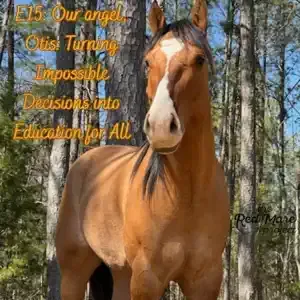
E:15 Our Angel, Otis: Turning Impossible Decisions into Education for All
April 5, 2026
About this episode
Join Taylor and Kahlan for a very special, intense, and raw conversation with Brittany West about her late gelding, Otis. Otis sustained a fracture on his front left navicular month at 18 months. After years of swimming upstream with countless interventions to rehabilitate him and keep him comfortable, Brittany made the impossible decision to let him cross over the rainbow bridge. Otis's purpose expanded beyond his 6 year lifespan; he is a teacher. Brittany generously and bravely donated him to Trinity Equine LLC, where osteopath Lorre Mueller, conducted a three day whole horse dissection. Taylor was very fortunate to attend this event, where Otis told his story. Trigger warning: This is the most intense and surreal episode the girls have done to date. Brittany West, bodyworker and natural horsemanship Project Pegasus Equine Services https://www.facebook.com/profile.php?id=100075859421372 Lorre Mueller and Trinitiy Equine Services: https://trinityequineservices.com/ Email us with your interesting stories. Your horse may be able to help another. redmareproject@gmail.com Taylor CL Schouten, MS, APF-I Hoofcare Practitioner Wild Hoof Equine LLC www.wildhoofequine.com Kahlan Ettere Equine management Wise Choice Equine Wellness LLC Check out our website: www.theredmareproject.com Follow along on Facebook: The Red Mare Project Instagram: Wild_Hoof_Equine
EPISODE TRANSCRIPT
— Welcome & Trigger Warning: A Heavy but Necessary Episode
Welcome back to another episode.
Today will be a bit of a heavier episode.
Otis' story has a very different type of ending than what we usually share, but the journey and learning that come out of it are tremendous.
Tragically, Otis fractured his navicular bone as an 18-month-old, and despite every possible intervention, achieving consistent and sustainable comfort became further from grasp.
His incredible owner, Brittany West, made the difficult decision to have him crossover and serve as a student for Trinity Equine's Whole Horse Dissection this past February.
His purpose was to teach, and teach he did.
Welcome, Brittany and Otis.
Welcome to The Red Mare Project.
I know you said we're like almost exactly a month out, right?
Yeah, it was Valentine's Day weekend.
Oh, that's rough.
Yeah.
But I would love to be able to go to one.
I know Sarah is having one, what, next month?
I just can't do more travel.
Like I can't.
No, it's okay.
Because we're going to be going to Georgia, and then I'm going to be going to Georgia in May, and it's like, you know, whatever.
One will come up.
But yeah.
For sure.
For sure.
Should we start with a little trigger warning, and like another one as we go into it?
Yeah, yeah.
So if you've somehow made it through the intro and still are not totally settled, here's a trigger warning.
This may not be an easy episode.
We're going to be talking about euthanasia and dissection and some pretty gritty stuff.
So we want to honor anybody who can't handle that right now, and we love you.
Listen to another episode.
We're funny elsewhere.
Yeah, this was a pretty, the whole experience, the whole journey was pretty intense.
So of course, we're going to have Brittany on in just a few minutes, and she's going to unpack his entire story.
But the really concise version of it, Otis was, as a two-year-old, I believe it was, he fractured his navicular bone in his front left, and it just has been a few years of doing whatever she possibly could to keep him sound, and she eventually had to make the decision to let him cross over.
And Brittany was very brave in making this choice to donate him to Trinity Equine, which is with Lorre Mueller, and Lorre does whole horse disunctions all across the country.
So these disunctions are typically three days, I was really fortunate that I was able to attend.
This was actually my second dissection.
It was pretty fascinating.
And if any of our listeners, if you ever have the chance to go to a dissection, please go, even if you're not a professional, even if you're just an owner, and you just kind of like be bopping around with your horse, just 100% if you can go do it.
I'm going to go into my third one next month.
But his story was told on the table.
So everything comes out.
The body keeps the score.
Well, it's kind of like someone said when Loki first started going through his bullshit, someone, a one-eyed friend said to me, you know, no one gets out alive.
Like no one gets out perfect.
You don't ever, you don't go to your grave with no scratches, no arthritis, no pain, no nothing, you know.
So you just have to do the best you can with what you have.
And sometimes the best you can is to let them go and let them tell the story.
So I was super, super generous of her, not only to donate her horse for this, but then to donate her time to talk to us.
Yeah.
We gave it a month to give her some simmer time so she could sit with this and we wouldn't re-traumatize her.
But that was incredibly brave and incredibly generous.
Yeah.
Oh yeah.
And she was so involved and she's actually in school to be an equine osteopath right now.
So she can like actually really appreciate a lot of the stuff on a very deep level, which I was so impressed with how well she was able to piece out like, owner, that's my child on the table, but then also wear the hat of being a student of ours.
Professional.
Yeah.
Yeah.
Yeah.
So impressive.
She had a fantastic support group too.
Her boyfriend was there, super great guy.
That was- That's so nice.
That was like the ultimate test right there.
Yeah, really.
But for shit like that, you just need your people.
Like you just need your people and then it makes you feel so much more brave.
Yeah.
And her mom was there who was just the sweetest person.
And we all- we had a big group there.
I think our crew made up like half of the class.
She had her own little support section.
Yeah.
That's awesome.
I think in total there were six, yeah, six of us.
Wow.
Yeah.
Now, how did you- did you know Brittany because you were working on Otis or, you know, attending with Otis?
Did you know her previously?
No, actually.
So that's a good thing for us to touch on.
So Brittany's trimmer is Kelly Roach, who is a very good friend.
And she has been taking care of Otis for the last year of his time with us.
And Kelly shared with our group, because we have, like, the best little trimmer group of all time.
There's about 10 of us.
And it's just this giant sisterhood.
And we talk all the time.
And it's the best thing.
And if you are a professional out there and you don't have your tribe, you got to find your tribe.
Makes all the difference.
So anyway, Kelly shared with us what was going to, what was happening.
And I was like, without a doubt, it was such an impulse by, I was just like, we're going, no question.
— Taylor Attends the Dissection: An Impulse Decision
So I met Brittany through Kelly, which was really great.
If you're up in the north, northwest Georgia area, check out, and you need some hoof care, check out Kelly Roach.
Yeah.
Not, not like the bug.
She's the fun Roach at the end of the night.
If you're a real one, you know what I mean.
Anyway, so, but yeah, so that's how, that's how we got connected to Brittany, was through Kelly.
Okay, cool.
I remember that she was Kelly's, but I wasn't sure if you knew her first.
So do you know, and we'll get into this obviously with her in just like a couple of minutes here.
Do you know how far along she is in school?
Oh, I don't know.
She's practicing as a body worker right now.
And I'm not sure how long she'll be in practice, but we're going to learn that right now.
But I do.
So Otis, his, his trimmer was there because Kelly was there.
His chiropractor was there, Dr.
Shelly Douglas.
She's fantastic.
So that was really great, too.
Yeah.
So overall, having the whole team there was really fantastic because we had, we had a chiropractor there.
We had two saddle fitters there.
Oh.
Which was very cool because they, what's really great about Lorre when she runs hers is that when the professionals are there, she's like, this is your world.
Please contribute and participate.
Like, let's, let's educate each other.
So cool.
So like, what are you seeing that I'm not seeing?
Or what, you know, from your eyes, how are you looking at this?
That's so cool.
So it was really beneficial that we were able to, you know, hear from the, hear from the saddle fitters about the role of different ways that just kind of, they just nerded out on it.
And it was so beneficial.
Amazing.
We had a nutritionist there, which was really cool because she gave us a very detailed tour of the GI tract.
So cool.
That was terrific.
And we had, I think, maybe like five body workers there.
And then our team of, I can't remember, four other tremors, three tremors.
Who was there?
That's a lot of people.
Yes, group of 20.
Wow.
So does she max out her classes or her sections at 20?
I would imagine so.
That's a lot.
I think if you get more than that, it gets a little cluttered.
There's not a lot of room for everybody.
And physically, there's not a lot of room.
It just probably drags it out.
It can.
Yeah, we had a lot of squirrel moments because there were so many professionals there that could all participate and contribute that if something popped up, we all just, I mean, the conversation just ran, which is incredible.
Amazing.
That's the whole point.
You're there to learn.
So we could all participate with each other and do some really neat things.
Oh, there she is.
Hold on.
Wait.
Admit her.
Come.
Hey, girl.
Hey.
Oh, you should have a place where I can actually see your pieces.
Hello.
Hi.
Hello.
Welcome.
Hi.
How are you guys?
All right.
How are you?
You have his picture in the background.
I had to.
Oh, beautiful.
Yeah.
What a nice touch.
All right, girl.
You okay?
You ready for this?
Yeah.
Yeah, I'm ready for it.
Okay.
If you need to tap out or like take a lap or if you need a breather, just say, okay.
Okay.
And don't push yourself too far.
Like if you feel something and you're like, I can't go there, just divert.
Just bail.
I will feel all of the feels, but I'll share a story.
Okay.
All right.
Cool.
That's very generous.
Thank you.
All right.
So just as kind of our little guidelines, which are none, but you can say, of course, say whatever you want.
You can swear.
If you get to a point where you need to like vent and you want to just let it rip, go for it.
If you need anything cut out, if you want anything just stricken from the record, say the word, snip, snap, snip, snap.
I can do it.
Okay.
Cool.
Great.
Okay.
So let's go ahead and start a little bit with you.
Do you want to tell us a little bit about you, your background in horses and your career as a professional?
Sure.
Yeah, absolutely.
So I have been working with horses for about 23 years now.
Started riding when I was five or six, took lessons for a while, started in the English world, went to the Western world.
And then after high school, my college was in equine science and pre-vet.
So I went to Montana State University, worked up there for a while.
I got my first horse at 18.
He was a rescue gilding.
He moved with me to school.
And my last year at college is when I got Teddy, which is my problem child I currently have.
And they both moved with me back to California.
After I graduated, while I was at MSU, I did their cult starting program.
I interned with a vet for a couple months, about a year.
Loved that she was a chiropractor.
In my time with my rescue gilding, when you're around horses, you think you know horses.
When you own horses, you learn how much you don't know about horses.
Oh girl, put that on a funny t-shirt.
I was so naive going into it.
I was like, I'll be fine.
I was not fine.
And he had all of the issues under the sun.
He was a six-year-old rescue who was a neglect case.
They put weight back on him before I got him.
He was technically rideable.
But within a few months, he was just reactive.
We went through everything with the Vet Med.
We tried back injections.
We tried everything till my vet at the time referred me to an osteopath.
— Brittany's Journey Begins: Trying Everything for Otis
And I was like, no, never heard of that before.
She came out and she did bodywork, did the spinal manipulations, the skeletal manipulations and some of the soft tissue stuff.
And I was hooked.
I was like, I want to do that.
Like I don't know what that is, but I want to do that.
And my vet had told me, he's like, if you want to do chiropractic, if you want to do osteopathy, he goes, you might as well go to vet school first.
So you have that degree and then veer off and do it.
Because I wanted to combine the two.
So I was like, that sounds great.
So I went for pre-vet and equine science.
And then I didn't get into vet school.
So I've applied twice.
Life circumstances didn't work out partly because I broke my back the last year I had applied.
My problem child me up.
But I did end up going into the body work field.
So I worked as a vet tech for a little while before finding the certification program that I actually respected the credentials for.
And was close enough and easy enough for me to, it was accessible at the time.
So I went to Animal Rehab Institute.
It has an online portion where it was a good chunk of time just for learning the anatomy, the different techniques, the trigger points, and then practicing.
And then we had a five-day in-person hands-on clinical.
So total about probably 40 hours of hands-on at the facility in Florida.
Excellent.
And yeah, I loved it.
I love the people.
One of my colleagues out here actually went with me.
We were at the same class, which was crazy.
Oh, very cool.
Small world, right?
Yes.
So that was kind of neat.
And I've been working full-time as a bodywork professional for about two years now.
I mean, it's awesome.
Yeah.
Where are you?
Oh, I'm in Northwest Georgia.
Northwest Georgia.
I'm a big part of Rock Mart, but you're willing to pay the travel fee, I'll travel.
Amazing.
Yeah.
My general bubble is about an hour and a half to two hours.
That's kind of my local routes, but I have and we'll go further.
Excellent.
Amazing.
Okay.
And I remember at the dissection too, you mentioned that you were in, you were actually going into the osteopathy program.
Is that correct?
I am.
Thank you for reminding me.
I am a student of osteopathy with London College of Animal Osteopathy.
So it's a self-paced online program, but it is very thorough.
I have slacked a little bit in the consistency over the last few months.
You've been present.
A little bit.
But I am more than halfway through.
I'm almost done with all of the pre-clinicals and I'm getting into the clinicals and once I get through the clinicals and can attend, there are five day, nine day, if you do well.
I'm doing the canine and equine route.
So it'll be cool.
And we'll be able to work on any mammal.
Right.
I know they have students there who graduated that work on like giraffes and like zoo animals.
Yeah.
Oh my God, sick.
Right?
I know.
It's pretty cool.
Wow.
Yeah.
Okay.
Good question.
Yes.
So you said London School of Osteopathy?
Yeah.
Are you gonna have to go to London?
They have their practicums all over the world.
I don't think they actually have one in the United States yet, but I've been eyeing the one in New Zealand.
So they have them in different locations, right?
They have ones in London, Canada, Spain.
They've done New Zealand.
They've done Australia.
So they basically, I think, it's two or three times a year, they offer them for the in-person.
Yeah, it's pretty spectacular.
What a time in my life.
That's incredible.
Yeah.
I think we'll work with people all over, and they have an online section where I can connect with other students.
So we've been able to talk and discuss different topics.
If there's something that's difficult in one of the courses, you can bounce questions off of each other, and the instructors are super available.
So if you have any questions, you can go straight to them, and I've definitely done that a couple of times.
But yeah, it's really cool, and it has helped with the body work I'm currently doing, just with my approach to what I'm looking at.
Like understanding the holistic, everything matters, diet, nutrition, lifestyle, exercise.
I mean, it all plays a role.
And osteopathy very much looks at the whole horse.
Like you can't look at one thing without realizing it affects the rest.
So, totally very cool.
You're so cool.
Thank you.
You're so smart.
I love that.
All right.
So why don't we jump into Otis' story?
How did you guys meet?
So I had moved to Texas back in like, beginning of October of 2020.
And I had moved with my rescue and Teddy.
So the ones that were in Montana moved back and came out with me.
And it was on my own property, and they were just the only two horses.
And I really wanted a third so that I could go off property with one and not leave the other behind and just kind of round it all out.
And I had looked for a while.
I ended up driving all the way down to San Antonio.
That coal didn't work out.
I brought a puppy home.
And then that next week, I took said puppy to a performance horse sale where I ended up bringing home Otis and Freya.
My mom was not thrilled.
I got it too.
This is Freya.
Oh, that's a Freya too?
She's so cute.
So Otis was six months old, freshly weaned.
My other half is looking around the corner.
— Freya & the Ranch: Where Otis Came From
And Freya was 18 months old.
So they both came from the same ranch.
It was Heartbar Horse and Cattle Company out in Texas, just north of Fort Worth.
Great ranch.
All of those horses are just spectacular.
The ones that were already trained and saddled.
Confirmation wise, they were gorgeous.
They were really just the train ability of these horses was pretty cool to see.
I wasn't familiar with the ranch before I went to the sale, but I definitely paid attention once I was there.
And after I got home, my mare has been a super easy start.
She is such a golden girl.
Like she is awesome.
And Otis had the mind to be like that too.
He was an absolute ugly duckling.
He was a duck.
His papers called him sorrow.
I'm not really sure why, but he was wonky.
He was that big baby butt for the quarter horse with the fancy, bitsy eunuch that he kind of grew into.
He didn't grow into it, but he was just such a dweeb.
And I adored every minute of it.
He was such a goofball.
But he muddied up with my older gelding, my rescue, because he was like the babysitter personality.
And so they were like this.
And then when he got a little bit older, he and Teddy became like best pals, where Bitey Face was the best game ever.
And they would just go get zoomies around the pasture.
My poor mare, she was like, she thought she was the bee's knees and the boys were like, but we have our thing going.
Yeah.
But they were really good.
So that's how I ended up with him.
He was kind of halter broke.
But I did all the handling with him.
I think I had bareback pads on his back and him picking up all four feet within the first month of me having him.
And he was just like an in-your-pocket kind of personality.
The best.
Oh, yeah.
If he could sleep in my bed, he would have.
Mine's the same way.
I love my Velcro pony.
Yes.
He's definitely a puppy dog personality.
I loved it.
He was my sunshine boy.
But yeah.
Okay.
So let's kind of get into the tale of it, right?
So he was two when everything kind of turned?
He was a yearling.
He was a yearling?
Oh, I misspoke.
Okay.
Year three months or year six months?
I don't remember.
I think he was 18 months old.
Okay.
We'll go with that.
I didn't look at the actual time, but sure.
Okay.
But yeah, came out one morning, he was three legged, like would not put his foot down.
And I'm like, okay, well, this is an emergency call.
So I reached out to my local vet, hauled him in.
It's his first time hauling on the trailer by himself.
And he had an episode and fixed the trailer loading.
But he went out there, we took x-rays and the fracture was either not noticed or was an assumed bipartite navicular, which is something they're born with.
They thought it was a bone cyst in his P2.
And because of that, I was like, okay, well, let's manage it.
They were like, well, the cyst was, what they thought was a cyst was right in the middle of P2.
It was actually just where the bone marrow was.
It wasn't even a growth plate.
It was, it wasn't on the ends.
It was just very strange placement.
So I was like, whoa, well, what were suggested to?
They said, let him be a horse, come back in 30 days.
We'll re-X-ray it.
If it hasn't changed, then it's okay to wait until we can get somewhere for him to have an operation to alleviate the pressure from the cyst and we can recover.
So I was like, okay, waited 30 days.
He never got sound.
I took him back in.
They re-X-rayed, no change.
And they were like, well, surgery is going to be on the optilike is the option.
But because there's no shift, no change, it's not emergent.
Because of that, my mare was coming into season.
She was old enough and became fertile.
And Otis got old enough.
He was still a stud.
Otis became old enough to start attempting.
And so I was like, well, if this is a congenital bone cyst, I'm not going to keep him a stud.
And part of me was thinking like, because I was intending to, he had the mind, nobody actually thought he was still attacked when they'd handled him.
Like he was just so mellow, so sweet, never, never behaved out of the ordinary or any stud-like tendencies.
So I went ahead and had him gelded.
And he had just turned two.
So we were about six months in when I had him gelded.
And then, I don't remember when that was.
I ended up moving to Georgia.
We had some family having some health issues and I wanted to be closer to home.
So we were like, well, we'll wait.
I'll make the move to Georgia and I'll get in touch with Auburn.
Because I'm like, when we're out here, it'll be a much closer drive.
If they're like, if I'm going to have anybody do the surgery, it's going to be them.
So we get out here, we get established.
I reach out to Auburn, send them the x-rays.
They're like, we don't see a bone cyst, but we need more x-rays.
We think there's a fracture.
I was like, okay, then everything stopped.
I was like, yeah, excuse me.
So I called Dr.
Amari out, adore her, bless her.
And she took more x-rays and she was like, yeah, that looks like a fracture.
And the biggest tell is it wasn't even.
But it was a complete fracture, far enough apart, it would never close.
And this was 10 months post-break.
So we had missed any form of stabilize, try to limit hoof movement, any possibility to try to even give it a chance of healing.
And so that missed window kind of broke my heart.
— Missed Windows & Broken Hearts: The Diagnostic Maze
Of course.
Yeah.
Obviously surgery was no longer a thing.
So we were like, well, where are we now?
The recommendation was to put steel on, like put shoes on, protect the foot, like keep him off the ground because he was really like, he was moving more sound at this point, but he was still tender footed, but he had to compensate.
So like he was moving pretty darn good.
And I ended up taking him out to Cusa Equine in Alabama for a full lameness workup.
He was about two and a half years at this point.
I was like, he seems to be okay.
But I know this is a thing.
So let's just look at everything.
When I took him out there, he was sound.
I was like, we don't see a lameness.
They x-rayed both front feet.
Right front navicular disease was not noted at the time.
I found out a few years after that, but it was actually pretty prominent.
I just didn't know what I was looking for.
And it wasn't noted on.
So they recommended what type of shoes to use.
My carrier and I had decided or determined that at that point in time in the environment we were in, that the aluminum rocker wasn't an option because he was turned out in pasture.
That was really rocky.
So he would choose really quickly.
So we ended up doing a steel shoe with a two-degree wedge.
Let him wear the toe so he had a natural rocker.
And that kind of worked for it.
It worked for a little while.
Like it got uncomfortable.
Everything was stabilized.
I was cleared to start working him.
They were like, he should be rideable.
They were like, we don't see any reason why he wouldn't be.
They lunged him for like 15, 20 minutes.
He never took a bad step.
So, okay, cool.
So we started doing actual training, like getting ready for ridden work.
So he was already saddle broke.
He was a little spicy with it, but he was saddle broke.
I progressed him up to ground driving.
He was doing beautifully with all of it.
My first few times on his back were bare back of the halter and the rope in the round pen.
And he was like, sweet.
I popped on.
Like he knew how to line up to the rail and everything.
Like he'd just walk up.
He was like, let's go do stuff.
I'm like, okay.
And walked trot both directions.
We got steering.
We got backing up.
Like he was doing really well, but I was starting to feel him get shaky.
Like we'd only ride a little bit and I could feel that knee shake.
Oh.
Okay.
Don't like that.
So we backed off on training.
Re-evaluated lameness.
I don't know how many times we had all kinds of mis-eval done on that point.
And it was always a conversation with my failure, with my vet of he's comfortable, but this isn't right.
And where do we go from here?
My failure at the time, he had an explanation for why he didn't want to try things.
Got it.
And I listened, I believed him.
As you do.
Yeah, that was the best I had.
And he was referred to me by my vet.
So I was like, okay, well, they have that dynamic, they have that relationship.
We have the team, not working.
And Otis had kind of progressed to the point where every time he was shod, he would go lame for about a week.
And I'm like, okay, this isn't working.
He had gone from a two year old to a four year old, where he filled into his quarter horse body.
He went from like 14'2 to about 15'1 hands and put muscle on and he stayed in double op shoes.
Oh, yeah, yeah, yeah.
And every time I was like, he's got tiny feet.
Like he's just got quarter horse feet.
They're just the typical navicular quarter horse feet.
I'm like, okay, sure.
But the heel was crushing it.
And I kept asking about it and it was always a, that's just how he wears.
You're never going to get the heel up.
You're never going to be able to do X, Y, and Z.
We can't take toe, we'll cripple him.
And then at one point I was like, can we try this?
And I was told, if you want your horse to have bigger movement, I can shoe him for that, but it'll cripple him.
But what I'm shoeing him for now for the short choppy stride is what he needs.
Now it's okay.
Uh huh.
Okay.
Sure.
So you were stuck.
You were stuck.
Yes.
So that was frustrating.
Doing everything in my power that I could with the information I had at the time, trying to do what was right for him and watching him slowly deteriorate.
And I think I had backed him bareback maybe four or five times.
Every time we do, we'd have a couple of weeks, couple of months between another session.
Like he'd go do round pen work.
We did liberty work.
He was good for all of that.
We'd go on adventures.
Like one of my neighbors and friends has, I turned lobsticles at her property.
I took him out there and he was like, this is so much fun.
It was all enhanced stuff.
But he just, he loved to go for adventures.
And he just wanted to come along.
Like he was the first to load in the trailer.
He was like, sure, let's go do stuff.
So I brought him along.
I didn't do much.
I would turn him out in the arena when I would go with my other two, practice cutting, training my mare how to cut with him because he would like run down the rail.
It didn't work that he was more dominant than my mare and she couldn't really get him to turn around, but we tried.
It was fun.
Yeah, we just, we had play dates.
Like it was, that was kind of his primary gig was, is it that you get to come up on you, we'll get to go play and just do, just do stuff.
— Otis's Purpose: Playing, Connection & Being a Buddy
Yeah.
And eventually when I did get to her, I'm like, okay, we got the clear, you're doing all right.
We're going to put real rides on.
So his first saddled ride was in my round pen.
It's a 60 foot round pen with a really soft stamp.
So it was like super easy.
We walked, trotted both directions.
It was maybe a five minute ride and we called it good.
Cause for me, I'm always like, if we're gentle and you're listening and you pick up on all of the cues and do everything right the first time, we call it good.
I'm never going to push past them.
Yeah.
Yeah.
And yeah.
And he was just like, cool, this is great.
And we did that a few times.
And then his third ride, maybe fourth ride under saddle and his last ride under saddle, I was determined to get a canner cause we hadn't made it to that point yet.
Or I was like, we can do it.
It'll be fine.
I'm like, we just, we just need to get through the lack of confidence.
It felt like a balance thing.
And then it was during a cal sorting clinic at my local arena.
So much going on.
I jumped on him.
He was an absolute dream.
He was trying so hard.
Like we were trotting figure eights and I was asking for the canner and asking for it and asking for it.
And he just, he couldn't get it.
I could feel he was unstable.
I'm like, I'm not going to keep pushing.
I don't want you to fall over.
It was just, we called it when he, we had a stop and point.
We called it good.
But I was like, something's just not right.
Like my gut was just, you know, at heart as a rock feeling where you're like, that's something's not okay.
Yeah.
So I didn't get back on forever, but I had him checked again.
Knowing that we had that navicular every year, at least we would take more x-rays to see what progression looked like.
And I'd started to notice some swelling in his left carcass.
That was one of the first things that I was like, that's new, that's a progression.
He started to get more lame on his right front.
Now I'm also not great.
And then I started to see this left timeliness, very, very mild.
But it was enough for me to be like, that's just something, it was that cringe.
But it's hard to track something that I knew was tertiary to other stuff.
So he had the farrier back out.
He reshawed.
And the next two days, the horse was just dead lame.
And I called my farrier.
I'm like, can you just come look at him?
I'm like, I don't know if it was a hot nail.
I don't know if it was just the angles or if it was trimmed too short.
I'm like, I'm not sure, but he's not right.
And he came out and watched me run in.
And he had flat out told me, if this is my horse, I'd be happy with how he's moving.
He looks fine to me.
I was like, I hate the answer.
I've heard that answer before.
I don't like that answer.
I've had that answer.
It sucks.
Yeah.
Was it just- I know what you got.
I was so mad and I was like, okay.
I also kind of ticked him off because I switched to Kelly working on my mare and didn't tell him until he showed up one day.
So like, I kind of get it.
It was, I think it was actually that week that I was like, I really made it mad that I hadn't come out for Otis to look at him after the fact.
Still unprofessional.
Yes.
Yeah.
And that next week, I had my vet back out.
We took more x-rays.
That is when we saw how far the navicular disease had developed on the right front.
Like he was starting to get the bones spurs all the way up the side.
We took x-rays of feet, fat locks, carps, both sides, and both hocks.
And he was four years old.
Obviously, the navicular on the left, we were starting to see the bone cysts, mild arthritis in the coffin joint, arthritis in the left carps, that was starting to develop mild arthritis in both hocks.
Right front navicular had problems and we were starting to see just soft tissue inflammation.
Like it was clear on the x-rays, but it wasn't calcification yet.
But he looks sound, right?
A little heavy.
Sister?
I get it.
Yeah.
So I hauled him out.
Per my, per Dr.
Ramari's recommendation, I took him out to Countryside Equine in Covington?
Covington?
Oh, yeah.
That's my vet.
Yeah.
He's great.
He was like my chiropractor told me that he was like the lameness specialist, like he is who he goes, she goes to for a guy.
And I was like, so I took him out there.
He was traveling pretty sound.
Like you could, he's lame everywhere.
So he looks second.
But it was one of those like just off choppy, short strided, but super bracy.
You don't really have a head bob.
He just kind of holds.
Yeah.
And his, because my goal was, okay, what is our next option?
Like I know he's not comfortable.
I'm probably never going to ride him again.
I want him pasture sound.
And it was, are we looking at anorectomy?
If we do anorectomy, how long is that going to be safe for?
But that was my logic is okay.
Let's just take the pain away.
But with how much he was seeing on the x-rays, he was like, we really need an MRI to know what our treatment options are.
He's like these, we have multiple that we could attempt, but unless we know what we're treating, we're basically throwing money at a question mark.
And he's like, you can try all these things.
There's no guarantee any of them will work if you're not sure what we're actually treating.
— No Guarantees: Vet Conversations About What They're Treating
like, okay, that makes sense.
I'm like, reasonable.
Yeah.
By the time we had spent, if I had done the treatments first, I would have spent the same amount in treatments as the MRI cost, and we wouldn't have known what was working.
Yeah.
That's how he rolls.
Yeah.
I very much appreciate because then we're not blind.
I think a month later, I bit the bullet and took them to AGA for the MRIs.
We got both front feet.
I'm going to pull up the record because I don't remember all of it besides what I have a hundred times.
Right forefoot, moderate marked diffusion and proliferative navicular bursitis, moderate suprasesmoidean deep digital flexor tendinopathy, navicular bone degeneration, chronic collateral sesmoidean and impart desmopathy, and moderate distal interphalangeal osteoarthritis with mild articular cartilage damage.
Left forefront, chronic navicular bone defect based on clinical history, marked navicular bone generation, mild chronic effusion and proliferative navicular bursitis, chronic collateral sesmoidean and impart desmopathy, and mild moderate distal interphalangeal osteoarthritis, mild articular cartilage damage.
The deep digital flexor tendons in both of his front feet were torn and frayed.
Because of the soft tissue issues, the neuropathic neurectomy wasn't an option because if we took away the pain, he'd run through and cause more damage.
Because of the bony pain, the soft tissue treatments weren't an option because it wouldn't have taken away the pain because the primary pain source was the bones.
So we were on, all right, how do we manage this?
How do we keep them comfortable and for how long can we keep them comfortable?
So that was June of 2025.
So that was last year.
Those are heavy.
Yeah.
Jesus.
I can cut off the emotions to talk.
No, no, no.
You just think.
Oh yeah, please.
Yeah.
Do you think?
You got it right.
Yeah.
Well, yeah, that was full stop.
Mostly my heart, but everything else got wrong.
And Steele had to be pulled for the MRI, backtracking a little bit.
Kelly had been working with Freya for about eight months.
By the time the MRI became a thing.
And I had seen the changes in my mare's feet since she started working on her.
She's always been barefoot.
But just the change in ideology, approach, method, all of it.
And I was like, okay.
I'm like, well, like what we're doing with Otis' feet isn't working.
I'm like, I want to take that plunge.
I'm like, we need a plan.
I'm like, I need an absolutely bulletproof, solid plan where we have talked to everybody else that we can think of to make sure that we know what we're putting him into and we can work to make sure he's stable.
Yes.
And I also had my other horse at the time, Teddy, fully shod.
So I'm like, if I take Otis out of steel, we're taking him out of steel too.
So we were like, yes, let's see what happens.
Because I was just, we're jumping in, jumping in with both feet.
Yeah.
And then Taylor, she reached out to you, right?
And Molly and Sarah and the whole- This was a group effort.
We were all there.
Yes.
Yeah.
So she was like, can I share your x-rays?
Can I?
Send them everything.
I'm like, I want all of the minds all messed because if we can come to an agreement on, okay, this is how we best support him, I will feel more comfortable doing it.
And so we'd had a couple months of kind of figuring it out.
We've bounced back and forth of, okay, this is where he's at.
This is what we need.
We had the plan in place of, he comes out of steel for the MRI, we'll travel in cloud boots.
And when we get him home, we'll trim him and we'll put glue-ons.
Perfect.
Cool.
And we were so convinced that the package we decided on was going to work.
And yeah, I know you know what's coming.
So he was still in the steel with the two-degree wedge.
Okay.
When we pulled him out of steel, bless his heart, he could barely stand up for it and take the shoes off.
And we put him in the clouds and he was like, oh, this is nice.
I was going to ask, he probably loved them.
Loved them.
He ended up in them for over a month because he just wasn't ready for the glueons.
I think we tried to put them on at one point and he was like, no, I don't want that.
No, thank you.
Do you want to take my boot?
Yeah, he was like, he didn't even want me taking them off.
I was the same way, just to clean up and put powder.
Then he was like, no, this is my shoe, my Sketchers Shape-Ups.
I ended up having to get two pairs.
I borrowed one from Kelly so I could rotate because he was like, I don't want to be without them.
I was leaving for two hours a day.
I'm like, yeah, you need to let them breathe.
Our package plan was the, what is it, the air ride, the steel, where the air, the aluminum composites that have the aluminum in them.
Oh, the speed metals.
The speed metals.
So we were going to do the speed metals.
We're going to use the two-degree wedge.
So it's a similar package.
His hoof grew a whole size in four weeks.
Hell yeah, it did.
Oh, yeah.
Yeah.
And I was like, what?
We had, I think I still have, well, I know I have the pictures.
I think within two or three trim cycles, his angles were better than they'd been in three years.
But I thought we couldn't take the toe bag and get the heel to grow.
But we put him in those, and we put him in that package and he was miserable.
— Boot Struggles: Otis Was Miserable in the Wedge Package
He was so uncomfortable.
And I told Kelly, I was like, hey, this isn't working.
And bless his heart, because her schedule was so busy, my schedule was so busy, he went the whole cycle without us resetting.
And then when he came back out, we were like, okay, we're putting him in versus.
Because we were like, we still wanted the support, but we didn't want the flexibility of the ones.
Yeah, yeah.
So we put him in those with the wedge and another pad.
I don't remember exactly.
We've done so many of them.
And when he popped one off and realized he could, without it hurting, he was like, oh, bye.
Like this one, gone.
Uh-huh.
This is so considerate and so convenient.
This is great.
Because I think we spoke about when Kelly was going through, when we were like, workshopping packages for him, I think we wanted to do a wedge and then some type of like, squish on top.
I think that's probably...
Which I did.
He didn't like it?
Too much.
Yeah, too much pressure.
I have, I've noticed sometimes, because I have a couple, one in particular, where the speeds, the design of the speeds, the frog support, touches right on that insertion point, and it can really irritate.
So sometimes we have to either like, cut that out completely, but then we don't want to like, remove it.
Lose, slurp.
Yeah, so it's really, it's hard, and we just have to wait for them to tell us what they want.
That's actually what we did the last set that he had.
I think it was, yeah, that suggestion from you, we cut it out of that and the pads because he just didn't want that pressure over the nidicular.
But yeah, we went through so many different things.
And I always knew it was something that was uncomfortable and not just a gluing thing because he would always pull the same one.
It was always that left front.
Can we get more than three days like that?
That would be nice.
These aren't free, you know.
No.
Well, I adore Kelly so much.
I paid for materials and we trade work service.
So incredible.
Thank you.
She's a real one.
Yeah, she's fantastic.
And she and I met before either of us do what we do.
So we've known each other for years.
And I was with her as she learned.
And I watched how she did her own horses feet when I was out there working on her horses.
And that's where I was like, you're starting your business, come work on my mare.
But she knew me when she worked at Tractor Supply, because I'd go in there all the time with my dogs.
Because when I first moved out here, I was in there like three or four times a week, just getting stuff for the fences, for the horses, the cart, everything.
You get to the point where Ruger, my younger, younger dog, she would see them go, oh, please, I would just drop the leash.
He would run across the whole site.
I was Aunt Kelly.
Yeah.
Yeah.
That's awesome.
We knew each other from that.
Then when I got my massage certification, Dr.
Amari gave her my number and she goes, I know her.
The whole orange started.
I love that.
Yeah.
She's been an absolute blessing and amazing to work with.
We co-manage so many horses now, and it's been so neat getting involved with your guys' community.
Because, I mean, just the mindset is so crazy.
Yes.
I've learned more about feet in the last six months than I have in the last 29 years.
That was me in the past couple of years.
I was like, I didn't even know what I didn't know.
Exactly.
Yeah.
These girls are so cool.
I'll just shut up.
It's just drinking from the fire hose, but we have built a really cool community, and we can all just support each other in that.
So it's not normal.
This is not normal, what we have.
No, it's not, and it is so unique and so special, and I am so grateful to be part of it.
Because I have any sort of question I defer to you guys, and it's so unique in my bodywork side of things, especially going out to a new client.
I'd say about 80% of the time, it's feet, especially out here.
And it's like, I go out and watch a horse move, and I just go straight to the feet.
And I'm like, I'm not zeroing in.
However, all of the dysfunction I'm seeing everywhere else is either contributing to the bad angles and or the feet are contributing to the dysfunction.
Because of, you have one without the other.
And it's that scale.
So being able to have the access to the information, the education that you guys have, and the knowledge that I've learned from you guys is beyond what I learned with school and with everything else, is super helpful with talking to clients about the importance of correct angles and proper trims and there is a time and a place for every form of hoof management, 100% when done correctly.
And it's the when done correctly that's a little bit difficult to do because everybody has their own idea of what's right and it's all well and good.
But you need to look at the results and the body to see how well it's working.
And that was kind of an alhambut with Teddy.
He had been clinically sound.
Every time I had him checked out, no vet could figure out what was wrong with him.
He is a very, very overly sensitive pain in my tuchus.
Because he's very opinionated when something's not comfortable.
And by opinionated, I mean, he's the one that broke my back.
— Explosive When Unhappy: Otis's Sensitive, Opinionated Nature
Like he's explosive when he's not happy.
He's very sensitive.
Yes.
He got to the point where he was starting to rear and throw his head.
And he used to bronch.
He doesn't bronch so much anymore.
He mostly rears.
I don't ride him anymore.
I shouldn't ride him again.
But you know, that's neither here nor there.
He I had roped off of him.
I jumped in.
We were starting sorting and he started getting to the point where the twisting was making him really angry and so we did more lameness workups.
His stifles are wonky shaped.
His like the actual joints are square, not round.
But the joints facing cartilage is perfectly healthy.
So my A is congenital.
I think it's a confirmation thing.
Yeah.
I think they're felt that way.
That way.
But he doesn't tolerate torsion well.
Does he camp under?
Yes.
He does.
So this is one of those NPA things.
So he toe drags.
He had a weak stifle, his right weak stifle.
That's fine.
We're on a different horse.
We'll get back to Otis.
But every time I was like, why is he toe dragging?
I can't get him to stop.
We rehabbed stifles.
He was doing well with that.
He palpated and flexed normal after a while.
He's on all the right supplements, all the things.
And he kept toe dragging.
And I kept asking my fair yard.
He just kept taking the toe back.
So he ended up with these very square back toes that were very NPA.
I started, I would go to touch his top line and he would dip out from underneath and he'd hold back, fisciculating.
Oh, buddy.
Oh, yeah.
Glutes started atrophying.
He started getting a whole bunch of just dysfunction.
Like he was, he's always been a flexy horse, but he got unstable and I was like he was not his norm.
He's, he's an Appaloosa quarter horse cross.
He's a little bit more of the leaner, longer Appaloosa side.
But he still generally like he's stocky.
He's tall.
He's doing well.
Yeah.
And I'm like, I can't, I don't know what's going on.
We pulled steel, we fixed angles.
He's no longer dipping.
He has no more back pain.
We, he was treated for ulcers at one point, but the ulcers are gone.
They haven't come back.
His glutes are starting to develop again.
He's not camping under nearly as much.
His stifles don't hurt.
He still toe drags, but I think it's a weakness thing now.
We're getting him in a Pro 6.
Oh, we can talk about Pro 6 later too.
We're going to talk about that.
Yeah.
Awesome.
Cause that's so bad.
Right?
So yeah.
So, so feet are everything.
I was, I texted Kelly, I think it was about six weeks after we, we gone barefoot.
And he never wanted glue ons.
He did fine in the boots and then perfectly just fully barefoot.
And I was like, we have glutes.
He's not, he's not flinching when I'm grooming him.
I'm like, this is wild.
Cause I've been asking my vets for months about that.
And they're like, we don't see anything wrong.
There's no kissing spine.
There's no, like he doesn't palpate to spinal pain.
I don't know.
Brittany.
Man, I was thinking when we were talking about, it was Teddy Stifles, you said Teddy Stifles were almost like square, right?
Is that what you were saying?
So I have a client who, not the same thing.
It's, he has something else that's going on, but he- You come back.
Did I forget?
She has weird internet.
It might be back.
Oh, oh wait, no, Brittany went away.
That's where she is.
You have a client.
Okay, we're here.
Yes.
Okay.
So I have a client who he was NPA.
He was toe-dragging really good on a rock, and we kept doing all the interventions that we were supposed to do.
And usually, they respond within like a trim or two, and you're good to go.
Bob's your uncle.
Go about your business and it's fine.
And he just wouldn't respond.
And I was like, this is not a foot problem.
This is not...
No, it was...
The shape of his stifles was just abnormal congenitally.
And they injected it with arthramid, which you can liken it to lip filler.
And within two or three cycles, back to normal.
No problems.
Yeah, so that was a huge thing.
Granted, there was a lot more that went into it.
We had some whoopsies along the way, but that was it.
He just needed some stifle support, and now his owner is doing a bunch of stifle rehab, just to really straighten fit him up, and he's good.
He hasn't crouched on me since.
Awesome.
Anderson was a game changer for Teddy.
The hyaluronic acid for the joint fluid made a big difference for him in our rehab.
But his stuff, it was all, I mean, you know, hand walking, ground poles, hill work.
He was everything, slow and gradual, getting him to start lifting and using himself better.
We're back to that because he's been a pasture puff for a little while.
Okay.
Yeah.
Okay.
Yeah.
It was weird.
And he's mildly sickle-hawked.
So that contributes to the crushing of the heels.
Yeah.
But we haven't had that issue since going barefoot and using him better.
He was blowing abscesses like crazy on his right hind.
And I need to get to that foot just to figure out why.
But his bars were welded over.
He had one, well, the last abscess was a hot nail that bruised and got gross and then it just kept getting gross.
So they're like soaking it all the time.
Yeah.
Even after we took a while for it to go away, we actually just grew it out enough that it broke off.
But yeah, right.
That medial support, who needs it?
It's just not necessary.
— Otis Goes Barefoot & the Clock Begins
All right.
So currently, Teddy's barefoot now.
Teddy decided, I'm sorry, not Teddy, Otis.
We're moving back to Otis.
Otis decided he's done with his outfit.
We went through so many different packages.
So we would find one that would work for a cycle or two.
And then his feet were changing so much that one package just wasn't going to work for the rest because, I mean, they grew so much more and he got more sole depth.
Like we were doing really well.
If you look at x-ray side by side between when we started and the last set that I took right before the dissection, you don't really see the difference because he started going backwards a few months prior.
But that was because the soft tissue and the bone changes, they progressed to the point where he just couldn't keep getting better.
But that upward swing when we first pulled it was incredible to see.
So we started with the speed metals, then we went to the Versus, then we ended up in the Ones and he actually really liked the Ones.
He was like anything that gives him that flexibility and he gets the balance.
Like he loved it, but he was still high-low.
And so we were trying to do different pads.
Instead of doing a wedge, we went down to flat pads, but we really did the 12 millimeter in the left front and the six millimeter in the right front.
It didn't like the uneven.
He was very clearly uncomfortable.
So he either popped one or I would be like, he's letting me to fix it.
Which one was the high foot and which one had the thicker pad?
I'm pretty sure the right was high and the left had the pad.
Okay.
Yeah.
Pad the high foot.
Yeah.
Yes.
My left, your right.
Okay.
But the pad was on the high foot.
Pad was on the low foot.
Is that right?
Yeah, the pad the high foot.
Okay.
I might have it now.
Oh, it's okay.
Kelly has it, right?
She knows what she said.
She did it.
Yeah.
She did it.
Yeah, yeah.
No, because I remember Kelly reached out to me about that, and we were chatting about it because I'm one of the ones who does the taboo thing where you pad the high foot, and it's worked for me every damn time.
But- Is it just because it lifts it up and gives them more room?
So, if next time you look at a high-low horse, look at their shoulders and the high foot always has a weaker shoulder.
So, if you pad it, that limb has support and doesn't have to- it's still weak.
It's hard to explain it over a podcast, but- Yeah, it doesn't make sense, but- One of our mutual clients, he has like an inch and a half different length cannon bone on his other one.
I don't remember which one was which.
If you've had her on a podcast, can we name drop?
We're name dropping.
Emma Stertecchi.
Yeah.
Oh, we love Emma.
Yes.
I know.
I still have thoughts on right there on our shoulder.
It's the left.
No, I think I have that back.
I don't remember.
One of them shorter than the other.
Sure.
Ellie did high-low and I went out there and his body was jacked up like he couldn't handle that.
His shoulders were all lopsided, his pecs were weird.
We were like, okay, we need to get the knees the same level and go from there.
But that was one of those.
Kelly had been out a few days before I went out there, and Emma and I were both like, we'll talk.
It's not working, but that's okay.
We'll just try again.
I love how adaptive everybody is for things like that.
I'm like, nobody's ego's getting hurt and something doesn't work.
She's like, okay, horse doesn't like it, figure it out.
Yeah.
So Otis went through all of the options.
We did DIM, we did no DIM.
We did pads, we did no pads.
We did the wedge, he didn't like the wedge.
We did a lesser wedge, he still didn't like the wedge.
And we got to at one point, he was pretty comfortable with the airs and I think the pads, but we had to keep the same level pad.
He didn't like the different thickness, he kept pulling that off.
And then he got to where he was hurting more.
So we did, Taylor, what you suggested with the versus, we cut in versus or ones, we cut out the tip of the frog.
The versus.
So that he had that.
And then we had to cut out the pad to do the same.
That's what he had for his last two rounds of composites.
He, I think I got a week out of that last round of composites, maybe two, and he pulled one off.
And I was like, all right, he's living in clouds.
And like he can't stand with them anymore.
I'm not going to force him through it.
Like, let's just put him in the boots.
We know he likes them.
We'll just keep them comfortable.
Cause we just, it was, okay, steel pulled in June.
I'm going to the Trinity thing now.
Are we just like jumping in?
You can do whatever you want.
Cool.
So timeline is bouncing all over the place.
But I followed Trinity Equine Services for a couple years and have wanted to go to a dissection for a wide.
I was supposed to go to the Sharon May Davis Clinic in 2024.
And I had a, wasn't a riding accident, but where my back had broken, it slipped forward during an endurance ride.
Oh, okay.
In September of 24.
And I couldn't physically make it to the dissection.
I had surgery the December after.
So like that was, and if you're like, I'm not going to do this again.
That was end of 24.
So come June, June, 2025, when I knew we were doing the MRI, when I got the MRI results back, I was like, okay, we're officially on hospice.
— MRI Results: The Decision to Start Hospice Care
Like, how long do we have?
I reached out to Lorre and was like, I didn't think I was going to be making this email anytime soon.
And it's kind of breaking my heart.
However, I've been following your stuff for a while.
And I have a force that would be a candidate.
I'm like, this is his story.
This is where we are.
I want to get him at least a year and see how, like, if we can get him comfortable, like get him to that point, would he, like, is there a wait list or something like that?
I could at least give, like, if it works out timing wise, that I can donate him for this.
Because I knew like, I had that boy five years and I was like, the only thing I was able, that he was able to gift was education.
Like, I really feel in my bones it's why I had him, was so that I could give him for this.
And now I'm crying.
Um, Lorre reached back out.
She was like, we do dissection spring and fall.
Um, she's like, let me know as it gets closer.
She's like, I can send you the dates that we will need a horse and we can see if something's like in, in your vicinity.
I was like, okay, give me a year.
Let me see what we can do.
Four months later.
Um, so Otis, sorry, backtracking again.
Before we had the MRI, so I think it was February of 25, was the first time we tried Osphos, um, for bone pain relief.
We knew the navicular had developed.
We knew he was hurting from that.
So we were like, let's give it a shot.
We had about five months before he was not doing good anymore.
And I was like, that's supposed to last a year.
So five months was hard.
But we waited to give another dose until after the MRI, because they, when they're reading the MRI, they read it differently based off of the Osphos, because it changed bone absorption.
Oh, okay.
So it registers differently, which is, I think, why we had really severe synovitis without bony changes.
Dr.
Amari put those two together.
I saw that you wrote that on the Facebook page and the group, yeah.
Makes sense.
I was like, um, so MRI was in June.
We got the clear to give him more Osphos.
So he got more Osphos.
End of June.
We got four months.
Hi, I'm Bree.
And a year ago, I bought my dream horse, Teddy.
But just eight short months later, he was diagnosed with wobblers and rapidly declined until I had to make the choice to let him go.
The only way I was able to get a diagnosis was by getting a CT scan.
Out of state, expensive, and honestly not accessible for most people.
But it gave me an answer, even though it wasn't the answer I wanted.
That's why I founded Teddy's Legacy, a non-profit dedicated to helping horse owners get advanced diagnostics to make informed, compassionate decisions for their horses.
We also support research, education, and welfare.
I know what it feels like to love a horse and not have the information you need to wonder if you're doing the right thing.
I have a CT scan candidate who applied for a grant through Teddy's Legacy.
Someone who is in the shoes I was in not long ago.
Someone who loves her horse and is desperate for answers she can't afford to get.
If you want to learn more or support our mission, you can visit our website at teddyslegacy.org.
Osfoss in June, one month later, Osfoss was no longer effective.
He was struggling really badly with standing for the farrier.
I couldn't do more than five, 10 minutes of groundwork just to check on him without him being head-bobbing lame.
And bless his heart, he tried so hard.
Like Kelly, every time he'd pick up a foot, he would offer the foot and start to shake.
And we'd put it back down and as soon as it would touch back down, he'd pick it back up, but he just couldn't hold it.
And I'm like, okay.
So I had Dr.
Amari out again, and she and I were both like, back in June, we're like, he'll be fine.
We'll get a while out of him.
It'll be good.
She saw him in October and when I walked him off and she goes, oh, I was like, that wasn't the confirmation.
Ouch, Ouch, Ouch.
So we ordered another round of Osfoss, and I reached out to Lorre.
I was like, he's not making it here.
I was able to look at their website to see what dates they had available.
Texas is a little far, but I was willing.
Yeah, Osfoss in June, Dr.
Amari came out in October, and I touched face with Lorre again in October about- February.
Yes, about dates.
So she reached out to Gabby, who's she coordinated everything with the dissection in Florida.
She's a victory on services, also amazing and super sweet and just a great overall human being.
So she got me in touch with her and with Dr.
Kahlan, whose facility we did the dissection at.
And I reached out and I was like, okay, this is Otis' story.
My boyfriend's still here, you shouldn't wake him up.
No, we can't hear him.
Okay, cool.
He's on the couch.
So back on topic.
So I reached out to them and it was just an email to all of them.
I was like, this is Otis' story.
This is where we are.
If this is the horse she would like to use for this, like let me know.
And they were both like, yes, like absolutely, like if you were willing to give him up for that, 100 percent.
Gabby had told me when I got to Florida, that she'd had, she'd been looking for a horse for that dissection for a while.
And it was hard finding somebody that didn't just want to free euthanasia for an old horse.
— Finding Lorre Mueller: Otis Becomes a Teacher
So when the opportunity for Otis to be the teacher came up, she was like, please.
I guess it's a very unique situation for me to be able to be there, knowing his whole story, answering questions.
And also as the body worker that had a whole community behind him, with my community being there.
Like Dr.
Shelley, she never worked on my horses.
I used Dr.
Cheyenne Coleman because I knew her long before I met Dr.
Shelley.
But I've worked with Dr.
Shelley, actually in her office, on people, and then have seen her work with the horses, and she's amazing.
So Dr.
Shelley was there, Taylor was there, Kelly was there, Molly was there.
So to have a chiropractor that has worked with Otis, just for fun, she didn't groundwork, we did a whole photo shoot, like she adored that horse.
To have all of us there, that new historian, were part of, especially his last like six months, was just not something they've ever really had the opportunity for.
Like a lot of the times these courses are donated and you don't have the full history, you're just kind of, it's a guessing game.
And for him to be so young with the issues he had, it was very much a clinical, not clinical experience, what's the word?
I guess unique opportunity, just because you don't think that a five-year-old horse is going to have that much going on.
Not that was fairly worked and besides an injury, I mean, nutrition was dialed and supplements were dialed and like everything about his care.
Not that I'm counting my own horn, but I mean, I did everything I could and you know you could write and I am still absolutely blown away by the extent of the findings that we saw in that dissection.
I haven't looked at the photos.
I have and I was told to put them away because I don't handle it well.
But I will be able to refer back to you later and I just, it's a lot.
Staggering.
Yeah.
I think I'm going to get ahead of myself.
So we reached out to Trinity.
We got it scheduled.
And so the last four months were, OK, how do we get him?
How do we get him to February?
How do we get him comfortable enough to make it to Florida?
Yeah.
And that's where Pro 6 came in.
It's so great.
Molly had one on loan.
She had a couple, but we had told her that he was getting to the point where he just could not stand barely for trans.
Like the poor boy, the rasping hurt so bad he couldn't walk.
Like it was bad.
And I'm like, we needed to get him to get these blue ones on.
We just, I was like, we need to get these on.
And we're like, it's our last time.
It's our last time.
It's our last time.
And Molly was like, okay, we'll borrow this.
See if it works.
Well, Kelly and I and all of our brilliance, forgot about it for the first one to go on.
It was a well-frozen first one.
But we had gotten to a point with him where we would pull the composites, we'd do a trim, we'd come back in two weeks.
He could not do it all in one go.
He needed a break.
He needed some decompression time and squishy clouds.
Then he would go on the glue-ons and be good for a few weeks.
We had done that a little while.
My property where my barn is has a very slight grade to it, and he didn't do well on the angle, so I started shelling to her on her flat pad.
We were at her property the last time we put composites on.
We were on the level, he was doing really well standing for the one.
We asked him to go to the other one, and he was like, I can't do this, like shaking, falling backwards, he just couldn't hold his foot up.
And she and I both went, we have that thing, we could try that.
We put that group 6 on him, and he was like, oh, okay.
I have the videos, it was the first time we put it on.
He turned and pointed at his belly and just looked at it.
I'm like, do not bite them, it costs more than you do.
Kelly was like, or after the medical bills.
And I was like, before.
I was like, before.
But he did, he went from barely being able to hold up that left front foot for 10 seconds to holding it for over a minute.
Whoa.
Wow.
Yup.
Okay, I need to buy one.
Yeah.
Yes.
Yeah.
I actually had a phone consult with Pro6 last week, two weeks ago, and was talking to them about it.
I will be getting a couple, just I want to have them on hand because I have clients from like, please use this.
I know it's expensive, please.
I really want this.
I love you.
Yeah.
Right.
So that was incredible.
I mean, it was for him just that little bit of support.
It was the proprioceptive awareness.
I think it brought attention to his brain to use muscles he hadn't of using, to just keep compensated for so much, for so long.
Like his baseline existence was pain.
And you didn't even notice how bad it was until you took something away.
Like the first time I ever noticed or like recognized the level of pain he was in was, he was about three, maybe four.
It was before we did the x-rays that showed the navicular in the other foot, but we nerve blocked to try to track that left hand lameness.
And I hadn't seen him like yawn and let go like that ever.
That to me was a, oh, you're hurting a lot more than I could have even fathomed.
And that was a blow.
That's where I started to go down the path of maybe anorectomy.
Just make him feel better.
Yeah.
And I knew if we went down that route, he would never be a ridden workhorse because I didn't want him to run himself into the ground.
— Keeping Him Comfortable: Not Asking Him to Run Into the Ground
It was just to make him comfortable and it wasn't feasible without causing severe damage.
So I was like, okay.
But yeah, so that Pro6, it gave him support.
It's like wearing a hug.
And he just, he braced into it and was like, this is great.
He was yawning, he was super calm.
He like fell asleep afterwards.
I get, I was like, okay.
If you read their website and you see them, because as a conditioning tool, you need to like gradually get them used to it.
It's just like going straight into band, like for some band training and you can fatigue and get really sore.
So Molly had told us that since it worked so well for me to keep it and let him wear it when we haul.
So he was going to wear trailer drive down.
It's like, okay.
So I started getting him used to wearing it.
So it was for 20 minutes a day and then half an hour a day and then an hour a day.
And he got to where he was putting his nose in it and then getting mad at me when I went to take it off.
I love him.
He communicated very clearly, respectfully, but clearly.
And he was hilarious.
Even my mom went out to go take it off of him one day and she's like, he doesn't want to give it back.
I know.
So it needs to come off at least.
But he ended up living in it.
I left it on him only for seven towards the end, because it just helped.
I mean, when I put it on him the second or third time, it was after we did the gluons.
So before he pulled it, it's the timeline.
And I sent him out on the lunge line just to check how he was moving.
And, oh, actually, the lunge line, United Circle, we were walking and we trotted in like a 20-foot loop.
Yep, my version of lunging too.
Right?
He loved sound.
Yep.
I called Kelly crying.
I was like, this almost makes me think there's hope, but I know there's not, but I'm so happy he's comfortable.
I think this was December, and I'm like, oh, my heart.
But he did, he loved that thing.
I mean, you've seen the video, right?
Like I have a full, I posted one on Facebook, on the business page of him.
Oh my gosh, that was him.
I saw that.
That's him.
Yeah.
Yeah, that was him.
That was him.
Yeah.
So they were like, we have this client who does this, that, and the other.
They were talking to Kelly and Kelly's like, yeah, I know that horse.
They're like, how is he?
She's like, well, I don't know.
But using it as a hospice tool, not that I'd be like, it's a hospice tool, but using it for him to give him that level of comfort through the end, it became his baseline.
Yeah.
He wore it the whole way down to Florida.
Took it off of him when we stopped overnight.
So when we did haul, I broke it up, so we had four hours and four hours a day, and we didn't do the whole eight-hour drive.
That's smart.
There was no way.
I had this grandiose idea that I could leave all of the things in the trailer open.
I have a three-horse stocking trailer.
A horse-free slant load.
His snoring is bothering me.
Oh my God.
I just heard it.
If John were out here, that's what he would hear too.
That's so funny.
I'm always worried patients are going to hear him snoring on the couch behind me.
That's so funny.
Oh my God.
So actually, it's so funny that we're talking so much about the Pro6 right now because I actually spoke to Kelly this morning and we were talking about the Pro6 and it's like on the list of things to buy.
Like I need to get a Pro6 because I have two horses in particular who I think like they need it for sure.
And so I emailed them this morning and asked them some questions about it.
I really want to have those ladies on.
I think they would be really great to talk to.
They would love to.
Yeah.
It was really neat talking with them because we just started sharing stories.
Yes.
A little bit.
They developed it with an idea in mind, not having any clue, just the breadth that it would go and all of the different things it's been used for.
And the more testimonials they get, the more experiences that people have that they share, it's just growing and growing.
And it's really cool to see something that was developed with a specific intention, turn into something so much more, that is so beneficial on so many scales.
Yeah.
We'll reach out to them for sure.
Yeah.
Yeah.
Oh yeah.
You did.
We should.
Cool.
But yeah.
Yeah.
Otis was that thing.
He was ridiculous.
He was.
Every time.
I had to get good about having it ready, like having all of the pieces so I could just stick it over his nose, because if I didn't have it prepped, he'd get so frustrated.
He'd like stick his nose in there and be like, figure out the straps.
Like the straps where they go.
That's so cute.
So bad.
You're adorable, but you're also a Venice.
You know what?
It sounds like through his life of experiencing a lot of pain and having every reason to be very unpleasant, that he never lost his spark.
Yeah.
It was when he started getting grouchy, that I knew he was getting a problem.
That was actually how it came to be with the farrier before I transitioned to barefoot, was he was just, one, he fell on the guy's assistant one day.
They would move his back down and he full body fell over.
He just could not hold himself up.
Oh, no.
Maybe don't jack the foot up and move when the horse starts leaning.
— Getting Nippy & Grouchy: His Body Telling the Truth
I'm just a thug.
But he got nippy, he got grouchy, he got where he was miserable.
I'm like this.
We pulled the steel, we've reached, he got his pet back, he got his spark back.
The last time Kelly came out for his feet was two weeks before we left, maybe three.
He pulled one of the cullons, par for the course.
I was like, I'm not putting him through it again, let's take the other one off.
He hurt so bad from the clean up rasp, that they almost couldn't put the cloud boots back on.
He was nipped, he didn't want to pick up a foot, and I'm like, he's around a nuzzle you.
Yeah.
He doesn't bite.
I could poke and prod and twist and do everything, and he doesn't bite.
I was like, okay, I'm like, it's time.
If we didn't have the goal of getting him to Florida in February, I probably would have put him down in December.
Well, it was just watching him suffer and trying to just manage it as best as you could.
He was still happy and faster, kicking up his heels, playing with the other two.
He wouldn't fool out and gallop that often.
He would usually like trot really fast with his tail on his nose, way up in the air, snorting, looking around while the others were zooming by him.
But he would still play and buck and, yeah.
So the last couple of months were rough.
Yeah.
But that was another telltale.
He didn't want to load.
He was a horse that was like, adventure, I'm the first to go.
And the first time he just stopped at the entrance of the trailer and looked at it and didn't just follow me in.
I'm like, he didn't have to buck, he didn't have to step back, he didn't have to do it.
It was the hesitation.
And I was like, we're reaching that.
So three more trailer rides.
We got to get to Kelly's once and you got to get to the two stops.
I was like, that's all we need to do.
Yeah.
And he did that the last day we went to load up, he just stepped right on.
That was when we saw him.
I think it's Ashburn, Georgia.
There's a little horse motel.
I need to find the name of these people, because if anybody's down that way and they want to stop there, they're such fantastic human beings.
They are all, I think it's like 50 acres, way out in the middle of nowhere.
Nice little barn.
They don't have horses anymore, but they get their horse fixed by the people that come and stay with them, and they rent out a room in their house.
It's like, wow, chill along the property.
And they were so sweet.
And we just met, like Jason was up almost all night talking with the guy.
And I was like, I'll go read my Bible and go to bed because my brain, I was so done.
I got like maybe three nights, hours of sleep the night before, and we drove four hours.
Oh my gosh.
But that would be a great overnight place for anybody calling.
But yeah, and I had traveled with my other two horses often and left him home by himself.
So he was pretty good at regulating being just the only horse around.
Yeah.
Out there at 5 a.m.
We'll get him loaded going from that stop to Florida.
And he was like zonked out sleeping, like fully laying down.
He almost didn't see me walk up to him, but I was like, I'm so glad you're comfortable enough.
They were the only horse on this property.
There's cows nearby, and you're terrified of cows.
And he was just sleeping with the cows.
I was like, sweet.
So can you tell us?
If I didn't know better, I'd say our horses are related.
Yeah.
You're as afraid of cows too.
Fucking hetrified.
Like, we'll fight a bear, has run away, has like saved me from a coyote, like protected me from a coyote.
But cows, they're sketchy.
So Otis is roping bread.
Like that is his lines.
He is supposed to be a cow chaser.
No, he's not.
He was.
He was curious about them when he was younger.
Unfortunately, I would bring him with me places and he would stand tight at the rail.
One of the places I took him to, they were having a roping practice and a rogue steer got loose and got between him and the fence.
And he lost his mind.
He said, he panicked, he reared, got his leg tingled around the lead rope, right on the top rail of a six foot panel, by the way.
Managed to get himself undone as I jumped off of my horse and hold one.
Oh, last word.
Oh, yeah.
Yeah.
But we spent a few weeks trying to fix that because my local arena, when they bring the cows down to the lower costure, I'll just go ride through them.
And so I walked in through them.
I was like, we're getting over this.
We're just going to walk in the middle of this big herd.
Unfortunately, the mamas get scary sometimes.
They snort and square off.
And he was like, he's looking at me.
He's looking at me.
He got to what he would be okay.
And then one would run at him, usually while he was standing tied.
And I was like, oh, that's when you're trapped.
So cows, cows are in here.
I'm scared of cows now because I'm like, I'm going to get killed if I try to ride near a cat.
My Baymare, she's cow bread.
She's reigned cow bread and she eats them.
She will pin her ears and square off.
And like she, she's not a vegetarian.
She would chomp out during cow sorting.
I'm like, we get in trouble for that?
We can be DQ, no biting the cows.
Don't bite the cows.
I was helping bring her herd down to get ready for a cow sorting clinic.
And I had my little Aussie mix with me.
— The Dissection Weekend: Dogs, Crows & Sacred Atmosphere
And he's very loud.
He's an Australian Shepherd German Shorthaired pointer mix.
So he thinks he can herd and he can't, but he's annoying.
So he'll let go and chase him out and move him around.
Well, some of those, some of those mama cows and some of the babies, they're a couple months old, were like snorting and trying to chase my dog.
And Freya, she's like, she tolerates my dog.
She jumped between Ruger and this charlay.
Ears flat back was like, you don't get to touch that.
I mean, she went for, like went for her face.
And the cow turned off and ran off and I was like, bless this mare.
I love her.
I adore her.
She's awesome.
Otis probably would have bucked me off and left me in the dust.
He was like, I'm out here for myself.
Yeah.
So, yeah, he tolerated the travel really well.
Excellent.
When we got down to Florida, we got there, I think about 11 a.m.
I had planned on being there by 10 and that didn't happen.
But Gabby met us there and kind of got us situated.
There was a paddock with a barn that he stayed in that night.
But he went out in that sand.
I was like, this is great.
It's nice and warm.
It's pretty.
He ran and trotted all around and started eating the little trees that were in the bathroom in such a mess.
Then Lorre came a couple hours after we got there.
So Otis kind of settled down.
She does a full assessment that she would do as if she was about to work on an animal.
She's an osteopath.
And he took to her pretty much immediately.
One of the first things she tried to do was look at his teeth though.
And he was like, I don't like you touching my lips.
And she said, let me have right here.
She said, how about down here?
And he just goes, oh, and I was like, so sweet.
But she did.
She looked over everything, checked the mobility in the joints, watched him move, like she had me put him out at a walk in a trot, a straight line.
And it always gets me when people were like, he doesn't look that bad.
Cause he didn't.
But I was like, but I knew my horse.
Like I knew how bad it was and I knew how bad it could be.
So I was like, I'm glad he looks comfortable.
Like that, that was the goal.
Like I always wanted him to, for other people to look at him and be like, there's something wrong with him.
Yeah, there's a lot wrong.
But she, when she palpated, obviously she felt more, but watching him move, he didn't look horrible.
So that was, that was neat.
That next morning, oh, I'll keep bouncing around.
There was a goat on the property named Rosie.
Oh, I remember Rosie.
Yeah.
Dr.
Kahlan said that she was the emotional support goat, or maybe Gabby.
I don't know But Otis was so enthralled.
He'd never met a goat before.
He wanted to say hi.
So bad.
I would walk him around, and he would go to the very end of the lead rope, ears forward, trotting after her, and she'd just walk away.
And he's like, I just want to make friends.
So that Friday morning, she kept trying to come around for the alfalfa, and then would leave, and Otis would come towards her.
Lorre came up to see us that morning, walked through the gate, and Otis walked up to her.
We were all the way at the back of the barn.
He walked all the way up to the front of the paddock to meet her at the gate.
And I was like, I have that on camera.
The goat came up, and they touched noses.
I was like, he got to say hi to the goat.
And I got it on a camera.
I'm just like, that's all he wanted.
I know, he just really wanted to say hi to her.
But yeah, so the whole experience with Trinity and with Lorre and Gabby and Dr.
Kahlan, I know Dr.
Kahlan wasn't around as much as she thought she would be, which was fine, but Gabby, especially, she was so sweet.
Lorre was so considerate.
Yeah, everything about how much reverence and respect and just kindness that they showed, it was so incredibly impactful and it made the whole process as painless and as smooth as humanly possible.
Well, I will forever be grateful to them for how well and how well they managed to all of it.
And knowing that Lorre does this on so many times a year, like it can't be easy to say horse, that I mean horses.
But she did tell me, well, us, I guess, when we were sedating Otis, because he was he was euthanized via lidocaine, so they anesthetized him first.
But while we were waiting on the sedatives to kind of kick in, birds were coming up.
And Lorre was like, oh, the birds are here.
Dr.
Kahlan was like, what do you mean the birds are here?
She goes, every single time one of the horses is put down, some form of bird will show up, like heaven's angels.
It's like they'll show up and they'll take the spirit away.
And I was like, huh.
She'd mentioned a story of a raven or a canary or something from another place they were.
And this one bird flew up, sat on the rail, as soon as the horse was gone, flew away.
And it was the type of bird that the owner had nicknamed the horse.
And I was like, and when I looked around, the birds that came for Otis were crows.
I don't have crows at my property.
We have eagles and hawks and turkey vultures that keep the crows away.
The week before we left, there was a whole flock of crows that had been around my pasture.
And so seeing the crows at that property after Lorre had made that comment, I was like, gosh.
— Crows at the Property: Signs, Spirituality & What Was Felt
And they weren't really around for the rest of the weekend.
Like not the crows, there were other types of birds, but not the crows.
Yeah.
So I was like, okay, well, thanks.
All the birds are coming down and taking the critters back.
But I'm like, that's something I'm going to be paying attention to more now.
But it was just, it was incredible.
Like we said a prayer before we put him down.
I mean, it was absolutely beautiful.
It was everything that I would have wanted and needed in that moment.
And with Dr.
Kahlan anesthetizing him, I mean, you know, sometimes anesthesia goes not great.
He went down so gently.
Like it was a, he rocked back on his hips and just like, Oh, that's the best.
And he, yeah.
And I was, I was worried about that.
Cause I was like, if he fights this, yeah, it's going to kind of, that's going to crush you.
Yeah.
Yeah.
But he was so young.
He was so ready.
I mean, it was, it was a heartbeat and he was gone.
And I was like, shh, shh.
So he did the right thing.
Yeah.
Yeah.
Afterwards, I felt like this quiet and this peace.
My mom was out there with me.
Jason came with me.
I wouldn't have gotten through that week without Jason.
But we went and got coffee and I was good.
Until I got back to the property and Kelly came up and was sobbing and we just started crying together.
No.
But it's the community thing.
You know, of course, you celebrate together, you mourn together, it's all things.
But yeah, it was a truly remarkable experience.
I'm very, very grateful that we were able to do it and that Otis was able to be the teacher.
Like his life needed to mean something.
I needed it to mean something.
And this was it for me, for him, for everybody that was there, for what I gathered on speaking for other people.
But you know, he was a teacher.
And now you're sharing it even more.
Yeah, we are composting his skeleton and we'll have a fully assembled horse in a couple of months, maybe a year, there was more on it than I know.
But he'll continue to teach.
That's incredible.
Yeah, I know it has changed a lot of lives.
Everyone who was there at the clinic, they all have their hands on multiple horses.
And just the ripple effect.
Significant, significant.
Did you see the one comment from one of the gals like the day after, like that Monday back, she's like she worked on one of her client's horses or three of them.
They had spent months, if not over a year, trying to get a breakthrough point on her, on these horses, body worker.
And she goes, we had a different approach and we made bigger changes and bigger leaps in this one session we have in the last months.
I was like, this is wild.
That is Otis.
That was Otis.
Yeah.
And that's one of those body worker side of things with him.
I couldn't work on him.
If I worked on him, I would cripple him.
And he just, he couldn't, he wouldn't mentally handle it.
He couldn't physically deal with it.
And he taught me so much about when to back off and why and how.
Because there's seldom cases with horses I work on where I'm like, this isn't helping, they need something else.
But he made it so very clear what did and didn't work.
And not that every horse has the same behaviors, but to feel the tissues and the reactivity and how he would mentally push me out.
Like he just, he was gone.
And if I did manage to get through the tissues and get him to release and relax, he was head bobbing lame.
And I'm like, oh, so he was a hands off.
He got chirod and he had PE math, but I would not do soft tissue work on him.
I did a little bit right before I left.
Do you think it destabilized him?
I think it destabilized him.
I think part of it was bringing more awareness to the areas that hurt.
Oh, he just previously had held so much tension.
He was literally bracing everywhere.
Yes.
And that became so apparent when we got inside.
Yeah.
I mean, it was absolutely flooring.
How much skeletally was wrong with him?
Like, it was just for me, I was like, I can't wrap my head around this.
It made a lot of sense.
He always clicked.
Like, every time he'd move, something was clicking.
His neck, his legs, he was always popping, cracking.
Even as a youngster, like, he was always just a clicky baby.
I was told that was normal.
So I didn't think much of it.
But when it was time for him to have another osphos injection, the clicking would be worse.
And then we'd inject and it would get better.
So I don't know if it was.
Yeah.
I'm not entirely sure what it was.
I mean, you had it most of his life.
Yeah.
I had it ever since he was weaned.
I mean, you know, the health of the mayor and the time before weaning matters too.
But that's just a lot.
Yeah.
Yeah.
Because I could reach out to the ranch part of me, wants to just to ask about stuff.
But because I don't know what his birth was like, I don't know what his upbringing was like.
I know not that I mean different bloodlines, different possibilities, but Freya has never had any issues remotely.
She's never had any issues.
She's really ever been sick.
A few times needed help is because she's gashed her side on something.
She's stupid, but there's just a few times.
But besides that, she's never had a lameness from something like that.
I'm like, and they grew up pretty much in the same environment, same pasture turnout situation, mare foal situation, they have property with a whole breeding and training program.
— Freya & the Ranch: Congenital Questions & Breeding Context
They have the facility for it, they have the land for it.
But yeah, I don't know what it's for six months were like, yeah.
Yeah, the findings on the table were, they were jarring.
They were jarring.
I think the two big things that I think really stuck with, not to speak for everyone, but that really kind of stuck with all of us were the findings in his back and in his back.
Because I think we didn't really get in there until the end.
And that was very unexpected.
Yeah.
Say more.
So we had a couple of saddle fitters that were there.
And Gaby had told me that one of them had reached out, like super excited to see a horse and how their musculature is with poor saddle fit.
She's like, this isn't going to be the horse for you.
Horses are saddled four or five times.
So his musculature, beautiful.
I mean, I see him behind you.
That's a sexy horse.
You're the beefy boy.
Like he was a beefcake.
He was 15'1, 15'2, 1100 something pounds.
Like stocky boy.
Yeah.
Yes.
And not like not fat.
I mean, he was muscle and we get underneath all the muscle and every single cervical vertebra was too close together.
Some of them, the joints were overlapping and hooked.
Yep.
You get down into the thoracic.
I believe it was at T13 or 1415.
I'll tell you right now. 1415 and then 18L1 refused.
Yep. 1415 had hooks on the dorsal spinous processes.
So becoming fused, kissing spine.
Thoracolumbar, kissing spine.
And then the transverse processes of every single lumbar vertebra were malformed or fused.
Every single one of them.
Yep.
Uh-huh.
That, so during Lorre's eval, the only place he really got angry and like spun your spin like he was going to mad.
Yeah.
Was when she palpated mid thoracics.
It was when he went there and his head whipped around.
That was the only place he got like, hey, that was where the hooks were.
That was where it was actively painful.
Yeah.
It was like, that's fair.
Yes.
I think that was a big one for me.
The synovitis in every joint in all of his limbs.
We did both sides.
I stayed at the very end and helped them open up the front right and the right hind.
He had the same level of synovitis with the cartilaginous changes on the hip joint, stifle joint and elbow on the right side.
I did it on the left.
So what was it?
The elbow joint?
He had blood in?
Or was it the hip?
Oh my God.
This poor horse.
Yeah.
Like this is a list.
Isn't it gross?
Yeah.
Well, it's like- It was the hip.
Yes.
Blood in his hip.
Left hind, one that I'm like, I knew he had a lameness that we just weren't going to track.
It was very- Everyone was like, he's fine.
Yeah.
But to see, we opened it up and there was blood and there were divots and damaged the cartilage in the femurocytobular joint, so the hip joint, the stifles.
Stifles weren't horrible, but there was synovitis there.
Hox had serious synovitis, moderate to severe synovitis.
Arcus had it.
The elbow joints were really bad.
The left elbow had a lot of cartilaginous changes.
That makes sense though.
Asterns, pretty much every single joint we opened was inflamed.
A lot of them had normal colored mucus, one of them was abnormal.
But- Well, they were decapitating him.
We got to play with the left forefoot because that was ground zero.
I think that's- Yeah, I know what you're saying.
You know, Lorre bless her.
She's like, if you guys want something to do, please.
So we all grabbed his left limb and scurried over to another table and just did our thing in private.
Well, they did their thing.
Yeah.
Well, we really wanted to see that in the vicular.
Yeah.
Yeah, because we knew that was ground zero.
And I have videos and pictures of me sitting there carving with a scalpel.
That was a pain in the butt to get down to.
Well, I was impressed.
It was like, okay, I mean, it's a good thing.
It's well put together.
Well, we got all the way down to it.
That was so, the MRI doesn't show anything further up the limb.
It was just like the hoof capsule.
But the deep digital flexor tendon and the superficial digital flexor were severely bruised about halfway up the metacarpal bone, or the carpal bone.
Not metacarpal, yeah, cannon bone.
And I'm like, that high up, I mean, we have the picture.
It was actually like purple and red.
It was weird.
I didn't expect that.
But it was very angry.
We didn't, I don't know if we would have been able to actually see the tears of the navicular bone, or the digital flexor tendon.
The navicular, because we couldn't really get all the way down into it.
But we pulled off P2 and you can see the bone, it was thinning and the fracture almost created this, but it didn't fuse, there was still very much a gap, but it just looked like it was trying to fuse to the coffin bone, or the deep digital flexor, like it was flush and curled up it.
Oh yeah, it was like really adhered.
Yeah.
It appeared thinner too, as though it had, it was very, flimsy is the word that comes to mind.
It almost looked malleable.
That's the word, that's the fancy word for it.
Yeah.
The bone?
Yeah.
And it was almost, there was, it wasn't translucent.
It was almost translucent.
Well, the edges were.
Yeah.
We'll call it that.
Yeah.
Okay.
I feel as though you should talk to the farm where you got him from at some point in your life.
— Telling the Farm: Sharing What Was Learned About ECVM
I'm going to partly, I want to let them know that some of this was congenital, so that they get more responsible breeding.
Because it is typical cordivores, big body, little feet.
His barrier practices didn't do him any good.
Yeah.
The right front navicular bone was also mal-shaped.
Dr.
Carter believes that that was just a congenital thing.
It was just wonky.
I think the left front was too, which made it easier to compromise.
That was the weakest link.
Yeah.
Because it was an absolute fluke.
He was playing in pasture, and best guess is he was dead on a rock.
There's nothing else that would have done it.
You can't kick that.
There was nothing for him to have done it on, besides running in the pasture.
It was a weak link.
His front right, it just all clicked.
That's why the spiral was so profound.
I mean, it would have been profound anyway.
I'd imagine so.
But that's why it just became such a global hit.
No one had told me about the mouth shaped right in the vicular until Dr.
Carter looked at them.
People saw the bony changes for the vicular, but it wasn't even noted the first time I had them checked.
So I was just like, it was weird that there were a lot of later down the line aha moments and not a lot of in the moment, hey, this could be a problem.
I wish I'd had more blatant upfront information.
Like if somebody had seen it at the beginning and said, hey, you all wish.
Yeah.
Especially with that right front because I didn't know as well how to read the radiographs years back when we first did this.
So I didn't even know to look for the right front for the navicular changes.
But they were there by the time it was two.
Yeah.
They weren't noted.
I didn't have that like, okay, I need to be managing this.
I was flagging that for you.
Yeah.
And so there's a lot of that going forward.
If I do more things, I do with more animals, more horses, I'm going to be like, I want you to tell me everything.
Even if you don't think it's important, I want it noted because I want the information to be able to utilize it as I need to.
Like, because what you may not think is clinically significant could be down the line.
And I want to be able to manage it before it becomes a problem.
You want to know all the red flags before they even are that red.
Yeah.
So that's, you know, you live and you learn, but...
And it's so hard because everywhere you hear is trust your professionals.
And I did.
And I guess one of the questions was the aha moments for me, right?
Like the, on your little note thing.
Yeah.
My biggest takeaway for any owner, anyone that's around horses or animals, trust your gut.
You know them better than anybody else.
If you think something's wrong, something's wrong.
And if you have that little like inkling of hey, something's not sitting right, keep looking for the answers.
Yeah.
Because everybody will look at something differently.
I can take that same set of x-rays and send them to four different vets and some will look at something different.
Yeah.
There will be the same basis, but there will always be those little bits of things.
It's just more information for you to have, to be able to manage it as best as you can.
Yeah.
Well, I mean, it's humans reading it, no matter how educated they are.
People see the world differently.
People are going to notice things differently.
It's like everything else.
You sure trust your professionals, but they're only people.
Yeah.
Trust your professionals, but verify.
Yeah.
Trust, but verify.
Trust your gut first.
Yeah.
Follow through.
I don't know if I would actually change anything that I did because I did the best that I could with the information that I had.
Now that I know better, I won't wait as long before finding some other options.
Like I won't, if something's not sitting right, I'm not going to wait months.
I might wait a few weeks, but I'm not going to wait months.
Yeah.
Because you know the rules.
Yeah.
As owners, we pick up on the subtlest changes.
So we can catch things before they become a problem if we listen to that little inkling.
I swear, trust your gut has become such like a pillar.
Every single person we talk to, that's always.
That's the biggest takeaway.
Yeah.
Trust your gut and listen to it.
It has to be.
Listen to your horse.
Learn how to listen.
Learn their language. 100 percent.
Yeah.
Not all of us are as lucky to have a good communicator.
So you have to be good at learning a new language.
Is Stoic horses are a thing?
No.
I was always worried mine would end up that way because he's half walking horse and they can be really stoic.
That's like a boy's been a fear, but no.
Well, and gated horses are harder to track too, because unless you really know their movement, it's hard to tell if something's wrong.
Yeah.
Yeah.
The story isn't about me, but I've got it.
Yeah.
It's really hard.
But I mean, clearly you did everything that you possibly could.
And obviously you learned a lot in your career.
You're going to keep learning a lot and use this experience.
Like, I don't, it feels selfish to say that he was born to teach.
He was.
You know, he was born to bring joy.
He was born to, you know, chase a little goat.
He was born to maybe be scared of cows.
You know, he was born to be a buddy.
— What Otis Was Born to Be: A Teacher & an Adventure Pal
He was born to be your little, your little adventure pal.
And he was a good teacher.
And he will continue to teach.
Yes.
That's not all.
And he was beautiful.
Like, I've been, I hope it looks like I'm making eye contact with you, but I'm not.
I was all the time, I'm like, damn, he's so cute.
Yeah.
He was a good boy.
Yeah.
He was.
I miss him.
Yeah.
So he's going to get home.
Sorry.
Go ahead.
Oh no.
He's at Kelly's, right?
She and her husband, Jason, and me, and Dr.
Shelley.
Well, Dr.
Shelley and Kelly and her husband met us as soon as we got back from Florida.
And we joked that if we need buddies to help us bury a body, we don't even know where to go because we already did.
Because they're good friends.
Well, Anthony, Kelly's husband had dug up about a foot, foot and a half out in what Kelly calls her little Rainbow Ridge, where she has her horses buried.
And so he had already prepped it.
We had gone out and purchased the supplies to make a proper compost.
And she has a whole pile of black gold on the back pasture.
So we got them home.
We got them laid out and organized.
And it was the five of us covering them up.
And two of the ladies from the dissection, I think it was Elise and Lisa, the flowers that last day.
So we put those flowers on the grave.
And we will go back out and we will, Kelly is going to check on them.
I haven't been able to run myself back over there.
That's fair, a little bit.
She'll check on them in a few months.
And we were hoping it would be like five or six, but there was a little bit more meat left than we wanted.
So it'll probably be closer to 10 months, maybe a year before we dig them up.
But you could use the time.
Yeah, yeah.
Lorre, when we told her we were making a, we were reassembling a standing skeleton, she's like, you sure about that?
Yeah, you're going to want to kill each other by the end.
Like it'll be a bonding experience, it's fine.
It's a real test of friendship and professionalism.
Actually, don't fight.
One's reassembled and there's no big deal.
Well, 207 if you count the broken one.
Hope we don't lose the Nodicular.
His highlight's still in my boyfriend's fridge.
I love you.
Does he know it's in there?
No.
He does.
Oh, thank God.
Okay.
Yeah.
That would be a terrible prank.
I meant to boil it within the first few days, and it's been there about a month.
Exactly.
A month almost.
It's fine.
Yeah.
It's okay.
Yeah.
It's a little bit, right?
Yeah.
Just don't.
It's all right.
There's bone.
We got it all.
They're hidden in the house.
It's very disturbing if the police ever come here.
Don't get, like, raided.
What the fuck's wrong with this person?
Don't push my bones.
Was it Sarah or Molly that has one that has teeth marks in it because the dog took off with one?
Oh.
Probably Molly.
Yeah.
I have been robbed by dogs, unfortunately.
I have.
Dog theft is a thing.
You got to be real careful with that.
I never thought of that.
Please don't let a dog take my horse's legs.
No, no, no.
He's safe.
He's still.
He's very secure.
Yeah.
Don't worry.
We know everything now.
I just felt Kahlan wrong.
She's like, Taylor has.
Taylor has.
I was like, oh my God.
That's why horses left.
Don't worry.
So I'm not even a dog crap.
I'm a cat person.
Cats will take the small ones, too.
Yeah.
Carnivores, wouldn't you?
Yeah, true.
So Brittany, do you feel that after going to the dissection, just separating being Otis' mom versus being a professional on this, just talking to the professional side, do you feel like your practice has changed from just what you've learned from the dissection?
If you want to.
Yeah, I think it's hard because my experience was so entwined with being the owner.
But one of the big takeaways I got, or one of the biggest things I was able to receive and retain from the dissection, was the community that was there, like the shared knowledge and the reliance upon each other.
But everybody shared their own experiences.
We learned from the Saddlefooters, we learned from the osteopaths, we learned from other body workers that were there, the farriers, like everybody contributed to just bits and pieces of their takeaways, but also talking things through on what we were seeing on the cadaver, on the horse, on the teacher.
That was really impactful to me because like we were just talking about the x-rays, everybody can look at the same horse and find something different, and having all of those perspectives, being able to bring it all together, that's how you get full horse health, that's how you get well-being and holistic care, and without every aspect, you're not going to make a big difference in the horses that you work with.
So my clients and my patients, I've been able to utilize some of the techniques people have talked about, which is being able to feel it out and try different things and soften, soften, soften.
That was the thing that was repeated the first day, that Lorre had talked about, that Isabel had talked about, that like all of the body parts, that was the hardest thing for any of them, was learning that the deeper you get, like you can get so deep into the tissue when you soften, you can't push into it, you can't force it.
The horses will force you out.
And I struggle with that.
I know I do, and I have, I have some horses that they really like that deep pressure and I have other horses where I'm like, if I push too fast, I'd say, okay, I'm going to earn your trust back a little bit.
— Deep Pressure & Earning Trust: Bodywork Lessons from Otis
But just being able to implement different approaches and mentalities going into working with the soft tissues and working with the horses specifically, understanding their neurology, their physiology, the anatomy.
I mean, there were so many things that I've learned in books.
I've dissected other animals.
I'd never dissected a full horse before.
I've done limbs, but seeing all of it interconnected, seeing the fascia network after doing a lot more study on what fascia is, what's incredible.
I mean, just the vast expanse of it and all of the different ways it works and forms and creates the whole organ, whole organism is spectacular.
And being able to see that and then feel it on the living creatures that I work with on a daily basis.
I have definitely felt some things be way more effective.
And one of the things Lorre had said is if you can picture it, you can touch it.
It's like if you can visualize it, you can touch it.
And being able to be in there and really get hands-on and seeing everything up close is, it has made understanding how everything is connected.
So if I'm working on something on one end of the horse, knowing how it's affecting somewhere else, just based off of how the fascia travels and integrates in all of the way that the nervous system works, was just really, really fascinating.
Myodural bridge, I use that all the time now.
I was like, feisty horse.
It's my little pause button.
I love it.
I'm like, this is so cool.
That was something I learned in my studying.
So I was like, that is amazing.
Wait, what do you say?
Say that differently.
Okay.
So there is a segment in the vertebral column.
So right behind C1 and to C2, there's an opening where you can access the spinal cord.
I mean, the actual spinal cord, the dura mater, and it's one of the back muscles.
Get it right?
You better hope your altar fits.
I was going to say that feels terrible.
Yes.
It's about this far back on a large horse from the pole.
Three fingers.
She was holding up there.
Yeah.
Yeah.
Yes.
It is, if people are listening and want to try this on their horse, do not put pressure.
You just touch like couch because you don't want to put pressure directly on the spinal cord.
But it's really fascinating because on a living horse, it's a very slow.
Accidentally, like not accidentally, but just like, you're not going to hurt if you're brushing and pinching like the muscle there, like it's thin.
No, I mean like I've experienced that in a good way.
Okay.
Yes.
Like just run your fingers down the neck.
There's a very, very fine divot in the muscle between C1 and C2, and that's where that myodural bridge is.
So if you're running your hand down your horse's neck, you can like palm where the atlas is, you feel that and the top of your fingers is right on it.
And I love it.
You'll feel the vibrating, you'll feel the energy from the spinal cord under your fingers.
That's so interesting because like, I've always, when I touch my horse, I, or any horse really, I just, nowadays I'm mostly touching my own.
I always like everywhere I place my hand, I'm watching their eyes to see like, what are you thinking?
What are you feeling?
And that, the spots that you're describing there, and then like, is SI kind of joint, is like an off button.
And every, and it's, it's so, all he does is blink.
There's never a big release, but it's just like, oh, it's like, yeah, that's so cool.
The system directly there.
It's incredible.
The economy works the same way.
If you're anxious and you're touching it, they're going to get a little tired.
Yeah.
But our energy directly affects theirs and vice versa.
I yawn more when I work than any time.
And I was on new clients.
I was like, I'm not bored.
I'm not tired.
Their heartbeat's slowing down and it's making mine.
So I'm like, yeah.
But it's amazing.
That was just really cool to see.
And the SI, the feeling that move, that micro movement and the actual ligament that holds the SI on, I mean, it's so minuscule.
So everybody's like, oh, big SI adjustment.
It's hairline, it's itty bitty.
If it's moving, then you have a problem.
Yeah.
But there were a lot of just really, really incredible things just from, from the nerdy perspective of like, when I was able to just actually get my head in the game and just dive in, I nerded out.
I was the one cutting open all the lens.
I was like, oh, let's pull this muscle away and let's do this one where it's like this.
I was like, I love that everybody just let me, but I was also like, I feel like I'm commentering all of it.
Well, I mean, of course.
That's what everybody told me, but I'm still like, if I'm doing, I probably would have fallen apart.
I was like, if we participate.
I'm golden, I only had to walk away a few times.
Science brain turned on.
Yeah.
Yeah.
And so that, I'm grateful I have that, and have Taylor sent me the notes that she took, because I took none.
I barely took pictures.
But I was present, and that was something I wasn't sure I would mentally be.
So I was really happy I was able to get in and really invest.
Kind of, it's not a sidetrack, it's we're back to different things.
— Beyond Muscle & Bone: The Fascia, Organs & Whole Horse
Outside of just the musculature and the skeletal system, one of the craziest things for, I think, everybody there when it came to the digestive system was he had ulcers.
Yeah.
Yeah.
Of course he did.
From the pain.
Yeah.
But he wasn't symptomatic.
Trigger points, nothing you wouldn't have ever noticed.
Yeah.
But he lived like that his whole life.
Yeah.
That was just one of those I was like, well, I was not expecting that.
Yeah.
That's why it's even more incredible that he was so sweet and goofy and pleasant.
That says a lot.
He was a really tough horse.
He was a really strong boy.
Well, I keep going back to, he lived with it for almost his entire life.
Yeah.
That was almost his normal.
That was his baseline.
Yeah.
That has made me look at some of the horses I work on in a completely different light too.
If I know that there's been a chronic issue, how much else has been affected and to what extent?
Yeah.
Horses are absolute masters of adaptation.
It's so hard to not spiral.
Yeah.
I think I heard a lot of people after they got home, be like, I'm never riding again.
I'm like, that was not supposed to be the takeaway.
Lorre kept saying that.
She's like, please don't go enjoy your horse, but just have it with this new lens on.
Yes.
Yeah.
It's the awareness and the intent that matters.
Yeah.
It very much, it's daunting and it's very, very difficult.
We already all look at horses and can point out everything that's biomechanically not correct.
That's part of our jobs.
Fair use, body workers, chiropractors, vets.
You can't look out in a pasture and not nitpick everything.
How much one thing can affect so many others so drastically and knowing them behaviorally, it might not be notable is a whole other level of how much am I helping?
How much am I hurting?
How much are they actually dealing with?
How much is fixable?
Because for me, I'm like, with Otis, there was no fixing it.
Then when I was at Sarah Hathaway's, discovering the Equine Hoof Clinic in December of last year.
Oh, cool.
You went to that.
Yeah.
Hell yeah.
There was a case study of a founder horse who had completely come through the soul.
That he chapped and was playing and running and bucking in pasture.
I had a moment where I had to look at Kelly and be like, am I giving up too soon?
It had to be one of those conversations of this horse had a chance at recovery.
Otis didn't.
But it made me one, I really had to sit there and look at how much other people were doing for horses that some would consider too far gone, that they were making drastic recoveries and then coming back from and having a good quality of life from.
It was hard for me to really accept that Otis was at that point where there wasn't coming back.
I was listening to him, but my brain was trying to get in the way and that was hard.
I have that struggle with some horses, especially the older horses I worked on, where I'm like, what's manageable, what's healable, and what's too much?
And the only one that has the answer to that's the horse.
And it's a matter of being able to listen and do right by them.
And that is the hardest thing I think any of us have to do.
Yep.
That's the magic trick.
Yeah.
To tease out those different options.
That's the magic trick.
Kahlan, you're never going to be done learning how to listen.
You're never going to be like, oh, yeah, I can totally, any horse is put in front of me, I'll know what they need.
It's a trick or an error.
And what works once isn't going to work always.
And I think being adaptable and being able to change accordingly is so important for every professional involved, owners included.
They have to have an open mind.
But I think it's also a hard reality that the owners have to face of when it's too much.
Yeah.
Like, are you doing this for your horse, or are you doing it for you?
And that's a really, really tough line to walk.
Yeah.
Yeah.
Because there's always something you can try.
Thumbs aren't a problem.
Then there are so many different things you can try.
I almost go back to prosthetics for horses.
Just because you can doesn't mean you should.
For me, that was a hard line.
That's a very hard line.
Yeah.
But people are like, but we can, but we can try.
I'm like, but at what expense?
Yeah.
Like you're prolonging the inevitable and making them have to go through so much suffering for you to say, oh, look, we did it.
And I'm like, so that's an extreme.
But that was the line I came down to with Otis is, unfortunately, finances were a thing and I had to be realistic that I was going to be throwing money at a lost cause.
I could have done different treatments.
I could have done different injections just to prolong the inevitable, but nothing was going to heal him.
And that was a hard one for me to get my head around because I was like, I'll do more if I can.
But that it was a very blunt conversation with my vets of, we can inject this, we can do lidocaine or we can do the steroid with the arthroman, they were going to do that, a coffin joint.
It was half the cost of the MRI.
So I would have been doing the MRI and that to maybe six months of some form of comfort.
There's no guarantee it would work and it wouldn't fix any of the other damage.
So that's a very tough emotional one to have to go through.
— Comfort Comes at a Cost: The Emotional & Financial Toll
Oh, yeah.
It will provide comfort, but it's hard on the wallet and it's not going to, not gonna say fix, but there's no reversing what was done.
Yeah.
And that's just giving you comfort for a little bit longer.
Yeah.
And I wasn't going to put him through that because it was another one of those, if he feels better, how much more damage is he going to do when he starts running around like a fool?
Yeah.
He has to self-regulate somehow.
He already acts like a maniac sometimes.
He doesn't know.
He doesn't know that he's, yeah.
Those are really like excellent points to bring up because I think there's so many people out there in the world who, there's only so much that we can do financially without destroying ourselves.
And I think that's something for people to think about.
Like, if you decide to go that route, good for you, fantastic.
But are you just postponing the inevitable?
Are you just making hospice care longer?
And who are you doing that for?
Yeah.
Is that really ethical?
That is always the line.
My logic is if you have the funds and it can get better, try.
Hell yeah.
But if you know that, but that's where some of those things can you really know?
Like, you know, there's medical miracles, things happen all the time.
But given the information that you're given, what's the prognosis?
What's the probability?
If you're dealing with the minuscule probability in a very, very poor prognosis, maybe don't put your horse through all of it.
But if you have a 50-50 chance and finances are not an issue, I would 100% go all in.
I'd go in with a 30 or 40% chance.
You never know.
But people have to be aware, like paying attention to how is your horse actually feeling?
How are they handling treatments?
How are they handling stall rest?
How are they handling the constant management?
Because I know some horses, sure, you can get them there, but the process of getting them there makes them absolutely miserable to the point where you're going to have behavioral issues and pain or something.
Ulcers, but the fear of handling, the fear of the vet, the districts or bandages.
You're traumatizing them.
Exactly.
If they're never actually going to be sound, like you might get the pasture sound, you might get them somewhat comfortable.
But if you can't treat anything else that pops up because they're so horribly traumatized from it, who would you do that for?
Yeah.
That's their pre-annuals.
They don't think like we do, and it's not fair for us to confine them for our own comfort rather than what they really need.
That's just hard.
Super hard.
A lot of times, what I tell clients when they're in this, I think there's something wrong, I think I need to work through something, and the spidey sense is kicking in, but they're worried about money.
A lot of times, what I'll advise is, sit down with your partner.
If they have a partner, sit down with them, because I think it's important for it to be a household decision, and pick a number of a cap of what you're comfortable going in for with diagnostics.
So if you have, I don't know, let's just throw out 3,000 that you're willing to put into diagnostics, do that.
And tell the vet, this is what we're working with, work within those parameters.
And a lot of vets will do that.
They'll party within the range.
And then just- Just give me the options.
You can choose which ones you want to go with.
Exactly.
And I think that's a really safe way because it's something that you as a household have decided on together.
Like we can do this comfortably without destroying us.
And maybe we can get some answers and the answer will, we can kind of, if it's something that we have successfully, whatever the case may be.
But I've always kind of really tried to make it, if you guys are making a decision, you need to make this as a team.
Yes, absolutely.
Yeah, I had a lot of conversations with my mother-in-law.
I was like, what's reasonable?
What's not reasonable?
Like, this is where I am, this is where I'm not.
I'm like, it was a stretch for the MRI, but I'm glad we did it because it gave us, it gave us the information we needed to know how to proceed.
And it clarified things and it solidified ideologies.
Like, I don't want to say it destroyed hope, but it, it was a reality check.
But it was one I wouldn't have had, and I would have kept trying if I hadn't had it at his expense.
Exactly.
Yeah.
So it is one of those pick and choose what you're going to spend your, spend the money on, but do what's most beneficial for information gathering and for treatment options.
And you can go from there because unfortunately, there's no logic to science.
There is.
You have a scientific method, but not one thing works for everything.
And the body is so complex.
It's really hard to determine what the primary source of pain is.
Even as a body owner, as a fairy, or as any type of equine professional or animal professional, being able to know, okay, well, we're seeing an issue here.
But is this where the issue originates?
The origin of the problem.
Because we can address this, but if we're not fixing these other things, this is going to keep coming back.
Same thing with vet med.
You can go and start treating stuff.
You can keep chasing it.
— Chasing the Primary: When It's a Guessing Game
It's a guessing game on what's really the primary.
We knew ground zero.
We saw the changes and understanding in general, through all the different studies, how the body responds to bone pain versus soft tissue pain versus things like that, and what causes those things.
We were able to extrapolate the fact that the bone pain was the primary pain, and there was no helping that.
Tissue treatments weren't an option, weren't a reasonable option because they wouldn't have gotten away.
They would not have taken away the pain.
I feel like I'm going in a circle.
But having that information and being able to extrapolate that, understanding the anatomy, understanding what the vets are telling you, what the professionals are telling you, that they're feeling and seeing, it takes a team.
You just have to be able to communicate with everybody.
You're going to be able to really make a big difference, and not permanent, but a longer lasting.
Sustainable.
Yes.
Have a team, but trust yourself.
Exactly.
Have a team you can talk to.
Share your concerns, listen to them, and know that they will listen to you, and give the guidance based on sometimes hard truths, but sometimes you need the optimism.
Sometimes it's hard to see past the, oh, this is the end of the line.
If somebody else has an idea, they're like, well, let's try this.
That was you guys.
That was the hive mind for the composites.
It was, that didn't work.
Okay, back to the drawing board.
And that was, that was a big thing.
And I've used that with my clients all the time.
I stopped halfway through a session and called my chiropractor.
Like I did something and I don't know how to make it stop.
Like, what do I do?
I know the worst.
He released at the poll and got hiccups.
What?
Every time I touched his neck, and his owner and I were like, what's happening?
And then it kept happening.
I'm like, oh, it's hiccups.
I went further back and it was fine.
But I got back up to the neck and it started again.
And I'm like, Dr.
Shelley, help me.
I think it's the diaphragm spasming, but I don't know how to make it go away.
It just keeps like, wow.
So we went and worked on thoracics, top line, all of things, intercostals.
And then I went back up to all of the musculature around the neck and the base of the shoulders and everything around the shoulders.
And it resolved and we never had an issue.
But that was definitely one of those I was like, I heard.
I don't know what just happened.
And I need to make sure this doesn't keep happening before I leave the house.
Yeah, that's crazy.
Anatomy is wild.
So this has been absolutely incredible.
Thank you so much.
This is, how can people find you?
If people want to find you and come work with you, which they should, how can people find you?
Facebook is probably the easiest one.
That's one of my business pages.
It's Project Pegasus Equine Management, or sorry, oh my gosh, words, management.
Project Pegasus Equine Massage Therapy and Bodywork.
I'm going to be updating it.
It's just Project Pegasus Equine soon.
And my phone number, my business line is 678-883-0960.
Those are kind of the best ways.
But yeah, Facebook Messenger, text or call.
Perfect.
Anybody that has my business card.
Well, we'll link, we'll link your page.
We always link.
Yeah.
And then obviously we need a picture of our son.
The one that we've been staring at the whole time would be a great option.
Yeah.
You're based in Rockmart, you said, yeah?
Yes.
Okay.
So two hour, about a two hour radius.
— Closing: Dark Humor, Gratitude & Otis's Lasting Legacy
Excellent.
Cool.
Brittany, thank you.
This has been- Thank you so much.
This has been so intense, but so beautiful and just- Yeah.
You're incredible.
You're badass and so cool.
And I am so grateful for the time that we've had.
It's been really nice to meet you.
Thank you.
Thank you for having me on.
When Kelly told me you guys are interested in this, I was like, okay.
That's super.
Your generosity knows no bounds really.
Thank you so much.
And I'm so excited for people to hear, and for people to learn, continue to learn from him and you.
And thank you.
Where is he going to Dr.
Shelly's office?
He probably will exist there.
Okay.
But I want you guys to be able to rent him out for clinics, for expos, like London working events.
I want to put on the little like sticky Velcro things and have muscles, muscles printed out so people can actually go and learn the anatomy and interact with it.
So cool.
He fits in a harsh trailer, so, you know.
Honestly, your kindness is truly...
I'm telling you, it's crazy.
You're amazing.
I couldn't reassemble him and not use it.
I'm like, yeah, people have to...
He has to be able to teach.
That's a strong point.
I want people to be able to use him to teach.
I don't want him to be stuck in one place.
Yeah.
Well, he liked to go on adventures.
He did.
Well, and who has access to a full-standing skeleton to just be able to use as a demo?
Like, I mean, it's so hard to come by, and there's thousands of dollars if you ever want to buy one.
So I'm like, okay, make it available.
Let people use it.
That's super cool.
Unless somebody crosses a line and does something stupid and breaks it, then they might have a conversation or a change of heart, but we'll bail you out.
Don't worry.
Yeah.
We know where to hide bodies.
Yeah, and we know how to.
We know the people to call.
Oh, man.
Brittany, just thank you again.
I'm so impressed by you.
I'm so impressed by you.
I think that was like the first thing I said to you.
I was like, hey, Brittany, nice to meet you.
Holy shit, girl, you're impressive.
I'm pretty sure.
Yeah, really.
And then she went back and texted me the same thing.
Yeah.
Taylor, meeting you and being around you that whole weekend, I was obsessed.
You were adorable.
You're like, yes, ma'am.
Also, we're getting back into it.
She's the best.
She's good people to have around.
Oh, I'm pretty sure.
I was a golden retriever in my past life, but that's okay.
You really were.
But a golden retriever with a big brain.
Oh, all right, girls.
Brittany, you have an awesome afternoon and just, I hope you have something really chill after this.
Yeah.
Absolutely nothing after this.
Maybe go take a bath.
Then go get coffee and play chess.
Oh, fuck yeah.
All right.
Thank you.
I appreciate the time.
Thanks.
You really do.
We'll see you later, girl.
All right.
Bye, all.
Bye.
If you or a friend have a topic, story or case study you want us to cover in an episode, visit our website at theredmareproject.com to leave your submission or email us at redmareproject.gmail.com.
If you have it, please include a cute picture of the horse we will be discussing so we can make it our Facebook page profile picture.
As a reminder for listeners, this content is for educational purposes only and is not meant to diagnose or treat.
We encourage everyone to do their own research and speak with your veterinarian and care team to make sound decisions for your horse's management.
If you like the podcast, please tell a friend, like, subscribe, and follow on all the platforms.
Peace.
NEVER MISS AN EPISODE
Listen on your favorite platform
Subscribe and listen to The Equestrian Podcast wherever you get your podcasts.
