
PODCAST EPISODE
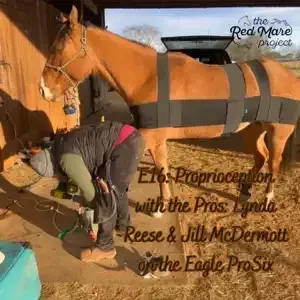
E16: Proprioception with the Pros: Lynda Reese & Jill McDermott on the Eagle ProSix
April 17, 2026
About this episode
Join your favorite red mares, Taylor and Kahlan, for another double feature episode! Today’s story isn’t just the story of one horse, but the many horses that are helped by Prosix Equine. Founders, Jill McDermott and Lynda Reese walk us through their inspiration for this product and all its different uses. Prosix is a whole body proprioceptive tool that can help support horses struggling with ataxia due to disease, kissing spine, body lameness from compensation patterns and so much more. They even have dog sizes! This incredible tool helps creatures big and small from training time to rehab to hospice care. Grab some snacks and settle in to hear the inspiring stories Jill and Lynda have to share., as well as some solid science. To learn more about the Prosix and purchase one for your horse, visit their website at: https://www.eagleprosix.com/ Link for the research study discussed: https://pmc.ncbi.nlm.nih.gov/articles/PMC12892970/ Learn more about our showcased foundation, Teddy’s Legacy at https://www.teddyslegacy.org/ 📨Email us with your interesting stories. Your horse may be able to help another. redmareproject@gmail.com Taylor CL Schouten, MS, APF-I Hoofcare Practitioner Wild Hoof Equine LLC www.wildhoofequine.com Kahlan Ettere Equine management Wise Choice Equine Wellness LLC Check out our website: www.theredmareproject.com Follow along on Facebook: The Red Mare Project Instagram: Wild_Hoof_Equine
EPISODE TRANSCRIPT
— Welcome: Introducing Jill McDermott & Lynda Reese of ProSix Equine
Action.
Welcome back to another episode.
Today we are joined by the exceptional ladies at Prosix Equine.
The Prosix product is a whole body resistance band that has helped horses with everything from relaxation to rehabilitation.
We are so excited to hear about their journey in the development and use of this product.
Welcome, Jill and Lynda.
Welcome to The Red Mare Project.
Hello.
Hey ladies.
Hi.
Good to see you.
Good to see you both too.
Welcome.
It's so dark here.
That's because of our lovely weather.
Yeah.
I have a plant light on me or I'd be in the pitch black.
Okay.
Yeah.
Totally fine.
You look great.
All right, ladies.
Well, let's go ahead and get started.
So, Jill and Lynda, maybe do you guys want to tell us a little bit about y'all's lives in the horse world and how y'all came to create ProSix?
Like, what's the origin story?
Oh, well, it was actually through a huge county rescue going on here in our area.
Lynda, it was a long-term person who was never called to account for his neglect of his horses, and Lynda moved into the area and pretty much started a little momentum on resolving the situation.
So the county wouldn't prosecute unless they had a place to put all the rescuers.
So, Lynda's the one man made the call to me, because I had a large facility at the time, 30-stall barn in the property.
So, I agreed to help her out on the condition that she had to help me with any of the rescues that came in.
And that's how she met, because we ended up rescuing like 17 of those horses in one year.
And then the following year, it was like 16 more.
Woof!
Lynda would come out.
Yep, Lynda would come out.
They were all feral, like brood mares.
Nobody's gunhandled.
Yeah.
No halter training, needing anything.
Well, there are a lot of some of the issues, because, you know, you have feral horses, and you can, they range from young to old, and you can see the dysfunction in a lot of the horses.
And Lynda is a nurse, and I have a massage background.
And so we would talk about the issues some of these horses presented.
And in the meantime, you know, I have horses, and I'm not going to say I go out and buy premium horses.
I always get the ones I feel sorry for.
And meantime, Lynda bought a horse, and those horses came with the issues.
So in the world community we live, that's a few and far between.
And the resources are limited because they not only do horses, but they do cattle, and the cattle are far outweigh.
And so we have to be kind of self-sufficient.
Self-sufficient, right.
And with her background and my background, we were able to resolve a lot of these issues moving forward.
Make it quick.
We ended up having annual events.
We had a trainer's challenge where these horses were given a hundred days of training from volunteer trainers.
— The Trainer's Challenge: Wild Horses & Rescue Beginnings
And we had an event where they competed with prizes for first and third.
And at the end of the event, we auctioned off those horses to pre-approved buyers.
So cool.
We made it through it.
It was great.
And we made it through it.
Yeah, of course.
Yeah.
All of those horses.
Yeah.
So 33 in total.
But wow.
And, but that's how we became acquainted.
And ever since that time, we were friends ever since.
But the ProSix came about by all these problems we were talking about, solving with our horses.
And, you know, it was a barn invention.
Instead of a garage invention, it was a bus invention.
And then, you know, we started with, with, like you said, all these little tiny issues that we, like how do we solve this one?
How do we solve this one?
And so I love that Jill calls us creative problem solvers because we still handle everything that way.
What, what my brain lacks, hers has.
We put words in each other's mouth.
We can look at each other.
She'll go, you know what?
And I'll go, that's brilliant.
This is not the right way to work.
You sound like us.
Kahlan, this is us.
This is us.
That's awesome.
Friends after all that.
Like that said, you know, Jill McDermott's got a large facility because, you know, in following this case and it had picked up more and more followers of people that, that knew and I think, I think I kind of instilled the guilt in them.
I belong to the County Animal Society and I'm a dog trainer.
So I was out on a call past this guy's farm and he couldn't believe what I was seeing.
And so at the meeting that night, I said, I have a question.
What's wrong with that huge arm?
And everybody looked at the floor and I thought, no, we're the Animal Society and you guys know about this?
No.
It's been going on for like 25, 30 years and people were giving him hay, giving him food, trying to help.
Obviously in a hoarding situation, you've got mental issues, right?
I mean, it just, he did not, he could not see.
But going back to the vet, the vet said, so call Jill, because she has this big facility and the prosecutor had said, we have to keep them together because these are kids' horses until they're not.
So we have to keep them all together and we want just, just normal care and don't do anything else.
Like initially, just feed them, you know, cane water, just like, you know, white good shit and of course, they started improving immediately.
Yeah.
You know, we had body scores of one and two.
It was, it was bad.
It was really bad.
So I called Jill and I said, and there's some presumed pregnant ones and Jill's like, well, I can definitely keep pregnant ones.
— Jill's Herd Grows: Pregnant Mares & the ProSix Origin Story
You know, there's a handful and then her voice died quiet.
And she said, how many are there?
Yeah, yeah, we can do that.
Bring them over and picking them up and bringing them to a place and the whole thing.
Yeah.
That's amazing.
That's such a frustrating process.
I've been through that exact process and it is so frustrating and it's so like disheartening.
Like you said, the people were aware of it, you don't know how to help, specifically with hoarded animals.
It's like, it's so hard because there's so many variables and the animals are the ones that end up paying.
So thank you for doing that.
That's incredible.
And that's so cool.
You did your own like Mustang makeover, but it was like Michigan makeover.
That's so cool.
What an amazing use of resources too to think that like we have all of these animals that need a degree of training.
Let's turn this into a competition.
Yeah, but like we get fun, create some incentive for folks.
Yeah, it was, you know, being an amber person, I knew these horses had no chance to be a successful adoption unless they had skills. 100%.
So I know I had to have them at a point where people can handle them in the back yard.
Yeah, and believe me, I called all of the stakes around me, everybody to in order to come up with enough trainers to do it.
And then the second year was a little easier because I had some of my trainers come back.
Wow, that's so cool.
What a cool group of people.
Yes.
Amazing.
Jill's criteria for this was amazing though too.
And the events were better than Christmas.
They were so much fun to go watch.
Oh, I'm sure.
Trainers would show up with these horses and walk these animals calmly out of a trailer and they were wearing vultures.
And then they tapped them up standing by the trailers and they were doing a meet and greet where you could go around.
Ask which horse this was and ask the questions.
And we hadn't seen them for, what, almost three months because it was 90 days with the trainer.
So for three months we hadn't seen these horses.
And to see them all, all bloomed and glossy and tapped up and that is so cool.
So what was the, what was the formal name of the event?
If folks want to look it up and see like videos and stuff like that.
Back then I don't know if I was into social media because that has been a pain for Lynda and I.
Relatable.
Through this whole process creating a company, social media has been our enemy.
Girl.
And so we too, we called it Food for Horses.
It was our horses.
Food for our horses.
It was creating fundamentals, opportunity, options, opportunity, fundamentals.
And I forgot what the D word wasn't even my last name.
Sure.
I washed that T-shirt.
— Food for Horses: The Rescue Foundation That Sparked It All
It had all that on there and that had the names of all the trainers in Atlanta.
And it was called Food for Horses.
That's so cool.
You guys are so cool.
I know.
This is us.
It was finding options, opportunities.
Yeah.
That's okay.
Email us when you think of it, because I want to know.
Yeah.
Yeah.
And what year was this in?
What year was this? 2012 were the events.
Okay.
Oh, cool.
Excellent.
Then how did that segue into where we are now?
What was the next step for you guys?
You can see these horses came in feral, so of course they were crazy.
We're like, how do you get a crazy horse to come down?
So then we went into the squeeze shoe, Temple Grandin, and we said, okay, we're going to get these guys to come down.
So we thought of tension.
We thought of Thunder Shirt.
Wait, we just started.
You know how you bring it?
Yeah.
You know, right?
We thought of that.
You found a jelly suit thing.
Yeah.
When Russians, when Russian cosmonauts went into space, they, when they came back with zero gravity issues, zero proprioception, they had made this, what's called an Adelie suit.
You have to look that up.
A-D-E-L-I.
Yeah.
So it went away.
It was in our minds.
And then in my, you know, like I said, we equated this back to our personal horses.
And I had a horse that would go around the arena a hundred times and be the perfect horse.
And then all of a sudden, none of the blue, you'd end up in the middle of the arena.
And you're like, how did I get here to the end?
What the heck just happened?
Yeah.
And this is dangerous.
And how am I going to fix this?
And my trainer used to say riding is like going down a hallway.
And your hands and your legs are used to open doors in the hallway.
Oh, I like that.
So you keep contact, you know, keep all the doors closed and only you open them.
So I said, how am I going to close that door?
So he can jump in the middle of the arena when I'm riding, you know, because I'm just going off one of these days.
Yeah, you're going to get hurt.
And I thought, well, that, you know, making the wolf around not only calm sources, but that's going to create my boundary for him to stay.
The doors are closed.
We're staying in here.
Yes.
Yeah.
So can I ask a question?
Have you ever experienced a horse who reacted negatively to it seemingly out of like claustrophobia almost?
Really?
Wow.
No.
Wow.
We hear from a lot of people.
We form relationships with our customers because a lot of them call on me saying, my trainer said, my vet said, can you tell me more?
One vote from my horse is the most common question.
Ask about shimpers and wild noose and string halt and EPM and all these things.
Hello.
Our answer is try it.
That's why we always had a return policy on it of some kind to let them know that, hey, try it.
— The Return Policy Philosophy: Let the Horse Tell You
See what your horse says.
Because at the very least, we knew they enjoyed wearing it.
It was calming, it was supportive.
The changes that we had seen were so immediate and not that it's a miracle thing, but the calming is immediate.
Then after that, you have their attention.
They're curious and you see them shift and lose minutes and things and they really enjoy wearing it.
Can it cure something like shivers?
No, but what a lovely management protocol.
If you can give them a little bit of support and they can feel that.
Of course.
You know, sometimes we see, sometimes with the rowdier ones and the people that choose the turnout, you know, is a place to process and everything.
After they get through that initial process and use a really good rule, which Jill and I love, and it's right, it's I-row adjustment, you know, and then they stand up and they shake and you watch this shake go through.
Jill taught me about that one.
So you're getting all this information.
And sometimes after that, they start experimenting and they might do a hot lap or two.
And I think they're just testing to know about, yeah, is this holding me or can I move with it?
Yeah.
I think the more you're apt to get a buck or reaction off of them is if you put it on them and move up, you don't let it cross us.
You have to, and that's why we're so encouraging, please put it on them and please leave them stand there, at least 15 minutes.
Let them make it personal.
Let them decide what they're going to do because there's a heck of a lot of information coming in at that time because this is hitting on mechanoreceptors and maybe ones that haven't fired before are going to start firing.
We know they do because we start seeing the stamp stomping of their feet of muscle quivering when they first put it on, but it's leaving them alone.
When we first started because this thing came off, a spin-off of rescue, I used to go to the rescues because I wanted rescues to have this product.
And many times you go there and say, you know, like one of the horses I remember most is this horse didn't want anybody near her.
She was used to her handler and only the handler was familiar to her and she was calm with the handler.
But she didn't want people near her.
She didn't want noise, anything.
And they used her, of course, for me to use as a demo with people gathered around.
So there's people gathered around this horse.
So this horse is very nervous.
And what I noticed, and I still don't know why this happens because ProSix still has some mysteries out there for us, is I started taking the ProSix front loop and just squeezing it like this on top of her nose, you know, just backing forward.
— Front Loop Discovery: Unexpected Proprioceptive Responses
And then she started breathing better.
And then I started crawling up her head.
And what I noticed is you can go right over these horses' eyes with this product and they don't break it.
Something about that stretch, what are the ways this?
Pressure and release, pressure and release.
And I was able to get that on that horse.
And then we let her cross us.
They lunged her a little bit in it.
And she was calm.
Before that, she was flying out of the circle.
And at the end, we were just talking.
And as we were talking, people were creeping into the area and they were right next door.
And she was as calm as calm can be.
And that's what I do when I have an anxious and excited horse.
I'll creep that product up over there and have it very slowly like that.
And thing now called the Jill Challenge, where it's like, you're not going to get this on this horse.
And I was like, okay, we'll see.
We'll see.
Give me a couple of minutes.
So, that's all it takes in a couple of minutes, right?
Yeah.
And usually, if I can ask them questions about, oh, why and what are your concerns?
And by the time you get to my question, the horse is standing there, tears drooping, lip banging, processing.
Jill's had it on for a couple of minutes at that point.
Yeah.
It's like a magic show.
It is.
But you'll never get on that one.
You know.
No problem.
The only thing that I have ever told the customer, please take it off, is with the dog.
I think the owner had a very, very old dog.
And it was at the end of its time.
And she was desperately trying to get more out of him.
But he was so far gone in compensation.
But he didn't have the strength to rebuild and restructure.
And so we put it on him and saw that it was just too much for him.
Just too much.
He just sat down or lay down with it.
Yeah.
Probably pushing 15 or so.
Oh, wow.
That's our older boy.
He was getting along.
He could do the things he had to do.
Yeah.
That easily.
And so we just said, no, no.
Yeah.
And took it back with us.
We said, this just isn't fair to him because he's not at his age in his life where you want to rehabilitate.
Yeah.
Yeah.
Fair.
So is there, and you may not, may have thought of this, may not.
Is there a most common pathology that you see this used in?
EPM.
Yeah.
EPM because what we found is that you can rehab with the meds and the anti-inflammatories.
They throw a triton.
We'll often see improvement with that.
However, Jill had rehabbed several cases, and these were so bad.
These are the kind that you hear, or they called, a friend of a friend saying, we go out, assess the horse.
Horses that would go up rather than back up because they couldn't feel behind them.
— Ataxia & Danger: When Horses Can't Feel Behind Themselves
You know, and becoming dangerous to themselves and others, but when the infection was gone, they're circling to get places or they're sidewinding to get places.
I remember one in particular that was bad.
And when she heard APM, I'm sure she's thinking, marquee, that she's like, that's thousands of dollars.
I could do that.
And she's like, and I'm not interested in rehab.
I can afford to have one horse.
I want a horse that I can ride.
And Jill said, I'll pick him up.
But she went back and got him and brought him home.
And he had to lean on the side of the barn, lean on the stowa wall, he was dropping feed.
That must have been a scary drive.
He was really bad.
He was stroke-like.
He was stroke-like.
Yeah, it was one of the worst ones we've seen.
But again, with meds and time, and then the ProSix on constantly, and on a horse that's so severely ataxic that it's a huge fall risk.
Yeah.
There's no time limit.
You put the ProSix on, and we used to tell him to do your skin checks and everything, a lot less really with the new ProSix.
Now, a lot of people come back, because it's better cabin and everything.
He came back, and he and several others, and we never knew rebound was a thing, a relapse, I'm sorry, was a thing.
We're following these EPM support sites, and people are talking about, well, then he relapsed two months later, and then he relapsed the following year, and we understand about stresses, weather changes, all these things that might, but it was like there was a piece missing.
I feel in our best guesses and educating guesses and thoughts, if you address the damage done to the neural system, because we know that an advanced case that, well, I don't even know how to advance, maybe we don't even need that word.
With BPM, you lose the myelin sheath on the nerves, right?
The destruction there.
So equate that to MS, people are more familiar, right?
And you can have, we're meeting relaxing, and yep, the anti-inflammatories work.
Somehow with Prosix, you avoid that.
I wouldn't say across the board, but I don't think we had a horse that was re-abusing the Prosix when we went through that process.
Well, we have people that use the Prosix, they give it results within a couple months, the horse is cured and they sell it, the Prosix.
Oh, that's true.
And then a year later, they're like, oh, my horse is relapsing.
I think once you have that kind of narrow destruction, you have to refresh your heart.
You want to refresh, keep refreshing, you want to activate those mechanoreceptors in the body.
And it just like, I think it's a, it's a full health well-being protocol for everybody, animals and people.
— Full-Body Wellness Protocol: Activating Mechanoreceptors
You should be activating those mechanoreceptors all the time.
And that's why we see itensia in aged people, aged animals.
You know, my dog can't get in the car anymore.
My, my, you know, this person can't maneuver in here.
I think if they would be wearing products like our Prosix, is a neural reset or a neural activation system.
Like a reminder Yeah, we would not be fading as the age.
Well, you can, the guys, I will.
It's always regularly rotates.
Like it's your day to wear it for a while.
In the winter, I am really bad because I hate winter.
And they have blankets on.
So they hardly wear it in the winter.
Yeah.
But starting in April, through probably December, they have to wear it at least once and make it twice a week.
And I have senior horses.
And my senior horses do not look like senior horses.
Beautiful top lines.
They still move an extension and they're whole movers.
I love that.
And when I ride them in the summer, I do work them.
And I need to be on the lens line and something with it on.
They get their reminders all the time.
Yeah.
And likewise, Lynda and I have products that we wear that remind us.
Yeah.
Because it's amazing the difference, right?
Yeah.
I mean, our body works in such a way that it shifts attention away from areas that aren't functioning very well.
And I suppose that's a self-preservation thing.
Of course.
And you shift into compensation patterns without being aware.
Well, a good example of what you can imagine your horse is feeling with the ProSix is, I recently started doing the treadmill again, and I was letting go of the handle, something, you know, I wanted to see, you know, the first couple of times I held on to the handrails when I was walking the treadmill.
Then I decided, I'm going to let go, and I'm going to start doing this and get more calorie burn.
And I can do it.
Yeah, I was falling to the side.
I was so, I got my light ProSix instantly.
Instantly, 80 percent better.
Wow.
There's a confidence with that.
We've seen it in the horses.
And it was really amazing to deal with what it feels like.
Taylor, did you have a question?
Yeah.
Yeah.
I wanted to go back to the Adelie suit because I feel like that's a really important piece.
And it kind of ties into the origin story.
So if any of our listeners do want to check it out, it's spelled A-D-E-L-I, the Adelie suit.
And it really sounds like this was kind of the, not the inspiration, but a lot of the premises came from this.
Yeah?
It was the Adelie suit and Temple Grandin's squeeze shirt.
Because like I said, we were dealing with a lot of, a lot of anxiety with those rescues.
Yeah, yeah.
Because I'm looking too at this and they use this for, for rehab for children, for the product that I'm looking at right here.
— Children's Rehab Parallel: Patient-Led Movement Therapy
But it's, it allows the patient to choose how to move if they have movement problems.
So it helps them be able to counteract gravity, which is why it works on, why it worked on the Russian cosmonauts when they came back.
Oh wow, this thing looks crazy.
Yeah.
That comes from disuse.
So now think about a horse on stall rest.
Yeah.
You have a horse and, and you know, whatever it is, you know, and the vet is saying stall rest, you know, that's it, you know, and boy, a few months in stall rest, you're not an athlete anymore, and you've lost a lot of perception and awareness, and you're unstable, and yeah, what that does to them mentally as well as physically.
Stall rest with a horse wearing ProSix is, now they're having a more or less a posture band reminding them, and they're doing isometric exercises in their stall, so they're working and they're getting better.
People don't believe that you can make great gains on stall rest, but you can.
Yeah.
Well, if you look up isometric exercises and start doing some of yourself as a person, they're not easy, they're hard.
Yeah.
And then also too, because anytime I mention it to someone, a lot of people will ask like, well, what's the difference between ProSix and the equi-band?
And recognizing that the equi-band really just works on the back half of the horse and still needs a handler, the ProSix is more independent use for the horse, because they're the ones who are running the show.
And actually, the research article that hopefully, we'll get to that in just a little bit, they do a really good job of teasing apart that the ProSix is a whole horse approach where the horse can actually be in charge of what they do, so they self-regulate within it without the need of a handler.
And then the equi-band only works on the belly and on the hind end.
So it's not a whole horse approach.
But maybe y'all could speak a little bit more about the difference, because a lot of folks do ask questions about like, well, what's the difference, because they both work on proprioception.
Well, I'll speak first on just as working a horse, and then Lynda can speak more on the specifics.
But as a handler of a horse and working a horse in bulk, in the equi-band, I saw my horses' hind ends being driven.
So their hind ends are getting along the stride.
And my horses were clipping the front of their feet because their front feet had no idea what to do.
The front end stride length even changed.
The back end was the only one that did.
That was what I was thinking was like, in the front is where they need, a lot of horses that I see and a lot of horses that I've had need more support than we think.
— Front-End Support: What Most Horses Actually Need
We, you know, you hear in training all the time, drive the back end, drive the back end, drive the back end.
But that doesn't really teach the rest of their body what to do.
You're just expecting a lot of the back half of the horse and you're not talking to the front half.
Right.
And they're only saying, oh, it's a 40, 60 situation.
You know, you went 60% on the height.
Well, they're finally starting to realize that that is not a thing, that there has to be equal load.
And that's why I said now, you know, as a horse owner, putting on the apparatus and watching it, that's what I saw.
But Lynda can speak more for the difference of what happens in.
And understanding how we approach all this, the horse tells us and then we run and look it up.
That's how it should be done.
You try something new, yet from the first time we put our first, you know, made of girdle material, the first time we put our ramp on and we look to the horse boat, what do you think?
You know, and so we're looking for things.
So when we hear people worry about the fact that it may be compression on shoulders and joints in the front and you got to get that thoracic sling free and unencumbered, you have to do this and that.
And I'm thinking, okay, but that's not what the horse is telling.
Yeah.
Well, with the thoracic sling, free and unencumbered is only good if they're not using that freedom to load in a compensation pattern because they're uncomfortable somewhere else.
Hell yeah.
Hell yeah.
Yeah.
Excellent point.
But what we actually saw was a lightness in the front, a lightness overall.
One of the tests that you can do, if you have a firm surface, you're looking at lameness and they ask you that, jog a little on a firm surface and it's listening as much as it is observing.
You're looking for weight load on each limb, and that sound, it changes with the ProSix and it gets lighter.
Because they are aware of that mode control, they were lighter in the front, and the front and back were talking to each other because the connection.
That band, we thought of all these different ways to describe it in the beginning.
When we talked about having a full signal, a lot of full signal with ProSix.
Stuff is turning on.
It wasn't just from behind or just from the front, and all these things.
People do a lot of work in the front with vibrance and tie downs, and just the bidding and the way that they hold them tight and all these things.
So the beauty of putting the ProSix on a horse like that was to see those releases, and to see them start to use even though their nuts were poorly muscled because they had been in control.
— Watching Releases: Poorly Muscled Horses Start to Move
Watch them get some of that back.
Which basically circle back to the difference in the apparatus is their product has to have a girth.
We had so many horses in our lives that have come to us with birth issues for obvious reasons.
We needed the abdominal lift to support the spine.
We knew that was a good thing.
That's why we went so wide on that band.
Again, the communication.
Where do you want to target the horses getting the full message from the brain, from the central pattern generators, and the spine, from everywhere?
Where does that information come all together?
You really need to hire the mechanoreceptors and the sensory apparatus all the way around, the whole body.
We have a video of a dog that had no- Oh, he's going to have luna.
Tell them about luna.
Oh, goodness.
We got contacted by this woman on the East Coast, and she did rescue, especially with pitties.
Love pitties because they were so maligned, and she had a lot of luck with taking in the sponsors and re-homing them.
She gets a call from the small rescue she worked with.
They had a dog in a cardboard box.
The dog was about a year old.
The dog couldn't walk or sit.
The dog was paralyzed from midway in the back.
Going back, they thought.
No x-rays had been done.
Nothing had been done.
The owner just surrendered this dog in the box because she's incontinent and they're tired of taking care of her.
And she says, and I saw your product, do you think it would help?
Yeah.
Oh, they did know about that, didn't they?
They did know about that.
They had done scans and this dog was born with cerebellar agenesis.
Dog did not have a cerebellum.
Really?
There was fluid where that should have been.
That's rare.
They gave a horrible prognosis and just put the dog down because.
Yeah.
And we were asking ourselves, well, wait a minute, if the cerebellum is responsible for taking all that input and creating movement and generating patterns and all those things, what is taking care of that?
And a lot of vets were like, well, we know when one part of the body fails, the other parts will pick it up in bits and pieces as best they can, but we really didn't know with this dog.
The best she can do is try, right?
And so we were making all of our dog wraps.
They've always been custom made based on the owner's measurements.
So she sends the measurements in.
She supplied us with the videos.
But the first video she sent, she was like, oh my god, oh my god, and she's calling it.
She's sending these videos.
She had been using the front half of the help mug harness.
So very little support and everything, but it gave you a handle.
— Dog ProSix: Helping Canine Rehab & Mobility
And it was amazing to watch.
This dog was so enthusiastic and so happy.
She had a t-shirt on, I think that is just for like having the front half of the help mug harness.
Is this still the dog with the cerebellar agenesis?
Or did you say that dog was euthanized?
Really, because they can't...
Not euthanized, no.
But she said, I need this dog to be moving because I can't just leave her in a crate or laying there.
She needs to build up muscle.
You know, she could be utilizing her limbs.
She put the ProSix on, you know, with...
So in the picture there's a help mug harness and a t-shirt and she's wearing the ProSix and the dog starts developing a gait pattern.
And it's sporadic at first.
The hind end is kind of bunny hopping, but the front end is walking.
And then the hind end starts to separate and it starts to walk.
And then the dog on the video squawks and urinates for the first time by herself.
First time she'd ever peed by herself upright and doing like we would do.
Lone mind thing was, okay, you don't need a cerebellum for patterns.
So we know the body is so much more than we.
Yeah, it's not just that one.
Because that pattern developed from somewhere.
So again, it's like you have to provide all the information for remapping.
And that's where it falls short because they're targeted areas.
Yeah.
You embrace the whole body.
If you're worried about Taylor.
Yeah.
Yeah.
I just wanted to give a little bit of context because a lot of our listeners might not know what a cerebellum is.
So I think it might be kind of helpful because we don't want to just kind of rush over a lot of stuff without giving some context.
But it is really rare that this dog even was born without one.
Because for human cases, there's only 10 cases of humans born without cerebellums.
So the cerebellum, it's yeah, that's why I was like, Jesus Christ, that's crazy.
But it is in charge of balance and coordination and motor control.
So a lot of things that we do, that we like don't think about like walking and thinking, or like riding a bike and chewing gum, or like being able to tie your shoes and not think about it.
A lot of that automaticity comes from our cerebellum.
So that's where the shock that this dog was able to actually just like go to the bathroom independently, that's all controlled by it.
Enormous.
Yeah.
And it sounds like what was happening is that the product was allowing this dog to really hone in on neuroplasticity, which do you actually know how old this dog was?
About 18 months, if I remember correctly.
So still young.
So I'm actually curious because neuroplasticity is at its peak during adolescent or child year.
So 18 months, that's a very rehabbable age for all species really.
— Age & Rehab Potential: Young vs. Older Horses with ProSix
But I'd be curious if there's more rehabilitation potential using the Prosix in younger versus older.
But I guess it all depends on what the pathology is.
And the situation.
Yeah.
Yeah, the decrymity in it.
But it's often enough that in studies of people, and we're talking about people with Alzheimer's, people with Parkinson's, people with other, even the Alzheimer's ones were probably the Lewy body with the dementia features.
Oh, sure.
Black.
Where I was going with that is they determine now that neuroplasticity does not end.
It doesn't end, it decreases.
It does not end, it decreases.
It does, but they used to think that older people, neuroplasticity was not available.
That was not going to happen.
They prove it to all kinds of different things that it does.
It's just how you reach all that.
What methods are using to reach it?
In Parkinson's, they were experimenting with amelading patients with a gait belt and everything, but having more headphones with music.
They could tap into because as the timers, and I believe in Parkinson's as well, there's a regression with the memory.
The music could hit them back, and actually they could dance before they could walk.
It was a little bit of a thing, but it went to the noreclasticity.
One of the things that we see as a mistake in rehab is when you approach physical therapy and in working with all of that, using repetition and using learning and using training, and that's walking the side down, and you're using the lip as an extension, and you're tapping and diving and training, why are we trying to teach something that the horse has always done without thinking about and our approach healing from the wrong pathway?
Yeah.
It's better if it's signals that they take in and they work with, and it goes to that nervous system pattern.
So you're not training, that's why we're advising, and no less, put it in the stall, put it in a small supervised tree.
Start with those things in the beginning, particularly if it's severe, and you need to be able to talk to the brain, and give them that sensory information, and in that vein, we describe what we've done with horse and dog products.
If you think of the ProSix as an external stimulus, you give them that feedback that they're not getting from their own body.
Because the premise behind the Adelie suit and these other suits is wrong.
That you can provide externally, but the connections they don't have internally.
Whether it's thorough damage, when you're having to totally be wider inside, or if you just need to wake up those pathways that aren't being utilized.
I guess off of that is a good time to ask, logistically speaking, like someone, mine will be here Tuesday.
— Taylor's ProSix Arrives Tuesday: Excitement & Logistics
Yay.
I'm so excited.
Oh my gosh.
I can't freaking wait.
I only have half days on Wednesday at work, so I will be flying to the barn as fast as possible.
I'm really excited.
My horse is a great communicator, and I'll send videos and all of that.
But say, a person who just got my Prosix, I don't have a horse with any severe neuropathologies or anything.
Where do I start?
Where is a safe place to start?
I think a lot of people, strap placement is a question, longevity of use.
I know that you had just said it was really important.
I think Jill said actually really important.
Fifteen minutes of processing time and then let them see where they want to go.
Those first couple of sessions, I like to go on walks with my horse.
I would probably, that would probably be where I start.
Just walks around the property.
It's an enormous property just to let him see how he feels.
And so I can hear, you know, like you said, hearing the difference on a hard surface.
That's enormous for me right now personally.
And I know a lot of our listeners can relate.
That definitely will be something that I plan on doing.
But is there a protocol for beginning safely so that you're not overwhelming them?
Smart.
I will not be turning my horse out in it because I will, that's a waste of money.
He will eat it.
I know, no matter how much he loves it and appreciates it, it will be confetti.
So that, I won't start there.
Okay.
We recommend that you start, because this is its sensory overload, you can see it in their eyes.
Their eyes kind of glaze over, there's an expression that they get.
They get that when you leave them alone.
We've seen that when we're working with a client and the horse is standing off to the side and nobody's throwing energy at the horse, and the horse is then free to process.
So letting them digest is the most important thing first.
So even though no attacks, no problems, nothing.
The other thing from a trained and behavioral standpoint that I really encourage is, their first question is, what am I going to do with this?
What are we doing?
Yeah.
Why?
Well, once the horse has been having issues, that can be anxiety producing.
Tiny attacking up and getting ready to go out.
Sometimes that look or the anxiety, they're starting to get revved up, but you can see those wheels turning and there's something about whatever they asked them in and can they do it.
That's anxiety producing.
So we don't want to tie this to anything.
So when I say, go ahead and put them on the cross ties, brush them all up, if they do all the things.
And now I want you to go back to the stall, if you can, if that's available to you or to a small turnout area, put the ProSix on and just leave them be for a bit.
— Introduction Protocol: Start in the Stall, Let Them Be
So that that question doesn't come up, what do you want me to do with this?
No.
I mean, and you.
And use it like one dessert.
And it's very interesting to see those things that Jill talked about, you'll see.
And they'll practice picking up feet, they'll shift the latin behind, they might stamp.
There were a number of videos that came up initially where people were saying, we want you to help with the fitting.
We're happy to go with what's at whatever.
We're happy to go with you to the barn and help you adjust this on your force.
And they would say, oh goodness, the flies must be bad and go for the fly spray.
It was more of a, it was more of a girl thing.
Like they were sensory seeking.
It was a sensory seeking.
Or the nerves were itchy because they were turning back on.
That's a lot of thinking.
Like when you fall, it's a lot of thinking.
You get rid of that.
I think that accounts for some of the rolling that you see too.
Sure.
Oh.
And I will say from a hoof care side, because the ProSix came to me just from my hoof care community.
Molly Agar and Kelly Roach were kind of like the, they were the, what's the word?
Yeah, they were the ones who introduced me to it.
And Lynda, I remember you told me when, before I got mine, because there's a case in particular that I wanted to try it on.
And you said, just put it on him, let him sit for like 15, 20 minutes in a stall, just hang out, or no, 10 to 15 minutes, keep it quiet.
So we put it on him and I went and I trimmed the other horse.
And we just kind of kept an eye on him while he was wearing it.
And dude fell asleep.
Like we put it on him and he had, he had his hay in front of him and he just, he just knocked out and it was, it was kind of bizarre because he's a bit of a busy guy.
But his ability to stand for that trim was, I would say like if I had maybe 80 percent better.
And this horse, yeah, and this horse in particular, we don't have a formal diagnosis, but he flipped over and he crushed his withers at some point in his life.
And we're pretty sure he presents, he checks all the boxes of wobblers.
I'm pretty sure that there's some gastodontic process in there.
And he has some spinal cord compression.
And he's very challenging to trim, very challenging, because he's where his body is.
You know, he kind of uses me as a wall, which the only reason why I allow it is because he's a very strong.
Well, he's a clear communicator.
But trimming him with that on, I mean, that is going to increase his longevity.
I couldn't even tell you.
I couldn't tell you just exponentially.
— Balance & Safety: Keeping the Horse on Its Feet
Taylor, doesn't it seem safer too?
Keeping balance.
Yeah.
Taylor, my friend has kept safe.
Yes.
Bring it to Jackson.
I will.
I will.
There's so many horses on there that I was thinking about bringing it to.
One in particular was Shivers.
When he picks up the Shiver legs, he's so off balance on his stable leg because he just when he flies all the way up there.
Yeah.
Which actually makes sense because Shivers is more of a cerebellum disease than anything.
That kind of ties back in to what you were talking about with that doggo.
Right.
Right.
So please get them that information.
Yeah.
Then your next step is the walk.
The walk is a powerful rehab gait.
Yeah.
Feel the gait all four feet hit the ground.
It's the mother of gaits.
Yeah.
If you want to rehab, rehab at the walk, please.
Because a lot of people want to just zoom and go to those faster gaits, but those are the gaits that it's most easy to compensate it.
Oh, true.
Rehab at the walk, please.
Process, walk, go slow.
Increase time.
Then we can move to the trot.
Through all this process, we're saying, don't add poles, don't add hills.
Just walk.
Just walk.
Just let them go.
Go slowly.
It all improves the horse.
You're improving the horse along the way, so there's no hurry.
Then you can get to your poles and you can raise them, and you can do all the challenges.
You can do your trotts, and then you can go on your saddle.
But it's like, you know, be the piper.
Yeah.
Yeah.
Yeah.
We're all about teaching self-balancing, self-carriage.
That's what this is about.
Because there's no learn dependence with the Prosix.
We advise that if you get them on a regular schedule, have one or use Prosix for maybe three days and have a couple of days where you do exactly the same thing, but no horse steps.
Get the body a little challenge at that point, now that we've gotten used to it, and you'll see that they don't lose anything.
You brought up Shivers before.
We did have a horse in our program that somebody kept the journal.
When you mentioned the journal, I thought of her immediately.
Yeah.
She kept the journal.
Her horse was diagnosed with Shivers, and in fact, went through a program at Michigan State with Shivers.
Anyway, she started her horse on the ProSix and did the protocol very slowly, because he was dangerous to her.
Now, she uses him for jumping.
He was a thoroughbred rescue.
Wow.
Yeah.
She got him out of a thoroughbred rescue, and he is no jumping and competing.
Wow.
That's amazing.
Excellent.
I would like to talk about the research study though, because I feel like that's such a huge milestone for y'all.
How did- Yeah.
Yeah.
We don't need to do a full peer-reviewed analysis of it, because it is a peer-reviewed article, which is terrific, because that puts even more feathers in your cat.
— The Peer-Reviewed Study: What the Research Actually Shows
But what I really appreciated from it, it really drove home the value that it does decrease cortisol, which is tremendous.
We found increased range of motion, and then it actually helped to decrease muscle tension in the semitendinosus, which was huge, because that I see is so overdeveloped and so stressed, and sometimes they can actually become fibrotic because of that.
So it seems that it's kind of, it's, I don't want to say like turning back time, but kind of.
So you see the effects of compensation then, and the tightening of these.
Oh, yeah.
And we talk about that, in compensation, they often use muscles of movement to try to stabilize themselves.
So trying to get, using the correct muscles to stabilize themselves.
Yeah.
So the hand patterns is a huge thing.
Now, the study was a wonderful thing.
Yeah.
It gets validity that we needed to learn.
We know that you have lower cortisol.
So you're putting them in a place where they can learn, and they can learn to regulate their nervous system too.
So I've always felt like I personally struggle with anxiety, and my horse and I are extremely close.
We've been together his whole life.
I've been his only human, and that obviously transfers to him, right?
No matter how much I think I'm controlling myself, I can't lie to a horse.
You can't lie to a horse.
It's not possible.
So I'm really through training, through rehab, through his injuries, through just his lifetime, I've always felt like no matter how well we're doing, whether he's in a sound period of his life or not, there's a wall.
It's like I have half his brain for learning, but the other half is in that survival, like what if, what if, what if, what if, what if, what if, what if.
And that's where I live.
I live in that place of like, okay, I'm focused and I'm doing what I need to do, but there's a wall.
And it's that anxiety, that excitatory state.
And so I'm really excited to see, because I've lately, he's been less busy.
He's very comfortable where he's, where he is right now, but his body is not comfortable.
So I'm really excited to see if that maybe helps with that wall that's there because it's like he wants to be present, but he's always got other stuff going on.
Yeah.
I'm thinking it's going to help.
Yeah.
It's going to quiet his brain and open it up to learning.
Like I said, when you have low cortisol, you know.
Yeah.
What I've noticed as a rider with Prosix on and going through the steps, the baby steps and getting up to riding, is that when I got on my horse, the first time with Prosix on, I felt 75% of that micromanaging going away.
— Riding with ProSix On: A Changed Experience in the Saddle
The micromanagement went away because he was doing it himself.
Yeah.
Well, they probably appreciate that so much from like a trust standpoint.
Exactly.
So their attitude towards me was, oh my God, she's not taking on me.
Get out of my way.
Constantly after me.
I will say our relationship got better.
That's to me like a horse's comfort and your relationship with them is like as paramount.
I don't care what I'm able to do.
I don't have any goals other than him being happy and comfortable and us having a good relationship.
I think that that's part of the reason that we do this podcast is to highlight that those are always the most important things.
If you have those things, you have everything.
When you're seven years old and you're a little horse girl and you want a horse so bad, you don't care about all the other crap that we put weight on.
We care about having a pony that we can brush and love and trust us and we can go on a walk with.
Like that's like a dream, right?
And then as we get older and we have these expectations put on them and then money comes into play, there's so much pressure and the horse has to carry it.
That's not fair.
So I'm just going to go on a walk.
I'm so excited to go on a freaking walk.
Just, yeah, Taylor, you had something?
I'm just kind of piecing it all together because it's kind of, I guess, I mean, it clicked and it's something that like, I guess I understood, but looking at the study and of course, I'm always going to go back to the study.
That's just kind of my nature.
He's a nerd.
I'm a big nerd.
But so the takeaways from the study, I'm just going to keep going back to it because I think it really just kind of like solidifies the ground that y'all are standing on.
So they found that there's going to be increased range of motion in the carpus or the knees and the tarsals, so the hocks and the shoulder.
So all three of those are going to have an increased range of motion, but then also the back angle increase.
So they're actually lifting their backs, which by doing that, that is going to take tension off of the semi-tendinosis because that was bearing most of the weight.
And I'm so curious now, there's two questions that pop into my mind as a hoof care provider.
If you have a horse that just wears the ProSix, what that would do to plant our angles?
And then if that could actually play a role in Hilo syndrome because it's going to balance out carriage.
And there's a million things that go into Hilo where one foot is higher than the other.
Often times you may have a front foot that isn't necessarily clubby, but they could be just high, just a high foot.
— High-Low Hooves & What ProSix Can Reveal About Balance
And then another foot that's usually is pretty squished.
And there's a million different theories about it.
You ask 10 people, you'll get 20 opinions kind of thing.
But I'm curious if just wearing the ProSix without any other interventions would have any type of impact on perhaps Hilo or low or negative plantar angles.
Because if they're overbearing, if they're overusing their semitendinosus, their hamstrings, they're likely going to be crushing their heels on their hinds.
So I wonder, I mean, I don't know, we haven't seen it in action, but if that might actually be a piece, if that makes sense.
You know, that's curious because I have a lady that's, that just started journaling the ProSix with her Crescent horse.
And she said her Crescent horse always sped in the prosthesis, like the sternum to one side.
And she noticed that the sternum was centering.
Hi, I'm Bree, and a year ago, I bought my dream horse, Teddy.
But just eight short months later, he was diagnosed with wobblers and rapidly declined until I had to make the choice to let him go.
The only way I was able to get a diagnosis was by getting a CT scan.
Out of state, expensive, and honestly not accessible for most people.
But it gave me an answer, even though it wasn't the answer I wanted.
That's why I founded Teddy's Legacy, a nonprofit dedicated to helping horse owners get advanced diagnostics to make informed, compassionate decisions for their horses.
We also support research, education, and welfare.
I know what it feels like to love a horse and not have the information you need to wonder if you're doing the right thing.
I have a CT scan candidate who applied for a grant through Teddy's Legacy.
Someone who's in the shoes I was in not long ago.
Someone who loves her horse and is desperate for answers she can't afford to get.
If you want to learn more or support our mission, you can visit our website at teddieslegacy.org.
Now that we had a study done and there was some evidence that now we have other schools that are going, hmm, shall we pick it up from here?
Hell yeah.
Oh, which we really like because when we initiated this study, am I going to say that what she studied was what we wanted?
No.
But they said we have to start at this level.
But yeah, I see what you mean though with the first study because you have to keep it very basic and look at really almost primitive questions.
Because otherwise, if you just go for really niche questions right out of the gate, then you don't have any ground to stand on.
So you have to ask questions like, will it cure a lameness, which sounds so basic like, well, no shit, it's not going to make them sound immediately.
— Realistic Expectations: What ProSix Will and Won't Fix
It's not going to do that.
But you have to have very clear boundaries of yes, it does this, it does not do this.
So then you can have clear questions for the next study.
So typically, the initial study, which is what you guys did here, the initial study has to walk so the other studies can run.
And that's exactly what you did here.
This is huge because it opens up a larger study.
Like having, in your study, it was mentioned, like in the study that they needed something like 40 horses to adequately measure certain things.
That's going to be the future.
Like because this one was so informative and clearly highlight how helpful the product is.
Now, not only can it help more horses, but we can get more horses, like not we, I'm over here, but like more horses can be part of this and be teachers for it so that it gets the word out.
Like that's enormous.
And me, I'm like, I want to see Nero, Nero.
And they're like, here's.
Whoa, whoa.
And Nero's way out here.
Well, of course you do because you already know, it's the capacity for good that it has.
You already know what you made, right?
Like you've already, you've been working with this product since before it was born.
So of course you have these like lofty goals, these expectations of it because you trust it.
Unfortunately, the nerds at school have to go through a little more scrutiny before they can make those claims.
But you're going to have them And it's super exciting that all that's going to come out.
So I think as we're approaching an hour and a half, this is typically where we try to get in our questions that we've had submitted from our listeners.
Like Taylor said, she's got a really badass group of farrier women that are just the coolest, smartest.
Oh my gosh, I'm upset.
I'm like a fan girl for these women.
And they had a couple just like logistical questions so that as they're using it on their clients, as they're recommending it to clients to buy their own, as they've got their own horses, they can answer these questions.
Taylor, do you want to go ahead?
Yeah, yeah.
Okay, so we actually already spoke about one of the questions was like the placement of the certain straps and like why they're there, but we kind of already went through that.
Like the belly band is to lift, the front and the back is to remind, hey, you have a whole body, use it, right?
One thing that did come up twice, and this is almost, this is kind of a silly one, but it's not.
So mayors who wear it long-term, how do we keep them from peeing on it?
Oh, we have a sleeve here that's made out of scuba material.
Oh, I'm listening.
It actually goes, it wraps around the rear bands, and goes across the whole thing with a velcro, and it's just there that you can put it on there and take it out and wash it easily.
— Fit & Design: Rear Bands, Velcro & Easy Care
Most of the urine goes off of it and beads off of it rather than soaking in?
Yeah, so you don't have to wash it too much.
Thank you, Raul.
But we do have a cover, more or less.
We call it a sleeve, but it's a cover.
Yeah, it's a protector.
Okay.
There's a couple of horses that it's been used for hospice care.
So it's been not a 24-7, but damn near 24-7 kind of thing.
But both of these horses who wore it as hospice care were gelding, so they didn't run into that issue.
But one of the first ones being Otis, who we spoke about on our last episode, he lived in that sweet boy.
And then another one, and this is a bit of an aside, one of our good friends had a border whose horse had a degenerative disc disease.
And as I share it, I don't have consent to say the name, but as this horse wore it or before he wore it, he kind of crab walked and he couldn't really get around.
And it was a very atypical, very irregular gait.
He was very off balance.
He really couldn't exist in the wild independently.
But when he wore it, it gave him six months of quality life as he wore it.
It extended his lifespan by six months.
Just because the proprioceptive awareness just turned on so loudly, he was able to overcome all of the disc degeneration and do his thing.
So, yeah.
That's when our hearts feel good.
That's why we're doing this.
We didn't look at each other and go, let's start a business.
We were both working full time.
We were both raising families.
We had all kinds of things going on.
Yes.
It was when we started seeing results that we said, we realized this is the responsibility now.
We said we can't keep this to ourselves.
No, there had to be some way.
Actually, real quick, going back to the quick questions, I'm assuming the answer is yes.
But for trailering, I'm assuming this would be very appropriate for a horse that gets stressed while trailering.
Absolutely.
Yeah.
Absolutely.
Because of that increased property section, we feel that they're going to shift a little bit more, move as they need to because they're going to feel it.
Their legs embrace against it, which is where you get the soreness.
When they come off the trailer so sore, sometimes with the deem, sometimes with all these other issues, we know that stressing a horse is hard on them.
Absent, they'll load better, they'll back off better if you have a little one.
All those things.
Anybody has any fit issues, they can text us with pictures, with video, and we'll make recommendations on how to adjust the straps.
Awesome.
And then you also said for the ability to wash it, I think you already said it, but can we actually put it in the washing machine and or the dryer or no?
— Care Instructions: Washer Yes, Dryer No
No dryer, but the washer on gentle.
Absolutely.
And use a mild detergent.
You don't want to use anything that's going to compromise the elastic, of course.
Got it.
Okay.
Ten years and ten years, but the elasticity stays.
Does it get soft?
Yes.
And here's another thing about it.
When it comes, it doesn't feel stiff, but it has a rigidity to it.
Yeah.
Sure.
We looked into that when we first got it.
That's from the manufacturer who used that particular elastic.
It's a heat set.
It's not a chemical set.
It's a heat set.
Oh, not bad.
It rolls it to roll smoothly onto the rolls smoothly and tightly.
The first time you wash it, you get rid of that and you'll notice that it feels softer.
You can crumple it and it bends better.
But it's not losing any stretch or anything.
Right.
Okay.
Awesome.
I will say mine just lives in the truck though, because there's so many horses on my books that struggle with the ability to stand and it's not a training issue.
I think that's really where the horsemanship comes in is recognizing when you need a trainer and then when you need physical support.
But that's the magic trick.
But mine lives in my truck and it has made a huge difference for a lot of horses that just need that little bit.
Just need that little bit.
Yeah.
Do we have any last wrap ups?
Because I am like, I want to go to the barn now and just like take videos of my horse without it so that I can compare.
I don't think so.
Yeah, ladies, we will put the ProSix link at the bottom.
But are there other ways that people can get in touch with you if they need to?
Or is the website best or Facebook?
Yeah, our mail, Info ads, the ProSix, we monitor that hourly.
And like I said, on our website, our phone numbers are there.
We don't have any text in us.
You know, I get texts from people through journeys.
And I love hearing, we love hearing these stories because if we hadn't heard these stories along the way, like the Otis story for one, we would not still be in business.
And I am earnest when I say that.
If we didn't have these stories to feed us, to keep going, we would not still be going.
Because like I said, business is hard, and especially for us, because Prosix is Jill and Lynda.
Yep.
That's her.
We can totally relate.
And we're inspired and appreciative of you, more than you know.
So thank you so much for your time.
Thank you for your open door policy with your clients.
We so appreciate that.
You're gonna, I'm sure, have a lot of people sent to you from us in the near, near future.
We're really excited about the updated product, really excited about my journal.
— Closing: Gratitude, Referrals & Taylor's ProSix Journal Plans
I gotta go buy a journal.
I'm gonna go to Office Max, I'm gonna get a journal, and I'm gonna go to the barn.
Enjoy.
Thank you so much.
Bye girls.
If you or a friend have a topic, story, or case study you want us to cover in an episode, visit our website at theredmareproject.com to leave your submission or email us at redmareproject.gmail.com.
If you have it, please include a cute picture of the horse we will be discussing so we can make it our Facebook page profile picture.
As a reminder for listeners, this content is for educational purposes only and is not meant to diagnose or treat.
We encourage everyone to do their own research and speak with your veterinarian and care team to make sound decisions for your horse's management.
If you like the podcast, please tell a friend, like, subscribe, and follow on all the platforms.
Peace.
NEVER MISS AN EPISODE
Listen on your favorite platform
Subscribe and listen to The Equestrian Podcast wherever you get your podcasts.
