
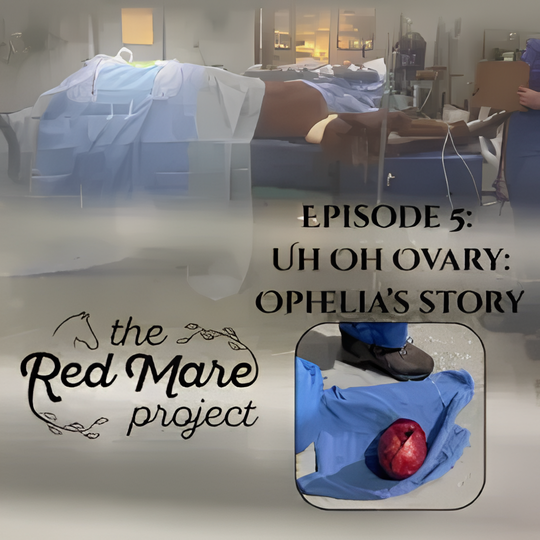
ABOUT THIS EPISODE
Kahlan and Taylor host their first guest! Sally Colbert is a life long equestrian and dear friend of Taylor. Sally was nice enough to come on the show and share the story of her own Red Mare, Ophelia. This poor girl has been through it, but Sally stuck with her. From radial nerve damage from a kick, EPM, a fractured elbow, and a very impressive ovarian cyst. Sally tells her story, how symptoms of all presented, and management. Today, Ophelia is sound and happy. Taylor CL Schouten, MS, APF-I Hoof Care Practicioner Wild Hoof Equine LLC www.wildhoofequine.com Kahlan Ettere Holistic Nutritionist Wise Choice Equine Wellness LLC Check out our website: www.theredmareproject.com Follow along on Facebook!
EPISODE TRANSCRIPT
— Welcome & Introducing First Guest Sally Colbert
Welcome to The Red Mare Project.
So I'm so excited to finally meet you, Sally.
I've heard so much about you.
Oh, hopefully good things.
All good, I promise.
You're our first guest, and we're so excited that you're our first guest.
Hey, I'd love to be your first, thank you.
And actually, so her, her mare, Ophelia, is, she is like the OG, the, like the big inspiration for The Red Mare Project.
So Sally's been gracious enough to share her story, which is a 46-page medical history.
In her defense, a lot of this is Coggins and shots, but meeting her, you wouldn't blink an eye.
You'd be like, all right, that tracks.
She is, I hate to say, the stereotypical Red Mare, but she has a lot of opinions and she wears them out loud.
She's also a thoroughbred and she's been a quintessential thoroughbred, and she's had a lot of issues that we've had to sort out, suss out, and it's ongoing.
I would love to listen to a podcast like this.
As horse people, to have a community to bounce ideas off of, we all want to do right by our horses, and to hear of something interesting or out of the blue, hey, that might make sense for what I'm experiencing.
I love that as a community, we can bounce ideas off of each other.
She fucking gets it.
Yeah.
Thank you for helping us with that.
Because it sounds like you've got plenty to say.
I've got plenty to say, however, I am a true adult amy, so while I do know a thing or two about a thing or two, there's a lot of things I don't know, and I can't speak as eloquently as maybe a vet or y'all could on certain things.
I mean, we're already doing pretty damn good, Sally.
Yeah, you're killing it.
Yeah.
Thanks.
I'm the personality hire.
Okay, I fear I might be too.
Everyone needs one.
Just like for a little bit of like back story, so Sally and I actually met in undergrad.
I found her, it was like a Thursday morning, and if you know the significance of a Thursday morning in undergrad, you know, but Sally was sitting on her tack box, I walked into the barn, and it's like, I don't know, the sun was up, whatever, and she was eating Taco Bell, a Crunchwrap Supreme, on her tack box, and I was violently hungover.
Yep, yep.
That beauty right there.
That's my buddy.
That's my pal.
And here we are how many years later?
Oh, God, let's not discuss that.
I know that I was 19.
I should not have been out at the bars.
And as a 31-year-old lady, I would simply pass away if that was my Wednesday evening.
Oh, absolutely.
I simply could not hang.
I would not be going to work the next day.
Yeah.
I think Taylor and I just locked eyes, and we were like, hey.
What's up?
I love you.
— Sally's Background & Her Bond with Ophelia
Love it.
Just, how are you?
Right off the, right into the D-Fan.
And, you know, one of the great things about Taylor is, even though we've lived apart for so many years, we've always stayed in contact, and horses in particular have always been our, hey, can we talk about this?
And let me bounce something off of you.
And I've just really appreciated that.
And hey, Kahlan, you might be now into that.
I'm going to start texting you.
Oh, we'd be bouncing.
We have a lot of bouncing.
We'd be bouncing.
We have like a 15-year running chat, and it's pretty excellent.
Yeah, I think we talk just about every day.
It's excellent, except when I need to find something.
Yeah.
Oh, you know, you can use the search feature.
We say a lot of the same stuff.
Well, you know, there's a little bit of digging in the weeds.
Yeah, it's okay.
It's fine.
Like a treasure hunt.
Yeah.
I guess if you want me to introduce myself a little bit to your audience.
Yeah, do it.
Which thankfully is not going to be me because I'm not going to listen to this.
I can't stand the sound of my own voice.
It's science.
None of us do.
It is science.
Thank you, lovely.
Thank you.
Agreed.
My name is Sally Colbert.
I have been an inventor for most of my riding career.
I started riding at nine.
We got my first horse at 11.
Second horse at 16, who I still own.
Her name is Millie.
We won't talk about her today, but she's amazing.
And then something happened and it broke in my brain at 26.
And I said, you know what?
I can handle a green thoroughbred.
That'll be good.
Two weeks after you got married.
Oh yeah.
Let's backtrack.
I got married and I don't know what happened.
I saw her picture online and I said, you know, I'm Jake, my now husband.
Hey, I've got plans to go buy this horse.
And he was like, hey, maybe don't do that.
And I was like, well, it's done.
So anyway, but we're still married.
That being said, he prefers the original horse, Millie, and Ophelia.
She's, he says, I'm in an abusive relationship with her.
Yeah, I guess that wasn't too much about my personal history with horses, but I've only competed successfully up through training level.
I've done half of a prelim.
I've got my good scores to second level in dressage.
I just kind of like to trail ride and pitter-patter around.
And my main goal as an adult amateur is just to have a horse that's comfortable and looks good when I take her to shows.
Amen, sister.
She's underselling it.
Sally is a Renaissance woman.
She figures shit out.
If there's a task at hand, she will figure it out.
She's very resourcful.
That's what I gathered.
Someone I've heard.
She makes it happen.
— Ophelia's Character: Big Personality, Big Problems
Yeah, which is why I think we have such, like she's been throwing all these obstacles with Ophelia and has conquered every single one.
And these are not easy obstacles.
So...
No, it doesn't sound like it.
No.
And we can get started on that if you want to dive into Ophelia.
Yeah, let's jump in.
The first one.
Well, one, she's still alive with, she's with us today.
So when we get into this, don't worry.
There's a happy ending to the story and it's that she survives.
She's a 2017 model.
She came off the track just before she turned physically three, but she turned three on January 1st.
They raced her one time in January.
She came in second to last.
I'm not sure why they thought she would race at all.
It's like cantering in place.
I just need to emphasize that before we get into it.
I like how there was a delay when you said second to last because I thought you were going to say she was second and I was going to be so excited.
I did too.
I was like, no, no, no.
To last.
To be fair, I think the only reason she wasn't last is because the horse that came in last place might have been injured.
So I cannot oversell the fact that this horse is a slow moving creature.
Beautiful.
That being said, I bought her and she came from Louisiana.
We drove her up to Mississippi.
She's going to R&R with my cousin and just eat grass and be a horse.
The first stop, this happened maybe about a month after I got her, she was kicked in the chest and what ended up happening was we weren't sure, because there wasn't an abrasion, we weren't sure what happened and her chest swelled up a little bit.
The vet was out.
It was a lot of bit.
It was a lot of bit.
Let me, yeah, let me back out.
This was five years ago.
Her chest swelled, the vet came out, he drained it and my cousin sent me a video.
I live in Tennessee, so this horse is four hours away from me.
And her, it was her front right leg was just sticking out and dragging the ground.
Like full-on paralysis.
Yeah, and this is within 30 days of me buying this horse.
My cousin's doing the best she can.
She has the vet out and the vet's kind of confused as to what could be causing this.
And a rare but interesting thing is it could be pigeon fever and that's a bacterial infection and it causes, and it's usually on the horse's chest or abdomen and it causes like radial nerve damage.
It ended up not being that.
She just got kicked in the chest.
Before we kind of figured out exactly what that was, my cousin was like, hey, this horse is not doing well.
It might be incompatible with life.
And I'm like, well, maybe.
I mean, the video that you sent me was haunting.
— The Kick Incident: Hematoma & Radial Nerve Damage
She had, I mean, the hematoma was at least the size of like a cantaloupe.
And her entire limb was just, I mean, it was just dead.
It was just a dead leg.
My baby girl, she looked so pitiful.
It was pitiful.
And she was just a kid.
That's so sad.
She was just a baby.
She hadn't even like officially turned three yet.
Her birthday's in April.
And she's just, she got booted from her first job, kicked in the chest by some mean quarter horse.
And she's just gimping along without wind beneath her sails.
What did you guys do for her?
What was the recovery?
She got, thank you for asking, because I'm trying to remember.
She obviously got antibiotics, anti-inflammatories.
I think she was on stall rest for a little bit.
My cousin really stepped up and cold hosed her every day, kept her leg wrapped because of course the swelling went down.
And then she, this was a pretty quick recovery once it, I think it was probably two weeks.
Oh, good.
And she got individual turnout.
I got videos of her gimping along.
And then eventually she just got turned back out.
And I was like, please avoid that mean horse.
Geez.
Make good choices.
But I'm sure everybody's had a horse kicked at some point.
Oh, yeah.
But like radial nerve damage, like that's kind of, that's kind of wild.
And I actually, I got to thinking a little bit, too, like the, like, because it made me think, like, the potential to develop Sweeney shoulder.
But that's like a completely different beast.
So like, Sweeney, that's connected to, like, the superscapular nerve.
But I guess the radial nerve can be connected to it.
But she hasn't had any atrophy or like anything connected to it since then, has she?
No.
She healed up great.
And you wouldn't know it.
But I, I wish I could show everyone the video through a podcast.
We can post it if you want.
We can put it in the show notes.
Oh, yeah.
Yeah, that might be.
Actually, that's a good idea.
We should do that.
I got lots of pictures and videos.
So, yeah, that was...
I have...
So, do you think or was the diagnosis just that the radial nerve was so inflamed so it wasn't like functioning properly?
Because I know if there was like true damage, I know in people nerves regrow at like a millimeter a month.
Really?
So, if there was like damage to the nerve that would cause it to need to literally be regrown, and that would have taken a long time.
So, like, do you think it was just the inflammation around the injury?
I think what he ended up saying was it was inflammation and it was almost impinging, and the swelling.
So something, like, I think the hematoma was pressing on the radial nerve that she needed to move her leg.
— Hematoma Pressing on the Radial Nerve Explained
Oh, damn.
That makes sense.
Yeah.
So, thankfully, it wasn't true nerve damage.
It was just...
That must have been so confusing for her.
You know, a fit racehorse, all of a sudden front leg doesn't work.
Bless her heart.
That's the song.
Yeah.
Okay, she's through it.
It was a quick recovery.
Her letdown was maybe five or six months in a field in Mississippi.
Lush grass, surprisingly, in Mississippi.
And then she came up here to Tennessee, where we'll get to the next fun bit of her history.
So, she came, horses coming off the track.
Everybody has a different experience.
She lost a ton of weight and muscle.
She wasn't getting 12 pounds of sweet feed a day.
So she kind of had to relearn, or her digestive system had to kind of re-function again.
And part of it, and a lot of off-the-track thoroughbred owners go through this, is abscesses.
Basically, as their diet changes, their body just kind of blows out a lot of stuff through their hooves.
And in particular, she kept getting chronic abscesses.
It was both front feet, right at the point of her toe.
And it would come up and out through her cornet band.
And I cannot stress enough chronic abscesses.
It would be like she would have a week of soundness, and then one would be brewing.
And then we'd get it out, the next one.
It was like six months of just, and these were big abscesses.
I have a picture of one of them.
You sent them to me.
And she still has, we reset her fronts yesterday, on both feet.
She has a crena.
So there's like actual, I mean, I would assume that there's bone remodeling in there.
Did you actually get a solar margin view, like a radiographic?
No, but I will get that for you.
Cause I'm pretty certain that she remodeled her coffin bone with all of those abscesses.
Yeah.
And it's wild.
One of the skills that she taught me is I can wrap a mean foot.
I'm sure you can.
Yeah.
In each class.
I could.
I can make sure.
I can tell you how to wrap a foot and it'll stay on and turn out.
And with abscesses, obviously, you know, soak, wrap, keep it clean, and movement.
You know, you want them to move and it to blow out.
That's it.
That's it.
And it's just a lot of people who think that you need to keep them in as soon as they're, you know, down from an abscess, as soon as they're unsound, keep them in until it blows out.
And that makes it take so much longer.
Yeah.
Yeah, you're so right.
You're so right.
And, you know, I think it's obviously like one of the scariest things as a horse owner to like come out and your horse is three legged.
And for some reason, even though abscess is most common, my brain never goes there.
— Misdiagnosis Fears & Ruling Out Abscess
No, it's not.
Oh, no.
Her leg's broken.
Yeah.
Call the vet immediately, alert the authorities, tell my boss I'm not coming in.
Yeah.
Well, and she's not stoic.
And they were, I mean, you sent me videos of her going when they were brewing and they were, I mean, she felt every bit of that.
Oh, yeah.
One thing about Ophelia Grace, and she is a redheaded mare, and she wears her ailments front stage on her sleeve.
She lets you know if we call her, and we'll get to this later, but the princess and the tumor pea.
Oh.
So she is the princess and the pea, any little thing, it's a level 10.
It's a big deal.
So we were working on her yesterday, Kahlan, just to like put this in perspective.
When we were working on her yesterday, something happened and spooked her, and it was, I don't know what it was, but it was something very small, and I literally heard the smear say, oh my god, like I actually have a child, and if you know, you know.
I do.
And I saw her grab her pearls, and...
Oh yeah.
Oh yeah.
Cameron, what was that?
Oh my god.
I love her.
She's a cool horse.
She's super cool.
Yeah.
She's beautiful, and sometimes that's all she has going for her.
But it's enough.
It's a good thing she's cute.
It's a scotly, it's a good thing she's cute, and she's really sweet despite everything.
But yeah, getting back to these chronic abscesses, just it was about six months, and I like how you said, you know, diet.
Just it had to work out of her system.
And since then, she really has not had an abscess since.
So it was six to eight months, I think, of just, you know, we were in the trenches, and I would, you know, lunge her for a little bit, maybe do a little bit, and then back to lame, and then figure out something, back to lame.
So.
And it was bilateral, too.
It was both fronts, right?
Both fronts, yeah.
It wasn't just one foot, and it was both fronts.
It's really good that you had the soundness of mind to know, like, this is temporary, this is, you know, like you said before, you think they're coming up, and it's always the worst of the worst.
But you know it's because you're doing right by her, and she's working out her past.
I would have been a puddle in her stall.
I would have been unwell for six to eight months.
I would have not been able to hold down a job.
I would have been unwell.
So it's so like she's so lucky that she had that, and you were like, okay, I know what to do.
This is temporary.
She's going to be okay.
And then she was.
And then she was.
One of us is allowed to freak out at any given time, and it's never my turn.
It's always her turn.
— It's Always Her Turn: Living with a Complicated Horse
So I get that.
It's usually my turn with my horse.
You have a gelding, right?
Yeah.
Oh, yeah.
But he's wide open.
Oh, good.
I need to meet this guy.
Your first episode, you were talking about it, and I was like, I really like Kahlan.
I love the way she speaks about her son.
See, that's my son.
Yeah.
And you have a delicate daughter, and she always has the turn with the freaking out stick.
Yeah.
She's never handed it over in five years.
I like that.
No.
I respect it.
Maybe one day.
Maybe one day.
He clutches it by her pearls.
Yeah.
So that was her history with abscessing.
I learned a lot from it.
And if anybody listening has a Thoroughbred coming off the track, and you're trying to reshape their diet, know that they have a lot of, for lack of a better term, junk to grow out of their feet.
And unless there's some other pathology, you know, that will pass.
Do you think a lot of times there's, I heard someone explain this to me, and I don't know how much science is rooted in it, but it makes a lot of sense because there's so much concussion on the track.
Like, I mean, these guys are just wide open that there's a possibility that, and their bones are still developing, that there's actually like little tiny, maybe little micro fractures in the coffin bone, like little pieces pop off.
And during that purging, they just, they're part of that expulsion process.
Yeah.
All right, I'm gonna start to get pissed off if we keep talking about horse racing.
Okay, I know how dirty it was last night too.
Oh my God, there were composites.
I saw composites.
I saw glue.
I saw glue.
Okay, progress.
So we were, actually, sidebar opened back.
Yeah.
So we had like a really great derby party at Sally's house last night, and this one horse walked in, and I had food in my mouth, and I just kept yelling, glue.
No one knew what the fuck I was talking about.
And they were like, Taylor, that's really rude.
I'm like, no, no, no, no, no, no, his feet.
Yeah, in any other context, someone staring at a horse walking across the screen yelling, glue, would hit very differently.
Oh, absolutely.
I get it.
Anyway, okay.
Back on track.
All right.
So we survived the abscesses.
We survived that.
Quick sidebar into how she got her name because this is around the same time.
Oh, essential.
Yeah.
So during one of the brief periods where she was sound, I was riding my older mare and I was ponying Ophelia.
And a horse fly bit her.
She takes great offense to horse flies.
And she came up and I saw hooves near my face and I let go of her.
You were leading her, right?
I was leading her.
She was in a rope halter.
So there's no breakaway.
— The Breakaway Incident & How It Happened
This is important to the story.
Oh, dear.
We live and we learn, however, she broke away and then realized that the rope was chasing her and she panicked.
I had to address that in training later, but that's not her medical history.
Anyway, she panicked, ran away from me trying to outrun that rope, flipped over a fence.
I think she tried to jump it.
It was a more slide flip, ran across the street into a neighborhood.
Meanwhile, I'm just sitting on my old horse like, well, this was fun.
Freaking out.
I would throw up, Sally.
I would throw up.
Oh, yeah.
This was my worst nightmare.
I'm thinking, all right, I've already started thinking, I'm going to have to call the police, report her missing, like she's going to be in the woods in the next county over.
I'm never going to find her again.
She's not going to survive in the woods.
Yeah, she's incompatible with life with the best of care.
So I see her, and I'm mentally thinking, all right, here's what I've got to do, XYZ, and this is the last straight.
I got my phone pulled out about to call somebody, and all of a sudden she comes flying back towards me.
So from into a neighborhood in the distance, she comes back into view, runs back down the driveway of the barn, and I had to yell at this little kid who was in the next door house.
I was like, shut the gate because I couldn't get in.
So anyway, we corralled her, we caught her.
She had a busted up nose, and she still has a scar on it from her stepping on the rope.
So I do feel terrible about that, and ever since then, I've spent a lot of time getting her desensitized ropes.
I can imagine, yeah.
Yeah.
You don't appreciate all the things that horses have to be desensitized to, to understand.
And you learn through.
All of that to say, as far as that's how her name came about, I'd already named her Ophelia, but I called Taylor pretty much in tears, explaining how I almost lost and killed my brand new off the track thoroughbred.
Taylor just was like, Ophelia Grace.
And I was like, that's her fucking name.
That's awesome.
We refer to her as OG or Ophelia Grace.
And when she's misbehaving, it's Ophelia Grace.
Oh, yeah.
Oh, Taylor will call my horse by his full government name.
Yeah, she's good at that.
I kind of love it.
Like when your mom gets mad at you and she calls you by your middle name.
If you pull out the mommy finger and do the mommy finger wag, it's a whole other level.
Yeah.
That's like- Oh yeah, I would be scared.
Oh my God.
But that was, yeah, I remember when you called me, that was, I didn't even know what to say because the story, I'm trying to keep up with all the things.
— The Phone Call: Trying to Keep Up with the Story
I'm like, why is she in a residential area?
How did she get there?
How did she get there?
I lost her for a little bit.
It's okay.
She came running back.
Just anyway, so follow that over horse fly.
All right.
They're mean.
I mean, they hurt.
Actually, that's proportional.
Yeah.
That's kind of how I react to a horse fly, honestly.
The reaction matched the offense.
Yeah.
Oh, my God.
All right.
So shortly after that, this is when the really big stuff started to happen, right?
Yeah.
So I had a couple of years, and I was very casual with her.
She didn't have a big job.
I would just kind of tack her up and putz around a little bit and try and figure out what was greenness and what was physical.
And that's been an overriding story with her, is what's going on in her body that is causing her to react this way?
Is it training?
Is it me being an adult amy not really knowing what I'm doing?
Or does she have a physical ailment?
And so leading up to this, we're going to get to like, this happened about two years ago.
In January, we started having a lot of explosiveness under saddle.
She's always been a bucker.
And, you know, she just, she didn't, it wasn't doing right.
She didn't feel right.
She seemed uncomfortable.
I'm trying to think of everything that, I thought maybe, you know, she didn't feel good in her body.
I had a massage therapist out.
I had the chiropractor out.
And that helped a little bit, you know, of course, as anything like that was probably going to help.
I had a saddle fitter come out and check her saddle fit.
We, you know, readjusted her saddles.
There was a lot of things that kind of came down, and I was like, this horse is just not happy.
You know, she's not acting right.
And we would have, you know, half of a good ride and then, you know, a bad ride.
And this would be in kind of a cyclical nature.
And that comes...
Hmm, foreshadowing?
Foreshadowing cycles.
So, I ended up, I took her...
Let me pull out my patient history.
I took her, I called the vet, and I was like, hey, she is...
She's just, she doesn't feel right.
I want like a soundness evaluation.
And he flexed her.
I'm talking away from the mic, sorry about that.
And we found a little bit...
We took radiographs of her hawks, and he was like, these aren't the greatest hawks I've ever seen on a six-year-old.
And he ended up prescribing her a...
We couldn't exactly pinpoint what it was, but she was obviously uncomfortable and a little bit unsound.
And he prescribed her an anti...
Like two different anti-inflammatories.
I think it was like a Equiox, some Butte and whatever that muscle relaxer.
— Pain Management Protocol: Equiox, Bute & Robaxin
Robaxin?
Yes, Robaxin.
Two weeks of that.
A hell of a cocktail.
Yeah.
Because it was like a rotating lameness.
Like it was just, it was like a floating body lameness.
Like it wasn't limb specific.
Yeah.
Everything was hurting.
Everything was hurting.
Nothing was right.
And the first thing that came to my mind with today's climate is, this might be a kissing spine or something like that.
Like she's obviously uncomfortable over her back, but it is translating into lower, different limb lameness.
Yeah.
So a couple of weeks off, a good cocktail, and then he was like, all right, and then try and get on her again and see how she does.
And she looked kind of okay on the lunge.
I tacked her up and I go to swing my leg over.
We walk, you know, maybe 50 steps that she just went up, just full on vertical with me.
And I was like, okay, yeah.
She does not feel good.
We missed the target.
That, yeah, good thought didn't help.
So I called back and I was like, hey, you know, let's do a recheck that, you know, that wasn't it.
And as my appointment was approaching, she started getting more and more unhandleable on the ground.
And she's got, despite what Taylor saw yesterday, great ground manners.
She's very respectful.
We don't need to go into that.
We don't need to go into that.
Don't worry about that.
So as, let me tell this funny story, how did the vet ended up finding it.
So right before our recheck, I was going to haul her in.
I was like, we're going to x-ray this horse from top to bottom.
I want as clear views as we can of her neck, maybe parts of her spine.
I know you can't get a good clear picture sometimes if there's a lot of muscle, and basically anything we can do.
He was asking about it and I was like, well, the barn manager has noticed, she's been acting a little studdish.
She's a mare and one of the men working at the barn, English is his second language, and he said, Ophelia, she tried to make Rachel, Rachel's her pastor mate, Rachel, her girlfriend, did not know Ophelia was a lesbian.
Wait, she started mounting.
Oh yeah, I forgot that.
Yeah.
Oh dear.
Whoa.
I was like, whoa.
All right.
I was like, hey, I didn't know either.
This could maybe be important.
I tell the vet this and I was like, hey, she's really sensitive over her back.
He knew that.
Rotating limb lameness.
Also, she's trying to make sweet, sweet love to her mare neighbor.
Yeah, her roommate.
He says, he's like, wait a minute, this might be something.
He drugged her up and stuck his fist up her butt and was going.
You know, so poetic.
Yeah.
So you know, hey, at least she, there was lube and she was on drugs.
— The Rectal Exam & What the Vet Found
So she didn't mind.
And he stopped and he said, hey, he's talking to another vet.
He's like, come feel this.
Oh no.
I was like, oh no.
Turns out her left ovary was the size of a volleyball.
Oh my God.
Holy shit.
For context, it's supposed to be the size of a lemon.
Yeah.
Whoa.
And the thing about, so he had a diagnosis like pretty much right off the bat.
What ends up happening, and it's pretty common in mares, it was a granulose cell tumor on her left ovary.
And it wasn't like a tumor that grew on, it was ovary and tumor together.
So, it was all one thing.
Okay.
I don't know the medical terminology, but when I think of...
All one thing.
Yeah.
All one thing.
When I think of tumors and stuff like that, it's something growing on top of something or in something.
No, it was just the whole ovary looked like a sponge, you know, just...
Oh, I think they use the word, it's like a beehive presentation.
Yeah.
I think that's the term that they use.
Okay.
I may be lying.
I don't know.
Heal her away.
Oh, yeah.
Did this cause her to produce more testosterone?
Yes.
Okay.
So he took a blood test, even though he could quite literally feel it and he ultrasound it too.
He ran a blood panel, and I have that written down.
Oh, for testosterone levels?
Yes.
No, it's over.
So while she's looking for that, Kahlan, I remember Sally sent me a video of her leading the mare out to her pasture.
Did you have a stud chain on her at that point?
I think I was using my rope halter.
You were?
Okay.
But when I was growing up, I used to board a breeding facility where they did live cover, and that's literally how this mare was walking, is if she was being led out to cover.
That's crazy.
She was flying a kite.
She was just walking out to the field.
Just walking.
I was thinking, the poor people at the barn who are leading her out, I'm scared of my own horse.
I can't imagine.
Yeah.
I hope they live.
Yeah.
They did.
They did.
Everyone's safe.
So her blood panel, it tested for inhibin, progesterone, testosterone.
Her inhibin was a little bit elevated, and that's typical for a cycling mare.
Her progesterone was consistent.
Her testosterone, and I'm quoting here, level is elevated for a non-pregnant mare.
So the reference range is from 20 to 45 pictograms per milliliter, and Ophelia had 296.6 pictograms per milliliter.
Oh dear.
Yeah.
That's like approaching normal for a human man.
Really?
Well.
Yeah.
No kidding.
It apparently needed to be quite low in mares.
One interesting thing about it though, because she acted so studdish, her muscle tone was great.
Yeah.
Oh, I'm sure she looks beautiful.
She looks stunning, stunning babes.
— Ophelia's Recovery: Looking Stunning Despite Everything
Stunning, absolutely stunning.
So she looked fantastic.
She just was the worst.
She was terrible to ride, obviously.
She was in pain.
She was terrible to lead.
She was very scary and she's just a girl.
She's literally just a girl.
She's literally just a girl.
So walking out into the field or just handling her, she was doing all that.
Out in the field, she was trying to cover her other horses.
What was she like in her stall?
It was a little hit or miss.
So back to being a little cycly, the vet explained it to me and he was like, because this tumor is making her produce so much testosterone, that he, and I'm going to quote him, his name is Dr.
Nathaniel Wright.
He said, when she cycles, her estrogen goes up, and then you have the testosterone that's already extremely high.
He's like, there's a lot of hormones going on here.
He's like, I wouldn't be surprised.
This feels, it's like an atomic bomb in a horse.
Oh, great to hear.
Actually, that does track.
She's traumatizing me, monthly, honestly.
I'm scared.
I'm terrified of this horse.
He used the word atomic bomb.
Yeah, he said it was like a bomb.
He's like, I understand everything you're saying based on this.
Once we figured out what it was, obviously, the only way to treat it is surgery.
It has to be removed.
So we tried to schedule it.
This was in early May.
So the Tennessee Equine Hospital, where she went, was extremely busy.
And we kind of had it scheduled for later on in May.
They were trying to work her in.
And I think that video I sent to you, Taylor, of her walking out, I was like, she's actually dangerous to be around.
Is there any way you can fit her in sooner?
Yeah.
And yeah, so they got her in, and within a couple of days, performed the overectomy.
And I got to watch part of it.
Oh, that's awesome.
Most of it, yeah, through a window.
It was a little bit like Grey's Anatomy for horses.
Yeah, I mean, kind of traumatizing, but also really insightful.
Yeah, it was cool.
The other thing is I had recently gotten a promotion at work, so I was getting paid more.
And Ophelia was like, hey, I need that.
Yeah.
All right.
I heard you like money.
I too like money.
Yeah.
She's like, I too have a requirement for your wallet.
Yes.
And so they went in through her left flank.
Let me see if I can find the exact terminology.
But underneath the point of her ilium and her hip, and before her stifle, like right in the mid, there's about a six-inch scar where they cut through.
And some of these they can do laparoscopically.
But her volleyball tumor needed to come out.
Yeah, I was going to say that probably was too big for that.
— Ovarian Cyst Discovery: How Do They Remove It?
That was too big for that.
So how do they do that?
Do they just cut it up into pieces and pull it up bit by bit?
No, they kind of like stave off the blood flow, you know, clamp it and cut all of its attachments and then just pulled it out.
Oh my God.
She, the doctor, Dr.
Allison Stewart presented it to me like a trophy afterwards.
You sent me a picture of it.
I thought I didn't have a way to preserve it and I wasn't sure I wanted to be that weird.
Did you keep it?
Oh, I would have kept it.
It's not weird, I would have kept it.
I have so much to thank for that.
And what's worse is eyeball and formalin.
Oh, hey.
Well, I would have needed a very large jar.
Like a bucket, really.
A bucket, yeah.
A bucket.
It doesn't make a good decoration.
Well, everybody coming over to my house, I would make sure to point it out.
Yes.
I mean, yeah.
So some of the common questions I get asked about this, because I tell everybody I know, if you've got a mare who's doing something weird, and mind you, one of the common questions I get is, how long was this brewing?
They don't really have a way to tell.
There's not a ton of studies on when they start, because once they're found, they're removed.
So there's no real timeline.
But it was extremely uncommon for it to affect a mare so young and not an older mare.
Usually, older mares, when they find it, it's one, not the size of a volleyball, maybe the size of a grapefruit.
And the reason they find it is because the mare has a hard time getting pregnant.
It is unusual for it to affect a horse to this degree.
And then, you know, soundness-wise.
That was going to be my next question, like the extre- not the extremity, but like the extent of it.
Because this was very severe, severity, that was the word I was looking for.
Severity, 10 out of 10.
Ophelia does nothing by half measures.
No.
Just red-line it.
Red-line it.
So like, do you know, have you thought about like there being any symptoms or like presentations or things like that, that she was doing like way early?
Like, if she was doing anything funny, like, okay, so on.
January is when it started.
May was when she had the surgery.
Was she doing anything like earlier in the winter or the fall that you think could have been like little baby cues?
Um, that's hard for me to maybe nail down because, you know, she's a green horse.
Yeah.
She's a green mare.
What, what is, you know, you know, she probably had some saddle fit issues.
Well, I know she did.
And when she cycled, I didn't know, like there weren't a ton of like little red herrings, I guess, so to speak.
Okay.
And if so, it sounds like they probably could have blended in with a bunch of other things that were also, they could have been more just like circumstantial.
— Behavioral Symptoms: What Was Circumstantial vs. the Cyst
Yeah.
That's horses in general.
Like, is this a symptom or is this?
Yeah.
Like girthiness, that could be a symptom of a million things under the sun.
So it's hard to actually say, like.
Yeah.
But weren't you telling me last night, like, oh, Kahlan, go ahead.
Well, I was just going to say, it sounds like you didn't have that much time experiencing what her normal was since you've owned her.
So you were still learning what her baseline was.
Yeah.
And I tell everybody, I'm like, when you have a green horse, in particular, if you're an amateur like myself, you're trying to figure out, all right, what's normal for this horse?
Because they're all individuals, they've all got their own little quirks and idiosyncrasies.
What's something physical?
What's something training related?
What's learned behavior?
And I still, even though I've had her five years, I somewhat know what's normal, but as soon as I say it, she makes a liar out of me and we have a new normal.
But that's a tall order to be able to parse out all of those.
I mean, granted, like, you know, that's our job, but it's still like, it's still a lot to do.
Five years is not that long.
Yeah.
Yeah.
Well, you know what?
Thank you for saying that.
Especially with everything that you guys have had to manage and problem solve.
Yeah.
She's had, she's thrown some curve balls at me.
Oh, another quick question I get is, what about the other ovary?
Because, you know, we all hopefully have two ovaries.
Yeah.
And I asked the vet too, I was like, while you're in there, do we want to just take the other one?
And he explained it.
He was like, well, we don't want to do that.
There's a possibility if you do that that, I can't remember exactly how he phrased it, but they would almost always be an estrus and she would be like cycling eternally.
Something would be thrown off.
He was like, don't worry, she'll have one ovary.
If you want to breed her, you can in the future.
Absolutely not.
Her bloodline ends with her.
We don't need to subject her to the rest of the world.
It ends here.
Yeah.
So that was pretty common.
Another thing, what about regimate?
Regimate would not have touched this.
No.
No.
That would have been like taking water.
Yeah.
It would have been pouring a cup of water on the fire.
Yeah.
Great intention.
How long did it take her to go back to normal levels?
Like where you saw in her behavior and her everyday handling, where she acted more normal?
She was pretty quick.
Once she doesn't feel very good, she becomes very easy to handle.
— Post-Surgery: Eight Weeks Back to Riding
She had, I think, from the start from her surgery to riding again, I think it was eight weeks.
That's quick.
Oh, wow.
It was actually pretty quick.
Most of it was just the healing of the incision site.
She had, I think it was like three weeks of strict stall rest and then a month of individual turnout and then back out with her friends and just kind of being careful seeing how she feels.
And when I got back on her, she's still, she's a bucker, but she wasn't, you know, louder about it.
She was just kind of lazy and I'm like, I think this is maybe her normal.
She's just a little bit slow.
Oh, man.
I remember you telling me last night that it was so big and you could actually see the.
Yeah.
So from the point of her ilium to the middle of her back, I don't know what the spine, where you can actually see, you know, the skin was raised a little bit.
And it, you could almost see the volleyball.
Yeah.
Yeah, yeah.
So right before she had surgery and, you know, I'm trying to deal with her behavior and everything, she couldn't even handle a soft brush on her right above her ovary.
It was extremely painful for her.
It was impinging and, you know, it, I cannot stress this enough.
It was very painful for her.
Oh, buddy.
And, you know, as women, if you have any sort of cycle issues, you know how painful truly it can be.
So I think one thing I'm kind of trying to like work through, and I know the answer is probably going to be like, we don't know, but I feel like it got so bad so quick.
Yeah.
And I think maybe this, you know, bringing it back to this podcast is like, how can our horses tell us until we can hear, or not until we can hear, like, so we can hear, and sometimes it takes until they're shouting at us, for us to be able to hear them and say, like, all right, we've got to get to the bottom of this.
Horses aren't dramatic for no reason.
Less, yeah.
I think it had just reached, you know, a pinnacle.
She couldn't handle it anymore.
Yeah.
And yeah, I don't know how long it was brewing.
I like to say, you know, maybe it was brewing for years, and that's why she was always a little bit terrible.
Unhinged.
Yeah.
So not really.
I mean, it probably was.
Let's, you know, we'll give her a minute to think about that on.
Yeah.
Like, that's when they're raised in such stressful conditions, there's bound to be some kind of hormonal dysfunction, right?
Yeah.
And, you know, she had an interesting, after it was removed, not that she wasn't perfectly fixed, you know, there was still this incision site that was really, you know, stiff and sore.
— Lingering Stiffness at the Incision Site Post-Op
And she kind of, she expected it to hurt.
She expected the saddle to, you know, not feel good.
She expected working to be painful.
And as an amateur without all of the answers, it was hard for me to understand, all right, what's learned behavior?
Are we still in pain?
What can we do to get past this?
And maybe, so I still struggle with that.
But that was an interesting thing in her recovery.
I think we all do.
I think that's even hard for the pros.
I mean, because that's a very challenging thing to tease apart.
Yeah.
To extrapolate those pieces.
So I'd give yourself some grace on that.
Well, yeah, for real.
Yeah.
Do we feel that this is like a thing of the past now, or is there a concern for anything in the future?
Oh, good question, good question.
Also, I asked the vet, and I was like, he said it would be extremely unlikely for it to affect her other ovary.
He's like, she should go back to cycling like normal, and she has, I mean, she goes into heat, and she's really, she's a typical, you know, not, I know when she's in heat.
Yeah.
I'm aware.
We're all aware.
But she did go back to normal.
He did say, I think, you know, it would take a couple months for the testosterone to fully leave her body and work itself the way out, and I have not had her levels tested since.
I can't really see a need.
Okay.
Did he mention that?
It's pretty clear when they're off.
Yeah.
Okay.
Especially with how she presented.
But is that, well, I guess that's not a recommendation.
It's just like to follow up, like to make it part of her normal routine, to make sure her levels are appropriate.
Yeah.
No, it was kind of just a, hey, let's remove this and carry on.
I like that.
Yeah.
Yeah.
Knock, knock, knock.
Yeah.
So it was kind of just a one and done.
I was like, all right, now we got this figured out, her saddle fits, let's move on.
I had about nine months.
How long?
So birth, the next.
Before the next.
The next thing.
Fun little interesting tidbit.
Do we want to move on to that?
Yeah.
Go for it.
God bless.
She's just been kind of a difficult horse in general.
She wears her emotions.
So going through that.
So this was in May 2023, right around April 2024.
I'm talking like 11 months.
I was like, oh dear.
She's just, she didn't feel quite right.
She just kind of had some other little oddities going on, and it was another kind of rotating lameness.
And I sent videos to you, and I was like, I just don't understand what's happening.
I put her back on some anti-inflammatories.
I was like, maybe she's just cycling and going through something again, or maybe the incision site is bothering her.
— Second-Guessing Everything: Cycling or Cyst Recurrence?
Like, I kind of want to blame everything on something I did know about.
And then she came up dead lame, like lame, lame.
And it was like the day before a horse show.
I'm sorry to laugh.
It's just...
Oh, it's funny.
It's funny.
Hey, we got to laugh or we'll cry.
That's true.
And I had signed up for...
It was like her first schooling dressage show and I was really excited about it.
That's right.
Yeah.
We were having a good time.
She came up laying the day before.
And I'll go into this story.
We went with Lindsay, who you met last night.
Oh, yeah.
And her mare, Mystere, that's Ophelia's best friend.
I was like, you know what?
We'll do a ride along and it'll just be exposure.
I've got a vet appointment next week.
You know, I don't think it'll hurt.
She was also in regular turnout.
So anyway, we go to the show, we unload her.
She looks fantastic, by the way.
Again, in muscle tone, she's looking good.
She's looking good.
She wasn't feeling good, but she was looking good.
And my friend, she rides her test, and we go back to leave and go home, and Ophelia won't load.
She will not get on the trailer, and it's downpouring rain, you know, a torrential downpour that the south knows.
And we could not get this horse back on the trailer.
And she's always been an easy loader.
And we'll circle back to why she wouldn't get on the trailer.
We had to get someone to help us, and we had to actually pick her leg up one at a time, like her front leg and then the other front leg.
So she wasn't afraid to load.
She just physically couldn't.
Yeah, she physically couldn't.
Was she getting emotional during this?
Um, no, not really.
She was just like, no.
I flat out refused to get on the trailer, which was really interesting.
So we'll come back to that.
The next thing I noticed was I think I had made a loud noise, and she picked, and we knew it was that front left.
She picked up her leg and was twitching.
This was back at the barn.
Yeah, back at the barn.
And so I took a video, and I like banged the saddle rack on the wall, and she would freeze, pick up her front leg.
That was obviously in a lot of pain and shake.
She would like hover it over the ground, maybe like an inch above the ground, perhaps?
Yeah.
And super odd.
So, anyway, we call another vet out, or, you know, the same practice, but he comes out and he's looking at her, and he's like, hey, this horse is wildly lame.
And I went, yeah, I know.
And we tried some nerve blocks, we x-rayed her to heck and back, we x-rayed her neck, thinking maybe it was there.
She didn't respond to any nerve blocks in her legs.
Clean neck, by the way.
Yeah.
— Clean Radiographs & Ophelia's Neck Looks Great
Actually, probably like the cleanest rads he's seen, right?
Yeah, he said her neck looks great.
I'm like, oh, cool.
Oh, yeah.
So, we x-rayed her knee down.
There's no heat or swelling.
Can't find it.
It's not in the hoof.
None of the nerve blocks work.
I showed him the video of her twitching.
He's like, wow, I've never seen that before.
Can you send that to me?
Can I have that?
Yeah.
We're just spit balling.
I was like, hey, the next step in the diagnostic process was maybe go in for a bone scan.
He's like, I'm not sure this is bone-related, but we can at least find something.
By the way, have you had her titer's tested for EPM?
Because she was twitching and it's just some weird things.
I was like, no, but hey, we're on the test.
Let's figure it out.
I drop her off at the vet clinic again one time.
The reason she wouldn't load, we had to slowly get her on my trailer again.
We drop her off for a bone scan.
She gets a bone scan.
They call me and I was like, they said, hey, we don't know exactly what it is, but it's in her elbow.
Which I don't know if y'all have ever had a horse with an elbow issue, but not something common that you hear a lot of.
Not really.
Well, we'll circle back to that.
Keep going.
Yeah.
They're like, okay, so it's in her elbow.
Once the radiation kind of leaves her system, and the way that a bone scan works is they send you a picture of it, and it almost pings as a hotspot when there's, for lack of a better term, something wrong with the bones.
That's cool.
I've never seen one.
Yeah.
Do they walk into, I should probably just research this, but what's the setup?
That's a good question.
You're not allowed to see it because there's a lot of radiation involved.
So they have to be inundated with radiation, and then they're standing, and it's some sort of imaging sneak.
Okay.
Like a giant when you go to the dentist?
Yeah.
I think, and please don't take this as if I wasn't allowed to watch.
I asked, and I'm not a vet.
A vet could explain this better.
But it was a cool, I think it was about two grand.
It was not cheap, not done.
But I thought maybe something's wrong with her hooves, something's wrong with her neck, or maybe it is this kissing spot.
I just didn't know.
It ended up being her shoulder, and the vet called me, and he's like, hey, best guess is she fractured her elbow, her radius, and we're going to try and take some radiographs of it.
They tried a lot of different angles, but you're sometimes going through the chest and it's high up.
It's a very difficult.
Yeah, it's hard to get.
It's a hard thing to radiograph, so we couldn't actually get it on camera.
— Fractured Elbow or Deep Bone Bruise: Hard to Radiograph
And the other option that it was was like a deep bone bruise.
So it was either a fractured elbow or a deep bone bruise, one or the other.
So come to find out, that's why she wouldn't get on the trailer.
She had a broken bone.
She couldn't do it.
She physically couldn't do it.
Yeah.
So that and also her titer's test for EPM came back super high, like extremely high.
You're getting a lot of information.
Yeah.
The horse, he was really cool about it.
He was like, broken elbow, EPM.
I'm like, cool.
Is she going to be rideable?
He's like, yeah, she should be fine.
Okay.
Okay.
All right.
So one thing at a time.
Okay.
So the elbow, are we thinking that she fell, she was kicked?
I asked him and he was like, there's no way to know.
I would just say she probably got kicked.
Was it a clean break or was it jagged?
Who knows?
We didn't get to see it.
You couldn't see close enough.
Oh, that's right.
That's really what you just so eloquently explained.
Yeah.
I wish, but she's in a pasture with good buddies.
I don't know.
It doesn't seem likely to me that she was kicked.
She could have just done some nonsense.
They do the dumbest things.
Let's be real.
So true.
You're right.
Let's not even.
Who knows?
I wish she could tell us in the Queen's English exactly what she did.
But yeah, fractured elbow and that recovery was horrible.
That was three months of stall rest on the down low, or not on the down low, on the high low.
Then a month and a recheck, a month of solitary turnout and small round pen, and then back to her friends.
The interesting thing about it being an injury to the bone is once it's healed, it's healed.
The rehab process is more just getting them back in shape and legged up rather than slowly working.
That's true.
Yeah.
Yeah.
So for the last two summers, my girl has been out.
First the ovary, she was in star rest, not doing anything.
Then last summer, broken elbow, star rest, not doing anything.
I think she doesn't like the summer.
I don't think she likes the south.
In addition to the elbow, it was the EPM.
We treated that, I guess we can flip over to the next page.
Yeah.
EPM is a little more, people know a little bit about that.
It says, it's our equine protozoal myoencephalitis.
Thank you for writing that down.
Yeah.
It's a mouthful.
It's a neurological disorder that comes from possum feces.
Please don't hurt possums.
We love possums.
They're just the messengers.
They're so good.
They're so cute.
That's my plug.
Relocate them.
Yes.
That's my plug for possums.
Please be nice to them.
Okay.
Keep going.
Yeah.
The interesting thing about that is, all the typical signs of EPM like loss of coordination, muscle atrophy, just neurologic symptoms, were not present with her other than the weird twitching.
— EPM Diagnosis: Atypical Presentation & Twitching
That was her only symptom.
The only other thing that we can maybe point out is her body worker.
As she's going through her spine, she said it was almost like hypermobile.
Really?
Yeah.
She's like, Oh, interesting.
The second or third horse I've worked with with EPM, like as a diagnosis, that had this kind of odd modality.
Yes.
Does she still do that now?
No.
That's one of the things we do keep an eye on is, so she was treated with protozoal, which is a feed through supplement and it was pretty easy.
She's an easy eater.
One month on and then like five or six months where it's like a half dose twice a week.
And we just kind of keep an eye on that.
Sometimes I bang a noise around her just to make sure she's not twitching.
Oh, jeez.
But you know, she didn't really have any other clear symptoms.
And I asked the vet, I was like, how do I know if the medicine is working for her?
She didn't have a ton of symptoms to begin with.
He was like, well, she might not be lame.
And that was all he said.
Oh, cool.
But don't get me wrong, I do really, I really appreciate him.
Always appreciate your vets.
He answered my texts.
He was very level-headed when I was like, hey, I think I can freak out a little bit right now.
What are we doing here?
My turn.
It's my turn.
She's in her stall.
I can freak out.
So.
Well, what were his thoughts on like, because I know EPM, the testing can be pretty nebulous because you can be exposed to it.
So like just exposure itself is going to cause the labs to be within like a pathological level.
But that doesn't necessarily mean that they are symptomatic.
Yeah.
So I think every horse, at least in the south, has been exposed.
They have some, I guess it's called a titer's test.
Yeah.
It's kind of pointless outside of clinical signs.
Her clinical signs were minor or odd, I guess, so to speak.
But her titers test, her levels, I think if it's greater than 4,000, I have it somewhere, it's a document, so I'm not going to fish through it.
If it's greater than 4,000, and in addition to clinical signs, it's kind of a- Hers was 16,000.
Whoa.
Okay, I digress.
As the vet said, he said, I hesitate to say this is what it is, but when you have levels this high, it's kind of a slam dunk.
Sure, yeah, yeah, yeah.
So I was like, all right.
The twitching, I didn't realize that twitching was a part of it, but it does make sense.
I mean, typically we look for the lack of coordination, muscle atrophy, maybe some ear drooping, some facial asymmetry, stuff like that, but I didn't really consider twitching, but I mean, that checks out.
— EPM Symptoms Deep Dive: What to Look For
You know, I think it was related to nerves, and this is a neurological disorder.
Well, that checks, yeah.
Yeah, and he was like, well, she just, you know, treat her, bring her back, see how she's doing, and since then, knocking on wood, aside from fitness and, you know, a couple weird little, you know, she's pretty, she can be pretty explosive and spooky, but she's been, she's been sound and trucking along and she's, God, she's an excellent horse to ride when she feels like it.
So what do you do when she feels like it?
What are you doing for her as like continuing support for EPM?
So I had her on an extremely high dose of vitamin E and we treat her, he wants to treat her yearly with a compounded version of that medicine.
He wants to treat her in the spring and it's like a month of just powder added to her feed.
And I can't remember the name off the top of my head.
It's a compounded version of I think Protozil.
Okay.
You guys already did that then?
We already did it.
Okay, cool.
But I think after talking to you, I'm going to change her vitamin E situation.
I think it's worth a shot.
And so like, Kahlan- Say more.
And we'll do an episode on My Mare and all of her stuff, but my vet was explaining to me how a lot of the explosive behaviors and things like that can really be mitigated by doing either Nano E or Elevate, because not all E's are created equal.
And by putting mine on Nano E, we did high dose.
I mean, she chilled out within like five days, which is bananas because she was always on high dose vitamin E.
She was always getting like 6,000, but it was of different brands.
And then...
Yeah, if she's not, if she's getting a synthetic form, she's not getting a usable form, then you're just feeding her expensive powder.
Well, she was on natural.
She's never been on synthetic, but like they're not, even all the naturals aren't created equal.
So I put her on Nano E and sure enough, she chilled out.
And then like the way that Sally explained Ophelia's like explosiveness, I had to, I think I just needed to meet her.
I needed to experience it.
She's a presence.
She is.
I don't know what I did in a past life to have earned this.
She's a cosmic punishment.
Yeah.
I was mean to somebody and she is my sentence.
So I can't in good conscience get rid of her.
I say that like I can't sell her.
She's a lifer.
She's a lifer.
She's with me forever.
I'm really curious to see how the, like what she does with that vitamin E.
That's like, that really has my little brain running.
I'm curious and I know you're all about diet, Kahlan, and I'm excited to learn more about, you know, all of the ingredients and the way that you talked about it with such passion was really incredible.
— Nutrition, Diet & Managing Ophelia's Complex Health History
And I wish more owners truly knew, like how essential their nutrition is.
And it goes past the shiny coat and healthy muscles.
It, you know, it's so deep.
Mental health, I mean, everything.
That's why I kind of brought it back to, I mean, this is a while ago, but like, I wonder if her upbringing, her like first experiences, the things she was eating first, how her body was moving first, I wonder, we can't know, it's not measurable, how much bearing that has on what story she's had so far.
Yeah, you know, her start to life.
As a very slow racehorse.
So I think moving forward is like kind of a closing note for my Red Mare.
You know, just listening to her, trying to figure out what's bothering her, what has bothered her in the past that maybe she's worried about, her emotional state, her physical state, you know, everything.
Just kind of trying to be on top of it and support her in the best way that I can and part of it is listening to podcasts like this and other educational tools and knowing a thing or two about a lot of things.
Incredible.
Yeah, sounds like you could probably write a book at this point about a lot of things.
Oh, my English teacher said, you write how you talk and I don't like it.
Are you serious?
Yeah, yeah.
Horrible.
Okay, your teacher's a liar.
Sorry, I was educated in Alabama.
Liar.
I'm doing the best I can, but you know.
You're great.
Absolutely.
Thank you so much for having me on and let me talk about one of my favorite topics, which is my beautiful Red Mare.
You love her already.
I mean, I can't wait to meet her.
Thank you so much for sharing and thank you for listening to her.
I'll say it again.
I've said it a million times.
Horses aren't fucking stubborn.
She's not just a bitch.
Something was wrong over and over again, and you listened every time.
And unfortunately, that's your sentence.
So thank you for doing that for her.
It's okay.
I'm paying the tax.
Whether it's not ever that she's being obstinate to be obstinate, they don't have the brain capacity to be stubborn or lazy like that, you know?
I totally agree.
There's a reason, whether it be physical or emotional, and I just have to understand or find a way to get her past it.
And we're doing the best we can.
And as of right now, she still looks incredible.
She's sound.
She ended up exactly where she was supposed to be, and she's taught me the lessons that I needed to learn.
Well, let's get ready for, we got barn time now.
— Closing: Barn Time & Gratitude for Sally's Story
We got barn time, we got- Yeah.
Yeah, go ride, me too.
Yeah, we all go ride.
Let's go lose ourselves in the void that is barn time.
If you or a friend have a topic, story or case study you want us to cover in an episode, visit our website at theredmareproject.com to leave your submission, or email us at redmareproject.gmail.com.
And if you have it, please include a cute picture of the horse we will be discussing so we can make it our Facebook page profile picture.
As a reminder for listeners, this content is for educational purposes only and is not meant to diagnose or treat.
We encourage everyone to do their own research and speak with your veterinarian and care team to make sound decisions for your horse's management.
If you like the podcast, please tell a friend, like, subscribe and follow on all the platforms.
Peace.
NEVER MISS AN EPISODE
Listen on your favorite platform
Subscribe and listen to The Equestrian Podcast wherever you get your podcasts.
