
ABOUT THIS EPISODE
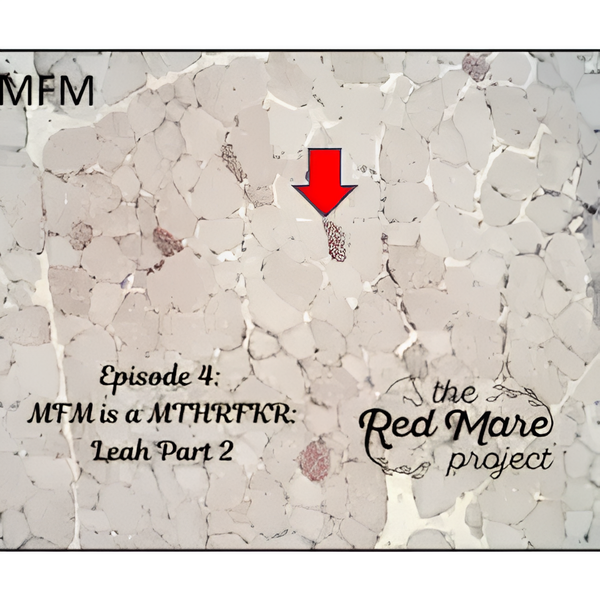
Myofibrillar Myopathy (MFM) is a muscle disease that disrupts the normal structure of muscle fibers. These abnormalities result in exercise intolerance, mystery/rotating soundness issues, poor performance, weakness, etc. In this episode, Taylor shares her mare's long journey to diagnostics. Turns out, her back was never the issue - it was MFM all along. Listen in to learn more about the presentation, diagnostic process, and management of MFM. Dr. Valberg is the pioneer of equine myopathy research. More information on MFM and her muscle lab available on the Kentucky Equine Research website (www.ker.com) Taylor CL Schouten, MS, APF-I Hoof Care Practicioner Wild Hoof Equine LLC www.wildhoofequine.com Kahlan Ettere Holistic Nutritionist Wise Choice Equine Wellness LLC Check out our website: www.theredmareproject.com Follow along on Facebook!
EPISODE TRANSCRIPT
— Previously on The Red Mare Project: Leah's KS Recap
I'm gonna hit the thing.
I'm a riff, just go.
Previously on The Red Mare Project, in our last episode, we talked about Taylor's mare and dove into her diagnosis of kissing spine as well as its surgery and rehab.
Fuck.
I didn't mean to say its, I meant to say into her, into the surgery and its rehab.
Oh, that's okay.
They're hard to do.
It took me at least 20 minutes to do the first one.
Okay.
Previously on The Red Mare Project, in our last episode, we talked about Taylor's Mare and dove into her diagnosis of kissing spine as well as the surgery and its rehab.
Today, we will be telling the other half of her story.
This is Leah, Part 2, Myofibrillar Myopathy.
Welcome to The Red Mare Project.
Someone has to jump.
Oh, shit.
Okay.
All right.
So, do you want to talk about the diagnostics of it?
Like, we know that after you're kissing spines, rehab and everything, it wasn't what you wanted it to be.
So then what was the next step?
Like, what did you, where was the detective work?
So, kind of everywhere.
All right.
So, we did the surgery, which, you know, and then we did the rehab.
I did all the things and, you know, I followed everything like I was supposed to.
And this is kind of where things got a bit bleak because by the time we were back up and running and we, you know, quote unquote, should have been in a situation where you never have to think about it ever again.
I had the same exact horse.
So I was like, I were drac...
Drac at the butt.
We're back at the drawing board.
And just at that point, we just, we kind of just limped through the next couple of years.
Like she was fine, but not great.
She wasn't feeling happy about life.
Yeah, that's a good way to put it.
We just, we really just kind of like coasted through on fumes and, you know, we, I think it was probably over a series of like what, three years or so.
And we did a bunch of injections, as you do, thinking that, you know, that's going to be the magic bullet.
Yeah, we'll just do the next thing the vet says and then that is going to be it.
Exactly.
So we did SI, we did Hawks, we did her neck, and we actually did her back at one point as well.
And this is the part that kind of got me.
And it, you know, I should have been more educated on this even like before.
I made the decision to do the surgery.
But the way that the surgeon explained it to me, who did the checkup, he said, even though we've taken out the dorsal spinous prosthesis that are in contact, he said there's still disease below the surface.
And I was like, well, you may have told me that.
And I'm not going to say that he didn't tell me because it's...
You were in another brain space.
Yeah, yeah, so trying to get myself grace on that.
And he probably told me, but like...
So if, you know, when you're looking at the spine, you have the dorsal spinous prosthesis, and then lower down, you have the transverse prosthesis, and those can also hit.
— Kissing Spine Deep Dive: DSPs & Transverse Processes
So I think that's what he was trying to explain to me.
Oh, okay.
Minor oversight on my part.
Everyone else did what they were supposed to do.
There's just a minor oversight on my part, which I think is why I'm, like, now I'm, like, adamant about client education.
Yeah.
Because...
And you're a badass note taker, my friend.
Well, it's because I've had oversight such as this.
So...
Yeah, yeah.
Now it's like, I've tried to turn that mishap into, like, a superpower.
But anyway, he was explaining that there's probably still some disease process going on, like, further down.
And I was like, well, what do we do?
What you got?
And he said, just inject it.
Okay.
And nothing.
We just kind of kept coasting through on fumes.
And eventually we ran out of fumes.
And we kind of hit that same impasse that we did before she was diagnosed, like before I took her to the hospital to get her diagnosed, where we had that period of like six months where I was like, I don't have a horse.
She's not sound.
She's not comfortable.
She's not good.
And all of that kind of compounded and resurfaced again.
And we hit another window of like, I don't have a horse again.
And we tested for a few things.
We tested for Lyme.
That came back negative.
Again, all the series of injections were pretty fruitless.
And then we tested her for PPID because at that point, she was 15?
Yes.
Yeah. 15, 16.
Yeah, yeah, 15.
Yeah.
So she was, you know, she was of age to drive the bus kind of thing.
And once they hit double digits, I think it's worth looking.
Yeah.
Yeah.
I think I read actually on the percent packet that one in five over the age of 15 will develop PPID.
And it's like a little younger and younger now.
It's like horses at 12 and 13 are already fully symptomatic, which is so scary.
That's bonkers.
We will do a whole, yeah, we'll do a show on that because we have a whole tinfoil hat lecture series on all of that.
So yeah, we tested her for PPID and it came back borderline.
And the symptoms of PPID that we were kind of curious about was just decreased performance, muscle wasting.
She was kind of pot belly at the time.
Just flitty too.
Yeah.
Oh, how shall I forget that?
Jesus, Taylor.
She was, yeah, her feet were just like not cool.
Half the bottom, she wasn't awesome.
Yeah, just subpar.
Subpar.
Damn.
I won't tell her you said that.
Please don't.
Which is not there.
And so we were like, all right, let's test her, came back like maybe borderline.
And if you go back to like the ECIR group, which is the equine, Cushing's and insulin resistance group, Dr.
Kellan runs it, they really advocate for treating the symptoms more so than the numbers.
Because it's such a hard number to chase too.
Like even if you test at the right time of year, you stem them, like, there's, you know, different times of year, there's better ways to test or vice versa, it's so hard.
— Lyme Disease Testing: Timing, Limitations & Frustrations
Like, I just did one for Loki in the spring, and I, like, it was a TRH dim test, and everything came back great.
His insulin was normal, his ACTH was normal, but like, never don't be suspicious.
Right?
Because even if the numbers, whatever the numbers say, like, you can't hang your hat on it.
Exactly.
So you did treat the symptoms?
We did, yeah.
So we started her on percent, and this was in the fall.
And that was also kind of another, I don't want to say red herring.
But a contributing thing.
Yeah.
Like, again, I'm not a vet, but the way I see it, if they're, like, mega symptomatic in the fall during the seasonal rise, I'm like, well, maybe...
It's pretty safe to say.
Maybe that's a factor to consider.
Yeah.
Just throwing that out there.
So, we started her on Percent, and it's...
She seemed to kind of improve on it.
She seemed to do pretty well.
Um, and then, just, you know, long story short, a couple months after that, she started to get really spooky.
Like, big, big, big spooks.
Not just when you were writing her, like, out in the pasture, panic.
Like, not her same person.
Her personality changed.
There was, yeah, there was a chip that there was a...
Something happened in the Matrix, and they were full-blown.
Like, you said panic.
Like, they were actual panic attacks.
That's probably really hard for you to watch.
It was quite...
I mean, it was terrifying, because I'm like, well, what do we do?
Yeah.
And when she would have these fits, it was like, the lights are on, but nobody's home.
Yeah.
Like, no...
What am I looking for?
She just had, like, no self-preservation.
There was no thought.
She would run through a fence or some shit if you...
Like, that was a fear.
Oh, yeah.
And that, I mean, so that started to happen, and I didn't really have any guidance on that, because it's...
Most people...
I mean, I, you know, I spoke with the vet about it at the time, and she was thinking, like, well, is she in any pain?
And I was...
Probably.
I don't...
I don't know.
She has...
I mean, she's been injected in everything.
Like, everything's being catered to, and it's...
We're still at this impasse.
We're just chasing...
Our tail.
Yeah.
And so, that was the thought on that.
And I was like, well, you know, you're probably not wrong.
And I held on to that.
But I got to thinking a little bit, and this goes back to my psych world, and I'll try to make this not as nerdy as I want to make it.
So, Percent is...
It's a dopamine agonist.
So, the whole point is to increase the level of dopamine in the system.
So, horses with PPID, they have a decline in dopamine production, and dopamine is what plays a really big role in regulating hormone levels, especially ACTH, which is a hormone that we're trying to control in PPID, or Cushing's for...
That's another thing we call it.
— PPID (Equine Cushing's): Dopamine, ACTH & Pergolide
So, in PPID, the lack of dopamine is what disrupts the regulation, which leads to the overproduction of ACTH.
So, by giving Pergolide, or the brand name Percent, it increases the level of dopamine, which allows ACTH to regulate.
Yep.
So, that's fact.
That's fact how that works.
The human side that I'm kind of like grabbing at straws about...
So, Pergolide was actually originally created for humans with Parkinson's.
Parkinson's is characterized by low levels of dopamine.
So, in humans, dopamine also helps with motor function.
So, like smoothing the movements that we do, which is why in Parkinson's, low levels, key characteristic is tremors, because the dopamine isn't there to smooth out the movements, right?
So, they give Parkinson's folks dopamine agonist.
Now, if the dose is incorrect and they get too much, and this is rare, but it can happen, high levels of dopamine are linked with schizophrenia.
Schizophrenia.
Oh, okay.
Yeah, this is where it gets kind of wild.
So, schizophrenia is a disconnect from reality.
It's a psychotic disorder characterized by delusions and hallucinations.
So, in rare occasions, if you give someone with Parkinson's a dopamine agonist and the dose is wrong and they get too much dopamine, they can't start to experience psychotic symptoms.
So, I have no idea if this translates to the horse world, but the algorithm made sense.
It's the same damn drug.
So, in my mind, I was like, well, maybe she was borderline in the high season.
So, maybe in the low season of ACTH, this was enough to kind of...
Throw her over the edge and to the other side.
Yeah.
Yeah.
Yeah.
And again, it's a bold ass claim, but...
No, but it makes sense.
I mean, you know, like I said earlier, correlation does not equal causation.
But if what you're seeing before your very eyes is telling you that that's the situation, then what else can you do but try to take her off of it?
So, when you did that, did you titrate her down or did you just take her off at Cold Turkey?
Like, what was the process there?
Oh, shit.
I know I went through it with you and I don't remember.
I know, because you were like, you were on the front lines with me on that.
Yeah.
Because I didn't really have...
I mean, I spoke with the vet about it and it was kind of like...
The response was, and I don't blame them at all.
I mean, it's super bizarre.
I think I did titrate down.
I want to say I did that.
I was responsible.
I think you did.
I think I remember when we were texting back and forth about it, and I was doing the very last stall on the right at the barn where I just came from.
Isn't that wild how they become core memories like that?
Well, we were bouncing.
You were like, is this crazy?
I was like, I don't think so, but what the hell do I know?
And you were like, I don't think this is crazy.
Should we just, I mean, there's plenty of vets who tell you to treat with pergolide according to symptoms.
— Treating PPID by Symptoms vs. Bloodwork
Just go backwards.
Yeah.
And she even said, you can try taking her off of it and see what happens, so.
Did it help?
How much did it help?
I think it made a difference.
I mean, she settled down pretty quickly, and I mean, that kind of solved that, but then it kind of came back.
It started to come back.
But we'll table the spooks in a little bit, because the spooks, I think, are a bigger piece.
Yeah.
I think that's actually like a huge factor.
So throughout all this time, from the surgery until today, her biggest symptom was body soreness, just mega stiff.
And I even had one girl get on her, really great rider, wonderful.
And I was like, you know, just hop on.
Tell me what you see.
What are you feeling?
What you got?
Because at this point, like, if you ride the same horse...
Oh, please.
You need variety sometimes.
Absolutely.
You know, to kind of, like, freshen the palate.
Absolutely.
So I was like, hey, girl, just hop on.
And she said, Taylor, this mare feels like she eat broomsticks for breakfast.
So mean.
I would be so offended.
I was like, well, shit.
Okay.
But that's, I mean, that's pretty accurate.
It was, it was, I mean, as much as it stung, it was actually really helpful.
Yeah.
Yeah.
Because you knew it wasn't just you.
It was certainly wasn't behavioral.
Wasn't anything that you could necessarily pin down.
It was just like stiff.
Yeah.
Stiff.
Broomstick.
Yeah.
Yeah.
And you just, our warmups were a train wreck.
Like, I, now I have it down to a science, but our warmups were so slow and just, she'd stick her head up in the air and kind of like, oh yeah, she would start rooting with her head up in the air.
And she did, you know, the little pony patter, the little, the like little dachshund shuffle that ponies do?
Eight.
Yeah.
I know that's such a weird way.
It kind of makes it sound cute.
Like a pony patter, like a little dachshund.
No, but I'm seeing like a little gray horse with a kid, the helmet that doesn't fit, jogging around, kind of pissed off with her head in the air.
That's exactly right.
Yeah.
Those were our warm ups.
That sucks.
And it was, I didn't know it, but she would eventually work out of it a little bit.
It was just really rough.
Yeah.
It was embarrassing.
Like I couldn't...
Look at me.
Literally.
So we almost got to a point where we were only riding when like no one was around.
Oh.
Or like if I went to my trainer's farm for a lesson, I would be the first ride in the arena so people wouldn't watch us warm up.
Oh, Taylor.
Because I didn't, I just...
No, I think.
And then part of me was like, shit, she's not having a good, no one's having a good time right now.
It's not fun if she's not having fun.
That's part of being the kind of horse woman that you are.
If she's not having a good time, you're not going to have a good time.
I think that's like honorable.
— Taylor's Emotional Breaking Point with Leah
Well, that's where I really got to think in because I was like, this is new.
She hates it.
She hates it and her eyes were just dull.
She wasn't bright and we were missing the target on something.
In my mind, I was like, yeah, she might not like this job, but there's no way she doesn't like it this much.
No, and she just enjoys, I mean, I've seen you on her.
It's like clicking together and suddenly she's super horse.
That wouldn't change depending on the sport.
That's exactly what my thinking was.
Like there's no way that it's going to be that big of a difference.
And anyway, we just again, just kind of kept coasting through on fumes, limping through and well, not limping, she never limped, but you know.
She did everything else.
I'll sput that.
And so she was super body stiff, really sore.
Her feet were still not, I mean, they were improving.
She was in shoes at this point.
I think she's been in shoes consistently for about two and a half years now.
That sounds right.
I think so.
Yeah.
And but I feel like I didn't, I haven't gotten them like confidently, like these are these are feet that I'm proud of.
Yeah.
Until maybe like a year and a half ago.
Yeah.
And so she's off pergola, still not right, in pain.
Did you call the vet at this point?
Is she, she's not spooking anymore.
She's still bucking?
Yeah, she's still bucking.
Okay.
Still bucking, very sore.
Arcanar.
Oh, that's an important thing to note.
Oh, that's right.
Yeah.
Arcanar was really, she couldn't hold it.
Like she would fall back into trot or she would just like run away?
She would just fall back into trot.
She would just fall apart.
Oh.
Which in hindsight, now that I understand the disease more, Sense.
That's like a huge factor.
So, and she was never really lame.
Because I feel like when we say lame, we mean like a limb lameness.
Yeah.
But body lameness, I mean, yeah, there's a argument to be made there. 100 percent.
For sure.
Hurty is hurty.
Exactly.
And I think she really was struggling with some body lameness that was so global that it wasn't able to be really isolated into one piece of anatomy.
So I feel like when you went on the after, at this point, like you're obviously devastated this is going on, blah, blah.
There was a point at which you had spoken to someone else and they suggested something or was this your own rabbit hole that you went down and then dove into diagnostics more?
Yeah, I actually spoke with a friend of mine who she's a groom for like a big fancy schmancy massage farm, and one of the horses there who is just a super cool guy.
He's since retired, he's gone up to the Grand Prix and has a few titles at the Grand Prix, really cool guy.
Awesome.
And this horse was all of a sudden had just someone flipped a switch on him, and he was having some really difficult challenges.
Long story short, he was diagnosed with MFM, which is myofibular myopathy.
— MFM Diagnosis: Myofibrillar Myopathy Explained
So at this point in the story, I'm desperate for anything.
I'm grabbing the bottom of the barrel, whatever weird diagnosis that can be thrown at us, let's get at it.
And I learned about myofibular myopathy, and I started reading through it.
Holy shit, did it fit the bill.
Yeah.
The timeline, the breeding, the- Yeah, because it's more common in warm bloods, right?
Okay.
More common in warm bloods in Arabians also.
Same, but- I know, right?
Okay.
But warm bloods, and this sounds so shitty, but it seems to be more common, like the more well-bred.
No, that tracks.
Yeah.
Which is like the weirdest flex of all time.
I mean, hey, look at the quarter horses.
Fair point.
So the way that it was explained, all right, so MFM, it's an exertional muscle disorder, which is abnormal buildup of desmin in the muscle tissue.
So that pretty much means if you're looking at a muscle cell, there's myofibrils in there, little tiny myofibrils, which allow the muscle to contract and relax to full capacity.
And then if you almost think of it as like, if you think of the muscle cell as like a factory, the myofibrils are like machines that kind of keep everything going.
And then the desmen are, you can almost think of them as like scaffolding that holds everything exactly where it's supposed to be, so it can do its job how it's supposed to.
So desmen in an MFM horse or an MFM muscle, or however you want to say that, the scaffolding or the desmen, it misfolds and it starts to clump together, which causes problems in how the muscle can actually operate.
So it can't fully contract or relax to its full capacity.
But it's working hard at the same time.
Yeah, it's working like double time.
So it just results in extreme muscle fatigue and weakness because it can't do everything how it's supposed to because the scaffolding, the desmen, is just locking everything where it's not supposed to be.
Okay, gumming up the works.
Okay.
Yeah.
So I started looking to it.
It fit the bill incredibly.
And I reached out to my vet immediately because bless her heart.
She was really hanging with us through this.
And she was in the trenches and I sent it to her, said, hey, this has to be it.
I think this is it, sister.
I think we're here.
And she's like, well, okay, let's do it.
And we did a muscle biopsy and we pulled it from the hamstring and it came back negative.
Whomp, whomp, which, dude, that shattered me.
Of course, that's heartbreaking.
I thought that was the answer.
She fit the bill so well.
The explosive behavior, the stiffness, the difficulty maintaining the gait, the rotating lameness, bodies, like everything, just to a T.
I was like, this is, I don't know what to do.
And my vet who was so supportive during this whole time and she kind of was just like, I don't want to say she threw her hands up.
— The Vet's Honest Reaction & Taylor's Desperation
But she was like, damn, sorry.
I really thought it was that too.
Yeah.
Yeah.
And it was kind of like, oh.
Now what?
Yeah.
So I ended up reaching out to the vet who diagnosed that gelding I just spoke about.
I reached out to that vet and I was like, maybe just fresh eyes.
See what we get.
So I had him come out and he looked at her.
I probably looked like a psychopath.
Probably.
You didn't even hear it.
You're like, yeah, you did.
I wrote up, it must have been three pages of her entire history.
Everything that she eats, everything we injected and when the spook started.
Full chart, full medical chart.
In this man, I still to this day don't know if he was just being gracious or if he was just trying to find a way to politely be like, oh shit, this is going to be a case.
But I handed it to him because I was like, I don't know what to say, but take it.
And he sat down and was like, this is actually really helpful.
And I don't know if he was lying to my face or not.
It's fine, either way.
But he sat down, he read the whole thing and he looked at me and said, well, the good thing is you don't have MFM.
And I was like, okay.
But what?
And he said, I think I actually want to check her out for a vitamin E deficiency.
Right.
Because a lot of warm bloods, not just warm bloods, but a lot of horses, especially today, I found.
Yeah.
Well, the grass now sucks.
That's a good point.
Yeah.
They have a higher need than their basic 1000 to maintain life.
Oh, interesting.
Oh, that makes sense with the grass being shit now.
Grass is shit.
They're under more oxidative stress.
They just have a higher need.
Wow.
You just made that sound so achievable.
Yeah. smartfact.com.
We got products.
Incredible.
Okay.
So he said, I think I want to do a muscle biopsy to explore that as an option.
And I was like, well, she gets vitamin E, which famous last words.
Yep.
Yep.
And he said, well, I get that she's on it, but there's certain...
It may not be the right form and it may not be the right volume.
Yeah.
All those things.
And so he said, let's go ahead and do another muscle biopsy.
All right.
Great.
And he said, I want to scoper.
And in my mind...
Oh, my God.
I totally forgot.
I know.
I know.
I totally forgot.
So this was...
I like now have to catch myself when...
I hear other horse people say this, because in the moment when this vet said, let's scoper, I was like, but she's such a calm horse.
She doesn't really seem anxious.
Why would she have ulcers?
And he just kind of looked at me and he was so reassuring.
He said, just let me look.
She shouts sometimes.
Oh, that's sweet.
Let's just look.
And he was so gracious.
This mare came back with grade four.
Yeah, she was fucked up.
In the back of his mind, I could tell now after the fact, I know he was like, Taylor, just let me do my job.
Just shut up.
Grade 40.
Yeah.
And he was in pain.
Oh my God.
— Muscle Biopsy Results: Some of the Worst Seen
And he even said, and this is not a dramatic man.
He's very stoic and he was like, these were some of the worst I've seen.
Wow.
So.
Well, if you think about it, like she's having body pain, just because you're feeding her perfectly and she's got all the fit, you're supporting her the best you can, but pain is incredibly stressful.
She's an internalizer.
Like Ren was the same way.
He could be literally having the worst, most painful day of his life and you would not know it.
He would make himself sick over it.
But he was so stoic and she's kind of a bad bitch.
Like, she doesn't strike me as a mare who whines.
No, she's not whiny.
So she was just like literally gritting her teeth and making herself sick over it.
I think that's such a good thing to mention is that a lot of horses do internalize.
I think we kind of, as humans, forget that if a horse is quiet, that doesn't mean that they're comfortable.
Yeah, they're not being peaceful.
They might just be suffering in silence.
Yeah, well, and just know your individual horse's personality.
If there, I know a mare that is, if a fly looks at her wrong, she says, ow, I'm dying.
And my horse, you could cut a leg off and he'd still want to go play at full fucking speed.
You just have to know where your horse is.
Yeah, for sure.
So it's a good thing that you did.
And she had, so you treated her for ulcers.
I imagine that started immediately.
Yes While you were waiting for this muscle biopsy to come back.
And the muscle biopsy said?
MFM.
Damn.
So I actually remember, I was sitting at, this was the Gerd Hirschman Clinic when he came in 2023, and I was signed up to do it.
And she was in such a place, I reached out to the host who's a friend of mine, and I was like, hey, I'm sorry, I got to sell my spot.
It's not going to happen.
She can't do it.
I'm not going to make the source do it.
I told her that, and she was like, Taylor, it's cool.
I'll handle the spot.
But the vet called me when I was actually at the symposium, and he said, Taylor, I have your answer.
We have grade four, and she does have MFM.
Was it like the weirdest feeling of relief, but also panic and like, I'm so devastated, but also, holy shit, yes, I have a diagnosis?
All of the above.
Yeah, that's heavy.
Because it was, I mean, I did have the answer, but the part that really kind of like we were told, he said it wasn't going to be MFM.
Yeah, you had already a negative diagnosis, and he brought home the fact, oh, thank goodness it's not that.
Yeah.
And suddenly it is.
So now you've got this to contend with again.
So that's great.
That's terrible.
Did you spend your two days crying?
That's great.
That's terrible.
Like, you are such a superhero, a superwoman, because like I told you with Lowkey's story, I spent a solid 48 hours sobbing after I had the vet out the second or third time.
And I could not, like, you know, I put my big girl panties back on, I figured the shit out.
— Grief, Resilience & No Time to Feel Sorry for Yourself
But you don't have that downtime where you just feel really bad for yourself and like eat a chocolate treat and cry.
You just kind of go right into cycle mode, researching and like getting onto it.
That's amazing.
I mean, I didn't really have a choice.
I mean, she was so uncomfortable and- You dove in.
I dove in.
But this vet was, he was really supportive because he had just diagnosed- Oh, he had just got it, yeah.
Yeah.
So, and actually, apparently before my mare was diagnosed, she, I think he had maybe seven or eight cases again before her.
It's contagious.
So, no, it's not, guys.
Don't, don't, listen, that's not, that's not true at all.
Don't panic.
That's not true at all.
It is maybe through greeting, if you say it that way.
I mean, yeah, okay.
There's an argument.
But anyway, so he was comfortable with, like he knew what to do with this.
Yeah.
So he gave me a diet plan for her, some recommendations.
And I asked him when he called me with the diagnosis, I said, we already did a muscle biopsy.
Why, why did it come back this time?
And he said, because when you pull a biopsy, you're supposed to pull from two sites.
You pull from the tail head and then you pull from the hamstring.
The hamstring biopsy didn't catch it.
It was the tail head caught it.
And also in defense of the first biopsy, you do sometimes need to be a bit mindful of when you pull the biopsy.
That's right.
You've said that before.
She almost needs to be in a flare of feeling like shit, being really uncomfortable for the damage to show better.
Exactly.
So the management protocol, because it's all completely manageable, it's just having a exercise program that works for them and the diet that works for them.
So we'll start with her exercise program, because it's a little bit easier.
Because it is exertional-based, but if she has too much time off too.
Right.
It's muscle use-based.
There it is.
So for her, our strategy that works really well is we do a schooling ride, day one, then we do like a trail ride where we just kind of like dick around in the woods.
I love dicking around in the woods.
The best.
That's a great day.
Oh yeah.
And then day three, we may do just like a long and low kind of day.
Stretchy movement.
Just go and do.
We may pop over a couple fences just for cross-training, for fun, but that's about it.
But if we do three days in a row, and then she'll need another two or three days off.
So is it always three on, two off?
That's like your secret sauce?
I think so.
I think so.
I mean, of course, like, you know, work schedules is going to kind of get in the way sometimes, but that's tough.
And it's because the thing is, if she goes too long, three days is really good.
She's fine after two days off.
If she's three days off, she's superb.
Oh, okay.
— Exercise Protocol: The Crucial Role of Rest Days
Superb.
But four days off?
Four, when we hit five, seven days.
Everything hurts.
Oh my God.
Do you have anywhere to work her if it's raining there?
Not really.
I mean, I can take her on handwalks.
Yeah.
Which is fine, but she needs to work.
She has to sweat.
Right.
A handwalk isn't going to get her where she needs to be.
Yeah.
So that's tough.
Certain times of the year, the weather doesn't really allow for that.
You just have to get wet.
Yeah.
That's crazy.
So, like, the last two, what was it, like, two weeks ago when we had a full week of rain and I couldn't ride?
Ay-ay-ay.
When I got back on her, yikes.
Swallowed a broom?
Ay-ay-ay.
Yeah.
Yeah, it was rough.
Well, I think, I feel like at some point during that week, you did a couple of handwalks with her in her outfit.
I don't know if you did Equiband or if you did the Eagle Pro.
I don't know if you have the Eagle Pro.
We talked about that.
She wore the Equiband, just the belly band.
Yeah.
A little bit of sit-ups walking around.
That's perfect.
Yeah.
It gets her there and it's better than just sitting around and doing nothing for the whole time.
Yeah, of course, especially like, her paddock is beautifully sloped, but it's not hard work.
She's not going to get that work naturally, as most horses aren't.
So, man, that really keeps you honest, huh?
I mean, I'm so grateful that we have a plan and we know what works, but it is a very, I hate to say it because I'm so grateful for her, but it's demanding.
Yeah.
Talk about the diet because it's really, it's intimidating to me because all I know about it is the opposite of what I want to do.
It's, and I mean, big same.
But I think the reason why she was so symptomatic when she was first diagnosed is because her diet that she was on was the literal opposite of what she needed.
So, you know, we're pretty, we're crunchy granola, we're forage-based.
Yeah, hell yeah.
You know, chelated minerals, keep it real.
Everything's organic.
Sugar, lots of forage.
All the, you know, granola stuff that we do.
And that's what she was getting.
And, you know, she didn't look great.
And, like, I have a lot of client horses who are on diet, similar to that, and they do so well.
And I mean, why does this horse looks like shit?
I mean, that's where I have mine, and he looks great.
But it's phenomenal.
I think, was she, like, skinny fat or just weak looking?
Weak, that's a good word.
Yeah, weak, that's a good word for it.
And, okay, so MFM diets, they require very high protein, lots and lots of protein, and moderate to high starch and sugars.
So that's the part we hate.
That's the part we hate.
Like 30% MSC.
And the one, and actually Kahlan, you can probably support me so much better on this.
The one thing that they really do need a good bit of are antioxidants.
And I don't really understand the role of antioxidants in this.
I wonder if because the Desmond is clumping together and misfolding, the muscles have a harder time getting rid of trash.
— Why MFM Muscles Struggle to Clear Cellular Waste
Makes sense.
So they need extra assistance.
But also, then all that stress is causing inflammation.
They can't really let go of it.
It's like they need an extra recycling center in their bodies.
That makes sense to me.
Yeah, that checks out.
Yeah.
I mean, I don't know nearly enough about MFM because you're the only person I know with a horseshoe has it.
Well, I mean, understanding how antioxidants work and oxidative stress, I mean, what you just explained, that checks out.
So she was, that's what the MFM pellet is.
It's a combination of NAC, which is, I'm going to let you say it.
N-acetylcysteine.
Thank you.
You say it so much better than me.
And so high doses of that, which is horrible because it smells like rotten diesel fuel.
I don't know how else to explain it.
No, it does.
That's, you're on.
Okay.
It's disgusting.
Now that's it.
Yeah.
Yeah.
They also on top of that knee, the vitamin E is going to be a big one.
And it matters, you said it matters a lot, the form that they have it in.
Yeah.
So you only do the liquid.
So this is actually one thing I'm teetering back and forth on.
So for, and this is where I have to watch myself, is the two brands that my vet recommended are Elevate and Nano E.
Nano E gets into their system, like starts to build up and actually like show effects in seven days.
Elevate takes 56 days.
Direct quote from him.
I don't know why I remember that, but it's a core memory now.
I've actually never heard that.
That's what the man said, that's, we can go with it.
Excuse me while I write that down.
So I have her, I started her on Nano E, and that helped her tremendously.
But it's expensive.
She needs to be on 5,000 IU, and I did one more for good luck because why not?
I mean, for good luck, obviously.
Yeah, we need all the good luck we can get.
So she was on 6,000, so I mean, we're burning through a bottle every, what, 20 days?
Woof.
Woof is right.
It's like $74.95 a bottle, right?
They're like $90 now.
What?
Yeah.
Usually, I'm pretty good about finding deals.
I was going to say, because SmartPak usually has a 20 percent.
Yeah.
You can sponsor us.
Hey, shout out, Kentucky Equine Research.
Shout out SmartPak.
You can sponsor us.
Yeah.
We'll give you business.
Products.
I feed all KER.
All my stuff is KER.
Their shit is good quality.
Yeah.
They're phenomenal.
You have to.
Yeah.
I have to have no choice.
You know what I do want to talk about?
So, high NSE, high antioxidants, with the MFM pellet.
Yes.
You said, so when she first got diagnosed, it was mild.
That's right.
Yes.
She came back as very mild.
And the vet recommended, you know, put her on this feed, a lot of alfalfa, vitamin E, and the MFM pellet.
Great.
And I did...
I kind of like made my own grain, because I was like, I got to hold on to some type of granola.
— Diet Overhaul: Going Grain-Free & Making It Work
Obviously.
I mean, let's not get crazy.
Yeah.
So I made a blend, and I did everything, and I was like, do you know what?
She was on the MFM pellet, and I did probably 10 weeks of what was recommended.
And I didn't notice a huge improvement.
But I think in retrospect, and we spoke about this before, I think the reason why I didn't have the wonderful epiphany is because she was still battling the ulcers.
Right.
I think those were a lot louder than we thought.
Well, yeah, and if she's got that much damage and inflammation, she's not absorbing everything you're giving her the way she should.
Oh, damn.
I didn't think about that.
Yeah.
She literally has open wounds in her digestive tract.
Oh, shit.
I didn't think about that.
Damn.
Well, I mean, that makes sense.
Yeah.
So, you ended up...
How long was your treatment that you did when you did the actual pharmacological treatment?
We did gastric guard for four weeks, then we re-scoped, and he said do two more weeks of full tube.
So, she did six weeks of full tube, and then he recommended the titration dose, which was two weeks half tube, two weeks quarter tube.
Okay.
And I did notice a difference after we finished that treatment.
And she, I mean, she was going really well, and at that point, I took her off of the MFM pellet because it's expensive.
Super.
And I was like, you know what, she's doing okay.
The ulcer treatment seemed to be the thing that moved the needle more than the MFM pellet, so got it.
Okay.
Yep.
Perfect.
And I think that's what the case was.
So, which to me was a huge learning of the impact of ulcers.
Yeah.
And really kind of made me eat my words because in the past, I was always like, nah, she's not going to be an ulcery horse.
Well, I've said this before.
It's something that's so, like, it's so common.
Over 50% of horses in captivity have ulcers or something crazy like that.
Yeah.
And they may not be screaming at you about it, but it seems like such a simple thing.
Like, I don't know.
In my head, I overlook it too.
And I look at other gut related issues because I'm like, oh, they probably do, but maybe they don't.
I don't know.
Everybody has ulcers.
We don't take it seriously enough, I think, even though we do know a lot about gastric ulcers, which is so weird.
We're just, I think it's easier to write it off.
Because it's, I don't know, maybe it's too easy of an answer.
I don't know what that is.
And especially among professionals, I see that happen more.
I agree.
In people who are really in this shit, they want to hear zebras, not horses kind of thing.
Yeah.
So I feel like that, like, give yourself some love there because I would probably have done the same thing.
That makes so much sense.
And I mean, that's true.
And I mean, I think to your point, maybe one of the reasons is because of the cost of treatment that we just don't want to go through it.
— Why MFM Is Underdiagnosed: Cost & Complexity
It's a pain in the ass treat and it's expensive.
It is.
Well, and like, especially when you're granola, you don't necessarily want to go that route of the proton pump inhibitors.
You don't, like, you want to avoid that at all costs.
Like, well, of course there's no reason to have ulcers.
Give her a great diet.
She always has forage.
She's got, you know, stomach acid buffering, access all the time.
I ride her well.
She doesn't travel very far in the trailer.
You know, like, on paper, she shouldn't have ulcers.
Yeah.
But she also wasn't showing you, she wasn't screaming to you about her pain.
Yeah.
So she was, like we said earlier, she's probably internalizing it and giving herself ulcers.
Yeah.
So that really moved the needle.
Then I know there's kind of a dip in your story.
Yeah, yeah.
So, yeah, so we did the treatment.
And I do want to add in one piece, and this is so petty, but it's such a pet peeve of mine that I have to use this platform.
And this, I think, goes back to, like, why a lot of people will just kind of, like, brush over ulcers, because it is so expensive.
And this is a direct quote from my veterinarian, compounded emeprazole.
And I know what you're about to say.
And we did not ask permission to use his name, so I'm not going to name him, but if you've met the man, you know who I'm talking about.
He says, just sprinkle it on their back.
It does the same thing.
Damn.
Shots fired.
Damn.
Sorry, compounded emeprazole.
But that's true.
I mean, if you're going to pay for it, if you're going to go through the pain in the ass of treating, just fucking do it right the first time.
Yes.
Just do it right the first time.
Yeah.
Because you're going to be right back to square one in six weeks, and you have the same horse, and you're going to be like, oh, it didn't work, blah, blah, blah, I need a new vet, whatever.
Just do it right the first time.
It's so simple.
I had to say it.
For sure.
It was eating me up inside.
So we did the treatment, and I took her off the MFM pellet, because at that point, like we spoke about, I think the ulcers were almost louder than the MFM maybe.
Yeah.
You were seeing more difference by treating the ulcers than the MFM.
Easy.
Yeah.
So this goes back to the dip in the story that you were saying.
I think for her, again, it's MFM is degenerative.
So when she was diagnosed, the labs came back as very mild.
Again, it's degenerative, which I kind of forgot about.
But sometimes you just lose track of time.
I mean, this is over what?
Sure.
Two years ago.
Yeah.
So she was doing better.
We did good for maybe a year.
We were still getting by on fumes, but it was definitely an improvement.
Definitely an improvement.
We improved her diet.
She now gets the most granola ration balancer I can find.
I still want my granola as much as I can, but it's working for her.
— Finding What Works: Don't Change a Thing
At this point, I'm like, nobody move.
Don't do anything.
Don't touch it.
She's on that.
She gets steamed rolled oats.
She gets Vermont Blend.
She gets her mineral salt.
I switched her to the C90, the mineral salt that they have at Trafford Supply and the MFM Pellet now, and 5500 IU of vitamin E.
Then she gets an alfalfa chaff snack with her electrolyte, which is the KER Restore.
Yeah, great.
Then she also gets the KER E03 oil, one pump of that, and the vitamin E is Elevate.
But before we have, if we're going to do a schooling ride, I'll give her maybe 2,000 to 3,000 IU of Nano E and a little extra.
Oh, smart.
Okay.
That seems to be- That seems to carry her through the work.
Yeah.
Cool.
But I'm thinking I need to take her off the Elevate and just lean on Nano E.
I mean- KER, please sponsor us.
Yeah, for real.
Could you possibly- You said she gets 5,500.
Could you take her down to 3,500 and only add the extra 2,000 or 2,500 on the days that she does hard work?
Do you think that would be worth trying or do you think that's dangerous?
I don't know.
I'm scared.
It's fair.
I'm scared.
And the reason why I'm- And I have thought about that.
The only reason why I'm a little weary of making e-changes is because of that- going back to that dip in the story that you mentioned.
Right.
So she was going good for a year and then the spooks came back.
The big panic spooks.
And do you- you haven't seen her do one, have you?
No.
No?
Okay.
Good.
Keep it that way.
You don't need to see that.
You don't need to know.
But she just, I mean, she explodes.
I mean, like I said before, it just lights her on, but nobody's home.
There's no talking to her.
Just like running around freaking out.
Full on panic attack.
And there was a point where I- I mean, I was worried about her safety, where, you know, she's going to run through the fence.
She's going to jump out.
I mean, she would do this with me on her as well.
Damn.
So this would technically was almost like our third impasse of, I don't have a horse right now.
Yeah.
Because she was having fits in the field.
I couldn't ride her.
She was dangerous.
And she's dangerous to, I mean, there's barn stuff that you have to consider.
And that's, I mean, there was actually a point, and we spoke about this a little bit in the past, where I was like, if we can't figure this out, I may have to consider putting this horse down because she's going to kill herself.
Yeah.
Or it's just not quality of life for her.
Or constantly living in fear.
Yeah.
And then I was like, oh my God, like her cortisol levels are spiking.
Oh, Taylor.
Oh, Taylor.
I know.
We need to retest for PBID.
We got to do everything.
And I just, I mean, no quality of life, like you said.
And I was worried about barn staff, like she's going to hurt herself, she's going to hurt a human, and I can't have that on my conscious.
And is that the word?
— Conscience, Advocacy & Being Your Horse's Voice
Conscience?
Conscience.
Thank you.
Jesus.
It's okay.
It's a lot.
It's a lot.
I can't have that on my mind.
And I reached out to the vet who originally diagnosed her and had him out for just like, you know, look at her.
And I told him what was going on, and he said, you need to put her on the elevate, or the Nano-E.
And well, there's actually two phases of this.
You had to put her on that.
And because at that point, I tried to wean off and try another vitamin E.
And he was like, no, no, no, no.
You can't do that.
Put her back on this.
And I put her on the Nano-E.
She started to do really well.
The spooks subsided substantially.
But then they came back.
So I hope I got the timeline right with explaining the story.
She was not back on the MFM pellet until maybe... two months ago?
Okay, great.
I was going to say three.
Okay, perfect.
That's right.
No, you're probably right.
Probably three months.
So three, probably four months ago is when the spooks also came back really, really, really bad.
And this is again that impasse where I was like, I don't want to have a horse.
Help.
What do we do?
Big help.
And I reached out to a friend of mine and was like, hey, girl, what...
Do you have any thoughts?
Because I just needed fresh eyes.
Yeah.
She's too in the shit.
And that happens.
Girl, yeah.
I was too in it.
And I reached out to her.
She's really smart and she just...
She's dealt with some weird stuff before.
And she made some recommendations that I wasn't... like, super cool with.
But I was like, I get your line of thinking because she mentioned...
She reminded me that MFM was degenerative.
And I kind of, like, forgot about that.
And she was like, well, what did it say when she was first diagnosed?
Very mild.
And she said, well, Taylor, this is two years later.
Maybe she's moderate.
She's graduated.
Yeah.
It's like, god damn it.
She said, you need to go...
You need to get...
Treat it like it's moderate.
You need to...
Yeah.
So I was like, oh shit.
Okay.
And so I revamped her diet and gave her everything that I mentioned prior.
You know, she's on the most granola, ration balancer, the oats from Mompland, the MFM pellet, and Elevate, and the spook stock right when she started on the MFM pellet.
Five days in, gone.
Take that for you.
Oh my god.
So she's been on it, and it's been keeping her nice and good.
Nice.
Nice and nice.
Yeah.
Nice and nice.
Nice and nice.
So that was a big learning.
And this goes back to what you said, if you're going to do something, do it right.
Yeah.
Just go balls deep the first time.
I should have, and I did.
You know, you did.
You literally did everything that you could do with the symptoms she was giving you, and with the resources that you had.
I don't think you did anything wrong.
Well, thank you.
Apparently, I did, though, but...
No, no, no.
You were just two seconds behind what she needed.
That's a good point.
— Management Tools: PEMF, Cold Water & Magnawave
Just two seconds behind.
That's a good point.
But she doesn't speak human English, so that's only fair.
Yeah.
I mean, you're not psychic, as much as we'd like to believe it.
You're not actually psychic.
So it's okay.
Yeah.
And now she's doing really well.
I mean, she's going super good, and I figured out, like, we have her diet routine, or her diet, her exercise routine well.
We have her diet is just, it's excellent right now.
Although, I do think I need to put her back on the Nano-E.
I mean, even today, before we started recording, I got a call that she was getting a little spunky in the field.
So I don't know, I think she needs to go back on the Nano-E, but that's okay.
We'll unpack that later.
But a few other things that I've noticed with her is, like, when I hose her off or give her a bath, it's got to be hot water.
Like, water from hell.
Yeah, she needs, like, the most soothing stuff to her muscles all the time.
Does she appreciate a liniment bath with hot water?
I actually have not tried that.
That's a good idea.
Oh my God, do it.
That's a good idea.
You could even do just, like, a shitload of magnesium salts in hot water and a little bit of just any liniment.
I like the Sore No More because it smells really good.
It does, yeah.
It smells so good.
If I leave it in my car, my car smells amazing on a hot day.
Not like horse pee.
She might really appreciate that, especially as it gets hotter because I know you mentioned before, like, she's kind of a princess in the pee.
Like she needs, like, just right or Goldilocks kind of situation.
She needs just right.
Not too hot, not too cold, not too wet, not too dry.
Yeah.
That's a good idea.
I might try that, especially, I like the magnesium salts too.
You're going to have to coach me through that.
Where do I get them?
No, Epsom salt.
Oh, duh.
Yeah.
Okay.
I can do that.
How much would I do?
If I just have a regular bucket, how much do I put in there?
I don't know, a shitload.
Okay.
You can't fuck that up.
Measure it with your heart?
Yeah.
It's like a garlic situation.
You can't fuck it up.
Okay.
Oh, that's such a smart idea.
I've never, I don't.
Honestly, if she's, not when she's in the throes of a spook, because I know she gets really frothy and hot, you don't want her to get overheated.
But after a spook or a particularly sore day, that's when I would do the hot water and magnesium.
You could do like for a one-gallon bucket, you could do like a cup or a cup and a half.
Okay.
And it dissolves really quick.
And then just do a shot of liniment, like some, any liquid liniment would be fine.
I like the gel lotion from Sore No More, cause Loki also hates cold water.
He's just kind of a princess that way.
He likes cold water in the rain and in the river.
He doesn't like to be touched.
If it's my doing, he doesn't like to be touched with cold water.
So I usually will do the lotion so I can avoid having to put cold water on him.
— Topical Lotion, Spray Protocols & Post-Work Recovery
But they have a good spray.
You can do a little shot in there and do that maybe after she works or the following day, like on her off days, to help the muscles relax.
That's smart.
Try it, see what happens.
That's a really good idea.
I will do that.
Epsom salts are cheap as hell.
So it's another thing you can do to keep her comfortable.
That's a great idea, yeah.
So yeah, we'll definitely start integrating that.
That's a good call.
So in addition to that, blanketing is also a big thing.
Really anything, I guess, that's gonna make her muscles stiff.
She has a hard time releasing, and then when her muscles are stiff, it's really painful for her.
Yeah, yeah.
So she, yeah, like cold rain, can't do cold rain.
There was a period there where, and I think I can kind of get away with it a little bit more now.
If it's under 60, she has to be covered.
Like all, I know.
She's like a goat.
I know.
Like all of her sheets have hoods on them.
Yeah, all her clothes are completely like head to toe.
He has a wardrobe.
He has a full ass wardrobe.
And if it's like in the 60s and it's raining, she still needs a rain sheet.
It's like the cold droplets, they kind of, yeah.
You both just sit the same like inch movement with our back.
All the way, yeah.
But it has been a lot to kind of figure out what makes her go.
But as of right now, just the diet, the exercise plan, the beamer has been a really big help for her.
Yeah, Taylor got a beamer, you guys.
I'm so jealous.
I've always wondered what.
She's been generous enough to use it on my horses.
Yeah, the boys, they love it.
Oh, their slut's for it.
Yeah, they love it.
It's been super helpful for them.
But yeah, Leah gets a lot out of it, which is really good.
Do you do that after a workout or on her off days?
They're just kind of whenever.
I kind of try and do it every day.
Oh, wow.
Okay.
I know.
Yeah, which is kind of hard in the summer because it's hot.
Yeah.
You just do like 20 minutes or?
Yeah.
So there's three settings.
There's P1, P2, P3, which is incredible.
Yeah, hilarious.
It's like you guys knew what you were doing.
And so I put P3 on her, which is a 20-minute cycle.
Perfect.
And she wears that while I do her barn chores.
Yeah, just chilling in the house.
That's awesome.
So she does that.
But yeah, she's going really good.
And I'm asking her questions.
I don't know if we'll be able to move up in the levels, meaning I don't know if we'll...
I mean, I would love to get my silver on her, but it's all a matter of just her comfort level and if she's enjoying it.
I mean, right now, the fact that we can just have a lovely ride and I know what she needs to be comfortable, that's all that matters.
What more could you ask for?
Yeah.
That's worth gold any day.
Yeah.
So we have the recipe for success and comfort, and if that leads to something else, amazing.
— Leah Today: A Happy Horse with a Recipe for Success
I would love that.
But if not, we have a happy horse and she's the happy part of the story.
Yeah.
This is the good part.
Yeah.
I love the good part.
Yeah.
It is a lot of management.
I do have to keep an eye out for ulcers because a lot of horses with MFM, they really hoard them, but I think it just goes back to that muscle pain.
So for her, I just have to watch if her eye gets a little muted, maybe, or if- The lip tension.
Yeah, little things.
She gets a little spooky, that means that maybe I need to up some antioxidants or something like that.
In the winter, I just need to be really aware of the temperatures, and everyone thinks I'm psychotic about the management, but I'm like, why don't you manage a horse with all this stuff?
You do it.
She needs a full spa regimen all her life, basically.
Yeah, but once you get it down and you realize it and what the routine is.
Yeah, and you know what?
I'm not a really Pollyanna kind of woman, but I'm going to choose to be in this moment and say, all this means is that you get to spend more time with her.
Oh, I like that very much.
Right?
Yeah, yeah.
I've been that way.
I'm going to cry immediately.
I love my son.
With everything that we've been through, it just keeps me more accountable for being there, being there with him and enjoying the little things that we can do.
Every hard thing that we've been through, both of us, has only made us closer to our horses, and forced us to hear them more, which is really cool.
It sucks that they had to go through pain or discomfort for it to get there, but they are our greatest teachers, and I'm so grateful for the time that I have with him.
I used to think a good ride used to have a lot higher standard.
Now, if I can putz around Wachtrot in just a neck rope, and he's comfortable and happy and breathing deeply the whole time, I fucking win.
That's the lottery.
That's my Olympics.
Nothing is better.
So it's like, I don't know, we don't have a choice but to choose to be grateful for it, and be grateful that we have enough brain capacity and the resources to be able to manage what we're dealing with.
Exactly.
And what our horses have been able to help, I mean, Loki's story has helped so many others working through rehab.
Leah's story, I mean, I've had in this last month, I've had two people reach out to me whose horses have just been diagnosed with MFM, and they're like, Taylor, what are you doing?
And it's, I mean, granted it took a couple years of just like, you know, some fuck-ups to get there, but.
But now we're here, and now we're helping.
And that means that my, like, my mishaps can shorten any mishap period that other horses have.
So, you know, it sucks that we had to go through it, but it's not in vain because it's shortening the rehab process.
It's shortening the shitty part of the story for other people so you can get back to the good part faster.
— Closing: Shortening the Shitty Part for Other Owners
Perfect.
Yeah, love that.
Well, thank you for sharing her story.
Oh, yeah, girl, I mean, she would have yelled at me if I didn't.
Yeah, I hate that fully.
My animals yell at me a lot, but.
I kind of hate that she's, we're not at the barn today because I'm super warm and comfortable in this room, but I love seeing her just kind of check on us from her stall because I'm always on the side where I can see her.
And I always just, it looks like she's listening and she's like monitoring. 100 percent.
Don't make me look stupid. 100 percent.
Don't embarrass my mom.
It's really cute.
No, she's a genius.
And I think that just kind of drives home, like listen to your horses.
Because if you sense that something is up and something isn't right, and they're going against their character, that's something of value.
And listen to it.
Every damn time.
Sometimes it takes two muscle biopsies.
True.
Ew.
All right, babe.
Well, I love you so much.
I love you for sharing.
And it's fun.
I can't wait to listen back to this because I just had so much fun.
This was a good one.
Yeah, I think so too.
All right, cheers.
If you or a friend have a topic, story or case study you want us to cover in an episode, visit our website at theredmareproject.com to leave your submission or email us at redmareproject.gmail.com.
And if you have it, please include a cute picture of the horse we will be discussing so we can make it our Facebook page profile picture.
As a reminder for listeners, this content is for educational purposes only and is not meant to diagnose or treat.
We encourage everyone to do their own research and speak with your veterinarian and care team to make sound decisions for your horse's management.
If you like the podcast, please tell a friend, like, subscribe, and follow on all the platforms.
Peace.
NEVER MISS AN EPISODE
Listen on your favorite platform
Subscribe and listen to The Equestrian Podcast wherever you get your podcasts.
