
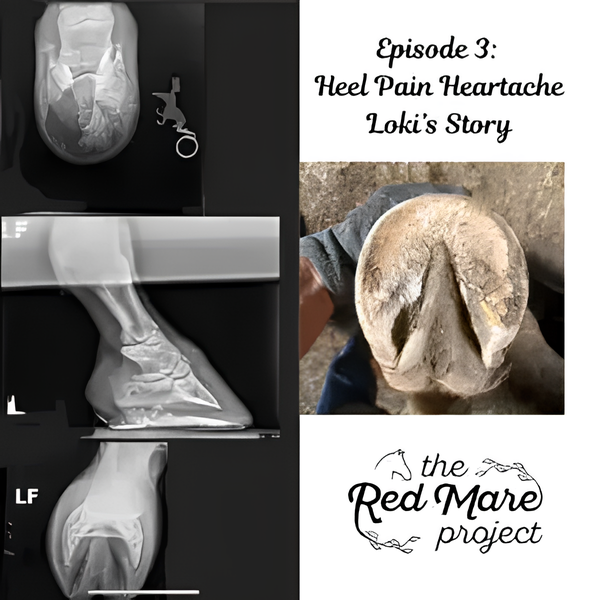
ABOUT THIS EPISODE
Kahlan, RMP's very own, share's the story of her gelding's battle with navicular syndrome. Taylor and Kahlan discuss navicular disease versus navicular syndrome, diagnostics, and different approaches to rehab. Resources: Alicia Harlov, The Humble Hoof Jean Luc Cornille, The Science of Motion Jec Ballou, Equine Fitness and Performance Equiband Eagle Pro-6 Hay testing: equi-analytical.com Grazing muzzles: flexible filly, greenguard, whatever they will keep on Boots: scoot boots, cavallos, cloud boots, whatever is comfortable for your horse Taylor CL Schouten, MS, APF-I Hoof Care Practicioner Wild Hoof Equine LLC www.wildhoofequine.com Kahlan Ettere Holistic Nutritionist Wise Choice Equine Wellness LLC Check out our website: www.theredmareproject.com Follow along on Facebook!
EPISODE TRANSCRIPT
— Intro: Navicular Disease vs. Navicular Syndrome
All right, navicular divi Here we go.
All right, navicular disease versus nicu- Why are these so hard?
Oh, my God.
All right, navicular disease versus navicular syndrome.
Let's get into it, Loki story.
Yay, not yay, but we're here.
But yay now.
It's yay now.
It's yay now.
All right.
Welcome to The Red Mare Project.
I went from hearing that like, oh my gosh, this is the end of the world, to her just going, oh yeah, he's got a little bit of heel spur here, or it looks a little bit like this, whatever.
I was like, oh, I'm not going to die.
We're not all suffering, we're going to die terribly.
So how did it all start?
Take us back.
I've kind of like worked backward from that.
So like I was saying a second ago, I think I know the exact day it happened.
So like we said previously, we've just kind of gotten by on, you know, Red Bull and gas station food our whole lives.
And he was always sounding great, and like thought he was indestructible.
I thought I was indestructible.
We did dumb shit and it always worked out.
But then when I moved from our barn we grew up in, we bought a house, moved to the mountains, and went and moved him to this like beautiful property.
The footing in the arena was shite, but it was fine because I didn't really ride in there that much.
Was it like really soft or really hard or rocky?
Rocky.
Oh, okay.
Was it deep too?
No, it was really, it was like packed clay.
Oh, with rocks on top?
Yeah.
Oh, so it was like Lego land.
Literally.
So, Dahlonega is that way, like my property was that way.
I didn't have Europe and the Dahlonega, it was cool.
Yeah, it was 3.4 miles from the square.
Oh, right on.
Yeah.
That's a story for a day when we have a drink in hand.
Fair enough.
But the property was beautiful.
It was just what we needed.
It was, he was on a 40-acre pasture with only four other horses.
Lots of woods and lots of trails through the woods where his pasture was, so he got a lot of movement, which was awesome.
He was really happy.
He was really content there.
The only reason that I think that I know that that was an issue is because there was this dog.
So the barn owner had a guard dog named King Leonidas.
He was a- I-dis?
No, King Leonidas.
Oh, oh my gosh.
He was just really inflamed.
Inflammation of the dog.
As you were.
He was the guard dog for the barn.
He was an English Mastiff.
He was the sweetest.
He was such a good dog.
Like, he guarded all the barn girls.
He would make sure the property was protected.
He was such a good guy.
And Loki hates dogs, like has always hated dogs.
But he loved Leo.
So, every time the barn owner, Julie, would bring the horses in to eat, like, they would just come into their stalls, have breakfast, then go back out.
Leo would, like, help her bring them in.
And Loki and him would play so hard in the driveway, like, Leo would, like, buff, buff at him, and Loki would immediately rear up and start, like, playing with him, and they were chasing each other, and they, Loki actually enjoyed playing with him.
They were pals.
They were pals, because I guess he seemed like a small horse, not a dog, because he was fucking giant.
Yeah.
Um, and he had such a good time.
I remember I came up to the barn one day, and Julie said, hey, two days ago, Leo and Loki were playing in the pasture, and he reared up and came down on a rock.
Oh, like his, like, he land wobbly.
Yeah.
And he walked off lame.
And I was like, oh, why didn't you tell me that two days ago?
Why was he, like, why have I not is, what, huh?
And she was like, oh, it was literally five minutes, and then he walked off sound again.
He just, I just wanted you to know in case, like, it abscesses, and, you know, because he has a bruise and it grows out, whatever.
And I was like, okay, okay.
Huh, sure.
What year was this?
Mm, 2021.
Okay.
Spring of 2021.
All right, so four years.
Yeah.
Okay.
And truly, he was normal for a while.
Like, I think maybe there was just, I don't know.
— Loki's Early History & First Signs Something Was Off
He was fine after that.
We'll say fine.
Looking back, I don't know, with the eyes I have now, if I would say he was fine.
But from what I knew at the time, he was writeable and sound and comfortable, and his eye was nice and soft.
He was behaving like he always did, so I didn't think anything of it.
I was like, okay, truly, it was just like he stubbed his toe, kind of energy, and then was fine.
And then in 2022, April, he started on the circle, like on like a 20-meter circle.
He was turning in like a bicycle at a trot, and I was like, that's so weird.
Like, you're pretty fit.
I don't know.
Like he wasn't bending, is that what you mean?
Yeah, he couldn't bend, and he was just super blocked in the whole front left quadrant.
Like the whole front left square of the horse was very blocked and stiff.
And I was like, okay, that's weird.
Like, maybe, you know, I've been riding you too hard in one direction, or you've played in the pasture too hard or whatever.
So I had, you know, my body worker come out.
I was constantly rubbing him.
Like, I did red light.
We did, you know, everything that I knew to do.
I did.
And it just kind of wasn't getting better, but it was only to the left.
I was like, okay, it feels almost like he's gonna fall over to the left.
On a straight line, he's fine.
And then to the right, he's fine.
And he even feels nice and loose to the right, but like to the left, he was just blocked.
I was like, okay, something's going on here.
And then I stopped riding him for a couple of weeks.
Bodywork, Cairo, blah, blah, blah, all the normal stuff that I would do.
And then started working him back in and just walk and trot on a straight.
I was like, what the hell?
He got like short strided in the front.
Not the floor's lava quite yet, but just kind of like, oh, that's not as nice as normal.
Like mismatched between fronts and hinds kind of thing?
Yeah.
More like a shuffle?
Kinda, yeah.
Okay.
And it almost felt like the weakness was over his back.
Oh.
And I was like, hmm, that's weird.
So I had everybody around me like look at him and whatever.
And they were like, no, he looks like he's such a lovely horse.
What do you, he's fine.
But because he's so long strided, if you didn't know him really well, you couldn't see it.
Because even him being short strided was still within normal limits for other horses.
But given his baseline of having a longer stride, it's like a whole standard deviation difference.
It was.
And I felt like I was losing my mind.
Because everyone was like, he looks beautiful.
Like, what are you talking about?
And I was like, okay, all right.
Maybe I'm just being nervous, whatever.
And I had just brought Ren home.
And so I was like, constantly spinning.
My wheels were constantly spinning, trying to get my new old horse to, like, his, like, optimized from where he was.
And he was really not okay.
And so I was just like, really in the sauce, right?
And I was like, maybe I'm just like making this up.
I don't know.
And then when I got one vet out for their Coggins in May, so a couple weeks after I got back on him and he was shuffly, I was like, hey, while you're here, can you do a lameness exam?
And she was like, yeah, no worries.
What's up?
What are you seeing?
And I explained the past month, didn't think about the thing with the dog almost a year ago at that point.
Okay.
Because it truly like he seemed like he walked off fine.
And then he wasn't, but it was long after, so I don't know.
But I had her do a lameness exam and she kind of didn't do a lameness exam.
She didn't block him.
She ran a sensory tool.
You know how they do for acupuncture?
It's like, or for neuropathy testing in people, it's like a hard piece of plastic.
And it's teeny tiny, almost like it looks like a cat's whisker, but it's hard plastic.
And you like tickle parts of like someone's foot to test for neuropathy or reflexes.
— Understanding Neuropathy & How Horses Mask Pain
Oh, oh, oh, yes.
Yeah.
So they use that in acupuncture as a tool to like signal where the impingement is.
I don't think I've ever seen that, at least in the horse world.
It doesn't look like much.
So she ran this tool down his neck, his left neck, the blocked side.
And she was like, yeah, his leg hurts.
Not nerve blocked side.
We need to do a...
Correct, correct.
His like stiff side.
Yeah.
So she ran down his neck and she was like, his leg hurts.
Gave him six months off.
And I was like, what?
What do you mean?
Okay.
Like is it DDFT?
Is it like, is it superficial?
I don't know.
What do you mean his leg hurts?
Like what part?
Because I'm old ass limb.
Yeah.
I know how to heal a leg injury.
Like I've had some really gnarly tears and breaks and like every soft tissue in the leg, I've had a horse come to me that I heard it.
Like, and I knew that that's not what I was looking at.
It's like, there's no like crispy pieces.
Like if I run my hand down, there's no like crispy tendons.
He doesn't react anywhere.
I don't feel like that's the case.
Meaning like scar tissue when you say crispy?
Yeah.
I like crispy better than scar tissue.
Yeah, it's less scary.
But that's what it feels like.
Yeah, it is.
It feels like little tiny pebbles under the skin almost, like gravel under the skin.
So I was like, that's weird.
And he flexed fine.
And then she was like, all right, well, that's 250 bucks.
Maybe get a red light.
And I was like, I have that already.
Huh.
All right.
When you say six months off, is that like stall rest?
Do I need to wrap it?
What am I, like, what are we doing here?
And she was like, no, I don't think he'd do well in a stall.
I was like, well, you're right.
Facts.
Facts.
These are true facts about my son.
Yes.
But, so just pasture rest him.
And I was like, okay, does he need any kind of support?
And I think at that point, you had given me a set of sleeves, because they were- Oh, the compression socks.
Yeah, because I was like, okay, maybe that would be great.
Just, you know, maybe he needs a little bit of support.
Because I know, like, with my knee, sometimes I need extra support to take the pressure off, whatever.
I didn't do much, because that wasn't the problem.
He hated them.
He wanted to kill them.
They were uncomfortable and itchy, and it was the summer, and he hated it.
Oh, God, yeah.
So that was not it.
But I did what she said.
I did six months off, and then started doing, like, some Jec Ballou rehab exercises that I already had known just from, like, starting horses.
And he was worse.
He was lame.
He was getting to be where, like, he's noticeably lame.
And he was doing the floor is lava.
Okay.
Everybody around me was like, yeah, he just looks like, you know, maybe he has thin soles.
And I was like, I promise you, he doesn't.
So when we say floor is lava, just going so fast, toe first, and just trying to get your feet off the ground as quick as possible.
His weight bearing is uncomfortable.
So that's our...
That's, yeah, the floor is lava.
It looks like they're walking on the floor, like, hot, hot, hot, hot, hot, hot.
And they just want to get their feet off at as quick as possible.
Yeah.
And he's a really hot horse.
Like, he's quick.
He likes to party.
So everyone around me was like, no, he's just being fast.
And I was like, no, he's not being fast.
Like, I am looking at his eye and I'm like, something is fucking wrong.
Like, something's wrong.
And also, why is he only being fast when he's on bad footing?
Why is he, you know, on like hard-packed ground that's smooth?
Because he doesn't like to slide.
Like, if the footing is too deep, it's a big problem.
So sometimes, like, if it's grass that's dry, if he's in a flat part of the pasture that's dry, he does great.
Ding, ding, ding.
Yeah.
We'll circle back to that.
Yeah.
Yeah.
And so everyone was like, you know, you're just being paranoid, whatever.
— Dismissed as Behavioral: The Struggle to Be Heard
It's behavioral.
It's whatever.
And I was like, okay, well, like, I appreciate your input, but, you know, get fucked at this point, because that's not right.
Yeah.
So I tried doing all this stuff and whatever.
Nothing was working.
Everyone was telling me I was crazy.
So then we're in after six months off.
So we are now in January.
No.
Yeah.
We're about January of 23.
Okay.
I had tried so much.
I had, like, I dove into research, whatever.
I thought, okay, there's got to be scar tissue somewhere.
So I did peptides.
I did all the different PEMFs that were available.
I spoke to my vet, and she was like, no, maybe give him more time off.
Give him confinement time off.
Like, make the pasture smaller.
So the barn owner, who was, like, super accommodating, she was, she's a good friend.
And she made us, like, a little, for my two horses, made us, like, a tiny little strip of pasture.
And she was like, keep him here, so that he moves around less.
And that went over, like, a turd and a punchbowl.
It did not help.
It was bad.
Everyone was having a bad time.
My horses were miserable.
I was miserable, and he was getting worse.
And I was like, why is he getting worse?
I don't understand.
It's like, he just needs to move.
He just needs to move.
He needs to move.
And, like, my instincts were telling me that.
But I didn't know there was anything behind that.
So then that, at the end of that year, in December, December 13th, I had their teeth done.
I had another full lameness exam with a nerve block this time.
And he blocked the back of his foot.
Okay.
You did a palmar nerve?
Okay.
And I...
This is where it gets pretty ass.
It was frustrating up until this point.
It started to suck here.
I paid all this money for this vet visit.
He blocked to his foot.
I watched him go off, still stiff in his neck, because his, like, compensation pattern left him really stiff in his neck.
And I was like, oh, it's his foot.
It's his hoof.
Okay.
Well, all right, X-rays are next.
Let's do X-rays.
So we walked back into the barn, and I was like...
My gut was telling me that this was going to be bad news.
I just knew, like, something's really bad.
So she blocked the back of the foot.
What did she do before that?
What did...
Like, what was the...
That was the first step.
Oh, okay.
You just explained the symptoms, what was going on.
She said, let's block the back of the foot.
Yeah, I said, here's the history of what's going on.
Let's block the back of the foot.
So he did a Palmer Digital Nerve Block, and he went off still a little out.
But it was more so body compensation patterns.
Got it.
Okay.
Body tightness and unsoundness, not actual...
I mean, she rated him a three out of five lameness at that visit, and that was probably the worst day he ever had, which is good, because I wanted the vet to see that.
But the arena where we were, I was like, can we go on the street?
And she was like, no, this is fine.
It wasn't fine.
He was walking on Legos with an already painful body and expecting pain.
So there was a lot that I would have done differently.
But it was when we got inside that it really started to get shitty.
So we get inside, do his x-rays, whatever.
She says, these look great.
He has good depth.
These x-rays are fine.
There's literally nothing wrong with his bones.
And I was like, okay.
And then my heart sank.
And I was like, well, then now what?
And she was like, well, here's the hard part.
You can't heal a foot from the inside.
And I was like, what does that mean?
That's what I said.
Okay.
And I was like, okay.
What?
And she was like, if there's soft tissue injury to the hoof, there's no way that you can fix it.
And I was like, but why does he have a soft tissue injury that didn't heal?
If there is one, why did it not heal?
And then that's kind of when I thought back to the day with Leo, where he, because that's the only thing I could think of.
— The Gravel Test & Realizing It's the Feet
If you're running barefoot through the gravel driveway and you hit a rock right in the middle of your foot, it's going to hurt.
And you could sprain something or tear something or put extra strain on a tendon.
And then it has to heal.
That was almost two years ago at this point.
Why is he lame?
What's going on?
And she said, well, you know, you could do the MRI and see how bad the soft tissue is.
But we basically know it's going to be soft tissue because it's not his bones.
And if you do that, all that's giving you is information.
And I was like, what do you mean by that?
She said, that's not a bad thing.
Yeah, well, I think her rationale was like, there's nothing, I mean, this is what she said.
It wasn't her rationale.
This is what she said verbatim.
There's nothing you can do about this.
So if you get the MRI, it's just spending money to have more information so you know how bad the bad prognosis is.
Oh.
And I was like, what do you mean?
Like, what does that mean?
Yeah.
And she was like, well, you can't heal the inside of the hoof.
Like, if there's tissue damage in there, this will never heal.
He will be lame forever.
And I was like, I thought I was going to throw up.
Yeah.
And I was like, okay, so should I rest it more?
What about his environment?
What can I do?
There's no, I don't.
What do we do?
What do we do?
And she said, there's nothing you can do.
She said, he'll be a pastor about forever.
There may be times in his life where he is sound, where there's times where he's sound enough to walk him.
Like you can ride him at a walk, but he'll never trot off sound again.
You can try to keep him in a really contained space or keep him, like he can live in a stall and that may promote healing to it.
But this is like this is his new normal.
He's a really cool horse.
So I don't think you should put him down, but you could donate him and he can just have a good life like as a donated horse to the hospital.
And I was like, like the whole world started spinning.
I didn't know what to say.
And so I just said, okay, thanks.
And I gave him my credit card and I just sobbed into his mane for hours.
And like, I don't take the word no well.
And so I sobbed and sobbed and sobbed.
And then I put him back in his grassy pasture, foreshadowing.
And went home and just like fell into my husband and really didn't move for like two days.
And then I got really pissed off.
There it is.
There it is.
I got really pissed off.
Because I knew that that's not right.
I was like, you know, everyone hugged me and everyone was like, Oh, my God, I'm so sorry about this terrible prognosis.
And for like two days, I just felt really bad for myself.
And then I was like, wait, fuck that.
That can't be right.
That's not like that's not who he is.
And I asked him, I was like, are you broken?
Do you, are you in so much pain that like, you're giving up?
And he was like, I don't know what your problem is.
Let's go play.
I was like, okay, so I don't know what, I don't know where to go, but I'm going to ask everyone that I've ever known what's going on.
And literally, like two weeks, maybe within a month, someone moved to the farm to keep her horse there temporarily.
Shout out King, my little buddy.
And she was, is a farrier.
And so she saw me like crying on my tack box.
And you just asked me, she knew I was having a vet visit.
And because I asked if anyone needed to like add on to it, if anyone needs anything, whatever, why not?
She'll be here for hours.
And she asked me how it went.
Clearly, it wasn't going well because I was not OK.
And she was like, oh, yeah, navicular is really hard.
King was like that because I didn't know how to treat an infection for years and no one told me any better.
And that's why I have this career.
And I was like, what?
Say all that again slower.
Say that like eight more times.
What are you fucking talking about?
— The Word 'Navicular' Is Finally Spoken
And so she dove into her story.
And at this point still, the vet never said the word navicular.
She said, yeah, soft issue injury and his hoof.
And I was like, okay, that sucks.
Sob forever and then, you know, jump off a bridge.
I never heard that word.
I mean, I'd heard that word.
But in my, like the only context I had for it was give them Prevacox until the pain kills them.
Yeah.
That's the only reference I had.
I knew one navicular horse.
And well, okay, looking back, I probably knew a lot.
I knew one horse diagnosed navicular.
I don't know what her, that actually called it syndrome or disease, because there is a difference.
But she was in a shoeing package, like she was in steel shoes forever.
She had that like weird rocking horse kind of movement and got pain medicine every day.
And then she died.
Like that's what I knew about navicular.
And I was like, no, he's not a navicular, Sarah.
That's not what, and she was like, yes, it is, idiot.
Like the back of his foot is hurting.
And I was like, okay, help me.
Like, what does that mean?
And that's where it got good.
It started to get good.
It was, it's been really hard.
But like, that's where I was like, okay, this girl knows what she's talking about.
I need help.
So I kind of had her break it down, like what this means.
I don't know if you want to jump in, Taylor, and help me explain with your brain.
So okay, we have navicular disease and navicular syndrome.
And I feel like whenever people say the word or hear the word navicular, it's followed by a cringe.
And they have four navicular bones.
And whenever anyone says they have navicular, I'm like, well, that's great.
They got four of them.
Which one?
Well, tell me about them.
Yeah.
What are they doing?
But okay, so navicular disease is when there's actual bony changes to the navicular bone on radiographs.
And then navicular syndrome is when there's just back of the foot pain.
And that's when it kind of creeps into the world of soft tissue.
So it's just heel pain.
That's really all like if a horse radiographs clean on the navicular bone, but they're still back of the foot pain, that's when we call it navicular syndrome or just heel pain.
And I think heel pain is a lot more palatable.
Right.
It's just like, because the navicular term, it's kind of, it's a scary word.
I literally was like, don't be stupid.
He's not navicular.
Yeah, he is because his hood is hurting.
It's like, that's all it is.
And it was like she slapped me in the face with a tortilla.
Geez.
Oh my God.
Yeah, so, I mean, that's, there are two completely different things, but since they kind of affect the same region in the foot, you know, we just- They get lumped.
They kind of get lumped together, although it's not appropriate to do that.
But anyway, so when you're looking at the navicular apparatus, there's a couple of different pieces that run into it.
We have some soft tissues in there, which is the big heavy hitter is going to be your deep digital flexor tendon, which runs behind the navicular bone and connects to the coffin bone or P3.
The collateral ligaments, which connect the navicular bone to the second phalanx or P2, which is the short pastern, which is just like the bone above the coffin bone.
And then we have the impar ligament, which connects the navicular bone to the coffin bone.
So that's like the big beast of it, but we got some little tiny baby little ligaments in there that do some really heavy stuff.
And if those get inflamed or irritated or there's some type of damage to it, it can create foot pain.
Yeah.
And oftentimes that kind of falls into the whole heel pain package.
Yeah.
The whole kit and caboodle.
Yeah.
So...
Symptom-wise.
Yes.
Symptom-wise.
So since this diagnosis and then looking back, I could tell you a lot more symptoms that were there, and I didn't know what I was looking at.
Well, they're insidious.
— Soft Tissue Injuries: Insidious & Easy to Miss
Yeah.
When they first start, like, especially soft-tissue things, and I had a trainer say this to me a while back, and this haunts me.
He said, if it's the little things, like that little minor misstep that you see on occasion, he said, that's the stuff that scares me.
The big stuff where they're crippled overnight, he's like, that doesn't scare me.
It's the little things.
And I was like, it didn't catch up with me until later that, oh my God.
Okay.
Like, I think it, anytime I hear someone say like, oh, my horse is so trippy on the trail, he doesn't pay attention, he doesn't watch, he's so clumsy, he doesn't look where his feet are.
Tripping.
I'm like, oh, hey, call the vet now.
Call your farrier.
Dude, don't assume that.
Like, oh, my horse doesn't like to go in the middle of, he wants to rub me off on the trees.
That one pisses me off a lot.
That's so good to say.
Because, okay, listen, like for real, everyone listen up.
If you're half-ass listening to me, now is the time to tune in.
If you're driving, pull over.
Yeah, pull over.
Mic drop time.
So I hear so many people that are like, yeah, I don't really like to trail ride my horse, or he's not a good trail horse.
He goes to the side of the trail and tries to rub me off on the trees.
Or like walking out to the pasture, they have to like hug the grass line?
Yes.
That is not a red flag.
That's like a red, like the whole side of the barn is red.
Like that is...
That's the pirate flag.
Yeah.
That's, oh, that's war.
We're at war now.
That's like, eat your weedies, it's time to go.
Cause, oh my God.
Like if I ever saw him do that, he never really did that.
And that's what, so what's weird about him is his personality.
He's so boisterous and he's so like, I'm invincible.
He won't do less to accommodate his pain.
He'll just do everything faster.
I think that's so important to recognize how your horse communicates things.
Yes.
Like if they have a personality change when they're not feeling well, if they do things faster or slower or like.
If your horse is like not a particularly forward boisterous out there kind of guy, but then they go from that to like refusing on the trail or hugging the grass line.
And then they want, you're thinking, oh, they just want to eat grass.
That's probably not true.
A horse isn't going to like particularly perch their little feet in a spot to eat grass.
They're going to drag you over.
They don't care what's in the way.
But if they're like tippy-toeing over to the grass because they can't get to the pasture through the gravel driveway, that's a huge symptom.
That's like, you've probably been having problems.
And that's just something that's easy to notice.
If your horse is tripping all of a sudden where they've been sure-footed, or you buy a horse and it's a trippy horse, do not discount heel pain.
Because like with Loki, he's so loud.
He just accommodates by running.
Like, he's running wrong.
And I think, I didn't, until like six months even into understanding navicular, did I even understand how important heel-first landing was.
Significant.
And we'll, we'll impact that a little bit more as we go.
It, like, I guess I never, like, I didn't, I didn't know what I was looking at.
Well, a lot of people don't.
I didn't for the longest time.
Yeah.
Like, they put their foot on the ground when they walk.
Super cool.
Yeah, wow.
They have to do it a certain way?
That's exhausting.
These things are exhausting.
I got to watch all four feet do something?
Oh my God.
Well, and so with him, the outside and Taylor, having been his farrier, can attest, the outside of his feet look great.
Like, absolutely gorgeous.
He looks like he should be crunching over rocks, not caring about anything.
Do you know what's so devastating?
So I have, I think, like currently, in the moment, I have three navicular horses on my books.
They all have the most beautiful feet.
— What Healthy Hooves Should Look Like
Oh man.
All of them.
Oh man.
But they don't work.
It's the inside parts.
Yet.
Yeah, there is hope.
Stay tuned, stay tuned.
They're all on the journey.
Yeah, yeah.
I'm still alive.
Yeah, so for the symptoms, again, like the short stridedness, like the floor is lava.
That's a big one.
Yeah.
Even though the floor is lava can also be a symptom of other stuff.
But floor is lava, toe first landing, and you can assess that with slo-mo video.
So check that out.
It's hard to tell.
Yeah.
It's now like after watching it a thousand times, I can tell when he's flat versus heel first.
Yeah.
But I couldn't for the longest time.
You can get an eye, like for especially if it's your own horse and it's like it's just one gate on one horse you need to.
Yeah.
You can usually kind of see, especially if it's toe first, it's a little bit easier.
Yeah.
If it's in toe jabby, that's a good thing to bring up.
If your horse takes a couple steps on the rocks where they're not completely confidently having their heel first, it's not always a big problem.
They may be avoiding one individual rock or something.
I don't get mad at that.
No.
But if your horse is like nubbing along and they're stubbing their toes with every step, that is emergent.
Toe jab.
We hate toe jabs.
Yeah.
We hate a jab.
Yeah.
And then also too, well, tripping, we talk about tripping.
That's a big deal.
Changes in the foot shape as well.
Yeah.
Say more.
I didn't see that with him very much, but now I know how important that is.
Well, because in your defense, he didn't really have any capsular changes.
His capsule stayed gorgeous.
Yeah.
So, if a horse is, and this kind of goes into the biomechanics of it, and I'll keep it kind of concise.
Horses are supposed to land toe first.
Never.
Scratch that.
Scratch that.
Edit that out.
So, horses are supposed to land heel first.
When they land heel first, all the pulley systems, the tendons and the ligaments, the hemodynamic system, everything is happy.
That's how it's supposed to go.
When they start to toe jab or land toe first, the back of the foot can begin to atrophy, and you'll start to notice that it will kind of start to close in a little bit.
Like the heel bubs contract.
There it is, yep.
They get a little scrawny.
Yep.
And then you'll notice that the frog, we'll talk about the significance of the frog health, the frog will also kind of start to wither away.
The frog should be pretty beefy, not too beefy.
It shouldn't be like the- Buffy.
It shouldn't be like, holy shit, that's a big ass frog.
That's another issue.
But it should be a healthy frog.
If they're landing toe first, because the frog isn't doing its role properly, it's going to start to atrophy.
And then that's when disease or infection can get in there.
And that circles back to what you were saying about- King.
Yeah.
Yeah.
So I knew, like, my whole life, obviously, I know what thrush is.
I know how to treat it.
I know what an infected central sulcus looks like, you know, like stinky butt crack in the hoof.
Go ahead.
Oh, well, just for central sulcus, just an anatomy piece.
So if you're looking at the frog, the central sulcus, just like what Kahlan said, should be a healthy thumbprint at the back of the foot.
But if it's diseased, you'll notice that that thumbprint will really kind of start to cave in.
It literally collapses into a crack.
And like all the bacteria and fungus and nasty viruses and everything bad in the world can get in there and stay in there.
And split.
And split.
And that's where you get that like butt crack at the heel.
And it's super tender.
Have you ever tried to, like, if you can put your hoof pick in it, you have an emergency.
It hurts so much.
It's so hurty.
And I think people just think it's normal.
Like, people don't know what a healthy back of the hoof looks like.
It should not be split.
It should be completely filled in with flesh and hair.
— Thrush, Heel Contraction & Reading the Hoof
If there is a butt crack on the back of the foot, if I can see your horses thrush with their foot on the ground, oh, does bed.
That's really bad.
You're in trouble.
You're in trouble with your failure.
And a lot of times horses will, since it's so painful, they will actually nerve block sound because that infection is so advanced.
They'll nerve block sound and they actually might even receive a diagnosis of navicular syndrome.
When really you just add poor hygiene or not great immune system.
Yeah.
So that's something that we really have to keep an eye out for.
And people always wonder why I'm so psychotic about thrush.
And I'm like, hell.
It's not just gross and stinky.
Like it actually causes them discomfort and can cause them disease.
It's a big ass deal.
It's a big ass deal.
I know a horse that got such bad thrush and it wasn't treated correctly and it certainly wasn't treated in a timely manner.
And it went into his coffin bone and he had to have bone resected.
Eww.
Infection can go.
Yeah.
Like it's an infection.
You wouldn't want to leave infection anywhere else.
If their eye was infected, you wouldn't leave it.
If you had an infected wound on their neck, you wouldn't leave it.
So why leave it in the hoof when that's the...
They're running on their toenails all day.
Like those...
That part of them carries such literal weight and is such a vital role in their soundness.
You got to take care of it.
Yeah.
Yeah.
Definitely get after your thrush.
And ask your...
If you're unsure if your horse has thrush, ask your farrier.
Yep.
Ask them.
And I mean, we have...
We'll put some pictures up as well and some recommendations.
We got some great articles about thrush with pictures and things like that so we can share that.
But that's a big deal.
So going back to like some other causes, some people say genetics are a piece.
I don't...
What do you think?
What are your thoughts on that?
So, you know, I never considered that being part of it until...
I mean, okay, I could see how genetics could play a part because like if you have a big chunky quarter horse with teeny tiny feet, they may be more prone to having discomfort.
Like if they're overweight, which so many horses are overweight, that okay, that could be like if breeding is causing teeny tiny little feet.
I could see that as being a cause or like previous position.
Confirmation too.
Yeah.
Well, okay, that's where I was going.
So his Cairo a couple weeks ago, she had said something to me that I always kind of was suspicious of, but I never really considered it.
She said, so I was talking about how he's so close coupled in the back.
Yeah.
He almost seems hypermobile, right?
Why have I never seen that?
I know.
Oh my God.
I know.
Well, and he's half walking horse.
Why have I never thought about that?
Why would you?
Because you just think he's loose and flexible.
But I think he's hypermobile.
I think because all the horses I see that are hypermobile are like in Capitals hypermobile.
Yeah.
He just he uses everything to his advantage.
He's got whispers of it kind of.
Yeah.
He uses everything as if it's his secret superpower.
And I don't notice it that much in the front.
It's in the back.
It's in the back.
It's in his hips.
In his hips and his stifles.
Bro.
And I think that's why the past couple years, his stifles have kind of taken the brunt of this diagnosis.
Yep.
He doesn't wring his hocks like a walking horse does when they're engaged.
Not at all.
No, he doesn't.
But I can tell there's a lot more action, like soft tissue and bone, like maybe, like ligament to bone and also like soft tissue versus muscle.
Like he's using more, he's not isolating those muscles to hold them up.
He's just kind, he's relying on their flexibility.
Yeah.
Which sounds crazy, like it's hard to picture.
But as soon as she said that, I was like, oh my God.
It's, I mean, we've been staring at this thing.
— Deep Dive: Analyzing Loki's Radiographs
Literally.
Like this whole situation.
He's wicked flexible.
And he is kind of like turns his feet out in the back just a little bit.
And I think that's because he's super mobile in his like stifle and hawk.
Yeah.
And so they take the pressure.
Yeah.
And then he just kind of like splays his feet out just a little bit.
Yeah.
And I've noticed that get better as I've owned him, but I didn't think anything.
Like I just thought like, oh, he's just stronger.
Yeah.
Like his muscles are better.
So he, I don't know.
There's so much to it.
There's so much to it.
That's bananas.
So yeah.
Confirmation is a piece.
Yeah.
For sure.
Workload.
Don't overdo it, kids.
Workload.
We'll just leave it at that.
Don't overdo it.
But also workload.
Correctly.
Okay.
Yeah.
Thank you.
That's where I was going.
She needed a half hole.
I felt it coming.
Thank you.
I was like, how do I say this?
So it's not how fast are you going.
It's not how many jumps you're going over necessarily.
It's at walk and trot on a straight.
Are you doing it right?
Because that can be just as damaging as all the big, scary, fancy stuff.
Oh, for sure.
Like that's what I was doing.
I mean, I was just trail riding him.
Sure, we were, I mean, we were, we were moving.
We were cooking.
Yeah, yeah, yeah.
And, you know, he'll climb anything, and he doesn't say no to anything.
But in the arena, if he's not, like, I always ride him in the arena before I go out on trail to see if, like, hey, this is...
Just check in.
Yeah.
Just a quick check in.
Like, are you comfortable?
Are you comfortable enough to use your body really well today?
And if he's not, then I don't do it.
And we go back to the ground, because that makes such a difference.
If I literally do one nonsense, like, for a day, the next time I ride him, he's not quite as good.
Like, I don't know.
It's really subtle.
Yeah.
Well, those are the nuances you got to kind of check in on, because that's, I mean, going back to even what my trainer said years, years ago, that it's the little things that you got to look out for.
Those are the little nuances to keep an eye on, because those are the ones that can kind of blow up.
Okay.
So back to different causes.
Yeah.
All right.
Another possible contributing factor is going to be just your hoof care.
So long toes and low heels are like a huge factor.
So each additional centimeter of unnecessary toe length causes 110 pounds of unnecessary leverage on the deep digital.
Now, if there's damage to the navicular, and this is a brash generalization, but this comes from Dr.
James Rooney and Pete Raimi.
If there is ever any damage to the navicular bone, there's already damage to the deep digital.
I mean, that makes sense.
It makes sense, yeah.
But that comes back to the idea of soft tissue rehab.
So with navicular syndrome and navicular disease cases, there's oftentimes, well, there's always going to be soft tissue involvement in navicular disease.
And again, I'm just quoting the greats here.
I can't take any credit for this.
I'm not a vet, none of that.
But if there's navicular bone change, that means that any navicular rehab should really be focused on soft tissue rehab.
Yep.
Because you can't change the bone.
No, bone's bone.
You're working with these bones, so what can you do to keep the tissues around them comfortable?
Exactly.
Which is, I guess, our next topic.
Or do you want to talk about how it's diagnosed?
Yeah, that's probably a good thing to jump into.
Yeah, because there's a couple of things I do want to say for sure.
Okay.
So if you're starting to notice some concerns with how your horse is going, definitely get the vet out.
That's always the best practice.
Your vet will probably do a lameness evaluation, and that's typically followed by a series of radiographs.
And there's a navicular series that can be done of radiographs, so there's a bunch of certain angles that they'll take, just like a couple different images that they can look at to get a better view of the navicular bone, because if there are bony changes, we want to see the extent, the type, blah, blah, blah.
— The Navicular Radiograph Series Explained
Because the changes that can happen, they can get bone cysts in there, they can get what are called malformed lollipops or synovial invaginations.
So if you're looking at the navicular bone, there's little baby channels in there where the synovial fluid goes in, and those can become malshaped or malfigured if there's any damage to the bone itself, change in bone density, shape, or size, or any type of surface irregularities.
Because remember, the deep digital has to gently roll over the navicular bone.
So if there's outcheas on the bone, it can essentially scrape the deep digital.
Yeah.
It's like you're running it over a cheese grater all the time.
That's a great way to think about it.
Yeah.
Yeah.
On another date that Taylor and I had, we looked at some bones and it was very clear.
I have that in my foot.
That's what we're talking about on that day.
There's always going to be that risk of friction there.
So you have to prioritize correct movement, or you're going to be putting excess strain, like you said just a second ago, with the unnecessary toe length.
There are so many things that you can do to put excess strain on the already compromised tissue.
There's really very little margin for error with this, which is hard, and it makes you kind of obsessed.
Yeah, but there's a happy ending.
We got a happy ending.
Yeah, we got a happy ending.
Hang in with us.
We got it.
All right, so we do radiographs, see if there's any bony changes.
There may or may not be.
Then sometimes the vet may follow up with a Palmar digital nerve block, which blocks the back of the foot.
Although, there have been some studies lately that have been showing that the nerve block may actually migrate to other parts of the foot.
I saw that.
And then of course I was spiraling.
So that kind of like muddies the water.
I would love to speak with a veterinarian about that a little bit more, but in my mind, that would translate to, well, that might kind of make the diagnosis a little bit more nebulous.
And then, but I don't know, that's...
But honestly, it doesn't matter because of the healing process for whatever it could be is going to be the same.
Exactly.
And then we can just do an MRI, which I say that so casually.
Yeah, if you have $3,000 at a trailer, you can do an MRI for sure.
I didn't.
Yeah, MRIs are really quite helpful because then you can see bone soft tissue.
You can see the whole kit and caboodle.
Yeah.
But they're expensive.
So.
Super expensive.
And you have to trailer out to a hospital.
It may not be.
There's a lot of reasons it may not be doable.
More information is always best.
Knowledge is power.
But I think definitely prioritize radiographs.
Is that something that you could agree with?
Oh, totally.
I love imaging.
Anytime I get radiographs sent to me, I'm like, it's Christmas morning.
It's the best.
I'll treat.
It's the best.
All right.
So, yeah.
So, that's how your vet is going to diagnose.
And then, you know, just communicate all the findings with your farrier.
And hopefully, your vet and farrier have a good relationship where they can work together and come up with a plan.
And the owner's on board, yada, yada, yada.
And that gets us into, what do we do with this information?
This is the fun part.
So, if you've listened up to this point, you're probably not feeling great about this.
And I hope that if you have a horse that's got this diagnosis, you hang in there, because this is the good part.
This is where it gets really good.
We should, should we say right now that he is beautifully sound?
Yeah.
He is beautifully sound.
And he is, I actually got to ride him.
Yeah, he carried me up to the barn because I was too lazy to walk up from the basher.
— Loki Today: Sound & Thriving
And Kahlan was like, just have, this is my Uber service.
And he is, he is sound as they come.
So when I say this, I'm only saying this because this is our first point on treatment options.
You may be in this boat.
I was not.
I had a very good history with my farriers.
My last three have been progressive hoof care practitioners, alternative farriers, hippie, beautiful women, whatever you want to call them.
And to say this, because I know some ears perked up, why does she have three?
The only reason she has changed is because of geography.
Oh, yeah.
And it was like all these practitioners, we were all really good friends, and we were like, hey, man, Kahlan's moving to this barn.
I know you go to this area.
You cool to cover?
Oh, yeah.
I didn't even think that it would sound that way.
Because I love you guys so much, I was like, I have these gal pals that have saved my butt, and I thought it feels like such a good thing.
Just to cover, just to ease anyone who had some weird thoughts.
Absolutely right.
Got to look out for my girls.
Previously, he had seen a traditional blacksmith style farrier.
He'd never had shoes, and up until that point, he was sound.
I've had this horse his entire life.
I can promise you with everything that I know, his feet have always looked good.
Yeah.
Always.
That's not something, like, it was actually hard in a lot of points in my life to convince a farrier to take him seriously in any capacity because they look so good from the outside.
Yeah.
And he's so flamboyant that, like, you'd never know something was ever wrong with him.
But he had a lot of inflammation in his body.
His feet technically were balanced, but the rest of him really wasn't.
Well, because for him, it wasn't a mechanical thing.
It was a soft-tissue thing, meaning it wasn't induced from poor mechanics.
It was induced.
I mean, again, this is us just kind of, like...
I'm going to take that as a compliment and say, yeah, you're right.
Because it wasn't, he's had fantastic hoof care his entire life.
He goes correctly.
His diet is on point.
This one, I mean, I'm not a vet, but after hearing the story and knowing him and just going back in time with the story with him landing on the Lego, that to me makes the most sense that he had a soft tissue injury that irritated one of those ligaments just a smidge and it was enough to kind of create like, the microchip was compromised.
Yeah, exactly.
There's like a tiny piece of gravel in the whole machine that's gumming up the works just a little bit and now there's no room for error with him.
His diet was really good.
His diet was really clean, except he was on grass.
He was on stressed grass.
Well, let's kind of go back a little bit to the role of diet.
So when...
Yeah, I guess it feels easy for me to say, because I've been doing this.
Yeah, yeah.
It's not that simple.
Explain the significance of diet with these cases.
So if your horse is in any kind of inflammatory state from their diet, so if they've got excess...
I am very hesitant to use the words processed foods because that's a whole conversation that we'll have in another episode, but...
Commercial?
Is that...
Commercial feeds, yeah, but it's not that simple.
If you have a lot of inflammatory ingredients, whether they're inflammatory because of excess spraying to the crops that cause them to be causing oxidative stress, or because you've got a lot of highly inflammatory oils that aren't balanced out by others, if you have underlying food sensitivities and or allergies, like so many things.
If you have mold, if you're...
Oh, when I think about mold.
Oh, please, I'm obsessed with mold and I have a mold protocol, if you ever want it.
Yes, just, yes.
Just broad spectrum, yes.
Anything that can throw the immune system into a state of inflammation can trigger this, especially like in my case, in a horse that is, like Taylor said, going correctly isn't neglected in his hoof care, but he's got a weak spot.
— Systemic Inflammation & Its Role in Navicular
He's got a chip in his armor.
And any inflammation goes right to that spot.
The Achilles heel.
It literally, it is, yeah, and it's literally his heel.
Damn it.
Damn it, Taylor, you're too good.
So he was, you know, I had a really clean diet for him.
He was at the time on a balanced mineral.
I can't remember if at the time it was Vermont Blend or Medicine Bag.
I can't remember what his mineral source was.
This was a while ago.
Okay.
I switched to omniate in the past two years and, you know, salt.
He was on camelina oil to balance out his omega profile.
There was nothing extra.
Like there were no fillers, right?
Like it was very clean.
He was at one point when this first started, I did put him on some herbal anti-inflammatories.
I put him on Devil's Claw and I put him on some extra vitamin C because I thought if he was trying to rebuild some tendon tissue, his liver was going to be working harder to get rid of those inflammatory cells.
And he needed a little antioxidant support.
Smart.
Yeah.
I didn't keep him on that for a super long time because I didn't want him to then not be able to produce it himself.
But it was a little experiment that I did.
And it did help a little bit.
But nothing helped enough because at the time, even though I had his diet pretty dialed in, he was on grass.
And he'd previously been on grass like in his whole life.
I mean, when he had this injury, he was on 40 acres of grass.
But it was really not stressed.
It had never been sprayed.
And this family owned this property since the Civil War.
Oh, it was like true virgin grass.
It was like the actual earth.
And just letting the horses live like horses.
That may be why I was able to get away with like, here's the original assault.
And then he walked off sound and was fine for a while.
I think that's why I was able to get away with that.
Because there was nothing triggering the inflammation to continue.
He was on a super clean diet with minimal added calories and the grass that he was on.
She would let it go to seed.
She would bush hog maybe once a year if the buttercups got out of control.
But because she didn't overdo it, she didn't spray, they never did.
They didn't stress it.
So this is an important time to mention.
Stressed grass actually has the highest sugar.
So I'll have clients sometimes bring me over to a paddock that the horse goes out.
And they're like, yeah, there's not much in there.
And I'm like, there's not much, but it packs a mighty punch, man.
The more stressed it is, if we got a lot of rain.
Yeah.
The grass is under attack by something grazing on it, or it being mowed down too small.
So it's going to conserve those sugars to try to stay alive.
And so it's literally like every bite is concentrated sugar cube.
Yeah.
And that's itis.
That creates itis.
I mean, I have super carpal tunnel.
If I have too much sugar, my hands fall off.
Oh, yeah.
And my knee is the same way, which is hard because I really be having a sweet treat every day.
But the good thing about our horses is that we control what they eat.
If we don't feed it to them, they're not eating it.
Can you say that one more time?
If we don't feed it to them, they are not eating it.
So don't fuck this up.
You have one job.
You have one job.
And be the crunchy mom.
Literally.
And do you know what?
This actually brings up a good point about timing of things.
If you have a horse, and Loki was really loud about this, and I appreciate him bringing this to our attention, if you have a horse that's doing so well over the winter, and then there's one trim in the spring that now they're like, Fuck you.
Ouch.
Yeah.
That tells me immediately that there's a sugar component.
Because when the seasons change, that tells me that the protocol of his management needs to shift.
And we came up with a protocol, and we'll circle back to that.
— Diet, Muzzles & Managing the Metabolic Component
But keeping their diet in check, grazing muzzles if they need it, or if you can't dry lot them.
Yeah.
Dry lot is like, is...
Or track.
Well, track is gold stamp.
Please get a track.
And also, if you have a horse that's very sensitive to sugars or maybe even too high a protein, whatever the case may be, test your hay.
Yeah, test your hay.
Test your hay. 30 minutes in hot water.
Let's, I think people significantly cover this, but if I neglect to say it, I'll have to go back.
If you soak your hay, do not let them have the water that's soaked out of it.
Because that is literally simple syrup.
So...
I can't even comment.
It's so disgusting.
It's where all, like, if you...
I've tasted it.
It literally tastes sweet.
You've tasted it?
Well, yeah.
Why am I surprised?
I mean, let's... come on.
Yeah, yeah, I'm with you.
If you're going to soak your hay, make sure to then, like, if it's in a hay bag, like a hay net, which it should be, like, shake it out.
Just flap it out a little bit.
Get as much water off of it after you've soaked it as you can, because the water is where the sugar is going.
I'll just hang it for a little bit and let it...
Yeah, that's perfect... .let it drip.
That's perfect.
Don't, like, leave it in its bucket of soaked water and then give it to your horse.
That's kind of counterproductive.
That's disgusting.
And also, yeah, you're going to leave...
That's leaving your horse open to mold and other toxins.
Bad things, yeah.
Yeah.
All right, so we get their diet right.
Then we got to work on balancing their feet.
If there's some type of imbalance that can be exasperating the issues, whether it be extra torque on the soft tissues, exceptionally long toe, low heel, whatever the case may be, have your vet and farrier work together to come up with a trim that's going to be appropriate for them.
And if a shoe package is appropriate or prescribed, that's between them.
But a lot of the stuff that we focus on for rehab is more so soft tissue rehab.
So think about if you've had an injury and you've had to go to PT, the whole point of this type of rehab, at least the way that we do it in our world, is focusing on getting the tendons and ligaments strong enough and well enough to where they can heal correctly and facilitate proper movement.
Yep.
If they're not, you're going to be right back to where you are.
Yeah.
Putting them in an environment where the terrain is pretty soft.
It's pretty steady.
We don't need them running up and down hills.
We don't need a bunch of obstacles.
Make sure that they're with a buddy who will make them move, but not aggressively.
Yeah.
They're welcome to play, but if they're doing nonsense because they're trying to protect themselves from a pasture bully, that's no good.
Like controlled movement.
Like if it's just going to be a gal pal that you're just going to go in like- This is your friend you go on hot girl walks with.
Yes.
You put on your squishy shoes and you get your water with vitamins and minerals in it and you go on your hot girl walk.
That's it.
That's literally all they- That's honestly I just wrote a book on how to cure an avicular.
Hot girl walks.
Hot girl walks.
That's it.
That's it.
You got to get the tie right, put them in an environment where they are controlled because we do need them to move.
I think that was a huge piece of Loki's rehab.
It was huge and he kept telling me like, mom, I just got to go.
I just got to go and it's hard to parse out where he's walking on lava and just running away from pain.
When he just needs to move, he absolutely needs to move.
And this is like, I didn't realize at the time there was such a developed community of women who are changing the narrative around navicular.
I didn't know that I wasn't alone.
The whole ass world, man.
I didn't know that navicular rehab existed.
— What Kahlan Wishes She Had Known Sooner
I didn't know there were books to teach you how to do groundwork correctly so your horse had the best chance of success.
I didn't know there were women who would drive to your house and drop you off scoot boots with pads in them to make sure that they fit your horse correctly so he could move right so that you could be successful.
Like I didn't know that these things existed.
I thought I was alone.
And I was literally told there's nothing I can do.
And there's so much you can do.
And like it's most important to me now to not lose hope if he has a bad day.
Because it's just one day.
It's just one day.
If you like you could only do what you can do.
And there's so much you can do.
Like facilitating species appropriate environment, movement, living is paramount.
That is the first thing.
The body has a miraculous ability to heal itself.
If you give it the right tools, if you give your horse the ingredients for success, they will heal.
And they may heal to, you know, give them five extra years of life.
I don't know, you know, your horse may be more severe than mine.
They may heal to, now, this idiot went on a trail ride with Taylor and tried to launch up an embankment and walked off sound, like...
There is stuff to be done, and there is a support system out there.
I think, like, I don't know, maybe we call it action items.
Action items for you and your horse.
Call a nutritionist.
Call your farrier.
If they are not hearing you, call a different one.
Listen to your gut.
Listen to your gut and listen to your horse.
Because I was told by so many people that he was fine.
And then, like, so many people told me he was fine, he was fine, he was fine.
And then someone told me, he's not fine, he'll never be fine, and, you know, he's never gonna be happy again.
And that's just not true.
Like, it's just not true.
If he's having a bad day, now I know to go back, like, if he turns a little odd, if he turns a little out, I know it's time to put his scoot boots on and go do a hot girl walk in a safe, controlled space.
It's not the day for a trail ride, it's the day for straddling a pole.
It's literally PT day.
And I have it all the time, I probably do that two or three days a week.
And that's where, you know, in the past, we've talked about it, and we can link some stuff down below.
We'll definitely have some links on our website for book recommendations and podcast recommendations and just resources.
Alicia Harlov has a really good book, if we want to shout her out.
She has done so much work.
She owns a rehab track system facility.
This is literally her life.
And without her podcast, like, I would have felt so alone.
She's been a huge educator in the field and has really helped a lot of us make navicular rehab more attainable.
And, you know, I mean, to your point, though, Kahlan, like, I know this is, like, a really upsetting topic for you, but using your words, you had no reason to know that this world existed...
Yeah... .until you had to, like, until you were...
Find it.
Yeah, until you were thrown into the fire.
Yeah.
Don't...
You are your horse's advocate.
You owe them every ounce of knowledge you can shove into your brain to make them better.
And the resources are out there.
And these people are so cool.
Like, there is not a single person that I've been in contact with through this journey of navicular rehab that hasn't been, like, incredibly loving and supportive.
And, like, hey, have you tried this?
Oh, where do you get this?
This antioxidant has a discount code on this website.
The grass is coming in.
You might want to do that.
Like, just the little things that we do to support each other help our horses do better.
And I think that's so important to mention because it's so easy to feel alone in this.
Well, any of those diagnoses, I feel, can do that.
Yeah, absolutely.
Yeah.
And, like, when I say there's no margin for error with this, it's like...
— No Margin for Error: The Rehab Protocol
Well, it's just recognizing the protocol that works for him.
Yeah.
And I figured out, we...
Oh, my God, we.
Yeah.
How dare I?
No, no, no.
We figured out Loki.
He's like, I've tried.
We've tried all kinds of composites, and he really is like a...
He's such a freedom, freedom boy.
He just...
He wants to be naked all the time.
He doesn't like...
Taylor has been gracious enough to help me manage his feet the best way that I can that he's told me he likes, which has been really cool and empowering and also scary, because I'm not good at it.
Well, because now what we're doing, since the...
Since the grass came in, we're having to do just kind of micro-trims once a week, and that's been doing really...
That's been working beautifully for him.
So, Kahlan has just been bringing the toe back every, like, 10 days or so, and if he has an outgy day, he goes into his boots.
Because that goes back to how we're actually rehabbing the soft tissue is proper landing.
They have to land correctly and in a controlled way.
And that's, like, what they do in human PT.
It's correct movements and proper posture, and then that allows the soft tissue to heal how it's supposed to heal, and that's all we're doing.
But, you know, with boots and things like that, it really kind of matters what their comfort level is.
I have some horses who, if the soft tissue is too injured, they don't like the instability of cloud boots.
No, I could see that, yeah.
There's too much movement.
So they might be a candidate to go into a scoot boot or a cavallo boot, something like that.
More structure, a little more firm.
More integrity.
Yeah.
Yeah.
So play around with the boots that they like and the boots that are going to allow them to have the most appropriate heel-first landing.
Yep.
And do your groundwork exercises.
Like, do your PT exercises.
Yep.
We do our little exercises every couple of days.
And if I don't, I know about it.
Like, it makes a huge difference.
Yeah.
So get creative, use your resources.
But I think most importantly with all of this, like, thanks for letting me share my experience.
But for other people, like, don't lose hope.
This isn't like a death sentence.
This isn't the worst news of your life.
There's stuff that can be done and your horse will thank you for it.
I mean, I've even had some horses where they have these horrible diagnoses and their radiographs are a disaster.
Like, their cough and bones, or their cough and bones, their navicular bones are just a train wreck.
When we fix their diet, we just pull out all inflammatory markers or factors.
Gucci.
Well, you said to me the other day, when he was having a bad day, I think it was after his spring trim, and he, like, went back, and I was like, ah, I'm freaking out.
You were like, don't, like, don't, he's been sound with these bones.
Yep.
Because I was worried, like, oh, my God, do I need rads again?
Like, is this getting worse?
And now...
Same bones.
It's the same bones.
Same bones, babe.
Like, there's not a single one of us that's going to get out of this lifetime without evidence.
Like, that's just not, that's not going to happen.
What does that mean?
What do you mean?
Like, when they dig out my body, they're going to see the heel spur on my heel from my improper landing, right?
That doesn't mean I had a bad life.
You know, they're going to see healed fractures.
They're going to see Ryder's bone on the inside of my femurs.
You know?
No one gets out with a perfect skeleton.
There.
Okay.
That's what you meant.
Yeah.
And you can still be sound.
Like, don't...
Like, imaging is really important.
Don't forget that.
But what you do with it is what matters.
Like, don't just take it and be like, okay, well, now my life is over.
Because that's what I did for two days, and it sucked.
I don't recommend it.
I mean, radiocrats are absolutely fantastic, but there's more to the story than that.
— Radiographs Are Just One Piece of the Puzzle
And I think even going back to what Kahlan was saying about body posture, both static and dynamic, the way that they're carrying themselves is significant.
I remember, I feel like I talk about this man all the time.
Jean-Luc Cornille?
Yes.
He had a post a little while back about navicular disease and or syndrome, because he just kind of clumped him together.
And his discussion was how he rehabs improper landing just by teaching them proper biomechanics, like teaching a horse how to actually balance and use their bodies correctly.
Well, that's been a game changer for me.
That's the whole thing.
Yeah, that's it.
And if I can keep doing that, it's a cycle.
It's a vicious cycle in both directions.
It's just maintenance.
It's just maintenance.
If you can get them moving well, they will continue to move well.
Yep.
You know, like, it's that simple.
If they are moving wrong, they will get more broken.
So you just have to be on the correct side of the cycle.
You just got to point the arrow.
Yeah.
And horses are incredible.
They are so smart.
And do your bodywork, do your chiro, do...
Those things, your sure foot pads, some horses do really well with sure foot pads.
They're doing a lot in their body when they've got this going on in their feet to compensate for the discomfort down below.
So don't leave that out.
Like, make sure you do have a body worker out.
The balance through the movement type nerve impingement release has really helped because they, like I was saying at the very beginning, that whole quadrant on that front left where he had the injury was super tight and blocked.
And that's still where he's going to tend to compensate.
Like, he's still going to want to protect that, which is why one of his first symptoms was that bicycle feeling on a circle.
He didn't feel comfortable opening up that front left and, like, confidently throwing his heel forward and landing correctly.
So he just kind of, like, scrunched up.
And then that's super uncomfortable.
Some horses will get super cranky.
Some will have behavioral stuff, like they'll refuse or they'll buck or whatever, like anything that a horse is trying to tell you.
Mine did not do that.
He just ran away.
Do you know how I could always tell with Loki, which is insane, because I wouldn't look at his feet.
I'd look at how he held his neck.
Oh, oh my gosh.
Thank you for saying that.
I'd look at how he held his neck.
That's so true.
He almost does this.
And it looks really beautiful if you don't know what you're looking at, because he holds his neck higher and super tense like a sexy stallion does.
But it's very...
Braced.
He looks braced and he leans forward and it makes him look over in the knee.
Yes.
And when he's correct, he'll stand square and his head and neck are more parallel with the rest of his body.
Like he's more of a horizontal line and you could see it in his eyes.
It's...
The posture is just everything.
I feel like I'm having this whole new love affair with my understanding of posture and balance.
Me too.
It's pretty cool.
And it's never over.
Like you're never...
There's never gonna be a day where you get on your horse and go, yes, our posture is perfect.
Everything we're doing is perfect.
I've won the game.
That's not a thing.
There's so much to always be working on, which is cool.
Because it gives you more time with your horse, more fun stuff to do with your horse.
Yeah.
I think I was telling you earlier, I have another navicular case that we're in the throes of it right now.
We just started doing the whole booting protocol and everything like that.
And I'm really fortunate because this owner also is super into biomechanics.
So I knew I could kind of lay it on thick with her.
So I was like, all right, if you're ready to get into the weeds, let's fucking go, sister.
So I sent her some really cool stuff.
— Equiband, Resources & Tools That Helped
I love the Equiband.
Yep.
Amazing.
The Eagle Pro 6, I think, is my new favorite thing of all time, which is like a proprioceptive body wrap that helps them just be more body aware.
So if you have a horse, in this client in particular, this horse just kind of will like just run.
She just falls forward.
Oh.
Yeah.
Oh, twins.
She runs forward.
OK.
Or she falls forward kind of thing.
OK.
And so I was chatting with her mom about it.
I was like, maybe we can play around with something like this.
And I think she bought one last night, like right now.
Immediately.
She's done.
Say last.
She's done.
Say last.
But stuff like that circles back to what we were saying with the, oh my God, Jacques.
Jean Luc?
No.
Jec Ballou?
Jec Ballou, yes.
That's what we were saying with Jec Ballou, Jean Luc Cornille.
It's all about how they actually use their bodies.
If, if, if, if, if, you know, the foot is balanced.
Yeah.
If they're capable of doing it, that's where you, like, balance, get the balance, the hoof balanced, get the diet managed currently and cleaned up.
And then when you do those PT exercises, they actually carry you way further.
They're making the difference in the horse's overall healing and comfort.
And then it's much easier from there.
Like, you know, it's not something that I ever stop thinking about, ever.
But it makes it like, it's kind of like when you use a crock pot, you can turn it on.
This is gonna be good.
No, listen.
Like, you can turn it on and it does the work for you.
If you teach them how to use their body, they're doing the work for you, because they're healing as they move through the pasture and with their friends.
If they're moving their body correctly, they're healing without you having to do too much.
It's true.
Oh, I like it.
Okay.
See, it's like a crock pot.
It makes sense, Taylor.
It does make sense.
It does.
I digress, yeah.
Yeah, you get it.
You get it.
I do.
That's so good.
That's so good.
But again, this isn't like, you know, a cure-all recipe.
These are just things that we've noticed and things that we've tried and things that have been successful.
But, you know, it's not a one-size-fits-all company.
Everybody's navigator journey is so different.
And like we've said in a couple different ways in this episode, like horses will present differently based on their different personalities, too.
So listen to your horse, advocate for your horse, and start here.
Start with the diet.
Start with proper movement.
Talk to your farrier.
And like, don't lose hope.
Ever.
Not allowed.
Unauthorized.
No.
And honestly, I feel like that's what, for me, this is one of the reasons that I am so excited to be doing this podcast and getting together with you so often.
Because we say it all the time, we want to be a resource, but we don't just want to be a resource for teaching you how to do it.
I want to hug everyone who has an avicular horse, because it fucking sucks.
And it's so cool to feel like I have this toolkit now and this line of women behind me that are like, yeah, he's going to be okay.
Oh yeah.
And I want to share that with everybody.
So email us, reach out to us, send us slow motion videos of your horse, ask questions.
If you want to start this journey, if you feel like you're here, this may be something that you need to look into.
We're happy to be a resource for you.
We'll link some other resources in the show notes and on our website, some resources that have helped us personally.
And yeah, thanks for listening to my story about my son.
Thanks for Sharon.
Yeah, of course.
Loki, the man of the hour.
Thank you so much for everything.
I couldn't have, I would be in a fetal position without you.
What I have learned from you and Loki, what I learned from every single case, every horse I work with, the gratitude is so mutual because the next horse that I meet that is struggling with something, that's not me.
— Closing Reflections & Gratitude
That's Loki's work.
Yeah.
And that's kind of how I like to see it, is that I'm just, I'm the vessel.
A lot of miles, but I'm just the vessel.
Well-loved.
I'll talk to you soon.
Okay, talk to you in five minutes.
Talk to you in five minutes, babe.
Cheers.
If you or a friend have a topic, story or case study you want us to cover in an episode, visit our website at theredmareproject.com to leave your submission or email us at redmareproject.gmail.com.
And if you have it, please include a cute picture of the horse we will be discussing so we can make it our Facebook page profile picture.
As a reminder for listeners, this content is for educational purposes only and is not meant to diagnose or treat.
We encourage everyone to do their own research and speak with your veterinarian and care team to make sound decisions for your horse's management.
If you like the podcast, please tell a friend, like, subscribe and follow on all the platforms.
Peace.
NEVER MISS AN EPISODE
Listen on your favorite platform
Subscribe and listen to The Equestrian Podcast wherever you get your podcasts.
