
PODCAST EPISODE
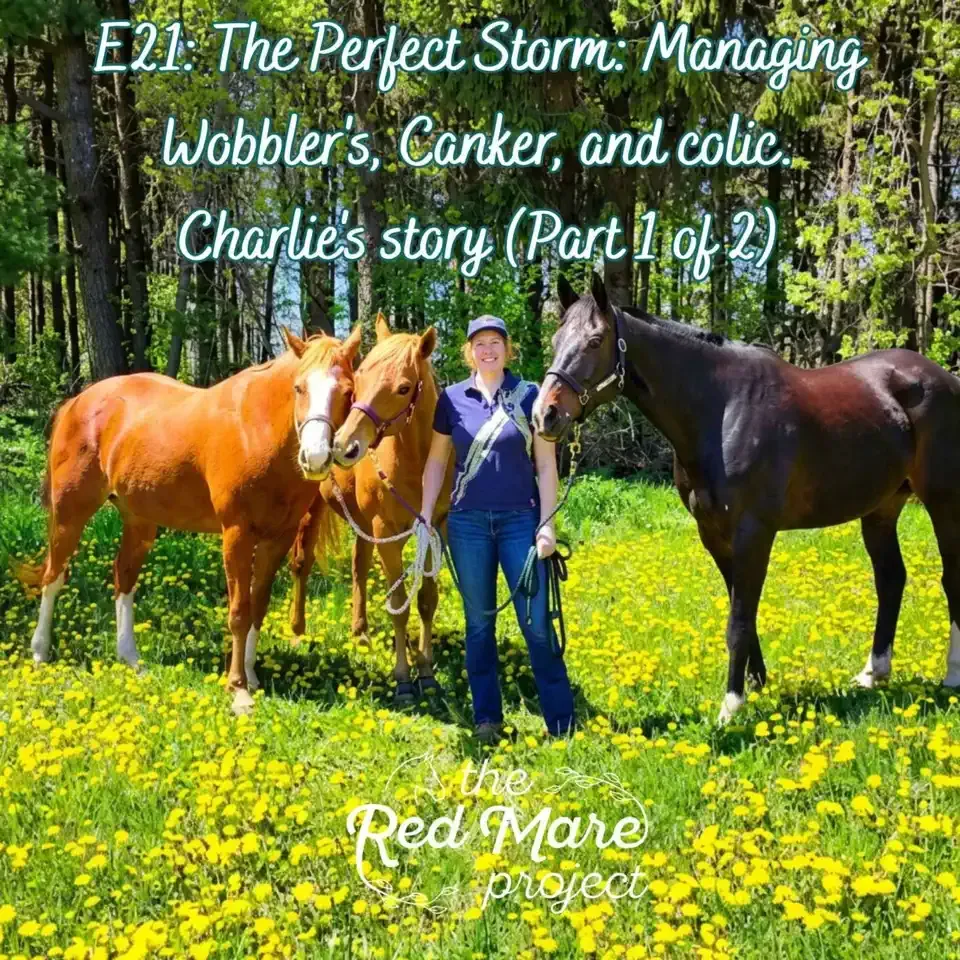
E21: The Perfect Storm: Managing Wobbler's, Canker, and colic. Charlie's story (Part 1 of 2)
August 22, 2026
About This Episode
Settle in for a powerful conversation with the newest member of the Red Mare herd, Rory Potter. Rory is a Wisconsin based farrier, rider, trainer, and Myofascial Release therapist. She shares the stories of her two geldings, Odin and Charlie. Since Rory is sharing two complex journeys, this is the start of a two part series. In this episode, we hear Charlie's story of Wobblers, DSP narrowing, canker, and chronic complex colic. Next episode (Part 2) will discuss Odin's story of EDM and sleep deprivation. For more information on wobblers, refer back to Episode 11: Teddy's Legacy. If your horse or if you know a horse struggling with neurological issues, or if you simply want to learn more, grab some snacks. This one's for you. Peace.
Host: Taylor CL Schouten, MS, APF-I Hoofcare Practitioner of Wild Hoof Equine LLC
Email us with your interesting stories. Your horse may be able to help another: redmareproject@gmail.com
Connect with us online:
Instagram (@theredmareproject)
Learn more about our showcased foundation, Teddy’s Legacy: https://www.teddyslegacy.org/
Copyright of The Red Mare Project 2026.
EPISODE TRANSCRIPT
— Welcome: Charlie and Odin’s Stories
Welcome back to another episode of The Red Mare Project. Rory Potter reached out to us via email to share the stories of her dear geldings, Odin and Charlie. Both boys tragically struggled with advanced degenerative neurological disease. An early trigger warning on this one: it will be heavy. Since Rory has two stories that she is coming on to share, we are going to split this into a two-part series.
Today, we will share Charlie’s story. He was diagnosed with Wobbler's, as well as narrowing of the dorsal spinous processes, canker, and some very mysterious GI issues. The next episode will be Odin’s story. Odin presented with equine degenerative myeloencephalopathy, also known as EDM. In addition, Odin struggled with significant sleep deprivation. Join us for a powerful two-part series on their diagnostic journeys, management, and true horsemanship. Welcome Rory, Odin, and Charlie.
Welcome to The Red Mare Project.
— Podcast Updates and a Message to Listeners
Y'all, coming up with a greeting on how to start an episode, especially when you are the only host, that can be a little challenging. So, hi! That's how we're going to do it. [laughs] All right, so it is just me this time. Kaelyn is stepping away from the mic for a little bit to focus her energy on some personal things. Everything's good. She's doing great. Uh, she just needs to direct the energy that she puts towards the show towards some other things in her life, and we're just going to keep the ball rolling. So I'm going to be forging forward solo for a little bit while she takes that time.
Uh, we're going to keep—we're going to keep the episodes coming. We may have some celebrity co-hosts just for fun along the way, but we are going to keep going for—uh, forging forward with these episodes for you guys. We are still getting emails, we still are getting messages, which is incredible, because that, to me at least, means that our mission of building that some more supportive community, it's actually kind of starting to build itself. It is—it's spreading like wildfire.
We had people e-—we've had messages from two other continents. We're in North America, in in the United States. We had a European country email us, and we had Australia email us, which is planet bananas! And they're not bots. They're wonderful. Hi, guys. How's it going? [laughs] But it's happening.
So, that said, since things are kind of starting to get some traction, we're kind of starting to pick up a little bit of speed, we do have a very exciting announcement with production. We are now working with a producer, so we have a production company! What the fuck? And uh, so that's going to be really cool. They're going to help us out with some social media things and just the overall production of the show, so stay tuned for some really fun things as we expand to different platforms and just kind of like graduate to the next level.
One caveat to that, uh, speaking of social media: um, I lost the Facebook page. Um, I fucked up. Uh, I am working to get it back, though. Uh, we have a lot of really smart brains working on it, so if you have messaged us on Facebook and we have not responded, please, please, please know that we are not ignoring you, we are not ghosting you. I just fucked up and I lost the page. Do me a favor: copy and paste that message and send it to us in an email. We want to hear from you. We want to talk to you. Just know that this was uh a Taylor fuckup, and we are not ignoring you. So please just email us. We check that multiple times a day, so we are here just waiting for you to—waiting for you to reach out.
And we may even have some other options as well. We're we're working with this with our manager, uh, where we can maybe come up with some options where if you don't want to come on the show, you can tell us our story, and we can tell the story for you. Because I know because sometimes it can be intimidating to come on a podcast, but it's just a couple of girls hanging out. We're just—we're just, you know, we're pretty chill, so. But we do understand that it can be a big thing. So if you do want to share your story, but you are not wanting to come on the show, we may have some options where we can just tell the story for you. But more details on that to come. But since I did just say it publicly, that probably will happen. So, [laughs] yeah.
— Introducing Rory, Charlie, and the Challenges Ahead
All right, so let's segue into the main event. So Rory emailed us uh maybe six weeks, eight weeks ago asking to come on the show, and she was very clear that she wanted to come on to help people who were struggling with the same issues with their horses. She just completely understands the concept of the show, what we're trying to do, and it was very clear that that was her intention. Yeah, she gets it, for sure.
Now, I did mention a trigger warning in the intro, and I'm going to say it again: this is going to be a very heavy series. While Odin is no longer with us—he crossed over this summer—Charlie is scheduled to be euthanized coming up here, probably in the next month or two. But Rory will share that in great detail. So just be aware that there is going to be some very heavy talk about euthanasia, management, making those choices, making those plans, all of that.
So let's talk about a little bit about what the boys struggled with. So we're going to start with Charlie for today. Charlie was diagnosed with Wobbler's, and Wobbler's is a stenotic process—stenosis—where there's compression of the spinal cord. We have an amazing episode on Wobbler's and ECVM, that's Episode 11, Teddy's Legacy, and in the preamble, where we get all science-y before the guest comes on, we go into really great detail about what Wobbler's is, what it looks like, how it presents, things like that. But if you want that that deep science, check back to Episode 11, Teddy's Legacy, to learn more about Wobbler's.
All right, Charlie was diagnosed with Wobbler's. He also—there there's a list here, gang. He was also diagnosed with DSP narrowing, or narrowing narrowing of the dorsal spinous processes, which is not quite kissing spine, but it's wanting to be, and it was narrow enough to where it warranted doing a full-on rehab. He was also diagnosed with some very mysterious GI issues. He struggled with some pretty chronic and recurrent episodes of colic that were pretty inexplicable, they couldn't quite figure out what the trigger was, but Rory will talk about that a little bit more. And then the icing on the cake for this poor guy: canker.
And if you've ever worked with canker, if you ever been around it, it is atrocious. It is equine proliferative pododermatitis, or we just call it canker. It's a chronic, progressive hoof disease that causes abnormal, spongy, it almost looks like cauliflower-like overgrowth of the sensitive tissue in the foot, and it is extremely vascular, so it's very easy to bleed, and it is—y'all, it has a smell to it. Ugh. It—like if you've smelt canker, you you know. It stays with you. It's horrible, and it's very painful.
There's a lot of, um—usually like typically the cause is going to be some type of hygienic issue. In this case, that was not at all the issue. This uh is kind of suspected to be a bit more of like a autoimmune issue, kind of kind of sorta. Uh, but it's very painful and it is just—you don't you don't want to deal with canker. I won't I won't touch canker. Um, I don't think I said it was in the foot. It's in the foot, if you—sorry, I'm not sure if I said foot, [laughs] but when it's in the sensitive tissue of the foot, often times the frog, that's usually where it shows up. Although I have seen it before where it actually started on the dorsal wall and then it crept its way into the sole and back. It was a very strange presentation, super rare. But yeah, I won't I won't mess with canker. That's that's vet—that's vet land all day. You send them to me when they're [laughs] when they're clean and good. And um, but that's just personal preference. Some farriers will, some won't. I won't.
All right, so let's get back on track here. All right, so we have—we spoke about Charlie's uh his list of symptoms. A quick little intro on Odin. Odin was diagnosed with equine degenerative myeloencephalopathy, or EDM, and he also struggled with some pretty significant sleep deprivation. Now, since Odin's story is going to be the next episode, I'm going to do a full breakdown on EDM the next episode before we pick back up with Rory.
Just a little bit on Rory before she comes on: she is a fellow farrier, which is always super exciting, and she runs her practice, Green Broke Farrier Service, out of Wisconsin. She is a dressage, hunter jumper, and event rider. She also offers training and exercise riding services, and she is also a trained myofascial release therapist. Super knowledgeable, extremely educated. We love to be able to take a whole-horse approach. Hell yeah! All right, so without further ado, Rory.
— Meet Rory Potter and Her Horses
Good morning.
How's it going?
Doing all right. How are you?
I'm okay. I'm okay. Hey, thank you so much for sending all of that stuff over.
Absolutely. [laughs]
Holy moly, those sleep deprivation videos were—they're heavy.
Yeah. There—I have like 30 of them.
Was it happening—
Yeah, it happened like multiple times every night. So like those are like small segments, but I would be recording for like 20 minutes at a time of him just like wobbling and... yeah, it was not...
Wow.
...a fun time. [chuckles]
No. Holy moly. Okay. All right, well, are you comfortable? Do you have everything that you need? Like maybe a water or anything or—
Yep, I have some water here. Tissues, that might be—[laughter]
Oh, bless!
Hopefully not. [laughter]
Oh, that's—that's a good idea. That's—
Yeah. Right, we best be prepared, especially like with everything going on with Charlie now, and that being like something that's going to happen in the next
probably two weeks. [laughter] That's a little—[laughter]
Oh, wow. Are you okay to do this today, then? You good?
Yeah. Yeah.
Oh, my god. Okay, I didn't realize it was two weeks. I thought you were pushing off until—
We—so we were trying to wait till the end of summer, which is variable. You never know when that's going to be. [chuckles] Um, but it was kind of like a let's
watch and see how he's doing. Mhm. And then my mare, she's also been riding a roller coaster for like the past year. Um, so and they're like extremely herd-bound. So she's riding the wave, and she'll go through phases where she just doesn't eat, and then he's doing his thing. So they're going to be like a unit.
Understood. Girl, you're like a hospitalist at this point.
[laughter] I am. Have a lot. I know. I was like, well, we maybe will end up touching on her, since she's hanging out and taking care of him right now. So I'm sure
she'll come up, cuz yeah, she basically guides him through his life at this—[laughter]
Oh, my gosh. She's the nanny.
Yeah.
Okay.
My red mare. [laughter]
Oh, really? Is she red?
Yeah, she's a chestnut mare.
Awesome.
Yeah.
Oh, boy. Okay. All right, so let's go ahead, if you're comfortable, let's go ahead and get started. So I did, uh—well, I received your waiver. Thank you. I have everything that you sent over. Your notes are outstanding. Thank you for putting that all together. That really helped guide a lot. So, I know that you you listened to the show. Thank you so much for supporting us.
So I did my little like preamble beforehand, where I explain like what EDM is and things like that, just because I don't want—even though like I know since we're both professionals, we definitely will get into the weeds on some science and some heavy stuff.
Right. Yep. What—
You know, I don't want to tax you with asking like, you know, more nuanced questions. If it comes up organically, awesome. So, uh, but I really just focused on EDM, cuz I know that Charlie is still a little bit more—I don't want to say nebulous, but it's just like general neurological abnormalities.
Right. Yeah, he's got a couple things rolling around. [laughter]
Yeah. Yeah.
Yeah.
— Rory’s Background in Farrier Work and Horsemanship
So, uh, that said, all right, so just like the the ground rules: You can say whatever you want. This is your time with your boys. Whatever you want. You can swear, you can talk shit, whatever makes you happy, whatever comes up. If you do say something and you're like, "Oh, I don't think I need the world to hear that," just tell me and I'll go through and I'll cut it out. It's no big deal. It's easy. So you just tell me what you're comfortable having the world hear. Uh, so yeah.
All right, so to start, even though I did do a little bit of an intro on you, because you have a very impressive resume, like you're—you've got some knowledge in there, girl. But why don't you tell us a little bit about you, and what that led—like how that led you to your multi-skilled career? Because you have a lot of roles in the horse world. It's pretty cool.
Yeah. [laughter] Um,
Go ahead. Yeah.
Yeah, I I kind of grew up with horses. I started riding when I was like seven. [clears throat] Um, we started just leasing and lessoning and, you know, working off board and all that stuff at the the barn I grew up at. Um, so it kind of all started there. I was always interested in farrier work, like watching the farrier come to the barn. I was always like in it, wanting to watch, and went as our far—first farrier for Halloween for like two years. [laughter]
Did you? Oh, you're so cute!
Yeah, he gave me an old pair of chaps, and so I put on that and some old shoes and walked around. [laughter]
Girl, I love that.
It was it was a fun time. But uh, I kind of like I kind of—I was always—I knew I wanted to do something like helping horses, um, you know, growing up with that. And then having, you know, my mare I had pretty much most of my time in horses from when I was nine to now I'm 23. So, um, I've had her the most consistently, but we've had a lot of other horses in that time, um, including Charlie and Odin, that have had a lot of issues. [laughter] Um, so I kind of I was like, "Okay, well, I want, you know, coming out of school," I was like, "I want to do something that helps horses." And I don't know why, but I kind of forgot about farrier work for a minute. [laughter] Um, I don't know how, but then all of a sudden, I was like, "Hey, wait a minute. I can make a career out of that," cuz I was like, "Nothing in horses you can survive off of." [laughter]
Fair point.
So, right? But then I was like, "Oh hey, you can!" [laughter] So I went to Heartland Horseshoeing School in Missouri, um, and that was boot camp. [laughter] Um, so did that uh in 2022, and then came back, started my business, um, and I kind of—
What—
You know, looking at that, you're like, "Well, I still want to help like the whole horse." Like it all starts with the hoof, but then everything travels, and like sometimes when you're working on a horse, like you feel like they're tight in their shoulder, or you know, and no, I can't do like hock injections or anything, [laughter] but um, that's kind of what led me to want to do like some smaller like body work courses, um, and myofascial release and stuff so that, you know, for these horses that are struggling and compensating in other ways, that I could kind of help them relieve some of their tension, and allow them to have an easier time moving around and an easier time for me to work on them, since that is a—a lot of people don't realize it, but it is a very strenuous thing for a lot of those horses, you know, especially if they're older, all that. So, yeah, that's kind of what led me down that like multi- [laughter]
Yeah.
-faceted route. Um, cuz yeah, I just I always want to keep learning, and the more problem horses that I have, the more I want to learn, and I dive into all these rabbit holes in different realms. And yeah, so that's kind of like professionally where I'm at. Um, riding-wise, I primarily I grew up doing like hunter jumpers, um, and then shifted gears more towards dressage, and then landed on eventing once I realized that was a thing that blended, [laughter] blended it all.
The ultimate triathlon, yeah.
It's a great thing! Yeah, so kind of landed on that route. Now I'm back to dressage just cuz this that's this horse, my current horse's wheelhouse. So kind of go off of what what they're telling me they like and all that.
Excellent. So you've been—you've had your farrier practice, which is Green Broke Farrier Practice, right? Or Farrier Service?
Yeah, Green Broke, yeah, Farrier and Training.
Oh, look at you! Attagirl. Okay.
Yeah, a little—[laughter]
Super cool. So you've been doing that—so you said you went to school in 2022?
Yeah, so—
So you were a baby! You were—if my math is right, you were 19?
Yes.
Oh, wow! Okay, so you've been—
Yeah, I had one year out of high school, okay, and just to work and save money for school, and then, yeah.
Okay, so you've been four years now. So what what type of clientele do you tend to service? Are you more performance? Do you feel like you lean more towards rehab, senior horses?
I think in the beginning, when I did more shoeing, I did more towards the performance route. Like I had a lot of, um, you know, your backyard trail horses and all that as well, [chuckles] um, but it was kind of a more happy medium. Now I'm geared more towards the the owners that just have their horse to love them and trail ride. I have a couple of people that show, but it's nothing like, "No crazy, we're going national" or something, none of that. I I like those people, you know, you the people that have one or two horses, they just want to pour all their love to them. I'm like—
They just hang out.
Those—right? I just do trims now. Don't do shoeing anymore.
Okay.
Um, yeah, I just—through research, I I like the, you know, I I prefer to keep a horse barefoot if you can. I do still think there's a time and a place for a shoe or like a glue-on or um, I do a lot of like Scoot Boots and stuff. Um, but I think it is it's just so much healthier, and then with my back being the way it is, [laughter] it's it's also less of a toll on me. So, I'm like, we swapped the truck out for the Outback, and [laughter] brings a—[laughter]
Love it! Oh, that's super cool. Yeah, there's definitely a place for everything.
Absolutely.
Yeah, yeah, yeah. Cuz I I think if there's, um, a really profound allegiance to one thing, I think that gets a little dangerous, cuz not every horse is going to fit into that mold, so...
No, absolutely. Yeah. That's why I have another farrier that's local that I really like his work and I trust him, so if I see a horse that I'm like, "They should really be in shoes," I'll send them his way. [laughter] I'm like, we work with each other, like that's that's what it's all about.
Excellent. No, 100%. Yeah, it's definitely—as much as it's like us out there by ourselves, we're not. There's a whole community. We have to support each other, so... Yeah.
Absolutely.
All right. Well, let's segue into the boys. Uh, so we have Charlie and Mr. Odin. Did you want to start with, or who would you like to start with?
— How Charlie Came Into Rory’s Life
Um, probably Charlie, since he was—he came first [laughter] in my lineup.
He came first. Okay. Yeah, yeah. All right, so how'd you find him? What's Let's go back to day one.
Facebook Marketplace. Or not Marketplace. [laughter]
Really?
Yeah. Um, Facebook, I should say. Um, yeah, he just he popped up one morning. I was very casually looking, since my mare was starting to slow down, um, you know, getting more towards her retirement. So, I was like, "Well, look for a horse that's, you know, if the right one shows up." And I don't know, I guess I've always been partial to my flaxen chestnuts. [laughter] It's not intentional. They just end up finding me. [laughter]
You have a type. Right? Yeah.
[laughter] Um, so he popped up. He he was adorable, um, and only like 2 hours away. So I was like, "Okay, I I can do this." Um, I would have to pull a little bit of money from my college savings, but you know. [laughter]
That's okay.
He was he was very affordable, though, and seemed like a really levelheaded guy, you know. He was listed as, um, I think he was listed as a seven-year-old, off the track. Everyone was just climbing around on him bareback, like having a good time.
Yeah.
So I went to see him, um, he was at this really big barn. Um, they had like over 200 horses there. It was insane. Um, but yeah, he I mean, he was super good. You could tell he was very green, um, you know, he just he didn't know a lot of the the things like lead pressure and and all that. Um, but I took it as a green horse thing, you know. A lot of horses don't get that right away, and he seemed levelheaded. If anything, I was worried that he would be, uh, a little dull. I was like, he—I don't know, he just doesn't have a a big personality, and I like a horse with more personality. And was wrong, but [laughter] once—once he got home, then I was like, "Oh, he's got a big personality," once he started opening up. But you know, they just sometimes in different situations they're just more shut down. [clears throat]
Um, and yeah, it was it was kind of just a weird start, though, cuz when we went to go pick him up, and his—they sent his Coggins, and they were wrong. So it said he was a 16-year-old palomino Quarter Horse, and it had his pictures, and he is a light flaxen chestnut, so I'm like, "Hey," and he's the way he's built, he it could pass as, you know, a Quarter Horse.
Yeah. I'm looking at his picture right now. 100%. He's super cute.
Yeah. I'm like, we were freaking out! We're like, "I don't need that. I already have an older Quarter Horse!" [laughter] So freaking out, and then they're like, "No, no, no, he has a tattoo," and then they took a video, they flipped his lip up. I looked up his tattoo. He was two years older than they had thought he was, but I'm like, "Okay, so he's nine. That's not horrible."
That's fine. That's fine.
Exactly. I'm like, "Okay, he's a Thoroughbred. Here he is. He's Irish, who knew?" [laughter] Um, yeah. So I was like, "All right, we'll we'll stick with it." Um, so that that was kind of our our introduction. [laughter]
Okay. Okay.
Um, yeah, when I—if I had known all these issues, no, I would still get him. [laughter]
Yeah.
In a heartbeat. Yeah.
Yeah, yeah.
Um,
So, we got him. You guys are just getting to know each other. His personality is starting to blossom a little bit. You're getting to know him. Uh, and then when—tell me a little bit more about that turning point, cuz it seems like that's the that's the crux right there.
— Charlie’s Early Quirks and Behavior Changes
Yeah. Yeah. Um, so as his personality started blossoming more, you know, um, you allow them to express themselves more, and you know, [laughter] um, he was a little scared like going through uh like the doorways and stuff. I don't know if he was corrected if, cuz he he can get a little in your space. Nothing bad, but he's a playful guy, and um, so he was a little scared going in and out of doorways for a bit. Um, but we started building his confidence with that.
Um, he didn't really understand like social cues very much. Like, he he was in with, um, one other horse in the beginning, and then we added my mom's horse, and um, and yeah, he just the horses would they would go and they'd like pin their ears at him, you know, to run him off the hay, as you do. And he just wouldn't get it. He would just put his ears up and tilt his head at them like, "Hey friend!" [laughter] Try and eat their hay out of their mouths, and [laughter]
Would you consider that like one of his quirks? Cuz I know quirky is kind of a— Okay.
Yeah. Yeah, it was something that like we didn't think much of, um, but now like in hindsight, we're like, that probably is like once you compile all these things, it's like, okay, yeah, something's not right. So, yeah, he just he really didn't understand. Like as many times as the horses would try to like get after, and they would get mad because he's not listening, and he just you could tell it just wasn't wasn't clicking. Um, so that was kind of our first like, "Huh. He's he's a little weird." Um,
Okay.
He's a little weird. Very sweet, though. Like he did not know how to pin his ears until he started mimicking the other horses [laughter] like a few months later.
Really?
Yeah. Like it was just like a child. Like he would they he would finally start pinning his ears, and he'd like kind of bob his head at them, and then put his ears back up like, "Yeah, that's what we're doing?" It's like, "No, buddy, that's not what we're doing."
That's so cute. Do you think that the, um, the—dare I say claustrophobia, like walking through a narrow area, did that seem a bit more, cuz horses are inherently claustrophobic, did that seem more in alignment with typical behavior, or did that—do you feel it kind of fell a bit more into the quirk land, the quirk territory?
It did start going away.
Okay.
So, yeah, like I would say probably after about the first first few months, probably four months-ish, that kind of went away. Like as his trust grew, and confidence grew, and all that, then that problem kind of went away. So I think it was probably something either with, um, you know, being off the track, if he was a little worried, um, from starting gates and whatnot, or if that was something, you know, from being corrected at his stall too much, I don't I have no idea. Um, but I think it was more of a a learned behavior than something he just The quirk. Right. Yeah. Yeah. Okay. Um,
All right. So yeah, let's let's keep going. So he's doing these weird little quirks and things like that, and we'll we'll talk about that a bit more, cuz when you go through the literature, there is a lot of—it's kind of weird to see the word "quirky" in a peer-reviewed paper. [laughter]
Right.
But that's the word that's used, so I would like to kind of tap in a bit more as to what that looks like.
Yeah. So that, yeah, that was one of his things. And um, he would forget like going to the water trough. He'd forget what he was going to do there. So you would see him licking his lips. He'd just eaten some hay. He's on his way to the water trough. He would get there. And then he would stand there, you could see him thinking, he'd kind of look around, and then he would just walk away. I'm like, "Weren't you coming for a drink?"
So then I finally started like going in there with him, and I'm like, "Hey," like, "you want to drink?" I'd cup my hands, bring some water up to his mouth, he'd lap it up like a dog, [laughter] and then I would kind of pretend to drink out of the trough with him. And then he would—you could see like a light bulb: "Oh!" He starts licking his lips, and then he starts getting a drink, too. And I'm like, "Huh, did you just kind of like forget what you're doing?" Um, which, yeah, it was just, you know, another one of those things that you know, you're seeing all these little things, and you're like, "Huh, he's just weird. Huh, he's just a quirky little guy." Um, and then you get more and more of these, and you're like, "It's not..."
It's a pattern. Yeah, it's a pattern.
Right.
So, and that started to—and I'm kind of jumping the gun on this one, but it seems like that kind of behavior really started to manifest maybe 3 years ago, so 2 years into owning him?
Yeah.
Okay.
— Recognizing Neurological Warning Signs
Uh, it was shortly, probably 6 months is when the first bits started shining through, um, like and like his head tilt with his tongue out and like all all these weird things that like Chiropractors like, "Oh, we don't find anything," you know. There's nothing like physical in that way, like that led me to think TMJ or something.
Sure.
She's like, "Well, no."
So, he had a head tilt with his tongue out. Now, okay, I do want to unpack that. Cuz I I guess what, um, what I'm trying to kind of map out is the timeline of the progression of symptoms.
Yes.
You know what I'm saying? So it's—when did the head tilt start with the tongue? Was there tongue tone when he did that?
No, it just generally hung out the side.
Okay.
Yeah. He would just tilt, and that that was pretty early on, too. Like that was, I think, one of the first symptoms aside from the, um, like lack of social awareness.
Okay.
I think that was one of the first things that kind of showed up as weird with him. Um, but yeah, we couldn't find anything that it was linked to.
Okay.
Um, at least in terms of like chiropractic work, and teeth, and all of that. Um, and he would just do it like very randomly. Like—
Okay.
—no pattern. It's just fun. He's like, "Hey!" Um, yeah, it was just there was no no consistency to it, but he would just do it.
Okay. Were you riding him at this point?
Yes.
— Changes Under Saddle and Difficulties with Steering
Okay. And he was—he was good.
Yeah. He was, yeah, you could tell like he was your typical green off-the-track, but nothing crazy, um, very, very willing, wanted to please. Um, and it was really like, I want to say almost a year in that he started having more inconsistencies under saddle. Um, like we noticed he would occasionally get a little trippy, um, but we're also rehabbing his feet, nasty feet. Um, so we're kind of working through that.
But then he would have days where he was like really, really good, starting to understand like moving off your leg, starting to understand like coming up and pushing into the bridle more, and balancing and all that. And you'd be like, "Okay, you're getting it! This is awesome!" And then the next day you'd be at like worse than square one. And he would be like super super dull, not responding to anything, flipping his head in the air, um, just really, really weird stuff. And you're like, "Well, how are we worse now when you were so good like the day before?" And then the next day he would be back to like really good. So it was like this back and forth, like really, really good, progressing, learning, and then just completely back to like not even square one.
So it was just, yeah, it was just like a really weird weird thing that we were like, "Well, why?" And then when it started happening more, that's when we're like, "Okay, we really need to have like a vet out, cuz this isn't right," you know, especially like with his demeanor being so sweet and so willing. We're like, it's not him to just get all [laughter] weird.
So it sounds like he was—he would be good, and then the next day it would almost like you'd ask him a question, and just "file not found."
Yeah! Seriously.
Like no retention.
Yeah. None. It was really weird.
Okay. Wow. And then, so you made a note, too, and this I know probably in the moment may have felt more of like a steering issue, just an education issue. But I saw that you wrote here he would have random days where if you rode him in a halter, he could only turn one way.
Yes.
So when did—so yeah, talk about that.
It's hard to know when that happened, cuz I didn't ride him bareback in a halter a ton for a while. Um, so I don't know if that's something that he came with or not. Um, but I know like when I did first start trying to hack him out like in a halter and stuff, um, I would have to like put both hands on—I believe it was the right rein, cuz he would just—or left rein.
Left rein.
He would always try to turn right. So we would be like going to the left around the arena, and he would just be constantly cranking his head and trying to turn the other way. But he only did that in a halter, which was very interesting.
Did he do it if you lunged him? Like did he have a direction if you lunged?
Mm-mm.
Did you lunge him with a bit?
I did not.
Okay.
Maybe a handful of times, but not anything notable. It was just, yeah, it was like a weird thing that was only bareback in a halter. He would And he started getting more imbalanced like jumping flash-forward once we started diving more into his rabbit hole. He did start having more, um, crookedness and all that, um, in the lunge and all all that stuff. But that was more when he was out of work.
So, just to make sure I'm picturing it right, so like if you—or just like the severity of it, if you were sitting on him bareback, and you have just a halter and lead rope on, would he just stay on like a 10-meter circle if you just let him cruise, or was it more of—
Pretty much, yeah.
Oh, really? That severe.
If I would let him do what he wanted, and I asked him to go forward, otherwise he'd just stop, you know. But if I asked him to go forward, then he would just turn. Like I had both hands on one rein to be like, "Stay straight, buddy."
Mhm.
I'm like, "This is weird." [laughter]
Did it feel like a fall, like his shoulder was falling in, or did it feel more like, "I just want to track this direction"?
More like he just wanted to go that way. And it was very very rigid. Like it was—
Okay.
—like stiff, like it was hard to pull his head to center straight, cuz he was very like strongly pulling that way.
Was he high-low?
He was, yep.
Of course.
Yes. [laughter] Yeah, obviously, yeah. Um, yeah, his left front is his super pancaked hoof. His right front is actually a bit clubby. Um, the vets think it's weird, because he cuz he still had the long toe, underrun heel when I first got him, um, but he had like in the X-rays, you could see like he he was clubby on that foot. So they're like, "This is like the first shallow-footed club foot that we've seen, like [laughter]—"
Why not?
Right? I'm like, "All right, my horse is weird." [laughter] They're like, "Just keep doing what you're doing, [laughter] cuz not going to fix that too much."
So he just went in his Scoot Boots, but he did—it sounds like foot-wise, even though like I'm envisioning what these off-the-track feet look like and Is that Is that the correct image that I have in my head?
Eew. Yeah. [laughter] Oh, yeah, they were gross. Um, and when his shoes first got pulled by, before I was a farrier, uh-huh, an old farrier pulled them and his feet just like tore apart. They were horrible. Um, and yeah, we we had already kind of been loosely introduced to Scoot Boots with another one of our horses, so started using those with him. I went to school, I started you know, really deep diving into his hoof rehab and his angles and everything, um, working on getting that toe back, getting more heel under him. Um, and then eventually, I would say probably a year, a year and a half, I would say maybe, um, maybe 2 years, um, he started transitioning out of the Scoot Boots. And like in in good footing, he was able to go without. Um, if it was really hard or icy or something, then I would pop them on again. But now the past couple years he's been boot-free, living his life. [laughter] So...
Good for you, girl!
Yeah, good stuff.
Excellent.
One good thing. [laughter]
— Back Pain, Rehabilitation, and Further Evaluation
So I want to jump into these back problems, too, cuz I know that there's Yeah. kind of that—I don't want to say it's like the beginning of the end, but it seems like that rehab, and all—you know, you'll go into all of it, but that rehab was kind of a highlighter of a lot of other things that were going on for him.
Yeah, so yeah, it was 20—May of 2023 he started getting um, just even weirder under saddle, having more of those days where he would just have his really big head toss and just be really sucked back. Mhm. And so then we were like, "Okay, let's let's get a vet out, because he's starting to get worse." Um, so had the lameness vet out, determined he was a bit sore in his lower back, primarily the right side. Um, and then he was tracking weird. When cantering right, he would kind of counter-flex to the left, and was very stiff stiff through his um, like his back and his hind end.
So they did X-rays on his back. They found um, he had arthritis and some changes and stuff going on between T14 and 16. Um, and so I mean, nothing was major, but they were like, "It's it's definitely enough that it could be causing him issues, especially with how he was presenting."
Okay.
Um, so they did an injection, and then they had me do a rehab. Um, I got like the Equiband system, I would ground drive him, do a lot of carrot stretches, tail pulls, [laughter] all that stuff, just to try and really strengthen um, like his core, his hind end, his back, all that stuff. Really get him flexible and strong and all that without a rider on his back. Um, so did that for about a month and a half, and that's when they said, "Okay, you know, now you can try tack walking and see how he does with that."
So, got on him. He was still very sucked back and sluggish. He wasn't flipping his head, but we were only walking. Mhm. Um, but just very, very sluggish and still doing all of those weird quirks like in the pasture and stuff. Um, and so we were kind of like, "Yeah, it's not really helping."
They came back out to re-evaluate him, to see what changes were made, um, and they're like, "Yeah, like there's still there's some improvements. He's a lot more flexible and and stuff like that, and there's not as much reaction when they palpated his back." But they're like, the the way he's carrying himself is still just not right. Yeah. Like, they're like, "He could have some arthritis in his hocks. We wouldn't jump to that being the root problem, because a lot of horses do, and they don't present this way."
Yeah.
Um, so they're like, "I I really I would maybe have him looked at for, you know, something else." Um,
So were they like alluding to more neuro stuff at that point, or were they still kind of thinking it was a bit more mechanical?
They weren't They were thinking more mechanical. Um, they didn't do a neurologic test on him, but he was I mean, he was tracking up appropriately, and um, I mean, he held his balance pretty well on the lunge line, aside from, you know, counter-bending to the right, but Okay. otherwise, you know, nothing glaringly obvious, like this horse isn't tripping and falling on his face, or you know, nothing like that.
Okay.
So they're they're like, "I don't know, you should maybe just have more looked at, or just do another month of rehab or something, and see if we continue to progress, um, or not."
— Neurological Testing and a Wobbler’s Diagnosis
Yeah, that's all reasonable, too. That like makes sense. So...
Right. Like that's and perfectly normal and fine. Um, but we ended up uh having to make a trip down to the vet clinic for one of my mom's horses for uh a surgery, so we're like, "Oh, well, we'll take him down, too, and we'll have them run like a neurologic exam, and lameness exam, and um, really see, do a deep dive and see what they can find with him." Mhm. Um, cuz yeah, it's like something's just not right with him.
ADR, yeah.
Right. [laughter] So, took him down, told them about all of his weird little quirks, um, and then the things that he had been presenting in our findings and all that. Um, and in theirs, they they found that, um, he did have mild ataxia, um, mildly abnormal to the walking tail pull. He was pretty good to the standing tail pulls. Um, he would go like when they walked him up and down this little hill and they had his head held high, he would kind of reach with his legs, like not really quite knowing where where they would land. Um,
The little fancy stepper that they do, yeah.
Right, yeah. So they're like, "Okay, yeah, he is he is, you know, mildly neurologic." Um, and then he did have some reactions when they palpated his neck as well, which was new. Um,
Oh.
So then they did they did X-ray his neck, then. And they found he had arthritis from C4 to C7. Um, just the whole thing kind of had mild to moderate arthritis. Um, they did a lot of tests. They spinal tapped for EPM, Lyme, all that stuff, um, ruled it all out.
Those were clean. Those were clean. Okay.
Yep. They ruled it all out. So with with the X-rays that they had and the neurologic findings that they had, they're like, "It's pretty safe to say that he's likely got some spinal cord impingement going on, and is an early Wobbler's case."
Okay. Yeah. And then it said also, so I saw here that you wrote like, yes, we're going to—our working diagnosis is going to be Wobbler's, but then also just an interesting case of it, because the other oddities are not going to—like the those like the forgetfulness, those cognitive changes, that's not going to speak to Wobbler's.
No. She was like, "I don't know if he was a dummy foal. I don't know—he has a scar on his head." She's like, "I don't know if that plays a role into it, not being able to know his full history." Um, it's hard to say, but she's like, she's been doing it like 30 years, and she's like, "Thank you for bringing him in. He's an interesting case." [laughter] I'm like, "Love to hear that."
I want to be boring to my vets.
[laughter] Right! I'm like, "Thanks, love it." So are you saying—cuz she's like, "Would not recommend riding." I'm like, "So are you saying I have to retire him?" She's like, "Yeah, I would not ride this horse with all of his problems." He was 11.
Yeah. [laughter]
So, okay, so two questions pop up, and one is more of a clarification. So when with his back, did they just say it was OA changes, or were they thinking that it was actual kissing spine? Cuz I I didn't—I don't think I saw—
Uh, she kind of she called it "narrowing spine."
Okay.
Which is something I haven't really heard, but she's like, "It's everything with him was early," I'll say. Like, they're like, "It's kind of it's working its way there. If we didn't start doing rehab, it would start, you know, fusing, and there were already changes forming between the vertebrae, so..."
Okay. Okay.
The remodeling starting and all that. So they're like, "It's not to an extreme point yet, but it's it's working its way there."
— Managing Charlie’s Hooves and Balance
Got it. Got it. Okay, so another thing that I'm thinking of, as well: You're you're his trimmer at this point. You have been, and I have one Wobbler's case, and at least like the ones that I've worked on that I feel definitely have some weird stuff going on, they they have a very different way that they have to hold themselves, and the way that I have to work on them. Did you feel like you had to make any accommodations for him just working on his feet at this point?
Yeah. [laughter]
What was that like?
Um, I usually usually I had I have a second person help, like my mom or my dad. We um, we got this like one of those snuffle mats for dogs.
Oh!
We got one of those, and we put it on a a board, like a wooden board, and we fill it with treats. And then I have someone hold it for him, cuz otherwise like that kind of distracts him, Mhm. cuz if he's not distracted, then he's super fidgety, wiggly. You go to put his hoof between your knees, and he rips it out really fast. Um, and he still occasionally does that, Mhm. but it's a lot more manageable Okay. when he's really focused. But he's super like ADD, like, "Oh, what's over here? What's over here? Oh, can I take the rasp from your hand?" All that fun stuff.
He's just a child.
So—[laughter]
So, and I know exactly what you're talking about, [laughter] but like if you were to like bring his foot forward, did you feel like there were proprioceptive deficits where like if you brought it forward, some of them—it sounds so weird—I almost like have to bring the stand to the bottom of their foot, and then I can put it down, so it's like, no, they can like I put the ground to them, and then I bring it down. Does that make sense?
Oh! Yeah, he didn't have any of that, um, but he would really whip that foot forward. Like it was rocket launch. You got to catch that thing and hang on to it. [laughter]
And watch your chin, too. Oh, shit, girl! [laughter]
Yes! I know, I'm like, "Whoa, Charlie, Charlie, Charlie! No, no, no, no, no." [laughter]
Yeah, yeah, yeah.
"Relax, foot down, easy." [laughter]
So do you think that was more of like a balance thing when he was doing that, or was it just his his personality cuz he was fidgety?
Yeah, I think it's a a mix of both. Like you like looking back, I didn't originally know this, but once I knew he he had some neurologic issues, I'm like, "Okay, some of the the slamming his foot down and stuff, I'm sure is a balance thing, Mhm. um, and just really having to catch himself, but I think some of it is his super playful personality." He's like, "Oh, here's my foot!" [laughter] Like, "Okay. Tone it down just a little." [laughter]
Just a little. I know exactly what you're talking about, and it it definitely is a "Oh, shit!" And then there's a foot flying, and then you're like, [laughter] "How quick can I move my face out of the way?"
Yeah, alarming! Right. And then when you know your horse doesn't fully know where their legs are when they're doing it, it's scary! [laughter]
Yes! The one guy I have, well, I have one that does it just because he's a he's like a 25-year-old child, so it just is, [laughter] but the other one that does it, I I do think he has some proprioceptive issues.
Yeah.
And for him, I put him in the Pro-Six, and that actually really helps him. It's it still happens, but I think it gives him a little bit more just body awareness, and it's not I don't have to move my face out of the way as fast.
Right. Yeah. Nice.
So that was a big help for for that kid.
— Recurring Colic and Unexplained Digestive Problems
Yeah.
Okay, so we talked about his feet a little bit. Where were we? I just kind of— Okay, so I think this brings us—so we're we have a working diagnosis of Wobbler's at this point. We sadly had to retire him, so right now he's he's your pal. Um, this brings us, I believe, colic.
Yeah. Um, yeah, so he was just living his life, being a pal, um, super good boy. Uh, and then we were coming home from Thanksgiving. Great way to come home. [laughter]
Oh, horses!
Um, come home, doing night check, all that, and then we noticed he he was acting funny. He wasn't eating much of his hay. He was still nibbling on it, but I mean, this kid like chows down some hay. So eating very slowly, just kind of not moving around much. Mhm. Um, kind of pulled him out of his stall to take a look, walk him, and he was very, very tense in his core. Like you could see all his little ab muscles working. Mhm. So we're like, "Okay, someone's having a mild colic here." Um, called the vet out, all that. He he tubed him and everything, trying to get things moving. He's like, you know, everything seemed okay otherwise. Um, nothing was flipped or anything on the the rectal exam, and so he's like, "You know, we'll tube him, all that, and then just give him like wait until you see him pass some manure and stuff before you start giving him more food."
Did that. He passed manure just fine. We're like, "All right, we're we're moving out of it. This is great." Gave him um, like a supersoaked alfalfa pellet mash just to really help hydrate, keep things moving, um, all that good stuff, and then he started acting like that again. Like, "Okay, well, he's eating, he's drinking, he's passing manure, but he's still like really grouchy."
Had the vet back out. They ended up finding out that his colon was flipped this time.
Shit.
They're like, "Oh, my goodness." They're like, "Okay, so it's flipped, but it's not like not super extreme." So they're like, "We should be able to like pack him full of a bunch of fluids, weight it down again to flip back over." Okay, we'll do that. Pumped him full of fluids. They're like, "Just give him really wet mashes to try and really get things moving." Did that. They come back out the next day. It's back in the right spot! But he's still acting weird.
So then they ultrasounded him. They're like, "Oh, his small intestine is like freaking out." They're like it They said it's like extremely hypermotile. It's just moving around really rapidly, um, and they couldn't figure out why. So, yeah, it was like, I think in total it was like 5 days at home that we were dealing with all this stuff. And then finally, the vet's like, "Yeah, this is just a problem. Like we don't know what's going on here." Um, and this was two different clinics that we had come out, and they were like, "Okay, you need to take him down to the equine hospital so they can at like bare minimum, they can give him IV fluids," cuz the only thing they were finding is like very, very mild dehydration. But nothing extreme.
Yeah.
So they're like, "Yeah, we at least get him IV fluids to make sure things stay in their place and stay moving, but we got to figure out why the small intestine is acting the way it is and see if we can figure out what's going on." So, yeah, we brought him down there. He was down there for like 5 days. They did a bunch of tests, ultrasounds, um, they did like the stomach tap. They couldn't find anything.
They at one point, they tested um, like the stomach tap, and the machine couldn't read it. They're like, "I I don't know what's going on." And then they re-
What does that mean? It couldn't—
Like the numbers were just not legible. Like they couldn't The machine couldn't read it. It's like couldn't comprehend what it was getting.
Oh. That's That's not good.
No! And we're like, "Is that a problem?" They're like, "I don't know. We'll send it to another clinic to see if they can theirs can read it." Theirs couldn't read it either. Then they reran it at their hospital, and finally they got a reading, and it was normal. And we're like, "That None of that makes sense."
Okay.
Huh, they're like, "We can't find an sign of an impaction, we can't find anything wrong with him. He's just acting weird." So they're like, "I guess at this stage, we're going to have to do like an experimental diet change, where you don't give him any hay, he just gets um, you know, a certain amount of soaked alfalfa pellet a day, and then they had him on like a senior complete feed."
Yeah.
So he got like seven small feedings a day of the alfalfa pellets and the complete feed.
Oh, my god, what a chore!
So much! And we don't have a spare pasture, so the kid's living in the arena right now. [laughter] Poor thing, at least it was winter. But yeah, then cuz they were like, "We can't We can't find anything, so we're just going to try and give him something that's easier for him to digest and see if that helps."
So, well, that's that's curious. Okay, so, but it was cuz we're we're on Charlie, it was Odin who we were suspected of the ganglionitis, which is more of a—my understanding, it can be a stomach thing. So both of these guys had possible weird stomach stuff going on?
Possibly, yeah.
But it sounds like this was not For Charlie, this was not like a gastroparesis, because there was hypermotility, so there was like excessive movement.
Right. Exactly. So, yeah, that's why they were perplexed. [laughter] That's why we're all perplexed to this day. Um,
— Charlie’s Recovery, Care, and Ongoing Questions
Okay. All right.
Yeah. It lasted like So we we had him on that diet for like 2 months, and then we're like, "Is there any way we can transition him back to hay? Because he can't stay like this forever. There's no There's no way." We were able to cut it down to five feedings a day, but we're like, "Still! Like, [laughter] we all have jobs, we [laughter] like It messes up a lot of your life to try and keep this horse in the arena [laughter] and giving him so many feedings a day, and that's not good for him. That's no happy line."
Yeah.
So finally, they're like, "Okay, you can try to start him back on hay like a handful at a time." So like first 3 days, one handful; next 3 days, two handfuls; and so on. So we kept increasing till we got like a flake, and then two flakes, and eventually, like after the course of like a month, then we got him where he could just have normal amount of hay again. And turned him out with a friend, with my mare, um, hoping for the best.
Mhm.
He was fine. Back to normal.
And this is the the red mare, the the The red mare, the babysitter. The your first mare. Okay. Okay. What's her name? Just so I can put a face—
Yes. Yep. Allie. [laughter]
Allie! What a gal.
Yeah.
Okay. So, Allie's out there taking care of him.
Yeah, she is a saint. Yeah. She she was wonderful in that, um, with all of his lack of responsiveness to social cues, and losing track of where he was going, she would guide him. So she wouldn't get annoyed with him. I mean, she would, but she wouldn't do anything about it. She would just kind of sigh and, "Oh, it's Charlie." And then, you know, we're, "Oh, Charlie, let's go get a drink now," and she kind of herd him over there, and they would get their drink together, and go back to eat. So she kind of really started taking on that role of like mother, [laughter] you know.
Yeah.
Guiding him around the pasture, and he would follow her around, cuz he loves her. He just adores her. So he follows her around like he's he's her little colt, and she guides him around, and yeah. Very sweet.
Tear down. So, like all right, so we have everything all resolved, she's taking care of him, he's back to his normal diet. So this really stood out to me, as well. So over the course of his retirement, and I think at this point he had been retired for a year? No, not even.
Yep. About a year.
A year? Okay. And homeboy shrank!
Yeah.
That's—
Yeah. I think it's got to be something with not using his muscles properly, I would think. Mhm. Um, we did ask the vet about it, and they're like, "Yeah, that's their guess." But it's just a weird thing. They're like, you know, it's some sort of dysfunction with his thoracic sling, because his rib cage and withers are sinking down like kind of below his scapula. So some days it's like looking level with his scapula, and then other days you'll see like a little indent where it's sinking below. Especially if he puts his head down, then it's like indented in. Which is He went from like a true 16 hands to like 15.2, 15.1 [laughter] the last time I sticked him. [laughter]
Wow! So there was a a drop, cuz he wasn't holding, and I'm assuming that there was also some topline, uh, atrophy, as well.
Yeah. Mhm. Yeah, and I I think a lot of it is like compensation for his back and neck problems, and just finding the way that he can carry his posture Mhm. in a way that's stable for him. I feel like the front end is the most stable place for him to land all that weight.
Mhm. So did were you seeing, too, that there was like an overdevelopment of the brachiocephalicus? Like was his low neck just like solid?
No, not horrible.
Really? Okay.
Surprisingly not. Yeah. Yeah, he's just I had like a little bit, and I'll say like a lot of, um, like the upper neck muscle and all that, like that all kind of declined. Okay. Um, and then some on his back, but nothing nothing horrible Okay. in terms of muscle loss. Really just the thoracic sling sinking down.
Well, that's curious.
This is why it was my interesting case. [laughter]
That's very curious, cuz usually—
Just a lot of unexplainable oddities.
So his—ugh, of course I'm blanking on the on the name. Um, the bone at the chest.
The pectorals? Or the bone?
Er, the the bone right here. Yeah.
Oh.
Oh, my god. "Don't think of a pink elephant." But you know what I'm talking about.
Yeah. Yes.
Okay. So have you found, cuz a couple of the horses that I've seen, sometimes it happens this way and sometimes it doesn't happen this way, when they drop like that, when the thoracic sling just falls, that bone tends to push out. Did you notice that with him?
Very mild.
Okay.
Nothing very extremely noticeable. Okay. In every other sense, he looks He looks like a big downhill Quarter Horse, basically. Big, still his like booty muscles are still massive and strong. Um, and so like, yeah, like he hasn't lost a ton of other muscle.
Interesting. Okay.
So, yeah, like he still has like very strong pectoral muscles, too, so you like you can feel the bone in there, Mhm. and you can faintly see it, but it's not like protruding out like on some horses.
Okay. You You get what I'm talking about.
I do, yes. I have seen that before.
— A New Problem: Leg Swelling and Hoof Concerns
Okay. Okay. So that kind of fast-forwards, now we have we're at the end of April, I'm seeing, and then this is where there's a weird shift where there's he does have a bit of a lameness that shows up, but then that then we have canker come on scene.
Yeah.
Which is What?
[laughter] Yeah.
So I have thoughts about it, but go. Yeah, tell us about that.
Yeah. Um, so we noticed, um, I got a call from the barn owner, cuz last year we ended up having to sell our farm, so now we board. Um, so get a call from the barn owner, and she's like, "Charlie's been laying down a lot today." Like, he loves to nap, so we're we're used to him laying down here and there, but she's like, "I don't know, it was like a couple times within the hour." So then I'm freaking out thinking my horse is colicking again, with his history. Run out there, I go get him. I'm like, "Okay, well, you're not colicking, cuz you got up, and you came trotting over, and took treats, whatever." And then I kind of put him out on the line to watch him a little bit, and that's when I kind of noticed he he would land on his toe and then drop the heel on that right hind.
So then I kind of took a better look at his legs, all that, and it was just the medial side along his tendons that was inflamed. Really hot. Really, really hot.
Oh, shit.
Um, so I called the vet. He's like, "Well, we're not going to be able to see anything with the amount of inflammation that's there, um, but it's likely, based on the location," he's like, "I would guess it's some sort of suspensory injury." So the way you treat that, you know, you standing wrap, cold hose, stall rest, pain meds. We had him on Equioxx, um, since we didn't want bute for his sensitive tummy.
Sure.
Um, but he's like, "Even if it was like a normal tendon injury, we'd kind of treat it the same way. So until imaging could be done."
Yeah.
So we did that, made him a little like a supersmall pen outside for during the day, and then his stall at night. Cold hose, rewrap. Next day, the swelling's gone. Like, completely gone. No heat, but he's still walking weird. So he's like, "Yeah, that's probably, you know, just the meds and wrapping and everything." Keep doing that for a while, and um, finally we had a hard time getting a vet out that could that had an ultrasound, like a portable ultrasound.
Yeah.
Um, so we were finally able to get one out. It was about like a month and a half later.
Okay.
Um, vet comes out, she ultrasounds, and she's like, "I don't see anything." Like, I'm like, "But it was I mean, it was really swollen, and he's still lame. Like, why is he still lame?" She's like, "Well, I don't see anything." And then she X-rayed his hoof, too, just in case there was something going on. She's like, "I don't know, like the angles and everything look good, the joints look good, like everything checks out. Like, it's fine." I'm like, "Then why is my horse lame, huh?" [laughter]
Mhm. Yeah.
She's like, "I don't know. I would I would say just turn him out, see what happens." Cuz at by this point, he's such a little piggy that he's stepping in his poop every day, Mhm. and we're we're cleaning it out multiple times a day, we're picking his feet multiple times a day, he just poops, he backs in.
Oh, he's that guy.
[laughter] Mhm, he's that guy. Um, so fun. So he developed some thrush.
Okay.
— Identifying and Managing Canker
Um, we're like, "All right, well..." By that point that the vets were out, I had started wrapping him and treating him for the thrush, and I did like um, I would wrap it in Vetrap and then put like the Gorilla Tape over top, and then the Scoot Boot over top of that, so it's like sealed, closed up, you're not stepping in poop anymore, Mhm. we'll change it out daily, all that good stuff. Um, so by that point I was already doing that. She's like, "That's good. You know, at this point, I would say just turn him out, so that he can get moving, and you can unwrap him for a little bit, see if you can get that thrush to dry out better, um, and then go from there. See how he is. If he's still lame, you know, maybe take him down to the equine hospital. If he's better, awesome." Um, so we started let him out. So scary. [laughter] Um, so scary.
I know.
At that point, you've got to do something. Um, and then yeah, like the next day he was like pretty sound again. Like, "Okay. This good, I guess. I'm scared still." [laughter]
Mhm.
And we um, how their pasture works, they have like a front uh like pasture dry lot area, and then it opens up to like a longer stretch of pasture. So we had that closed off so that he's on more level ground instead of going up and down the hills, um, just in the beginning. And he seemed to be doing okay with that, um, but his thrush was being very stubborn.
About see, by June, like end of June, the the thrush started drying up. It was looking good. I'm like, "All right, this is awesome! We're getting somewhere." Um, but then I noticed on both back feet he had like this little little nodule, and almost looked like proud flesh. Just like this little nodule, a little redness, very tender, bleeds. I was like,
Uh-oh.
"Uh-oh. I really hope this is some weird like proud flesh, like I don't know." [laughter]
Yeah, yeah.
"Something something other than canker, please." [laughter]
Was it smelly at that point? Did it have the canker smell?
No.
Okay.
Didn't. So that's what made me hopeful. I'm like, "Okay, doesn't like stink horribly bad, like, all right, this maybe this is just a weird way that his hoof is recovering from the thrush," cuz the thrush was pretty bad. Mhm. So, I'm like, "Maybe it's a weird way he's recovering from it." Um, so at that point, I I was still wrapping it to keep it really dry, and I had put um, like gauze pads on it, too. Um, and then I started then it started like smelling more. And I was like,
Ah, shit.
"I bet this is canker." And then I reached out to a couple of my colleagues. I was like, "Hey, what are your thoughts?" [laughter] They're like, "Does it stink?" I was like, "Yeah, smells like death." They're like, "Yep, that's canker." [laughter] Um, so I was hopeful, but you know, you want to be in denial here. Yeah. And be like, "Someone just tell me, 'No, you're overreacting,'" because at this point I've had a lot of issues with him that I'm going to jump to the worst thing.
Sure, yeah.
Um, so I was like, "No, it's not. We'll be okay." Nope. They're like, "No, that's that's that's canker." What I'm to say. [laughter]
Yeah.
So...
So are you're doing the same protocol with it now then, and I know that you're not you're not going to do the debridement.
No. I I heavily considered it for a while, but then there's no way to know for sure, but since nothing showed up on the ultrasound, I'm wondering if the canker is deeper Yeah. than it is, cuz it's not protruding out a ton.
Oh.
Right. So that's why I'm wondering if it's it's deeper.
Mhm.
Yeah.
Oh, shit.
So I'm like, maybe that's why he had that leg swelling and soreness, if it was just deeper and it hadn't had a chance to become visible yet. Um,
I wonder, too, if there was maybe like perhaps a little uh I mean, you probably would have seen an abscess on the radiograph, but not always. They don't always make themselves known.
Right. Right.
And I have had a lot of limbs that if I do have an abscess brewing, all of a sudden the limb just gets pissed off. So, Yeah. I don't know. That's just a thought, but...
Yeah. No, but I was like, yeah, I just There's no way of knowing how deep it's going until you get in there. And with him already like he he's got a tough time. He doesn't The back legs are a long way from the brain! [laughter]
Yeah.
— Treatment Choices and Charlie’s Quality of Life
So he he already gets a little weird with those, you know. He needs a lot of breaks during trimming and stuff. He gets a little fidgety, a little kicky.
Okay.
When I'm rewrapping and stuff, and with all of the pressure he already puts on his front end, and his thoracic sling being the way that it is, I'm like, with every other issue that he has going against him, physically, neurologically, all that, I don't want to put him through having so much of his back feet removed, and then having to try and do even more wrapping than he's already getting, and treatment, and you know, he's he does the best he can, Yeah. with our current wrapping situation, but it is hard.
Yeah.
And it's not getting any easier. So, um, that's kind of where we're like, "Do we do it? Do we not?" It's really tough, but probably just ride it out and then make the tough call.
Yeah, let it go with him.
He gets too uncomfortable, right.
Yeah. Is he still sore on it?
No.
Oh, okay. Well, that's a win!
Not particularly. Um, he's pretty even in both back feet right now.
Okay.
Um, he always moves a little funny just with his neurologic stuff, he kind of gets like a little paddle with his back feet, um, which makes it harder to tell unless there's a very definite lameness. Um, so, but he's still he's still trucking along, still trotting around, stuff like that.
Yeah.
Um, but like, I would say this past week he's kind of had a harder time balancing for his wraps to be redone. So that's kind of where I'm like, yeah, we're kind of getting to that We're starting to get to that point.
Yeah. A little harder.
This may be a hard a hard question, and you can tell me to fuck off, [laughter] but when when you guys do make the call, do you plan to—well, this is I guess a two-part question: Do you do you ever harvest cadavers and go in there and look? If you were to take his limbs?
Yeah, I have thought about it. Um, I thought about asking a client of mine, too. Um,
We all have.
Right? Yeah. Uh, but I don't know, probably not for for him. Just
Yeah.
one of those. It's so strange. [laughter]
No, it's different when it's your own.
Right? Yeah.
It's really different when it's your own. Like there's so many times when I have something that's going on with mine, and I have to reach out to my crew, and I'm like, "I don't know what to do with her feet. I don't even know what a hoof is."
Right? Yeah.
And it's just we just tap into client mode when it's our own.
Right! Yeah, right? I know. I'm like, it's just hard.
Mhm.
I thought I did think about it, but I'm like, "You know what? He's my little mystery. He can stay my little..."
Yeah. Yeah.
He's got so much.
Do you think that y'all would do a necropsy on him, and let a pathologist do their thing?
Uh, if I had a better way of transporting him to one, yes, but I don't. [laughter]
Okay.
Um, it was the same situation with Odin. I've been reliably I would have to transport them down to the vet clinic while they were still alive, Mhm. and he does not trailer. [laughter]
Oh!
Yeah, he We worked on it a lot, and he would have days where he would get right on nicely, and then there would be days where he is taking hours, and he you can't put any pressure on or he'll shut down, and um, Yeah. So I'm like, I don't I don't want to stress him out. I want it to be peaceful, chill, Yeah. just let it, yeah.
Oh, absolutely. I'm sorry, girl. I have I have like so many more questions on it, but we'll we'll pause that. We'll pause that, cuz I think a lot of those may actually like organically come up when we go through, um, with Odin, so...
Yeah.
Did you Are you okay? Are you good?
Yeah.
You promise?
Yeah. [laughter]
Okay. Do you need a break or anything?
No.
Okay. Okay. All right, do you want to switch gears into Mr. Odin?
Yeah.
— Closing Thoughts and a Preview of Odin’s Story
Oof, heavy, heavy stuff. Hopefully, Charlie's story was helpful to you if you fear that your horse may be struggling with these things, or if you know a horse that may be struggling with this these things, or if you're just want to learn a little bit more about nuanced neurological cases.
If that's the case, uh check out Odin's story, which is going to be the next episode that'll come in this series. And just to recap, Odin was diagnosed with EDM, or equine degenerative myeloencephalopathy, and he was also really struggling with some pretty significant sleep deprivation.
Now, as mentioned uh at the start of this episode, I will be doing the the preamble or the breakdown on EDM uh as the preamble for Odin's story, which is going to be the next episode. So I'll do a full breakdown of EDM before we pick back up with Odin's story. Again, he also struggled with some pretty significant sleep deprivation, and if you want to get a jump start on pre-gaming for the next episode, check out Episode 19 with April Shaeffer. That was Ollie's story. In that episode we go into beautiful detail on sleep deprivation, what it looks like, and just the the whole picture of it.
All right, well, thanks for hanging out, guys, and uh we'll see you next time. Peace.
If you or a friend have a topic, story, or case study you want us to cover in an episode, visit our website at theredmareproject.com to leave your submission, or email us at redmareproject@gmail.com. And if you have it, please include a cute picture of the horse we will be discussing so we can make it our Facebook page profile picture.
As a reminder for listeners, this content is for educational purposes only and is not meant to diagnose or treat. We encourage everyone to do their own research and speak with your veterinarian and care team to make sound decisions for your horse's management. If you like the podcast, please tell a friend, like, subscribe, and follow on all the platforms. Peace.
NEVER MISS AN EPISODE
Listen on your favorite platform
Subscribe and listen to The Equestrian Podcast wherever you get your podcasts.
