
PODCAST EPISODE
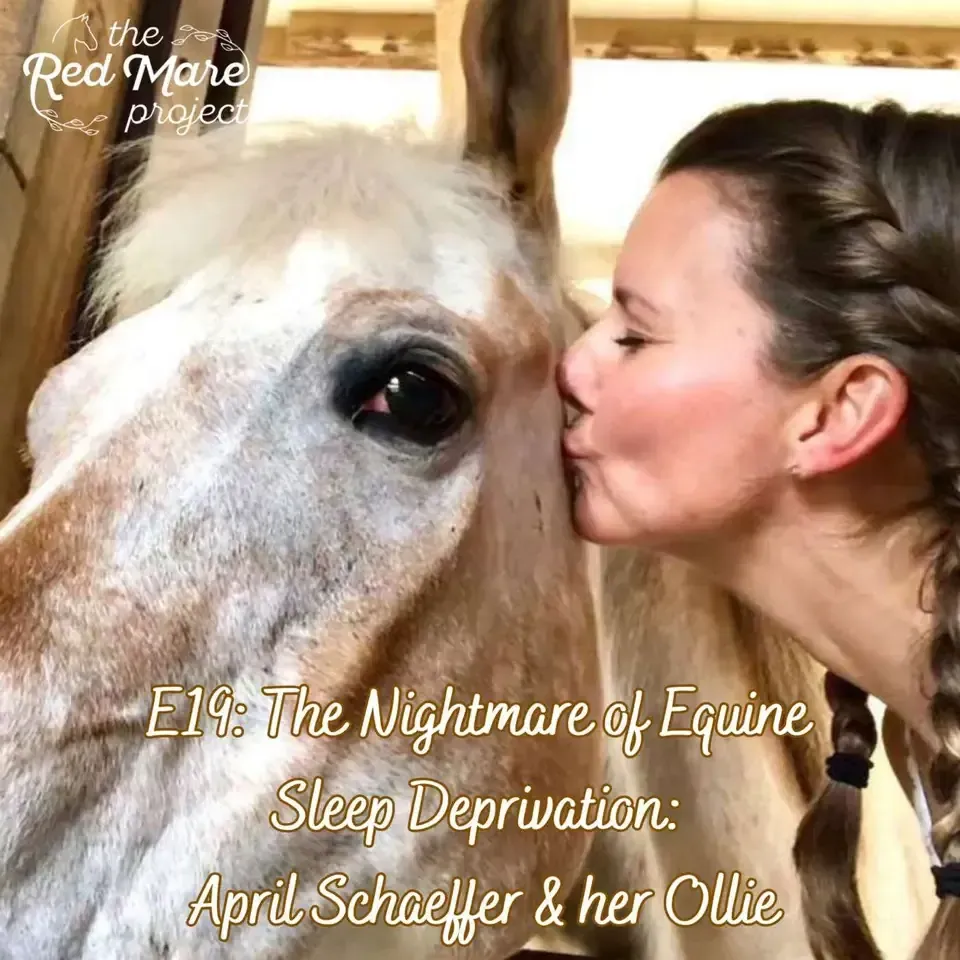
E19: The Nightmare of Equine Sleep Deprivation: April Schaeffer & her Ollie
July 22, 2026
About This Episode
This may be one of our most important episodes to date... Come join the girls and their new friend, April Schaeffer of Schaeffer Bodyworks, for an educational story time about sleep deprivation and its devastating effects on equine wellness and longevity. April shares her personal experience with equine sleep deprivation. Her sweet Appaloosa boy Ollie, had quite a traumatic experience before he landed with April that ultimately caused him to suffer with long-term sleep deprivation. While sadly Ollie is no longer with us, April learned tremendously from that experience and uses her knowledge to help every horse she meets. April is a motivated advocate for equine sleep hygiene and species appropriate living. Check out her podcast, The Equine Advocate Podcast on Spotify. This is a collaborative episode and is cross-posted on April's show. How to get in touch with April: https://www.schaefferbodyworks.com/ For more information on equine sleep deprivation, please listen to the following outside episodes. If you're concerned your horse may be struggling with sleep deprivation, speak with your vet. Don't wait.
Link: https://open.spotify.com/episode/6aJYBCVSquHrdkkzwLFcdv?si=5424ac1909a74c60
Link: https://open.spotify.com/episode/38KpliutYHnqDXUfpxCfQv?si=oUTyY9tJQDGHx1xmdCaiCw
Link: https://open.spotify.com/episode/5jOtRfDQSQFMr5QmCpg9nZ?si=2LgfQBFwROKvk58Uh7fnyA
Host: Taylor CL Schouten, MS, APF-I Hoofcare Practitioner of Wild Hoof Equine LLC
Email us with your interesting stories. Your horse may be able to help another: redmareproject@gmail.com
Connect with us online:
- TheRedMareProject.com
- Instagram (@theredmareproject)
- TikTok (@theredmareproject)
- YouTube (@theredmareproject)
- Facebook (@RedMaresOfficial)
Learn more about our showcased foundation, Teddy’s Legacy: https://www.teddyslegacy.org/
Copyright of The Red Mare Project 2026.
EPISODE TRANSCRIPT
— Welcome: Meet April Schaeffer & Why Horse Sleep Matters
Welcome back to another episode of The Red Mare Project.
Today, we welcome our new friend, April Schaeffer of Schaeffer Bodyworks and The Equine Advocate Podcast.
April comes to us with a very special story of her late gelding Ollie.
Well, initially, Ollie presented with chronic abscessing and mysterious cuts and scrapes.
An old injury causing profound sleep deprivation was the tragic culprit.
Join us as April shares Ollie's story, what he's taught so many, and a passionate discussion on equine sleep hygiene.
Welcome, April and Ollie.
Okay.
So this is going to be a very cool episode because we have a very special guest who also has her own podcast.
So we're going to be doing a collaborative episode, which means that we're obviously publishing this one because you're listening to it.
But April is also going to be publishing it on hers.
So the interview portion is going to be synonymous on April's podcast as well, The Equine Advocate Podcast, and that one's on Spotify.
She's just on Spotify, right?
Yes, ma'am.
She's just on Spotify.
Nice.
But she does a lot of cool stuff.
She does.
She's very cool.
I'm excited to talk to her.
I feel like this isn't a topic that gets talked about much.
Yeah, it should be.
Yeah, for real.
I mean, I had that experience when we first moved here at that first barn, where they kept all the lights on overnight.
Loki got depressed so fast.
Sleep deprivation is a big deal.
This was, I think for April's story, or as April tells Ollie's story as it unfolds, it took a while for it to be recognized as sleep deprivation, because there were a series of other things that built up to get to that.
But we'll leave that for her.
But we do want to talk a little bit about sleep hygiene and horses, which I think is also going to be deeply interwoven into the conversation with April.
She's a huge advocate for it.
She actually just published an amazing episode on her podcast with Kate Workman, all about sleep deprivation, and it's so damn good.
So if you're interested in this stuff, Dr. Workman just throws off probably a bajillion nuggets of outstanding information.
So check that out if you are interested in the very nerdy level of science on it.
The intent of the stuff.
I loved it.
I thought it was great.
But as a trigger warning for this story, usually we always like to tell listeners if the horse is with us still and how they're doing.
Sadly, Ollie did cross over.
But it was, we'll let April talk about that transitional piece, but it was-
But trigger warning.
Yeah, trigger warning.
But she did some really amazing things after the fact.
So we'll let her tell that part.
That's not my story.
That's hers for sure.
Yeah.
All right.
So should we start and chat a little bit about basic sleep facts for horses, and then we'll kind of parse out the difference between sleep deprivation and then narcolepsy?
Yes, because one thing that has driven me crazy my entire horsey life is that one of the first things other than when people see fly masks on in the pasture, one of the first things that people note about a horse is like they can't lay down.
Horses can't lay down.
Horses only sleep standing up, and it's like, no, they can have a little nappy nap.
You have a really cool locking mechanism in their limbs.
But that's not really the same as getting deep restorative sleep.
True.
Horses need to dream.
It's way cuter when they do it, but it's very important and they all sleep.
I don't know if you already have a plan to talk about this, you probably do, but sleep is so interesting with horse personalities because it shows you so much about their herd dynamics.
I remember living at the barn where Loki's pasture literally was outside my kitchen window, which was sick.
I heard this horrible sound.
It sounds like a broken lawnmower or some shit.
I go outside and I was like, oh my gosh, I think they're sleeping.
I want to go see them sleeping because it's so cute.
It's very special.
Clearly, someone was snoring and I wanted to go see.
Well, it wasn't Loki's turn in the herd to sleep.
It was a halflinger named Magnet's turn.
So Magnet is out cold like tongue hanging like cartoon- ass sleep, right?
He's gone.
He took his turn.
All the other horses are doing their thing.
Rockets over there on the perimeter watch.
We've got Loki who's clearly next in line because he's standing over Magnet, hip-cocked, lip flopping around.
Getting ready.
Eyes half closed.
At some point, I'm sitting there watching for God knows how long.
It's the middle of the night.
It's like four in the morning.
All of a sudden, Loki pops like perks up, and I was like, oh my gosh, he must have heard something.
Nope.
He wanted his turn.
He goes over, it'd probably been like 20, 30 minutes max.
Okay.
He goes right over Magnet and literally steps on him.
Oh, shit.
It was sick.
Then by the time Magnet was standing up, Loki was on the ground and he was done.
He was like, bitch, it's my turn.
It is my turn, had you.
You guys didn't watch, brother.
It was so funny.
I was like, wow, that's a really hilarious example of aerodynamics.
I'll never forget that as long as I live.
I swear before the other horse was even fully on four feet, Loki was down and snoring.
That is so on par.
But that is an amazing example of Loki.
Well, horses work.
It is, yeah, because that's how they do it.
They literally take turns and they watch over each other.
Yeah, I mean, they have to if they're prey animals.
I was explaining to people when I hear that horses can't lay down, they had to sleep standing up, whatever.
I'm always like, no, it's actually way, way cooler than that.
— Sleep Stages, REM & Why Horses Must Feel Safe Lying Down
They all have a role to play in their family units, and they take turns so that they can always be safe.
But yeah, that truly is how they work.
Okay, so let's look into how the stages of sleep and how that unfolds.
I won't go into too much detail.
I won't tap into Professor series on this one.
But they have three stages.
It's going to get clean.
We'll keep it light.
All right, so the first stage is light sleep, and they can stand while doing light sleep.
They actually do light sleep about five to seven hours a day, which is pretty cool.
Then they have deep sleep, and then they have REM sleep.
Now, REM sleep, that's where the money happens, because they have to do that every night, and that usually is about 30 minutes.
But they got to be out cold, like recundant, down for the count.
Yeah.
Look like they're dead.
That's when people get phone calls from people driving past the pasture, and they're like, there's a dead horse in there.
They're just taking a nap.
But they don't need a long time.
What is it?
Is it like an hour total or two hours total?
The REM?
Yeah.
REM is about 30 to 60 minutes.
Okay.
I know sometimes they'll do more than one burst of it just depending on their dynamics, but that's, and REM, if you don't know already, I'm sure lots of you do, REM transfer rabbit eye movement.
So you can literally see that we do it too.
All mammals do it.
Then that's where that deep restorative, that's where garbage gets taken from your brain and the trucks come and clean up in your brain.
That's why when you don't have that, things can go bad quick.
Well, that's such a good way to put it.
When I used to teach, we did, there were actually a couple of lectures that we did on sleep.
And when we, as humans sleep, because we don't have a lot of studies on course sleep, so we have to extrapolate a lot of the human stuff and just kind of, you know, inevitably apply it.
Yeah.
But for humans, that's why if you just sleep really, really shitty or you don't hit REM or you don't hit enough REM, like what you were just saying, you almost feel foggy because while you're sleeping, the channels in your brain actually enlarge and there's more CSF in your brain to wash away any of the by-product.
So if that doesn't happen, you just got to punch your trash head.
Yeah, literally trash head.
And you feel like that.
And you can all tell like, okay, I was in my bed laying down for nine hours, but I feel way more tired than when I lay down.
So let's sleep quality.
Like sleep hygiene is super important because just because you're like, just like a horse can stand up and do light sleep.
I can sit down in my desk chair and fall asleep, but that's not going to be restorative.
It's not going to be like brain clean up, recovery sleep.
Such a good way to put that.
Yeah.
So they got to be out for the count.
They got to be comfortable.
That goes back to what you were saying about herd dynamics.
In order for them to feel safe enough to lay down, that also means that, so when they mean safe enough, that means space-wise, so if they're in a stall that's too small for them, they're not going to feel safe enough because especially the smart ones, they're going to be like, I'm going to cast.
I'm not going to do this bullshit.
Not going to be able to get back up.
And that's where a lot of issues, sorry, go ahead.
That's where a lot of issues come in with the oldies.
Like you have to really watch oldies because like if they've got arthritis that causes it to be more painful or difficult for them to get back up, they're going to sacrifice the sleep rather than sacrifice the stand up because they're prey animals.
Like they can, everyone can go on a little bit of sleep deprivation.
It's when you get into that like wall where it's multiple days, multiple weeks, that's where it can be really, really damaging.
But like Wren, towards the end, I noticed his sleep patterns were different.
He napped more during the day.
And I'm imagining that's because if there's coyotes on the property at night, which I know there was, probably still is, he's not going to be quick on his feet.
Like if he's sleeping, he's not going to be able to burst out of sleep and get up and run like he would, like a young horse would.
That's an excellent point.
And I'd imagine too that they would consider the agility of their guardians as well.
Absolutely.
So if you've got a pasture of only seniors, they're going to all be more aware, probably taking naps in the day, or taking more of those frequent, leaning more on the seven hours of light sleep, as opposed to the five, because that's what they can catch.
But it just, I mean, it just depends.
That's why, like reason 400 and 700 and bajillion million jillion, you shouldn't have a horse that can't see other horses.
Like I know there's, like your horse, she doesn't like others.
She doesn't play well with others.
She's not friendly.
She needs like a vest that says, do not approach, but.
She has them, it's her face.
Yeah, actually, for real.
I always say, give her a kiss for me.
Don't, I know she wouldn't want that.
But like she can see other horses.
She can always see them.
So she is experiencing her dynamics to some degree.
She knows there's horses around her.
And Loki is the same way, like so many horses, they can be alone for a small amount of time, or even if it's at their preference.
But if they're truly alone as the only horse on the property, that's different.
That's a big damn deal.
Like get them a pet, get them a pet.
They cannot be alone like that.
But it was everything.
You see it all the time, like people yards.
They'll just have one horse.
It's like man, that horse must be tired and scared all the time.
I know.
But the herd dynamic is a big thing.
I think recognizing that I'm so glad that you mentioned that, the quality of the relationship and the trust, because just because you have horses that are pals out in the field, doesn't mean that they feel safe enough with each other to actually sleep.
Because you have your drinking buddies, and then you have your study buddies.
— Herd Bonds, Two Weeks Without REM & Human Sleep Records
Exactly.
They need their ride or die study buddy.
Because if that horse doesn't value their herd enough to stay with the herd in fear or communicate about something dangerous, that other horse isn't going to relax.
I wouldn't either.
Exactly.
If you're just my friend that I go out with once a month, I'm not going to trust you with my house keys.
Exactly.
Yeah.
I think recognizing that there is, not all relationships are going to be suitable for fostering really good sleep.
Just because they get along really well doesn't necessarily mean that.
Then that brings us into the whole idea of sleep deprivation.
Because these animals are actually really, really at risk for it big time and we don't really recognize it.
But horses can usually go up to about two weeks without REM sleep, which is an insane.
That's fucking nuts.
Humans die at that time frame, it's like it.
No, truly, truly.
I mean, okay.
Actually, I looked it up because I couldn't quite remember what it was.
The longest that a human has stayed awake, that's been recorded. 16 days?
Well, there were two of them.
The first one was Randy Gardner.
The dude was 17 and he did it as a science fair project.
Oh, no.
Which is the most 17-year-old bullshit I've ever heard.
Really is.
He did 11 days, but then another guy, Robert McDonald, he did it for 18 days and 21 hours during a rocking chair competition.
Hey, what?
That's the only appropriate.
You're rocking yourself to sleep and you have to stay up?
That sucks.
I don't know.
These guys are all fucked, but you notice there's no women doing dumb shit like this.
You know what?
That's exactly right.
This is why we live longer.
Our horses can go two weeks.
That's crazy.
Two weeks, but then that's when we start to creep into the scary stuff.
Do you want to talk a little bit about what sleep deprivation looks like?
I know that you've seen some of these poor babies.
It also is like, yes.
Number one, yes.
Number two, it is one of those things that can be dependent on the personality.
So, like, you may, with a horse that is a typical prey animal that's really stoic and hides their feelings, you may not notice it until they start collapsing.
Like, until they literally crash, and that crash may be out in the field and you didn't see it, or it may be under saddle.
All of these things are going to cause performance issues.
I've seen some horses that are so exhausted they won't eat.
They don't really know how to behave with their herd mates.
There are some horses that can become aggressive or just really listless, which is super, super sad to see.
That's a good word.
If you haven't identified the cause, you're not going to think of sleep deprivation first.
My horse, I don't know that it would be true sleep deprivation because I don't know.
He's a trooper.
I would be surprised if he didn't get any REM sleep.
But he definitely was missing sleep when we first moved because the lights were on overnight.
He had to be in a stall.
First of all, he doesn't like a stall.
I didn't have a choice.
Then I find out after we move across the country to this place, that he keeps the lights on 24-7.
He said, quote, this place is lit up like a fucking Christmas tree.
I was like, oh no.
Oh no.
No fucking bad.
That makes much sense.
At horse shows, they just made it illegal to keep lights on overnight.
I saw that.
I love that.
No one's enforcing that bullshit.
So just go around and turn the lights off.
Good night.
I did the last show that we went to.
I stayed on site in a little cabin.
Because I'm a dick, I just kept looking out the window and I felt bad because the braiders needed the lights on.
But I'm like, mommy, you got a headlamp.
You can see sister and they would turn on the whole shed row and you'd turn them off.
Bad a girl.
Leah needs her sleep.
I would not want to see her tired.
Oh, no.
We expect people to travel.
How many people do you know that arrive to a show or an event two days ahead of time to let the horse recover?
I don't know many.
No one.
Yeah.
Then consider their sleep hygiene and then ask them to perform these crazy tasks that we're asking of them like these are athletes.
We don't do this to our human athletes.
We get like saunas and pools and special sleep masks and all the bullshit.
They've got top doctors.
Shout out.
But we would never do that to a person.
We just don't consider it.
We're like, oh, they'll sleep.
They may not.
Some of them might find to sleep through the light.
But I know that when that was happening with my horse personally, he got depressed.
We were at that barn just under three months.
He was a different animal.
It was like he was dead behind the eyes.
I never saw him collapse.
But every time we walked into the arena, he's not a huge sand roller.
He rolls a normal amount.
Every time we went into the arena just to do their in-hand exercises or plop around, he would roll and then just wait.
He would lay there for up to five minutes and just like, oh, I'm just going to take a little nap.
Then he'd pop back up and I thought it was just because it was so hot, he was really enjoying the sand.
— Lights, Hormones & the Scary Collapse: Sleep Deprivation vs. Narcolepsy
Yeah.
Because it was shaded until the barn owner told me that.
I was like, oh my God, that makes so much sense.
I'm out of here.
He's sleepy.
He was so sleepy.
He was a tired dude.
He was depressed.
Turn the lights off and turn the fucking radio off.
We could use that.
I don't know.
It's like leaving the TV on for your dog or something.
Why are we doing?
Why?
I don't know.
People just leave it on all night.
Another thing too with the lights, not only does that keep them up, but it also will disrupt for mares in particular, it will crash their hormones.
Like their astral cycles and all that.
Oh, you asking for a dragon?
There you go.
Yeah, you're going to know about it.
Before my period, I be sleeping.
Your sleep needs increase immensely.
We just get away from them and then we're like, dance monkey, dance.
Exactly.
Difficult task.
Run this cross-country course.
It's like, girl, get her a nap.
It's the metabolic and the hormonal impact that sleep has.
So on humans, I don't know if any men listen to this, but you're welcome for this.
Sleep-deprived men have smaller testicles than men who actually sleep eight hours a night.
You're welcome.
Get at it.
Knock them out.
All right.
So if we have a horse that we think is sleep-deprived, the awful thing that we will see, and you may have seen this at some point, speaking to the listeners, is when they just crash.
That is one of the scariest things that you will ever see.
I have a client horse that started doing it, and they'll put their head down and they rock back on their hind limbs, and then will sometimes just fall to the side.
Is that a good way to explain that?
Yeah, almost like, I don't know, you know those toys where it's like a articulated little plastic creature, like it's like a pig or a person or like a whatever, a critter, and then you press your thumb down on it and it collapses, it does exactly that.
Nailed it.
I'm going to find what those are, and we're going to post a picture of it because it's exactly like that.
They literally just like, so scary.
It can happen under saddle, it can happen while the farrier is there, it can happen during bodywork which is super scary.
At this point now, there are people involved that can get seriously injured.
The horse could break its neck collapsing.
There's so many consequences of this.
It's so scary.
The thing is that a lot of people will immediately think that they're narcoleptic, which is where they have REM attacks where their body is immediately is forced into REM sleep.
In humans, yes, narcolepsy is a thing, but in horses, it is so fucking rare.
Rare stuff happens.
Rare stuff happens.
But it's more likely that you didn't turn the barn lights off or your horse is arthritic or needs a friend.
Yeah, or needs a pal.
We don't put enough value in that.
Even if your horse is like mine and doesn't like other horses, my horse, she just doesn't like fucking nature either, but.
She doesn't.
I don't think she knows she's a horse.
No, no one told her.
I tell her, I try and tell her, but she just.
She's like, no, what are you talking about?
Well, the way that they do it, so there's another pasture across the way that's maybe like what? 10 feet across the way.
Yeah.
Then they both like, so there's two mares in the paddock across the way and then her paddock.
So they kind of huddled towards the fence.
That's kind of what I was picturing.
They still look out for each other and they still take turns and everything.
Yeah.
Because the important thing is, and mares are so intuitive, like the important thing is that they have the friends so that they can be alerted to danger.
So they may not necessarily need to cuddle with their friends.
They don't need to have any physical touching.
But the thing that they know is going to keep them safe is being alerted by another horse that something is around.
So they just need to know that someone's watching that they can trust.
A hundred percent.
Yeah.
It's really fortunate that there's a nook where they can all sleep together and hang out.
I would love for her to be able to have one of those girls out there with her, but I think she'd kill it.
I think she would or she'd blow through the vents and run down the street and scream, stranger danger.
But you know the girl's setup, her little area is like paradise.
Yeah.
Yeah.
It works really good.
Yeah.
But yeah, the buckle in the crash is a big, definitely a really big piece.
A lot of horses will do this when tacking up, or that seems to be where that tends to happen the most, is when they're getting brushed or tacking up, they might just like collaborate on the cross ties.
Well, because I would imagine it's happening.
Number one, that's like a skewed result, because that's when we are seeing them.
Unless you're on property with your horse and you work from home and you're working in the pasture, that could be happening six times a day in the pasture.
We don't know.
That's those things like cuts and scrapes and little dings and stuff that you know, they're not fighting with their pasture mates, but they've got little stuff on them all the time, or their knees are a school then.
That I have seen a lot of times.
Oh, and they can get the, this might, this kind of plays into what you were saying about, they can get like thickening of the skin.
I can't remember the term for that.
Oh, oh, oh.
Like, it's like sclerotic, but that's not what I'm looking for.
It's okay.
It's okay.
They'll get cut some scrapes on her knees because they're falling and then they get a thickening of the skin.
— Telltale Signs, Noisy Environments & Blind Horses: April Joins the Show
But yeah, there's usually a lot of telltales, but I have one that will do that.
And she just, and a lot of folks don't really recognize the pain and the discomfort that's associated with this.
It's painful.
I mean, to be tired, imagine the last time you were like super duper sleep deprived.
This is how these horses just live.
Yeah.
And then they're expected to be athletes in a lot of cases.
I mean, it's amazing they can fare as well as they do during that time.
They can go so long and we may not notice it as that.
Because, I mean, I don't know, when I was a kid, I didn't think of that.
If a horse was acting cranky or kind of draggy, I wouldn't think immediately sleep, right?
Because they're pretty self-regulatory creatures.
But if there's something taking that ability away, then we have a problem.
Yeah.
We never really talked about it when we were kids, though.
That was not something that we really considered.
But I think life may have been a little bit quieter back then too.
Yeah.
I know the farm that I grew up on was like an oasis.
Yeah.
The pastures were a quarter mile away from the road, down a hill with trees.
There was a stream.
It was more comfortable for the horns.
Everything about it was more comfortable and more like what they need.
But now, there's not as much land.
There's a lot of, especially if you're in that performance world, there's so many things that could take that away from them.
Yeah.
Or even if your pasture is next to a busy road, if you have a senior, they might not be comfortable with the sound of cars going by.
Or if they're in a pasture that's by a road and there's a big streetlight there.
Yeah.
That makes a difference.
I can't sleep with a streetlight right outside my window.
Well, and also, what we didn't talk about is blind horses.
I know a lot of blind or half-blind horses that have gone through periods of sleep deprivation.
I never thought about that.
Because in humans, there is, what's it called, non-24?
Blind people?
There is a thing that's called non-24 where blind people, they do struggle with their sleep cycles because there's no light input.
Well, that's like, the time of year has an effect on hormones.
The light has an effect on hormones.
Temperature, like, hormones rule the world.
And if your hormones are fucked up because you can't perceive light, your entire circadian rhythm is going to be fucked up.
Yeah, yeah.
Which is crazy.
Can you get something like, there are certain jails that leave the lights on all the time?
Is that torture?
Are they doing that as a torture or punishment?
Those are like maximum security prisons.
So it is, in their eyes, a fortunate, torture is a fortunate outcome for them, but they can't call it that.
They're doing it for safety.
Interesting.
Like a sleep deprivation is considered a form of torture.
Yeah.
Like by law.
Yeah.
Oh, she's here.
She's here.
Hi.
Hi.
Hey, April.
How are you?
Awesome.
You're welcome.
Thanks.
Thanks.
This is so cool.
Thank you so much for doing this with us.
No problem.
I'm super excited.
I don't get to be the interviewee very often.
Yeah.
Still, I'm excited about it.
I thought I didn't have to think much.
I'm just going to answer the questions.
No, we're just vibing.
Makes it much easier.
I love your podcast.
It is so good.
So well-spoken.
So informative.
Thanks.
Thanks.
I try to be as unbiased as possible, but still deliver the direct wellness message of it.
We have to know better to do better.
We can give each other grace for what we don't know, but once we know, we can't pretend like we don't know.
So yeah, it's been fun.
I don't know if you guys feel this way, but I typically feel like we all just think we're alone on our island, talking about our things and nobody's really listening.
Then when I put that post out to be like, hey, does anybody want to come talk to me?
And I was like, over overwhelmed when the people that wanted to come talk and that's exciting.
It's like, and all those people that are listening.
So that's why we're doing this.
It's been fun.
Yeah.
And people are listening.
I mean, I thought I think there were like over 70 people who commented on that post that you put up.
It's wild.
Absolutely wild.
I mean, I thought the day that like, Yakin Shalise's team reached out and wanted to be on my podcast.
I was flattered.
And I'm like, weird.
Like, their people are contacting me.
Oh, yes.
Right.
And then there was Dr. Workman from Denali.
They reached out to me.
And I mean, not that I wouldn't have loved to talk to any of those people.
But again, I think we tend to think it were little fish in a big pond and the big people aren't listening.
And it was a really cool reassurance that clearly what I was saying was resonating.
The big fish.
It was resonating.
The big fish.
Yeah.
It was resonating.
People do listen.
It is an oh shit moment though.
Like I remember my vet told me that he was listening and I had a panic attack.
Freaked out.
I have no idea what happened the rest of the appointment.
Yeah.
I'm not sure.
Yeah.
You automatically think like, oh god, what did I say?
Did I say anything?
Oh shit, we're fainted.
Do you guys have any questions for me about anything before we start?
I know that you got our paperwork and you saw how we do things.
Thank you, Taylor, for making such pretty stuff.
But if you've listened to the other episodes, you always know at the beginning, I always like to do a little disclaimer.
The rules are there are no rules.
If you have any rules for us about stuff that you're like, hey, let's cut that out or hey, Kahlan, you have a potty mouth, then just because we know you're going to use this on your platform as well.
We totally respect that.
Just let us know.
You can let us know in the moment or you can text us after and be like, hey, cut that part out actually, I shouldn't have said that, or I don't like the way I sounded.
Anything like that, we can totally make that happen.
You know how the movie magic works.
Sure.
— April's Story: From Hairdresser to Equine Massage Therapist
If you want to just tell us about you and your career and what you do, and then we'll get to Ollie.
Tell us about April 1st and then how you connected with Ollie.
All right.
Well, I'm April Schaeffer.
I am the sole proprietor, the jack of all trades that does all the things for Schaeffer Bodyworks, LLC.
I grew up around horses as a little girl.
I came up in the late 80s, early 90s Western Pleasure World.
I was very lucky to be just put on the old rocking horse style.
Back then, the best kids Western Pleasure horse was like a retired turn back horse.
It's nothing like Western Pleasure is today.
It looked then, I feel like a little bit more like ranch riding does today.
That's how my mom and I got into horses when I was young.
Like most little girls fell in love with horses.
They were my safe space and helped me through weird stages through childhood.
My mom got divorced when I was a teenager.
The dreams that I had of working with horses, I guess if you asked me when I was little, I just always said, I'm going to grow up and work with horses.
I didn't exactly know what that was going to be.
But the divorce took the horses.
My dreams went away just like that.
I became the second mom to my little brothers, helping my mom raise my brothers through high school, grew up really fast, met my high school sweetheart.
We had our son when I was 18.
He's 27 and a successful computer engineer now.
My husband and I have been together 30 years, married 25 this year.
When my son was in high school and decided he thought he wanted to be a computer engineer, for those who haven't listened to my podcast or followed me long enough to know, I was a career cosmetologist hairdresser before I decided to branch into horses again.
I knew that the salon wasn't going to bring in enough money to put my son through engineering school.
I used it as an excuse to start a side job working with a business.
I see what you're doing.
Yeah.
I'll never forget it.
My husband and I were on our way home from a float trip.
I said, you know what?
I think I'm going to start a side job working with horses to help put you on it through school.
I need to know my husband is to love him.
He always says, well, you've never done anything that you haven't figured out how to make work, so whatever you want to do.
In late 2016, after doing a little bit of research about what, I want to go back a little bit and say, I didn't set out to become a massage therapist.
I just knew I wanted to work with horses.
I knew that I was always way more, as a young person, I really enjoyed caring for them.
I was the weird kid that liked to clean stalls and groom more than I necessarily like to ride.
I knew that I wanted to be in the wellness aspect somehow.
I just started putting some feelers out in my local equine groups, asking, what is something that this area doesn't have that they would like to have?
I kept coming across posts where massage therapists were coming from other states once every three months and having these marathon massage weekends that people would trailer into.
At the time, I was pretty big into competitive CrossFit bodywork myself.
I thought to myself, while I'm sure the horses enjoy it, once every three months probably isn't really serving the purpose it's intended to.
Then I started asking questions about if anybody does this, would anybody talk to me about what schools they went to in crickets because everybody thinks everybody's trying to be somebody else's competition.
Yeah.
I had one person reach out to me privately who had taken a class with a Northeast Indiana Equine Massage out in Decatur, Indiana.
The instructor's name is Connie Bultemeier and my friend Chelsea reached out to me and said, I took this class, I loved it, I think you'll love it.
So that's the class I wound up taking because nobody else would talk to me about any of the other ones.
So I was a terrible student in school, like a safe student at best.
So the idea at 36 years old of going back to school for something made me a nervous wreck.
So I reached out to Connie and I said, is there any way that I can get access to the curriculum to study before I come take the in- person four-day in-person certification part I was like, sure, sends it to me.
Studied that stuff for six months, scheduled my class, loved it, never looked back.
Gone on to get, I think the last time I checked, like 16 more certifications in various things.
I just started collecting education.
It felt like every class I took brought me to another question, then another class to figure out.
That took me to dissections, to hoof education, to nutrition education.
I naively thought that I was going to become a massage therapist, rub all over these horses and make their lives magically better.
Realized that it wasn't enough.
I was like, well, why?
Why isn't it working?
Then takes me down all these different rabbit holes that resulted in all the classes.
So my initial plan was just get my son through school.
I had no other plans.
I got him through school and he had to take out very minimal debt to do so.
So it definitely served its purpose in that stretch of time.
So I certified late 2016 and I was diagnosed with breast cancer in 2018.
Just as my business, my side business was just about getting to the point where I thought I might be able to start stepping away from the hair salon, I get this diagnosis.
Good news, super early, stage zero.
When I found out about it, I knew that I had the whole summer that I could work, really stockpile some money.
I'm a self-employed hairdresser, so I knew that I could take all the time off to have the surgeries, reconstruction, just wham-bam, get it done.
And I did.
And all of my clientele came back.
My hair business all came back, the horse business all came back, and almost a little bit the horse business kind of with a vengeance, which was a big sign to me.
When you sit with your own thoughts and the idea of what your mortality might have been, if you didn't get that chance to find something early like that, you really start to think about what you're doing.
— From Side Gig to Full Time: Teaching & The Equine Advocate Podcast
And hair was great.
I mean, I have clients that I've had for every bit of my 26-year career doing hair.
The relationships are wonderful.
And it was wonderful to raise a family and be in control of my schedule and go on field trips and take vacations when I wanted and doing all those things.
But as my son was graduating high school and even graduating college and moving out, I started to think like, what do I want to be doing?
So definitely that six months sit on my butt and think about my life made me realize that I was going to make a go of it.
So in that period of time, I acquired Ollie, which I know we'll talk about later.
And Ollie was one of those beautifully broken animals that teaches you everything you didn't think you knew about owning horses, or at least questions the way that you thought you knew how to do things.
And through the process of going through all of that with him, I developed an owner's massage class, is where I started with kind of the education side of things, because I wanted to be able to give an affordable opportunity to people that had broken horses like Ollie, the chance to become a part of their horses wellness team.
Managing a broken horse is expensive.
Bodywork is super beneficial, but not everybody else wanted to do it.
So it was kind of my goal before I let him go, was to use him to create that class for owners.
Right around that same time, I had people were starting to get the hint that I was a pretty open sharer.
So new massage therapist would reach out to me, they'd come spend a day with me, and lots of encouragement and nudging from fellow therapist was like, you need to create some professional education.
And again, if anybody knew what a horrible student I was, like the idea teacher is really wild.
But I think it's probably become my favorite part of all of this.
And maybe it kind of made me realize that even through my hair career, I always tended to bring the younger hairstylist under my wing and teach them what I knew and I wasn't scared to share.
And I learned even through my hairdressing career, like 10 people can go to the same school and they're going to come out and do hair 10 different ways.
And I'm, but it's the same with bodywork.
I think that we can all consume the same education, but we're all going to really find a passion part of it in a way that makes us different than the next therapist.
So why not help each other out?
So, yeah, so here we are 10 years later.
So this is my 10th year massaging horses.
And it went from a side gig to put my son through school to my full time job.
Created education, decided that I just couldn't talk loud enough on Facebook.
So I started a podcast, which is The Equine Advocate Podcast.
Hi, I'm Brie.
And a year ago, I bought my dream horse, Teddy.
But just eight short months later, he was diagnosed with wobblers and rapidly declined until I had to make the choice to let him go.
The only way I was able to get a diagnosis was by getting a CT scan.
Out of state, expensive and honestly not accessible for most people.
But it gave me an answer even though it wasn't the answer I wanted.
That's why I founded Teddy's Legacy, a nonprofit dedicated to helping horse owners get advanced diagnostics to make informed compassionate decisions for their horses.
We also support research, education, and welfare.
I know what it feels like to love a horse and not have the information you need to wonder if you're doing the right thing.
I have a CT scan candidate who applied for a grant through Teddy's Legacy.
Someone who's in the shoes I was in not long ago.
Someone who loves her horse and is desperate for answers she can't afford to get.
Ten years later, I went from just being a side gig massage therapist to an educator to a full-time massage therapist.
I'll step away from my salon job completely at the end of this year.
I will be doing Schaeffer Bodyworks full-time and I enjoyed sharing so much on social media that I wanted to see how much further I could get my reach because the wellness message of what I learned through massage, I felt like was really what people needed to hear about.
Like, massage is great, but why do we need massage and how can we prevent things environmentally so that we're not trying to use massage to deal with environmental problems and we can just use massage to prevent new problems.
And so, yeah, so the podcast got big.
That's how we are here today.
I put a post out on Facebook and was like, hey, who wants to talk to me?
And you guys are one of the first.
So here we are, let's go.
Yeah.
So I love everything, everything horse.
I'm really, really passionate about everything on the wellness side of it.
Because I think that most of the common horse problems we deal with are the result of human convenience.
And we've kind of gotten away from what horses need.
And we prioritize a little bit too much what we want and need or think they want and need based on what we need.
If that makes sense. 100 percent.
Yeah.
Man.
Okay.
So then where did, where does Ollie come into all this?
How did, how did you and Ollie connect?
So in 2016, so the year I got certified, my mom traded a yearling filly for a husband safe trail horse.
Nice.
Reasonable swap.
Yeah.
And we knew when we got him that he was, he was an impressive bred, halter bred Appaloosa.
So he looked like a halter bred quarter horse.
— Meet Ollie: A Missing Pec, Failing Sight & Deep Fetlock Scars
He was a very barnished out, done.
I had seen a couple of videos of him online.
He definitely had that like rockin impressive body that I grew up with.
So when mom saw that she was getting him, I was super stoked.
So we went to see him.
We knew that he had like a cloudy eye.
And they told us that he could see shadows, like he could follow you with his hand.
He was missing his right pectoral muscle.
And they didn't know why at this point.
And I did a lot of digging to figure out why.
But it was obvious that at some point or another, he had had a lot of trauma to the right side of his body.
So I assume there was some sort of accident that he had just been kind of passed around from that we didn't know about.
But it didn't seem to really bother him.
Like he still moved very willingly.
She told us that he got along with the herd that he lived with at her house.
But that they were just downsizing and looking at younger horses, hence the trade with the yearling filly.
What does that look like?
A missing peck.
I'm trying to envision that.
Especially on a horse that otherwise looks like that.
Yeah, yeah, yeah.
So I mean, it's exactly what it would look like.
Like it was just like he was completely flat, if not a little concave on his right side, and his left was banging because he was using that one so much.
Now, again, this is before I knew anything about thoracic sling, before I knew anything about how detrimental that muscle was to his body comfort, his stay apparatus, all of those things.
So fast forward, we get him home.
We obviously trained for him.
And it was like fall when we brought him.
And he came from up north where I guess things are a little cooler, maybe not as dusty.
And he wound up with an eye infection, which zaps the rest of the vision.
And now he is a newly blind horse.
No longer has been safe because he's swinging his head to his good side to try to figure out and get his bearings.
And my mom, right off the bat, she's like, I don't want to sell him.
What am I going to do with a blind horse?
Who's going to buy a 15-year-old newly half-blind horse missing a chest muscle?
Like, I'll buy it.
I'll find out.
But you know, because I just I fell in love with him.
And again, I knew I was going to massage school.
I knew that maybe there were some things I was going to be able to do to help him.
And I mean, the journey just took off from there.
I think taking, taking that away from him, just kind of started peeling back the layers of the other things.
One of the first things I noticed on him, which I remember noticing when I went to look at him, he had, you know, really deep Fetlock scars.
And she, the lady that we got him from, kind of tried to chalk it up to, well, he's got some arthritis.
You know, when he gets up and down, you know, I think he just kind of grinds a little bit on his Fetlock.
And knowing now what I didn't know then, that was really the first sign of sleep deprivation.
And he probably had had it for a really, really long time, but was able to kind of, I think, hide it or they weren't looking at the right times to see it happen.
Started blowing abscesses left and right.
I mean, just, you name it, all the things.
Like his body was just like, falling, driving, falling apart.
So obviously, the app, like it started presenting in his feet first.
So I'm like, okay.
We had a tradition, a very traditional failure at that time that kind of just let them walk it out.
They just got to, abscesses to come through, it'll be fine.
And I had been learning enough to know that that wasn't always necessarily the case.
So I sought out my first barefoot tremor and she was extremely direct.
She showed up and was like, look, in order for, now, she was a Pentecostal woman.
So she had on like the leggings, the skirt, chaps, braid all rolled up.
And she came out and she said-
She meant business.
She did.
And she came.
So I'm like 15 minutes outside of St. Louis and she was driving up from Carbondale.
So I totally respected the fact that she was like, look, this is a hall and I want to help you.
But she said, you know, we got to take him off the senior feed.
You got to do this.
You got to do this.
You got to do this.
I'll come here and I'll do my job and we'll get through it.
But you have to do what you need to do on your side.
Well, again, Western Pleasure Kid of the 80s and 90s, everything got a feed, a complete feed.
Everybody ate grass.
Like there was no-
I didn't understand.
There's no discernment.
Yeah.
Yes.
Then the way we were doing things as we had gotten back into horses as adults was exactly the way that we had learned when I was a kid.
We really truly didn't know any different.
My mom, of course, was extremely offended because she's like, who's this woman to come tell me that the way that we take care of our horses isn't right.
I was intrigued by it because, again, I mentioned a little bit that I had been doing some back in 2013.
Me, my husband, and my son all started doing CrossFit.
So when you do that type of fitness, you have to eat right or your body doesn't recover, and the functional wellness side of it, so the human totally made sense to me.
So that's where I started putting the pieces together for Ollie.
So for the abscessing, did it rotate or was it isolated to one limb?
So it would rotate towards the end.
He would blow them out of the heel bulb on his right hind from crawling on his right hip.
Oh, makes sense.
Yeah.
— Cameras Reveal the Falls: Abscesses, Injuries & Years of Clues
And that was the only foot towards the end that it would happen with.
Because by the end, he's living on a track, he's got the cleanest diet ever, he lives with me.
Now, like we were doing all of the things, and it wasn't until we put cameras on him that we could really see that it was like the blunt trauma, the hard falls were just shooting inflammation right down into his hoof capsule, and they'd come out his heel bulbs.
Was there, of course, I'm going to ask all the hoof questions, was there a seasonality to it?
Did you notice it was more common at a certain time of year, or was it just regardless of the calendar?
It was really, by that point, when I tell you, when I got in at 15, how deep those felt-lock scars were, I think he had been so deprived for bong bong before me.
I think, I've said before, I think bringing him to the track made him feel safe enough to show me what was happening.
He, one of the big things that happened at the track for him, I mean, half-lined horse, the little Appaloosa Pony at this track facility had took it upon himself to be his guardian.
He would sleep on the other side of the gate where we kept him in a big open area.
But we started closing him up at night because one night he fell asleep and fell into a hot wire fence.
And then severed his right front extensor tendon.
Oh, no.
Yeah.
And that's what made us put the cameras up because initially, initially the facility owner was like, if there's some sort of critters running my horses around, I want to see.
And then, so we put cameras in the barn and that's when we started seeing him just flat out, flat out falling and then it was almost like once it's like he knew we saw that.
And then he started like showing the collapses when we were just in the barn, like through the day, he was trying to sleep standing up.
It's kind of started, he would buckle over at his fetlocks, which is where the fetlock scabs spars came from.
And then before we knew it, it was down to his knees.
He would, he would position himself where he would like put himself, he would put his butt in a corner so that as his from collapsed, like his butt would catch himself and he'd...
But before we started even recognizing any of that, you know, poor Deb would, you know, she'd come out to the bar in the morning, she'd be sending me pictures, he'd have, you know, mystery boo-boos, you know, you know, a shoulder, like a gouge in his shoulder or his knee or his face.
And she's like, you know, running her hands over everything, trying to figure out what happened.
And really he was just literally busting his face on the ground.
And we just didn't know until he was able to really, really show us.
Wow.
How long was the abscessing continuing before?
You said it, but there's so much.
The abscessing went on for how long before you guys realized it was, it was leaked up?
So I had him for a full five years, five and a half, about five and a half years.
And so when they first started happening, I was attributed to laminitis, you know, to like just like I was focused on the hubs.
We had event ratings, like it had to be the diet.
So I fixed the diet and the abscessing, the abscessing would come like in ebbs and flows, but it wasn't consistent with seasons.
Like sometimes it's over and over.
Yeah.
So I think it would, they would, if I think about it, I think that it would probably happen whenever he was struggling the most whenever he was walking because I don't believe that the abscessing was ever, it could have been, but once I fixed his diet, I don't think that it was gut or diet related at all.
I think it was just internal inflammation that would settle into his feet.
Then obviously from the trauma of hitting it on things.
The wild thing was by the time I figured out what it actually was, what we think was the biggest contributor to it and that I couldn't fix it, he was in his best body.
His feet had never wound up.
His body condition was great.
He had, I feel like, at least the social-emotional wellness that he lacked everywhere else because he got to live in this herd of horses.
But yeah, that was bits and pieces of the story.
But yeah, he turned everything I knew up just completely upside down.
And then you go out and do your client horses and you see Fetlax horse, or you see hot runs, you see these things, and you don't want to scare people, but you feel like it's like you have to say something.
Yeah, it's your duty to the horse to say, and lots of the equine groups that people ask around about sleep deprivation.
There's always at least one or two people that will tag me and people will reach out to me, and I'll try to talk back and forth with them about it.
All the same things they said, I said, I just got to figure out what it is.
I might be able to, I might be able to help.
Yeah.
Yeah.
What was the vetting process?
So we're having all these abscesses.
I know you did the whole diet overhaul.
You moved him on a track.
He got his little buddy.
So where's the, because I know that you did a lot of interventions with him.
So what was the vet side?
What did VetMed look like?
So for me, so I obviously tried to start with like massaging Cairo.
Like, let me see how balanced I can get his body.
Because by the time I brought Cairo in, I had been doing all of the massage and bodywork modalities that I could do myself.
— The Vet Work-Up: X-Rays, Ultrasound & a Deteriorated Meniscus
So I bring Cairo in and Cairo pretty much always wound up focusing on sternum and hind end.
Every once in a while, he might be a little out in his neck or out in a rib, but it was always like his pelvic lumbosacral area, and his sternum would always be out.
Once we saw the videos of the falls, it was like that twisting when he would fall.
So once we started realizing that he was falling, I started my journey with the vet, brought him out, showed her all the videos and said, I will absolutely let this horse go, but I have to try to determine what it is and that I can't fix it.
He has a safe place here.
I won't keep it.
If we never find it, I'll let him.
If we exhaust all our possibilities, I'll let him go.
But I didn't want all of this to be for nothing.
I won't need to be something away from it.
So she basically just said, we start from the front.
We just x-ray everything that we can possibly x-ray and see where we're dealing with arthritis.
So we did it front end, middle, hind end.
So we x-rayed everything from his pole to his shoulder.
He had some slight arthritis in his neck, so we injected that.
Then we waited a couple of weeks to see if anything got better.
Then she came back and we did shoulder, front legs, a little bit in his knee, we injected that.
He would get better as far as how he moved, but the falling was still happening.
That was kind of the process.
I literally x-rayed that horse from his nose to his tail down to his hooks.
Right in the back.
Yeah.
We tried to inject one thing at a time to see if anything gave him enough relief that that might be the deal.
At that point, I felt like I had exhausted my options outside of ultrasound, but we didn't really know what to ultrasound from there.
So it probably took about three, four months to go through that whole like extensive radiograph process.
And I took a kinesiology taping class from Sozo Equine.
She had an in-person class and I got to meet loads of people from all over the place And I met a holistic farrier from Texas named Shannon, and she was also an animal communicator.
So we had all kind of, you know, throughout the two days that we were there talking about our horses.
And she reached out to me after she got home back to Texas.
And she said, you know, I didn't, she goes, I don't typically share with people when I go to things like that, that I'm an animal communicator.
She goes, but I thought long and hard about Ollie on the way back.
And I really think that you should ultrasound deep up in the hind end.
She's like up inside his legs.
I'm like, you know, she says, I just feel like he's in pain.
And I think that you're going to get your answer there and you'll be able to make the right choice for him.
Is it okay?
So I had my vet out.
We ultrasound it up inside and found a completely deteriorated meniscus on his right side.
Wow.
So that is where his stay apparatus was compromised in the back end.
Seeing it.
I thought it was going to end up being the front.
Now his peck muscle.
Now I think that that's probably, I mean, it probably didn't help.
Yeah.
He was definitely missing the stability in the front to kind of compensate for it.
So back to how he lost the chest muscle.
So in the process of doing the food and the feet, you know, went down the radical, how teeth are connected to feet.
So had an equine dentist come out.
And this equine dentist was like, how old is this horse?
And he was favored, right?
He was favored picture a little baby Ollie on the back.
And at the time would have been 15, 16 and that equine dentist told me that if he didn't have papers, he would age him at like 25 or 26.
So for a minute, I thought, did somebody sell me fake papers with this horse?
So the last owner that was on the paper was the breeder.
So I went to old Facebook and I got into as many Appaloosa groups as I could in that state.
And I started asking around about who these breeders were.
And I lined up finding their daughter.
So their daughter contacts me.
She asked me to send her clear pictures of the papers.
And she says, April, I promise you that that is that horse, that they were like blue stall fronts.
She's like, that was my mom and dad's barn.
We were the only people I knew that had those blue stalls.
Like he is who those papers say he is.
And I thought, okay, well, do you know anything about him?
And she said that Bay raised him to three years old.
He was a three-year-old Fraturity Halter baby.
And he was sold to a show home.
And they were in a terrible trailer accident, where the drivers of the vehicle were hospitalized for an extended period of time.
It's where he lost the chest muscle, injured the eye, had whatever injuries happened on the right side of his body.
So he was basically taken to probably like a rescue vet hospital type of situation where they did the thing to save him.
But then when the owners came back to retrieve him, they couldn't afford to pay for wet bills.
— Why Ollie Came Into April's Life & What He Taught Her
Yeah.
So he lived there and she said from there, she knew that he wound up like a 4-H horse for a young girl for a very long time, like until she probably went away to college or something.
From there, it gets pretty cloudy.
Like the lady we got him from, HIP got him from somebody else, but it wasn't that girl, that girl's family.
So I think there's a couple of owners in between, but I think that he probably started having these intermittent lameness, abscesses, mystery injuries, and people just kept sending him on.
Yeah, sending him on because they had to figure it out.
Yeah.
Then lucky old me.
But I always say, I wouldn't know really any of this.
If I wound up with an easy horse, I wouldn't have learned any of it and it wouldn't have developed into what I do now.
So he was brought into my life for a reason.
So many things when I was a kid that were hard, I would go sit in the barn.
He needed me just as much as I didn't know I needed him to go through breast cancer.
I think that that is why he came into my life.
Maybe because he really needed somebody to figure out what was wrong so that I could go, you know.
But that he came for just enough time to be there for me.
So you're okay, you're okay right now, right?
Yeah, I'm totally okay.
It was really, really hard.
Oh, you mean the breast cancer, yes.
Yeah, you.
Yeah, you, you're human self.
No, no, it was, so it was stage zero.
When you do a full mastectomy at stage zero, you have like a 0.1% chance of ever dealing with breast cancer again.
So I was sick.
There was, yeah, there was no wait and see for me, like.
Amazing.
Just in time.
Bless you, sister.
Yeah.
Yeah.
You have had an impressive life.
You're amazing.
I was, I was looking at your website last week and I was like, God, this lady's cool.
I want to take all of you.
I want to learn everything from her.
She's so cool.
Yeah.
I enjoy it.
I think that there's something to be said for being given kind of, I want to say a second chance, right?
I feel like that's cheesy.
I really wanted to make sure that when I went through my, like my cancer did not define me, it didn't become my identity.
I never wanted to be a victim of it, right?
Like I survived it, I lived through it and I was going to make damn sure that the second half of my life was going to be the best half of my life.
And I like to think that I do that and that I'm able to really present that to people when I'm talking about horses.
It's not matter of fact and know it all.
It's like, I'm really excited to share this with you.
I'm like, I'm really excited to help you help your horse and.
Yeah.
That's how it should be.
Yeah.
And it was like that with Ollie the whole time too.
Like while it was sad and it took me a really long time to be able to look at Facebook Memories.
Because there was so much wrong with him in the process of learning about all of that.
And now I can go back and look at it and be like, oh my gosh, I totally see the thoracic sling dysfunction.
Oh my gosh, I totally see the.
I see all of these things.
And then to have interactions with clients who have horses that struggle with different things like that.
And listen to them say all the same things that I said.
I'm like, everybody's on a journey, you know?
Everybody's on a journey.
Well, that comes up like once an episode.
It's like, now that I know all of this, and no matter how much we know, we don't know that much.
No, but no.
As we learn, it just makes you see your past courses so differently.
The smallest little thing that you would not have noticed five years ago, now you're like, oh my god, duh, how did I know that?
And then you just get loud about sharing it with other people because you don't want someone else to miss it.
I mean, the horses that had behavioral issues when I was young.
Yes.
And I think about the 150- pound pleasure saddle dripping in foam, that was probably way too heavy, lumber interference, missing it all now.
And I think it was not that horse at all.
It was totally what we were doing, what we didn't know any different about.
I think that state of always learning, that's just kind of where we are.
Even now, the failure, I mean, I'm now this whole conversation going back to all the inflammation was settling in that one hoof, and that's why he kept obsessing.
Because if we have chronic repeat obsessing, we do diet, but we also look at metabolic issues, PPID, maybe there's a keratoma, there's just a question, let's get some radiographs in here, what P3 looks like and all that.
In Ollie's case, those were all non-factors for him.
Did he have thin soles?
Yes, chronically thin soles because he had inflammation.
It did not matter how much copper, zinc I pumped into that animal.
He was missed ever.
I wound up elapsed in between barefoot tremors, and I had one that I didn't really know well, but it was like he was way overdue, and she paired his soul to no end.
Oh my God.
It set us back like six months.
We were so mad about it.
But again, another one of those experiences where I tell people, especially when I'm consulting people on diet, because a lot of times it's, my horse has to wear shoes because they have such thin soles, but they eat this laundry list of sugary, sweet candy food.
Yeah, and I'm like, well, we keep them in shoes until we fix the diet because they're going to be really sore, and they need to be able to grow a better foot.
But the things that we didn't know, I didn't know anything about any of that until I had to.
Yeah, that's exactly it.
Not until you have to.
Like the stress, the high levels of cortisol, that's also going to trap their hormones.
But if they stay in a chronic state of stress, that is going to hinder their ability to grow like a healthy foot.
Yeah.
That's there.
The immune system starts to be dysfunctional if you're not sleeping.
Yeah.
The whole, and it's so important.
— Blind Horses, Light Exposure & Dr. Kate Workman's Insights
I'm sure you know, we do a little synopsis, a little, we call it the preamble before we click in with our guests.
Yeah.
We just, it was kind of an easy one to do because there's just like, oh, and then this, oh, and then this, and then this, and then this, it's all tied together.
Like, what about this?
I didn't realize that Ollie was partially blind, but one of the last things I said was, oh my gosh, blind horses.
Like, you know, like there's so many things that this can look like, and then that leads to this and this leads to that.
And it's like, oh my gosh, these giant bodies are exhausting.
Yeah.
And it's all connected.
You know, there isn't, I don't think that there's one aspect of the horse that isn't impacted or affected by another part of it.
Another, yeah.
All of it, for sure.
Are you familiar if there's any information?
I asked, because when Kahlan brought up about, you know, blind horses or one-eyed horses, I was curious because I know in humans, there's the non-20 or I think it's called non-24, where blind people will struggle with sleep cycles because there's no input from light.
Yeah.
Do we know anything about that for horses too?
You know, I don't know any like specific studies.
I feel like that's something that Kate Workman touched on a little bit.
I think just light exposure in general, right?
Like I think-
For sure.
And I find this a lot with people that reach out to me with sleep-deprived horses, they want to confine them to keep them safe.
And then they typically wind up not getting like enough vitamin D, you know, they're not outside getting like sun into their eyes.
So, you know, whether it's sleep-deprived or blindness, I think when horses are kind of left to their own vices and able to be outside when they want to be outside and inside when they feel like they need to come inside, I feel like they regulate and they cycle that really well.
I mean, we definitely watch that with the horses on our track.
Like, their routines are so funny.
And it's totally different with each season, you know, the amount of time they want to spend outside versus inside, you know, standing in the end of the barn that gets sun versus the end of the barn that gets shade.
Like, it's very...
If you are able to really spend enough time out there with them to watch how they develop it as the seasons change, it's really interesting.
But no, I don't...
I mean, I think that there should be...
You guys have probably listened to enough episodes to know that I'm like, I just don't think we should put horses in stalls at all if we don't have to, you know, and wasn't an injury or a safety issue.
But I think in, like, your traditional environment where all the horses come in the barn and everything's shut off, I don't know how more or less comforting that is for them.
You know, like, should all the lights be off?
Yeah, probably.
But how scary is it to be locked in a box with a bunch of other things locked in boxes?
And you don't have light.
Yeah.
And you can't, you don't have any light at all to kind of make out what's going on.
What I'm thinking as, like, we didn't think of this earlier, but April, you're, like, making me realize.
We mentioned, okay, blind horses probably have a hard time because they, the input, the light input, like with people, right?
But people don't rely on her dynamics to know when it's safe to sleep.
Right.
Right.
And that was another thing that we did.
We tried everything.
I mean, we tried, obviously, just letting him be with her and do whatever he needed to do.
And then we tried, like, enclosing him into, it was a pretty large area, but we tried first with his pony friend, you know?
And it was the funniest thing because the pony would still lay down and sleep right next to him, and then Ollie would fall, and the pony would kind of, like, aww, you know, and let him get back up, and then he'd lay back down.
And we tried putting one of the mares in there with him.
Like, it just didn't matter.
And the one thing that, when I was talking to Dr. Kate Workman on my podcast about it, that really resonated with me and made me realize why, you know, I didn't get anywhere with Ollie, was she said, by the time that they are collapsing, like really collapsing the way that Ollie was, the prognosis of being able to turn it around is so slim.
It's so, so slim.
And she said, you know, she goes, for owners that, you know, for peace of mind, want to know why all of the diagnostic, all the imaging, if you have the money to spend, and it's, you know, it's worth that to your peace of mind.
She's like, I will never tell a client no.
She goes, but I'm always really straightforward to say that by the time we get to that point, is it, you know, if you don't have the money, know that we are probably not going to find something we can fix.
And I thought that was, I thought that was wonderful of her to be, you know, that upfront and transparent with her clients.
And another thing that she mentioned that I really appreciated was that she said that sleep deprivation in horses is sleep deprivation, that there are no proving cases of actual narcolepsy in horses.
She said, no, yeah, she said that there are a couple cases and like there's a couple studies or papers written on like miniature horses with narcolepsy, but that there has never, there has never been an adult horse studied for legitimate, like just narcolepsy.
I didn't know that.
I didn't know either.
— Why the Prognosis Is Poor: Donating Ollie to Science
And I think, and I think where it gets a little, people get it confused is that like she made a mention of horses that sometimes will suffer when they go to shows, right?
Because it's an environment, they don't lay down.
And then, you know, that whole circadian rhythm gets out of whack when they get back home, it takes them a while to get back into it.
So she said, you know, there are some cases like that where as soon as they get back in their groove and they get back home, they lay down.
But you know, if you go spend two weeks at Congress, you know, like it might take a while for you to get back into your group when you get back home.
So she says that she usually has really good luck, you know, resolving those cases.
But, you know, a horse like Ollie that had probably been doing it for years.
It's just most of his life.
Yeah.
Yeah.
So is the reason for the poor prognosis, if it's not like, you know, an event because they went to a show or something like that, if it's, is the poor prognosis because it's typically from a physical thing or because I remember listening to that part and I don't remember her actually saying like, why we can't fix this.
I know she spoke about ketamine, I know she spoke about anesthetizing them perhaps, but there wasn't.
I think if I understood it right, I think it was more along the lines of long term sleep deprivation to the point where they're collapsing like that, even what it does to their brain.
So like they didn't get to where once they are not, because that was the wild thing about Ollie, he got up and down, he rolled multiple times a day.
He could get all the way down, roll over to both sides, get back up.
So she said like, it's not that they can't, you know, it's whatever is preventing them from doing it.
So like Ollie, if you think about a deteriorated meniscus, you know, he can slowly get himself up and down and avoid as much discomfort as he can.
But if he was flat out sleeping and he had to hop up fast, like, yeah.
And she said they instinctually are not gonna put themselves in compromised positions like that.
So once they've kind of trained their brain, but they can't, it's pretty hard to retrain their brain that they can.
Interesting.
That might be the saddest thing I've ever heard.
I know.
I know.
Because I think there's a lot of horses that are probably kept.
I mean, admittedly, I kept them around for five years to figure it out.
But I think there's a lot of really cool things nowadays.
The forever learners and the people that wind up with horses like that that can.
One of my student graduates, her family had bought a boarding facility, a lesson training facility, and they inherited like 20 lesson horses, most of which were road hard.
When she was going through my class, obviously, I share about Ollie, I share about hoof stuff and diet and all these things.
Her mom had reached out to me and said, I think I have one with sleep deprivation.
She goes, I know I do.
She talked with her about a little bit about it, and they came to this same conclusion that Kate said, you got to consider age, you got to consider quality of life, how long you think it's been happening, and how much you're willing to invest into it.
He was like a 24- year-old lesson horse.
He had taught so many kids.
So she was intrigued by the whole thing, and she does a lot of community, when I say community events.
They're not a sport-specific lesson barn.
They are very big.
Well, they're very big into the home school community.
So kids, various types of learners, she's got kids on the spectrum, she's got kids that go to regular school, all over the place, but they all come out and they learn about horses, not necessarily just how to ride horses.
So she took the opportunity to compost.
So she is composting her sleigh.
Oh, wow.
Her and her daughters and a handful of the people that are involved in her facility are going to exhume him next year and be able to study his bones and maybe try to figure out why his sleigh deprivation was happening.
What cool people.
That's awesome.
Yeah.
The number of dissections I've been to and the people that I know now that have done so much.
I mean, if I knew the people then that I know now.
Oh, girl.
Ollie's skeleton would be reconstructed and I'd be traveling over the floor.
But yeah, and one of the biggest reasons that I wanted to be able to make the decision for him is because I knew that his will to live was strong.
I mean, obviously, when you watched the way that he was falling and for how long.
But I also knew that he was going to wind up falling really hard on the coldest day in February when the ground was frozen, he was going to break something and he was going to have to sit under the cart behind the barn until things thought out.
And like I just couldn't not, A, do that to his herd mates, do that to the facility owner who just fell in love with my broken boy as much as I did.
And I knew that if I could get the opportunity to donate him somewhere so that I could make sure other people got to learn from him, that's what I wanted to do.
And luckily, my vet had a connection to a local university and they were just about to do a joint replacement simulation on a cadaver leg.
So it was perfect timing.
The professor told me that in his 40 years of teaching, that they had never had a course that they were able to take from lameness exam to sedation, to exploratory, to euthanasia.
Wow.
The way I look at it, Ollie got to go take the absolute best nap of his life.
That he just had a little grumble.
And future vets got to see inside his deteriorated meniscus.
They got to study his eye.
Because I told him, I said, I want you to use it all.
And my farrier trimmer at the time lived in close proximity to the school, had a relationship with them, and she was able to go get all of his feet.
Oh, nice.
Yeah.
So she's actually in the process of splitting in half and preserving one of them for me.
We composted another one because his right front always seemed, right front without the peck, always seemed to be one that he just had a thinner sole on.
— Hidden Findings, Bodywork Cautions & Where to Start
Was it tiny?
Did he have tiny hooves?
No.
No, he didn't.
He didn't have tiny hooves.
They actually were, they were pretty big and round.
Good for him.
Yeah.
Yeah.
He definitely did not have small feet on his big body.
But yeah, so we learned all kinds of things.
When we composted that right front, his navicular bone was actually fused to the underside of his coffin bone.
None of the x-rays showed that.
None of them.
So I'm really excited.
I'm excited that it's probably going to create some people out there.
I carry my late horses leg around with me, but I have more questions.
Yeah.
Hold on.
It didn't show radiographically because it was a soft tissue fuse.
It was a soft tissue fuse or a flame on it?
I mean, in the scheme of things, he was always lame in some way or another, like three-legged crippled lame.
No.
No.
No.
I'm back.
He went out and got around just like everybody else did.
But then again, they were a group of broken horses.
No.
It was wild.
It's insane what they won't tell us.
Yes.
Well, and how much further we have to come with diagnostics.
I mean, I know we've come a long way with diagnostics, but I encourage most of my clients, especially if they have known hoof issues, I'm like yearly, at least yearly, but that's right.
I mean, it's just to me, just as important as like your yearly checkups or your seasonal warming, like something can change and you won't know because they are masters of disguise.
So you can get ahead of it.
It's always better to be ahead of it.
Wow.
It was this hind right that was chronic abscessing, right?
I believe that is the one that she is cutting in half and if I saved the picture of it, I'll send it to you.
It's still a little frozen.
She said she's waiting for it to fall out.
Okay.
I'm just curious what that looks like.
Yeah, I'll send it to you.
Wow.
I had a thought about bodywork in terms of working on sleep-deporses.
Because oftentimes, they will creep into, they'll go into a deep processing state.
Yes.
At what point do you, how do you handle a situation like that?
Because you're facilitating.
Dangerous for you too.
The relaxation.
Yeah.
In my experience with Ollie anyway, she, it wasn't ever something he would do when I was working on him.
It was usually something like he almost needed like a quiet space.
He'd go off to himself in a corner to do those things.
I never had him or any other sleep-deprived horse that I would massage.
I never had them collapse on me during bodywork.
Now, if I had an idea of where the issue was coming from, I would avoid that area just so that we didn't wind up relaxing something so much that they let go a little bit more than I wanted them to.
But with any chronic issue like that, for me as a bodyworker, less is always more.
My touch is very, very soft.
I don't go deep into anything.
I don't remove any crutches that they may need compensating for what they deal with.
I think that was food for thought after the fact when I realized, I mean, the amount of tape and cupping and massage, red light and the things that I did to that animal, and I probably took so many crutches away from him at some point.
Well, at some point, you feel like you're holding them together with duct tape.
Yeah, they have their own duct tape.
They're such masters of compensation that it's like, how much we're doing of what we're doing is actually helping versus, it's hard to know.
It's a rabbit hole for sure.
It's a hard thing to teach my students too.
They just want to get in there and do the thing and help all the horses, and teaching them to really sit back and evaluate the situation.
What do you think the problem is, and how do you think they're compensating for that?
What are you finding in your evaluation of their soreness, do you think is the cause or the compensation?
Don't take the compensation completely away, because then they're going to struggle more.
They're going to suffer more pain.
Yeah, to pull that crutch back.
Then it snowballs into encouraging them to learn about whatever those things might be, and learn as much as you can, so that you can refer to a different barrier or a nutritionist or a chiropractor.
Get as many people on the team to help whatever is happening, but always encouraging people to find the root cause.
Do you have any advice for listeners who think that their horse may be struggling with sleep deprivation?
Where would you tell them to go first?
Because I know there's some people right now who are kind of spending.
Yeah.
So while I had an experience with it, I don't feel like I'm an expert on the topic.
The one resource that I always send people to is the Horse First Podcast.
Dr. Audrey DeClue has a couple episodes on sleep deprivation, and she gets pretty deep into what to look for, how to try to alleviate it if you can, when to get your vet involved, how to get your vet involved.
Initially, get your vet involved.
Like if you suspect it at all.
But what you have to really do is you have to spend enough time to observe their behaviors and find out what is changing.
It can be the smallest thing.
Never ever, ever ignore a fetlock sword.
I wish I would have paid more attention to that.
I have this picture of one of the very first times I wrote Ollie Bear Back.
I marked it up with all the things that I could circle that I now know.
Things of it.
Observe their behaviors, figure out what's going on.
Are they not laying down?
Are they still rolling?
Are they collapsing?
Are there any injuries?
Was there some change?
Did they lose their friend?
There's so many different things that I think can impact it.
— Watch Your Horse: Shows, Travel & Keeping Things Familiar
A little bit like we talked about with shows and stuff.
Does it seem to happen right before or after some change in their routine?
Yeah, definitely get your vet involved and listen to as many informational podcasts as you can about it because most of the people out there that are talking about it are pretty direct.
Pretty direct and to understand that it is absolutely not normal for horses not to get around sleep, period.
It's how their body heals.
It's the only time all of their muscles shut off and they're truly at rest.
It can be a really, really horrible existence.
They're not going to let us see that because they're animals, they're masters of disguise.
But once you see it, you really have to try to figure out how to alleviate it.
If you can't, you have to be brave enough to let them go.
Yeah.
I think you brought up an excellent point.
Just because they lay down to roll, doesn't mean that they lay down to sleep.
No, absolutely not.
I even know of some sleep-deprived sources that they'll lay down, they'll lay down, but they will not lay flat out.
So they'll get in bed, but they won't actually?
Yes.
Okay.
Some of those, they'll do it out.
They'll lay down, they'll get down, and they might shut it off like they would standing up, but they don't sleep down and go into REM sleep at all.
Yeah.
They're still holding awareness, holding tensions at once.
Yes.
Yeah.
Recognizing the role of lights or sounds or if there's new horses that moved in across the way or-
Is their environment.
Go stare at your horses.
Yeah.
I mean, honestly, ladies, I think that all of us to some extent are guilty of like, we go to the barn of the plant, right?
I'm going to ride today, we're going to do this, we're going to do this.
If you're so set on that plan, you're probably not paying attention to those slight behavioral things that can happen.
But if you are starting to notice that something is happening and you spend that time to really watch.
Another point to really make, because we talked a little bit about it with shows and stuff, horses get very accustomed to the sights, sounds, and smells of their familiar environment.
So when we think about what it would be like to take one horse away from a barn full of whinnies they recognize, smells they recognize, sights that are familiar to them, and we take them into an environment where they're hearing all new noises, all new voices.
Stranger danger.
Yeah, it smells different.
Lights at shows is a big thing.
I even think a lot about how long it takes for horses' eyes to adjust to light changes, and how many, to like a night barrel race, where the warm-up pin is outside in the dark, and then they have to go under the bright-ass lens, yeah, run, lights, and then they kind of look a little drunk at the first barrel or two.
Yeah.
I can't see.
Yeah.
Then when you think about how that might disrupt them going back home to get into their group.
Have a little rest, yeah.
Yeah.
And just moves in general.
Like a lot of people want to bring a new horse home and just thrust it right into whatever job or plans they have for it.
It really does take them a while to get used to all of their new friends' voices and meanings and what those things mean.
And I think it can be pretty stressful and they can deal with a little bit of sleep deprivation when that happens too, because they just don't know how to be comfortable in a new environment just like that.
Yeah.
I mean, who does?
Yeah.
Right.
I remember hearing, and it may have actually been on your show, April, but I remember hearing someone say, when you go to a show, if you have a horse that has just like a good friend, bring like their saddle pad or bring their flysheet or something where it smells like them and put it in their stall.
It's just a little creature comfort.
I can't remember where I heard that.
I was like, that is so sweet.
It's really cute.
It is.
Even the same with water.
Bring your water from home.
My gosh.
They can be so picky.
Yeah.
As many things as you can to keep it as familiar as possible.
Yeah, for sure.
Even changing turnout, like we do night turnout in summer, and then we swap turnout.
When we switch to night turnout, I don't ask my mare to do shit for at least like four or five days, because now she's out in the wilderness and she doesn't like nature.
Yeah.
So out of a courtesy, I'm like, I'm not going to make you do anything because now you're in camping.
Right.
A lot of people don't think about that.
Yeah.
No, they don't.
They don't.
Not at all.
I think that we have a lot to learn about species appropriate environments.
You know, we have no.
Yes.
And respect the jet lag.
It's easy.
We would want it done for us and it's only fair.
They're not machines.
If you want something that if you want to participate in a sport that doesn't have feelings, get a dirt bike.
This has been awesome.
Yeah, that's so much fun.
I'm so glad.
This was a really cool conversation.
And I'm still really sad about what you said about their brain has trained them to just not sleep anymore.
And that's what like that, that kind of like that's going to haunt me.
Yeah.
Well, if you, if you do there, there's lots of papers on human sleep deprivation and it talks a lot about that.
And Kate and I went and read a couple of them after Kate mentioned it on my podcast.
That, you know, there's just sleep is so important.
And we just don't think, we just don't think about it.
We don't, we don't thought it enough because, you know, again, we can control when we do, we can say, I'm going to take a nap or I'm going to go to bed at this time.
— Resilience Myths, Sleep as a Superpower & Closing Thoughts
And totally depending on what's going on in that animal's body and what's going on in the, you know, the herd and the environment, the weather, you know, there's so many things that change, I think, for them.
So it's definitely, I think, courses depend way more on their emotional state, being healthy, than we realize.
And I think they get, they get this reputation of being super resilient.
And really, they're just those masters of disguise.
So they shouldn't have to be, we're just not listening.
Yeah, yeah, yeah, yeah.
They've just grown to have to, you know, kind of put up with whatever they're subjected to.
So yeah, I think their minds, their minds have to be powerful enough to keep them behaving, right?
Yeah, and that's so true.
Everyone thinks that they're so resilient, and they are resilient, for sure, but I don't know if that's...
And why are we forcing them to be?
Yeah, and I also think it's not...
It might not be the best word because they are, but the reason for the resilience is not...
It doesn't align with what resilience is.
Well, it's self-protection, right?
It's not, you know, they're making themselves tougher.
It's they're protect...
They don't have a choice.
Yeah, they're protecting themselves.
They don't want to look...
The other herd members can't know that they're weak or scared or...
Yeah.
And I mean, we don't...
Even for humans, sleep is our superpower.
I mean, Brian Johnson, the guy who's trying to live forever, I'm not sure if you all have seen him.
Yeah.
I mean, he's such a pain in the ass.
He looks like he fell out of Twilight.
But anyway, his top priority is sleep.
He's like, you can fuck with whatever you want.
Don't touch my sleep.
Yeah.
And the fact that his whole...
Like, I think that really kind of speaks to the value of it.
I mean, it is our superpower.
Yeah, it is.
With so many other things.
Like, I mean, I know, obviously, through my...
Like, I doped on the functional health side of things for me.
And I mean, your sleep affects your hormones, your sleep affects your adrenal hormones, it affects your thyroid, everything.
That's a strange thing.
Absolutely everything.
I mean, even just like, you know, minerals.
Like, the way that your body metabolizes and absorbs its nutrition can be impacted by how much sleep you are getting and vice versa.
So, we would only assume that it would be the same with animals, right?
I mean, when we change the clock and lose an hour, there's a 24% increase in heart attacks the next day.
Wow, I didn't know that.
And then when we gain an hour, there's a 21% decrease in heart attacks the next day.
It's crazy.
It's my favorite day of the year.
It's the, oh my God, I'm so happy that day.
All right, well, I hope you sleep better tonight.
Thanks.
All right.
I'll see you girls next time.
Bye, April.
If you or a friend have a topic, story or case study you want us to cover in an episode, visit our website at theredmareproject.com to leave your submission or email us at redmareproject.gmail.com.
And if you have it, please include a cute picture of the horse we will be discussing so we can make it our Facebook page profile picture.
As a reminder for listeners, this content is for educational purposes only and is not meant to diagnose or treat.
We encourage everyone to do their own research and speak with your veterinarian and care team to make sound decisions for your horse's management.
If you like the podcast, please tell a friend, like, subscribe, and follow on all the platforms.
Peace.
NEVER MISS AN EPISODE
Listen on your favorite platform
Subscribe and listen to The Equestrian Podcast wherever you get your podcasts.
