
PODCAST EPISODE
E18: ECVM, a tale of two mares: Maliki and Rowan’s stories
June 29, 2026
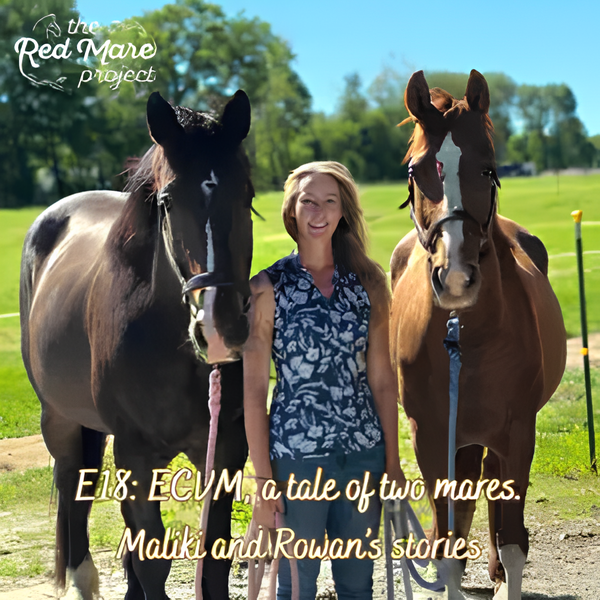
About This Episode
Equine Complex Vertebral Malformation (ECVM) is a congenital malformation affecting C6 to T2. ECVM is becoming more common and problematic in today’s equine landscape. In this episode, Kahlan and Taylor sit down with equine osteopath in training, Jessica Rein. Jess currently works as a bodyworker at her practice, Magic Hands Equine, and is the proud owner of two ECVM mares. While her girls have two very different ECVM presentations and associated symptoms, Jess has cracked the code on how to manage these two mares specifically. Join us as we learn how Jess has custom built their management protocol to keep her mares happy and well. For more information on ECVM, read anything from Sharon May Davis, and the ladies at Equus-soma, Pamela Eckelbarger and Diane Dzingle. https://www.equus-soma.com Jessica Rein’s practice: https://www.facebook.com/NHETOfficial1 Check out our website updates! https://www.theredmareproject.com/ Email us with your interesting stories. Your horse may be able to help another. redmareproject@gmail.com Taylor CL Schouten, MS, APF-I Hoofcare Practitioner Wild Hoof Equine LLC www.wildhoofequine.com Kahlan Ettere Equine management Wise Choice Equine Wellness LLC Check out our website: www.theredmareproject.com Follow along on social media Facebook: The Red Mare Project Instagram: Wild_Hoof_Equine TikTok: redmareproject
EPISODE TRANSCRIPT
— Welcome: Introducing Jessica Rein & Her Two ECVM Mares
Welcome back to another episode.
We hope you eat your brain food this morning because today's topic is a big one.
Today's guest is an osteopath in training with a well-established bodywork business, and she's here to tell us the story of her two ECVM mares.
If ECVM is a new term for you, don't worry because we go over it in great detail.
Jess walks us through the diagnostics and very meticulous management of her girls with equine complex vertebral malformation.
Welcome Jess, Maliki and Rowan.
Welcome to The Red Mare Project.
Finally, we're back and we do have a couple of things that we want to talk about before we get started.
First is thank you so much for your patience.
We've had to send our beloved podcast system, our RODECAST, our original system that we bought when we first started all of this, had to go to the RODECAST hospital and she died on the table.
She never came back, guys.
So we have a new one and we're still working out some bugs.
So if you notice any kind of quality difference throughout the episode, we promise it's going to get back to normal, back to our fancy, beautiful voices.
Just give us a minute.
We didn't want to miss this because we've had this person scheduled and we're really excited about it.
We will fix it.
There's a lot of stuff that goes into the equipment.
A lot of equipment people.
There's a lot of buttons.
It's like flying a spaceship if you look at the RODECAST thing.
We'll fix it.
Don't worry, but just hang with us for now.
Hopefully, this is listenable.
Yes, for sure.
Then we've got some housekeeping stuff that we need to go over.
Nothing new too much, but we do have some updates to our website, which is really cool.
Yes.
We had our web designer, Steve.
Thank you, Steve.
Hi, Steve.
He took all of our episodes and transcribed them.
Well, actually, AI did.
He didn't listen to them and write them all out.
But he transferred all of the episodes and made them into little blog posts.
The cool thing about this is that if you go to the website and then just click on podcast, you'll see where to drop down and say blog, and there's a search bar there.
Let's say you want to listen to all the episodes that we talked about, Nubicular.
Just type in Nubicular and they'll all come up.
If you want to listen to an episode on MFN, type in MFN, it'll all come up.
If you want to listen to that, e, blah, blah, blah.
But you can just type it in and then it will just list out all of the episodes where we discuss those things, so you can really stream live whatever it is that you are researching.
Hopefully, that will make things easier for our listeners.
Yes.
Thank you so much, Steve.
We never could have done that without you.
Something else that's new on our website, you'll notice that we've got a donation button, make a donation.
Do not feel obligated, but it's there.
If you want to buy us a cup of coffee, the roadcast isn't cheap and we want to keep putting out good content.
So awesome if you can, but don't stress.
Another way that you could really, really, it would probably go even further, support us is by interacting with our social media.
We have a social media person now who has us a TikTok, Instagram, and Facebook.
If you can like, comment, subscribe, share things.
We do plan on putting up a post in the near future, or it may have already come out yet, we're time travel here.
On a Q&A episode, we really want to get some interaction on some posts and see if we could put together a fun episode of just question and answer, and that could be like, hey, Taylor, why do your shoulders look so good?
Or hey, Kahlan, what's your favorite brand of vitamin E?
It could be a professional question, it could be horsey related, it could just be friendship questions, whatever you want.
We really would like to do something like that.
So interacting with our social media would be incredibly helpful to support us and it doesn't cost you anything.
Yeah.
Tell people about us.
Yeah, we're cool.
Awesome.
Then all of that is on the website, very easy to navigate, the redmareproject.com.
The last order of business is just inviting people to send us your stories.
But if you are interested in sending us a story, we do request that you have a firm veterinary assigned diagnosis.
Yes.
If you just want to email us cool pictures of your horse, and just if you want to do a friendship email, that's awesome.
We would love to hear your story even if it's not confirmed yet.
But if you want to be featured, we do need that because educated ears are listening, and we want to make sure that we're getting out the best, most scientific content possible.
Absolutely.
If your vet said it's X, Y, and Z, that works for us.
Cool.
All right.
Awesome.
You're ready to jump in to story time.
Well, the preamble.
Yes.
Do not glaze over, guys.
We're going to do a pretty nerdy overview of this disease process, because once we get our guest on, we want to be able to just let her highlight her story.
But you do need a little bit of background because this is so complex, literally in the name of the diagnosis.
Take it away, Taylor.
Okay.
Today, we're going to be talking about or hearing stories of Equine Complex Fertile Malformation.
This is a genetic skeletal disorder, and it usually affects the low neck of the horse.
Typically, the cervical vertebrae that are impacted are going to be C6 and C7.
Although T1 and T2, which is just a fancy way of saying the first and the second rib, those guys can also be included.
— ECVM Anatomy Deep Dive: C6 to T2 Malformations Explained
It's that C6 to T1, there's going to be some type of malformation, and it can cause a whole array of issues.
But there's a couple of different chants about it, about whether it's new, cynical or not, blah, blah, blah.
But we will get to that.
We're going to explain first what it is.
Kahlan, do you want to talk about prevalence rates and how common this is in the world?
Yes.
As in a lot of things, there is a higher prevalence in certain breeds of horses.
For thoroughbreds, we're seeing 38% or higher prevalence in thoroughbreds.
Warm-bloods, 30-35%, which means one in three have a partial or complete malformation of the C6 ventral lamina.
In quarter horses, it's a little bit lower, still very significant at 23-25%.
Stock horse breeds frequently exhibit transposition of the ventral lamina from C6 to C7.
Arabians, not super notable at 10% or lower, which is awesome, and we'll get into all that goopy stuff I just said there in just a second.
It's just to keep in mind, give you a picture of the horse that we're talking about.
The research that we do have, Taylor said earlier, he will get, again, even thicker into it, but some professionals say like, oh, it's just decoration on the x-ray, and then some say, oh no, this is a big deal.
This will have clinical presentation and is always a problem.
But, you know, it's true, vets are human.
Well, we'll get into the breathing part.
Yeah, for sure.
Say that again.
I was saying like, vets are human, they're all going to have different, especially when stuff is newly researched.
No one can say for sure.
And so I think vets tend to err on the side of ambiguity.
Sure.
Yeah.
But that also kind of speaks to like what you were just saying about, sometimes they can just be decorations on the radiographs.
But this is where it's really tricky, is that not all bony changes are going to cause a presentation.
So there's a lot of works where they actually will have ECVM that's radiographically diagnosed, but it doesn't impact their performance or quality of life.
And before we get into the two different camps on it, because that's like a whole can of worms kind of thing.
So let's talk a little bit about what it actually looks like.
So we said that there is, it's typically C6 all the way to T2, but that's going to be, if there is going to be an affirmation, that's where it's going to be.
But it seems that C6 is really the hallmark affected structure.
So the interesting thing about C6 is that it does in fact support the low neck, and it houses a lot of major blood vessels, and it provides attachment points for a lot of the core neck muscles, like the longest coli.
So it really is a significant stabilizing structure.
And I have a couple theories about what happens with blood flow impingement and things like that, but we can get to that a little bit.
But it seems that C6 really is, it's going to be affected, that's where it's going to be.
Yeah.
And the other thing that's interesting is that sometimes you can have a bilateral impact, looks like.
So we said that there is, it's typically C6 all the way to T2.
That's going to be, if there is going to be an affirmation, that's where it's going to be.
But it seems that C6 is really the hallmark affected structure.
So the interesting thing about C6 is that it does in fact support the low neck, and it houses a lot of major blood vessels and it provides attachment points for a lot of the core neck muscles, like the longest colag.
So it really is a significant stabilizing structure.
And I have a couple theories about what happens with blood flow impingement and things like that, but we can get to that a little bit.
But it seems that C6 really is, it's going to be affected, that's where it's going to be.
Yeah.
And the other thing that's interesting is that sometimes you can have a bilateral impact.
Those guys seem to fare a little bit better it seems, because there's a balance in the, yeah, well, they're wrong, but they're not being tweaked to one side or another, which is like, it almost, horses are, everything's connected, everything needs to be balanced, so like it almost makes sense if they have like one, especially with, like if there's ribs involved, I think of like, you know, when you get a knot in your scapula, and you just feel like there's an ice pick in your upper back, I feel like it's probably like that versus pain in that entire region, or lack of coordination, like lack of muscle, muscling or nerve pain or whatever, however it presents, it's like, it does make sense.
Yeah.
Yeah.
So the, it's more so, well, not more so, but it seems that the ones that have a unilateral impacts, those are the ones that are going to have a little bit more of, they're just affected a little bit more it seems.
But the big thing that we're noticing is that there's going to be transposition of the lamina, which means that there's a missing bony piece from C6, and oftentimes that is found incorrectly fused to C7 or T1.
So the short way of saying that is that there's a piece of C6 that's either missing or it's connected to the way long place.
And the problem is if there is a transposition, that means that a lot of the attachment points and a lot of the soft tissue and nerves and things like that that go through a certain area, they might not be where they're supposed to be, which changes.
— Transposition, Soft Tissue & Why Placement Matters So Much
It's a significant wrinkle of that on the stabilization of the spine, and it can just cause a huge, huge array of issues.
Well, it's like, it's kind of like there's a road closure, right?
So like, this is in the way now, or this can't attach here, so we've got to reroute it.
Well, now there's a traffic jam lower down in the neck where there's already the horses are supposed to be put together a certain way, like this bone attaches to this bone, the muscle attaches here.
If there's a traffic jam there, there's going to be issues, whether that's blood flow impingement, nerve compression, spinal cord compression, there's so many things that can come of that because this road, one vertebra up is closed.
That's a really good way to praise that.
Thanks.
That's excellent.
That makes fantastic sense, especially when they're saying about the RID abnormalities.
The RID abnormalities seem to really impact the thoracic inlet, and where a lot of the nerves interface within that region.
That's a good way to explain that.
Going back to what you're saying about the issues with C6 and how there can be a traffic jam.
One thing that I think is very interesting, and there's no science to back this up, but there is a lot of vascular protection that takes place in C6.
If you look at some of the stories of horses with ECBM, it seems as though later in life, once things become really quite clinical, they'll almost start to have a degree of cognitive decline.
I've had some people say that their horses almost seem demented to a degree, which I don't think that's the case for Justice Girls.
They seem to actually have a really nice story.
We'll leave that.
But it was Audrey DeClew and Kate Workman.
He recently did a podcast on ECBM, and they were speaking about how if there are blood flow impingements, I was even thinking about this beforehand.
If there's blood flow impingements to the brain, that's a stroke.
Or at least like a TIA, like a mini stroke.
Yeah.
The more I've been thinking about it, the more I'm like, are we, is it, how far down the line is it for that to be looked into further?
Because a lot of the times, like if a horse is at that degree, they're pretty progressed in the disease, like they're pretty, they're done, right?
Like you're not going to, that's not a horse that's thriving anymore.
That's a horse that's at its end of quality of life.
And in, during the dissections, that's not something like, you're not, the boat has, the ship has sailed at that point.
Yeah.
So it's like, I wonder, and how, you know, for diagnostics, that's diagnostics at a hospital to see if that act, there's any evidence of that in the brain.
So how many of these horses are even viable to get on a trailer and go, and people are, you know, spending money to do all these brain scans, to see if there's any damage.
And the horse is going to go down anyway.
So right now, it's just a theory, but it makes sense.
I mean, that's exactly what a doctor would be scared of in people if this was a situation.
Yeah, I would think so.
And it seems like it is, like you said, towards the end as things progress, because there is a degree, like a lot of times these guys, I don't want to say they're okay because it really depends on the severity of the malformation.
But a lot of times it's not until there may be like five or six, depending on the breed and how quickly the skeleton closes.
But it's not uncommon for them to be okay.
And then all of a sudden they're not.
And I'm curious if it's that where they are in development, if that changes the skeleton enough to walk them in a place where the malformation is extremely clinical, and then that clinical reasons why the malformation just escalates, and then eventually there's an end of life care.
Yeah.
Well, like you said, there could be...
That's two different horses.
As the arthritis progresses, as growth plates close, as horses get more and more impinged blood flow, and like they're going to get muscling differently.
It's not a progressive disease in the traditional way that you think about it, but a horse can get significantly worse.
Which, did you want to talk more about the anatomy portion?
Because that's a good way to lead into the symptoms.
Yeah, yeah.
So just the muscle attachment.
So there's going to be a lot of the muscle attachments are just going to go to places where they're not supposed to be.
And because of that, there could be a destabilization of the neck and a change in the way that the action flex, as well as posture too.
So a lot of times we might see horses doing a really unique stance.
And I'm probably jumping ahead on this, but that's fine.
If you have a horse that is in a relief seeking posture, you might actually see them crossing their front legs, perhaps.
I've seen that like a time or two.
And I think by doing that, they're trying to just create a little bit of slack within the pecs.
Yeah, there's a lot of strain there.
And like, we had talked about it in conversation.
You know, every time we have a topic and we do any research on it, you think, oh my God, did that horse that I saw have this?
Or did that horse that I rescued, was this the missing link that we didn't know about?
And I was before about the thoroughbred that we had that I'm, I would be so confident had this, because as his arthritis progressed, his weird posture changed, like he did a lot, he was very intelligent, and he would stand in the cross ties.
— Recognizing ECVM in Thoroughbreds: Posture & Arthritis Clues
He would almost like get himself really square, and then cross over in the front, and he would have one leg, like fully braced and on the ground, and then the other one, like, almost like when a dog lays down and does fancy paws And it was almost like he was putting pressure on the leg that was fully standing, like weight-bearing.
It was very weird.
They come up with some really interesting ways to explore their bodies.
Yeah, they're so smart.
And like he had a really weird, like he was very eunect, and he had a weird overdevelopment here, and his pecs were really uneven, no matter what we did.
He struggled with any kind of stretches, like he couldn't, carrot stretches were, I wouldn't let people do carrot stretches with him, because he couldn't do it.
Like it physically was hard for him, and people will think like, oh, he's just stiff.
And the more I think about it, the more I think that was probably the case, is that he had ECBM, he had a thoroughbred of bloodlines that, whatever.
But I think a lot of that too can also speak to the nerve transmissions and how, we have to remember that the spinal cord blends through the central canal of C6, and how there can definitely be some miscommunications in there.
And there's also a candidacy for compression.
So that kind of speaks to the whole world of wobblers.
No, that was, what episode was Teddy's?
That was recently.
That was a few back.
That was three, four ago?
Three-quarter, yeah.
But check out, if you want to hear more about wobbler, which is stenosis or spinal cord compression, check out Teddy's Legacy episode.
We go into really good detail about that.
But I think something to keep in mind is that wobblers can exist without ECVN, and ECVN can exist without wobblers, but they can coexist.
Yeah, they tend to be.
But also that's again, breed and- Yeah, there's a lot that goes into it.
And a lot of it can also be like where they are in development as well.
So there's a million different variations on what can actually happen between C6 and T2.
There's a bunch of different variations, but C6 tends to be the vertebrae that is most impacted.
When it comes to the ribs, T1 and T2 can be weird.
They can sometimes bifurcate where they split like a chicken, like a wishbone.
One can be a floating rib.
They can be wildly soft and under the belly.
Kahlan, do you want to talk about the symptoms and how we broke them down into three separate worlds?
Yeah, absolutely.
So symptoms typically fall within three distinct categories, and it is kind of easier to look at it that way.
So I'm just going to run through and give some examples.
So for neurological signs, that'll include anything that affects the spinal cord or nervous system is going to be your neurological signs.
So if the bony malformation or any secondary arthritic swelling, so like as they get older and arthritis develops because of the malformation, if that's encroaching on the spinal canal or the nerve roots exiting the vertebra, a horse can display neurological symptoms.
So anything from mild to moderate ataxia or end coordination, clumsiness, snuggling over, unexplained tripping, all of those go from neurological signs to these are proprioceptive deficits that you could see in real time.
So something that horses are really, really good at, which I'm sure we all have experience with and it's really scary, if they trip, even just the tiniest trip, they're really, really good at re-stabilizing themselves.
These horses are not.
They may struggle to catch themselves if they trip and they're more likely to trip.
They may have a hard time balancing on uneven terrain, really uncoordinated when they are asked to transition or back up, which the backing up, I'm wondering if it's, if they're getting that like that compressive nerve pain, that shooting pain, and that's why the back, because horses tend to kind of go behind the vertical and, and lean back on their chest.
So I'm wondering if that's why or if it's the lack of confidence because of the in coordination.
I don't know.
That's an interesting thought.
Like why back up specifically, and some will just flip right over, but that's another, that's another disorder.
Yeah.
I can imagine that that is because of the nerve pain versus in coordination, whether that's because, because these horses also, it's, it kind of, as with everything, it kind of all goes together.
So if you're having an end of nerve compression or like inflammation in nerve bundles, you can have that pins and needles feeling.
So like the way I'm sitting right now, I've got my leg crossed and I've got an ankle under my thigh.
When I stand up, it's going to feel like my leg is covered in ants and I've got TV static in my skin.
TV static.
Sure.
I picture under my skin just looks like TV static until the blood knows.
Right?
And if horses are consistently living with that, it may be frustrating to do things like backing up where they don't feel confident.
Obviously, something else that we haven't, I haven't heard of, Taylor noted it somewhere else, but I do want to bring it up, is like biting at their heel bulbs.
So it would be, imagine, I would imagine it'd be really hard to ask a horse like, hey, are you having pins and needle feeling in your chest and down your legs?
— The Horse Can't Tell You: Pins & Needles, Phantom Pain
You know, how do you know?
But I would imagine it's with that crossover, that leg crossover like we were talking about earlier, and things like biting at their heels because it's frustrating.
Like if you do sit weird, you sit crisscross applesauce and your leg goes to sleep.
It's uncomfortable and it gives you a lack of confidence in your next step.
So that's where you're going to see things like the performance issues.
Like there's a whole bunch of stuff that goes into it.
Those are just the neurological symptoms.
Like we also have biomechanical and performance issues that are, in my head, easier to see as the owner or the rider.
Well, and the trainer too, being able to pick out like, is this a training thing, a weakness thing, or is it more insidious going on?
Yeah, these horses tend to be not just one-sided, but like totally not able to function to one side.
Like they may have not just a hard time with a lead, they may be beautiful in one direction, and then completely locked, stiff, blocked, or it in some cases, like it just depends on the horse and the personality and the severity, but some horses can become like really angry, like really agitated and just completely shut down on themselves, which is another place that if we time travel 10 minutes backwards, that comes up with like the bilateral changes, might be even easier to manage there.
Because if you've got a horse that goes beautifully to one side and is a complete monster that's in pain and trying to kill you to the other side, that's a big red flag.
There's a difference between, oh, my baby doesn't know how to pick up a left lead versus, it's trying to kill me when I ask it to go left.
But I mean, that makes sense.
One thing to add to that too is that my trainer always says and I really appreciate this, we actually have like four different gates.
We have the wall, the trot, the left lead and the right lead.
Because there's going to be a hand in it, right?
So there is going to be a handedness that's in there.
But what we're getting at is that there's going to be, if the canner is impacted, it will be so profound to one side, it's undeniably going to be a weak thing.
But again, this is where the horsemanship and the training really comes in, because every horse is going to have a better right leader.
Our good side is our left side.
Cannering to the right, there's definitely a weakness, and there's a bit of like, there's just a difference in there.
But we realize that it's a rider thing, and it's also a weakness thing, but it's getting better.
Really being able to have a trainer tease out, okay, is there something more nefarious going on?
Another thing too would be the gooseneck thing, which is really interesting.
A lot of these horses will go around as what we call goosenecked, where yes, they will have an erect posture and they'll hold their head up, it's almost as if the thoracic sling is physically unable to lift and engage.
But again, that's going to take a very, you need to decide between is this a weakness or is this an actual biology that we're teething apart?
One other thing I want to try and travel back to the heel biting thing, another thing that comes to mind as well, some of these horses will also self-medilate and they will also bite their chests.
If there's something going on in the low neck, people will try and bite their chests, I've seen.
I wonder if that's another way to tell, like to distinguish if it's a nerve pain, like the pins and needles pain, because I would imagine that communication, like that would be very frustrating.
Yeah, I don't know, but I'd imagine it would be a similar, like if they're biting, I would imagine it would be more of a nerve pain thing.
Like the heels and then the chest fighting.
So do we want to get into the behavioral changes?
Kahlan, do you want to talk about that?
Sure.
Yeah.
So again, it's hard because there's so many nuances to it, but resistance to contact is a big one.
I would think it's obvious.
It could be as far as like violent shaking of the head when a side rein or geometric turn is applied, behind the bit significantly behind the vertical, head tossing or conversely leaning heavily on the writer's hands.
I wonder if that must feel scary because that must go in with the tripping, like the proprioceptive thing where they can't pick themselves back up.
So they're like, hold me, catch me.
I can't do it myself.
They also tend to be really spooky or panicky, like out of character reactions where if a horse is typically a super chill horse, they may turn their head one direction or try to do a movement and absolutely lose their shit because it triggers that nerve pain.
So where we've had horses with like, MFM horses tend to have those blind, panic, runaway spooks, these tend to be, it seems like maybe they're shorter lived, they're more acute spooks.
Maybe.
I'd be curious if Jess has anything to comment about on with that because also Line is going to have that really intense hypervigilance as well.
That's true.
Yeah.
They also tend to, because of postural issues and difficulty finding like their comfort space, you have to feed them differently.
Not, you don't have to, but you may need to listen and ask them how they like to be fed.
— Feeding Posture: When Ground Feeding Isn't the Right Answer
We always think of feeding a horse on the ground is the best.
But if a horse has a hard time keeping their head down for that amount of time, if they're resistant to getting enough food in their bodies because it hurts or they are not coordinated to be able to do that, then you have to adjust, maybe spine neutral is better to feed them or just slightly off the ground.
They may have those difficulties raising those of posture or they may do this thing to try to accommodate where they, if you've ever seen a giraffe bend down to drink water, where they go all the way out to the side, they splay their legs way, way out.
They may try to do that, which I imagine for an ECBM horse would feel crazy to have that opening in their chest and then try to get back to neutral.
So that needs to be noticed because they could visibly struggle and choose not to eat enough forage, which obviously is going to lead to a whole bunch of other stuff.
Yeah.
So one thing going into the postural part is what we found is that anytime that there's a ribbed involved, there's going to be a straddle twist, which I think is very interesting.
I don't know if that's going to speak to them having a laterality or high-low syndrome within there.
Typically, if there is a unilateral malformation, it is going to reflect in their feet.
I think it's very interesting that anytime there's a ribbed involved, there is significant straddle twists, because that's going to completely change the trajectory of how they hold their bodies and how they operate with gravity.
So I wonder if that's less likely in the bilateral cases.
I don't know.
You mean both ribs being in there?
That's a question for Sharon and Pamela Eckelbarger.
Yeah, right.
Because the external bits, I'm imagining they're trying to find relief, right?
They're trying to be able to function around either that nemo rib or something that's connected, weird, that's causing pain, whatever.
But if it's on both sides, how do they operate?
Yeah, I don't know.
I don't know.
I don't know if I've seen.
I feel like anytime I've heard there being a floating rib or an affected rib, it's only one of them.
But I mean, there's a million different variations.
Yeah.
It's a combo situation.
So it's really hard to say.
Well, that's tough.
Okay.
So diagnostically, how do we diagnose this stuff?
Step one, call your vet.
Call your vet.
Don't call your mom.
Call your mom on the way to call her vet.
Yes.
But radiographs are going to be the main way to do this.
There is a very specific radiographic protocol on how to do this because if you take just a lateral view, for example, C6, C7 and T1 and T2, that's like deep in the cavity.
So those are really hard to get in the field.
You can get them, but they're just very challenging.
But there is a very specific protocol where you have to take very unique oblique views because if you just take a lateral, you might miss if there's going to be a unilateral or bilateral impairment.
You can see right through it and you might miss something.
So there's a really specific protocol for it.
You can also do CT scans or myelography.
You can be bad as well.
But the tricky part with the diagnostics, and the tricky part with all of this, if you're radiographing the neck and it's not for a PPE, you have a reason you're radiographing it.
This is where it gets sticky.
Exactly.
Because the thing is with ECBM and this is the part where it creates a lot of the word for it.
Not shade, but yeah, maybe shade.
That's what we use with it.
Suspicion.
Yeah, that's a good word.
Yeah, suspicion.
So if you have a horse that does have ECBM, it might not lead to a clinical presentation.
There are many horses that have ECBM that are clinical.
But how do we know which one?
It's like we've talked about it so many times at this point, because Taylor and I talk every minute of every day.
It's like with the navicular thing.
If you were to PPE a horse and light them up, get an x-ray of every single inch of the animal, and they had bony changes, but they were completely sound, you know, barefoot, rock crunching, having a good time, heel first sound, I wouldn't think anything other than that.
But if you have a horse that is having caudal heel pain and you get them x-rayed, they may or may not have anything visible.
So it's kind of the same thing.
It's like, you know, if you are doing this for a PPE, how much does it matter?
What are your goals?
Because a lot of these horses, as we get into kind of our wrap up of what next?
Like what do we do with this horse?
There's not a cure, but a lot of these horses can be managed.
It's just harder with the higher level sports.
So you may not be able to do a three-day with your ECVM horse, but you may be able to be a happy hacker and go out on the weekend with your girlfriends and go on a trail ride.
Your horse is perfectly happy, maintaining that level of fitness and living a good quality of life.
So it depends on severity, it depends on clinical presentation at the time and it depends on your goals.
If you are someone who gets a PPE and gets these views and they don't look perfect, but you'll keep an eye on it, you know you're a good listener with your animals, and you'll keep getting things checked and keep asking your horse how they're feeling, you probably are fine to buy that horse.
— PPE Red Flags: Knowing What You're Signing Up For
But if you've got a six-year-old warm blood coming up as an option and they've got a couple of these clinical signs, clinical signs, and then you go to X-ray, it's worth looking at and reassessing what you do in the future with them.
Yeah.
I think a lot of people forget too, a PPE, it's not a pass fail.
A PPE is this horse has this, are you willing to manage this?
That's what a PPE is.
No one gets out of this life alive, right?
No one gets out if no evidence of living, whether that's genetic or arthritic or I got kicked in the head when I was a baby and I got a dent in my head.
If we x-rayed and CT'd and MRI'd every inch of us once a year, there would always be changes and you may not feel them.
Bodies do things, bodies change, so it's just triage for your individual lifestyle and your goals with your horse.
Exactly what you said about considering what your goals are, what you want to do.
Also, I think another important thing is to recognize when you do the radiographs.
So Dr.
DeClue and Dr.
Workman just released a podcast episode on ECBM, where they do a literature review on a recent study that came out, and a lot of the horses that were radiographed and deemed ECBM, they were still quite young.
The thing that's interesting about that is a lot of times these horses won't become clinical until later in life.
Not always, but they might not become clinical until later.
If you do an ECBM radiographic protocol on a five-year-old, and you find the meat changes, and then they're deemed clear because they're not clinical, wait a couple of years, check back in, we haven't done that yet.
They might be deemed non-clinical ECBM, and then you come back four years later and all of a sudden, well, the orthostatic euthanized because of neurological issues, will that use the data?
Yeah.
It is a really hard thing to get clean research on, especially when there is such a polarizing thing with whether it's clinically significant or not.
That's always going to be hard to get, lots enough research to be able to know.
I know that, I can't remember who it is, they're working on figuring out genetic markers.
Hopefully that will help.
If we consider ethical breeding and what we're doing with these horses before they hit the ground, that would obviously go a lot farther than managing and euthanizing a horse because it's hard.
They're already on the ground, they're walking around, they're a living creature, and they may not have any issues until they're eight years old, but at this point, you've bred the mare, and the cycle continues.
It's a really tough thing, so it's not like we're here to give advice, but it is something that needs to be heavily considered, especially with bloodlines.
Hopefully, we'll know more.
Hopefully, it seems like there's more attention being paid to it.
I think so too, especially with insurance companies, because insurance companies now are being really vigilant about it because there have been a few lawsuits that have been going on because people have spent over six figures on these very well-bred horses to do the upper levels.
Then all of a sudden, they'll pass the PPE, or pass, they shouldn't be deemed as a pastel, but they will do a PPE, and the horse is deemed as having very manageable, appropriate, things that are not a big deal to manage.
Then a couple of years later, after the breed, the mare, all of a sudden, they're super clinical.
So we do need a lot more on it, but I think it's becoming so common.
You can't ignore it anymore.
It's getting louder.
Yeah.
Which unfortunately, that's just the way of research.
There's not going to be funding for research for a pathology or disease that's not affecting people.
There's got to be money involved.
It would be proper research done.
So there's got to be a lot of money-wise, not just ethically speaking.
There's got to be a lot of money-wise for things like this to be funded.
But something that I didn't want to forget to talk about in our management section is the body.
Yeah.
Talk about that.
Good point.
So there's a couple of things that we can do.
Physiotherapy, core strengthening exercises, obviously specialized, you know, talk with your farrier.
If there's anything that's changing in your horse, they're going to notice it first because everything shows up in the feet first.
Horses are like creatures of compensation, and movement is such an integral part of how they show up sound in the world.
Your farrier will notice it first.
So pay attention to that.
If you've got all these other things going on, definitely consider asking your vet about it.
But the thing that we normally reach for, I know I do, if a horse is, I don't know, stiff, acting weird, having a hard time picking up a lead, stuck behind the vertical, just not quite where I want them to be, my first reaction is to call a body worker, right?
But with these horses, they rely so heavily on their funky posture because they may be missing a rib, they may have nemorib, they may have arthritic changes, they may have at C6, they've got compression and so if they stand in a certain posture, they can relieve themselves.
If you destabilize them too much with bodywork, you can actually make them significantly worse.
They're in some case, and it's not all of them, but in some cases, these horses are barely holding it together and you cannot, it's like the Jenga piece pulling the tower down.
— Jenga Analogy: Why These Horses Are Barely Holding It Together
So definitely more conservative approaches with bodywork of any kind.
I know some horses' MagnaWave particularly, like specifically is a little hard on them.
So when you're looking at these adjunct therapies, just make sure to start, which this isn't my advice, this is just from what I've heard, start gentle because they may have just one Jenga piece holding them together.
Yeah.
That's an excellent point too.
And make sure that you're working with a body worker and a care team that recognizes, okay, this Jenga piece cannot be touched.
Do not touch it.
And do whatever you can for more like, perhaps even like comfort care, it's like that.
Like, yeah, and there is a lot of, oh, go ahead.
No, I just said you can absolutely destabilize them.
Like it's, and that would be probably heartbreaking.
Yeah.
I think a lot of, there's also a lot of back and forth.
There's a pretty significant dichotomy too, when it comes to injections as well.
Some people claim that injections are safe and good and helpful.
And then other folks think that injections are going to be problematic and destabilizing.
So I think it depends on the variations that the course has, how they're managing, fixerating.
I don't know if this is the type of, I don't want to say disease, I don't know if this is the type of pathology where you can have hard and fast rules about what you can't do because there's so many variations in it.
There could be a horse who lived its entire life and you don't even know it has ECVM.
Exactly.
Yeah, that horse obviously is going to be managed differently than one who's got mimo ribs and they're falling apart in the front and they are in pain all the time.
Those are completely different animals.
With most things, especially with healthcare in any realm, there's not going to be a lot of hard and fast rules with art.
Like, yeah, just because, I mean, everyone is different, like bodies are different, they present different, and with this, it's like a combo meal.
You could have just the fries or you could have the whole shebang.
That is true, though.
There's so many different variations that it's really hard to piece out.
And then also, like, you know, this is the part that's kind of a nightmare about it.
You can have a horse with these clinical malformations, but it's not clinical, but then guess what?
They have Lyme and they may have Lyme disease that's masquerading with PCVM.
So how do you know if or, like, you can have a horse with PCVM and then they develop or they have MFN.
So that, I think, is where the horsemanship, having a really good veterinarian, having a great care team to really be able to parse out because you can have multiple things.
Which, as we've seen, you've had lots of, lots of guests come on and they're like, hey, my horse has this and this and this and this and this, and it's all diagnosed, but they're doing fine.
Yeah, and it's been a while.
Which is awesome, you know, like, unfortunately, I say it in every fucking episode, the thing that your horse has that is ailing them, you will become an expert at.
So learn to listen to them and figure out what exactly is going on that is affecting them, how you can best support their individual case, and just communicate with your vet, and also follow Sharon May Davis.
Yeah, Sharon's going to be the one, and Equus-soma, Pamela and Diane, they have some just excellent, excellent stuff.
So, all right.
Yeah, there's a whole bunch of other things that can go into it as well, but I'm sure it's going to come up in the story that Jess asked for us, and I'm curious to hear what specifically her girls are dealing with.
But she did say both of her mares are rideable, and they're well, and they're sound, and she has figured out, they have different variations, but she has figured out how to keep them going and how to keep them happy.
So, I think we're due for a happy ending too.
I was just about to say that.
I'm so excited to just sit back and hear that they're doing well.
Just tell us how you manage them.
We want to hear a good bedtime story.
We've had some heavy ones lately.
All right.
Well, I think she's here.
So, are we ready to switch gears and go into story time?
Yeah, let's do it.
Cool.
All right.
Here she is.
It's so good to see you.
It's very nice to see you.
How are you?
Wow.
We're doing good.
Yeah.
Keep them busy.
My period.
Yeah.
You're getting married too, girl, and you're finishing up your exams.
You got a lot going on.
Yeah.
Next week, I have flight of Florida and my exam is the 29th.
It's coming up really fast.
I actually have my good friend who, she's already gone through the course.
She's been tutoring me.
She's coming to stay with me this coming week for a few days to just refine anything that needs to be refined.
That's awesome.
Yeah.
I'm looking forward to it.
Yeah.
Cool.
All right.
Kahlan, do you want to get us started?
Yes.
Okay.
We are really easy to get along with, but I do go over rules beforehand, and the main rule is that there are no rules.
So you can say whatever you want, you can curse, you can be yourself.
We really want you to be yourself and tell your story.
If there's anything that you want to cut out, Taylor is an excellent editor.
So if you catch yourself in the moment and say, oh shit, I shouldn't have said that, or, oh shit, I don't, nevermind, totally fine.
— The Bodywork Practice: Jessica's Journey to Magic Hands Equine
Just let us know and we'll do the timestamp.
And if it's afterwards, totally fine.
Make sure you send us a picture of one or both of your horses and that's it.
Okay, perfect, can do that.
Awesome, okay.
So to go ahead and get us started, Jess, why don't you tell us a little bit about you and your just life with horses and kind of segue that into your professional life?
Because I know you are a fellow professional, so tell us about that too.
Yes, okay, so I'll try to not make it too long and wordy, but I mean, when I was a kid, I just ran to the barn as fast as I could.
I mean, I always was interested in horses growing up.
I didn't come from a horse-y family, but they really supported it and I'm really thankful for that.
And I got my first horse when I was 14 and it's just kind of been, I've just been accumulating ever since, as we do.
Accumulating, that's great.
Accumulating.
And yeah, and then I moved south to South Carolina for a little while.
I thought that I wanted to get into training and I thought that was kind of where I wanted to be in the industry.
It really wasn't, it just didn't work out for me.
And I tried to go home, go to college, do the normal, you know, business school kind of situation.
Didn't like that either.
I was like, well, this is just not what I'm, I want to do.
And it wasn't actually very long after I got home that I sustained a traumatic whiplash and head injury.
Actually, by my first horse, she unfortunately passed away that day, the same day I got injured.
And I then struggled for a year or two afterwards with something called post-concussive syndrome.
So essentially, it's like you have concussion symptoms long-term.
So I really struggled with headaches and vertigo.
I mean, I still have vertigo.
Vision issues, memory issues, just like your concussed.
So I actually was introduced to osteopathy through my mom.
She went to this osteopath and she was like, let's just go, let's just see if it helps.
Because I had been to neurologists and everyone's like, oh, it's just anxiety, you're just anxious.
I'm not.
Can't function.
I love just everything's anxiety.
Anyway, so I had my first session with the osteopath and my first experience with craniosacral therapy and it was just immediately life-changing.
I was like, wow, I love this.
I need more of this.
At that point, I had already started exploring massage therapy.
I knew that I wanted to become an osteopath at that point.
I just didn't know where to go for all that, where to begin.
I actually started with massage therapy.
I went to school for that and finished that, began my business as a massage therapist, and eventually started my journey at the Vlugan Institute, which is now coming to an end, thankfully.
I'm sorry to be dumb at school.
I've taken some courses in between the original massage certification and the osteopathy that have been very transformative, I think, for me.
That's how I got into the bodywork.
And yeah, it served me really well with my horses.
I really enjoy it.
It's hard work sometimes, but it's very rewarding, so I enjoy it a lot.
Is there a certain population that you really enjoy working with?
Like, do you prefer performance horses or like hospice care?
Where do you feel like you're being drawn to?
You know, I really thought for a long time, I wanted to be in the performance world.
That's really changed for me.
I just, I've spent a lot of time, I mean, really, my mare is being diagnosed with ECBM was very catalytic for me, and it sent me on this other journey of learning about pain science and ethology and different training practices and just exploring kind of what they need versus what we need, or we want, I should say.
Want to do with them, yeah.
Yeah, and then I started kind of seeing things that I couldn't really unsee.
Behaviors, management, things like that, and I have performance clients and they're lovely, they're wonderful people and they really care about their horses.
But as a whole, they're not my focus.
I really enjoy the retirees or the adult amateur who just has a surplus of money they want to spend on their horse and just have them.
My favorite line from a client is, I just want them to be happy.
I'm just like, you know, I love that.
So, I mean, I'm not object to working on performance horses.
It's just not where my heart is at this time.
So, yeah.
Absolutely.
I love the oldies.
I do too.
I just love the oldies.
Oh, yeah.
It's so much more rewarding because the goal is not a movement or an accomplishment.
It's just you can see that they're grateful and you can see like, oh, wow, I really made this horse have a better day.
Yeah.
And that's everything.
Yes.
Okay.
So, where do your girls come in?
What, where did you, how did you get connected with them?
Um, so.
Origin story, all the way back.
Yes.
Yeah.
I guess I'll start, I'll just start with Maliki.
She's in the picture I sent.
She's the big draft mare.
Pretty, yeah.
I got her when I was 17 and she was six or eight months old.
So she was very young.
Oh, baby, baby.
Oh, she was a baby, baby.
She was a donkey.
I got her from someone in Massachusetts.
They wanted a lesson horse.
I had a thoroughbred at the time that I really like it was just she was too much for me.
She wanted to be worked more than I really wanted to do.
She just needed something else.
So they took her, I took the full.
— How Maliki Came to Jessica: A 12-Year Partnership Begins
And that's how I got her.
And I've had her now for she's 13, so 12 years.
And it's been a very interesting road as you can imagine, having the ECVM diagnosis, which we found that kind of accidentally.
And then for Rowan, the chestnut, she came into my life.
It was 2022.
Yeah, it was late 2022.
My girlfriend was working for this very beautiful high-end facility.
I mean, these horses are worth more than my house.
And she reached out to me and she was like, hey, do you need a horse?
And I was like, I already had three at the time.
I was like, no.
But let me see the horse.
Well, she's a chestnut mare.
And I was like, say no more.
I'm in.
I'm like, I'm a lethal.
Yeah, I don't know what to think her of.
So, but essentially the story was that she was unsound.
They had found some changes in her pastern that they thought were the reason for her unsoundness.
So, they wanted to find a new placement for her.
And it was between me and like a lesson program.
And so, I went and saw her and I watched her go and all that stuff.
And I was like, I really think I can work with this.
I didn't think, I looked at the x-rays.
I had vets look at the x-rays.
It's like I didn't really think that that was the problem that we were seeing.
And so far, knock on wood, those findings haven't been relevant in all of this.
So, that's how I got her.
I got her for free.
And I walked away with the worst I would never be able to afford otherwise.
Oh, hell yeah.
Yeah.
It's just, I'm very fortunate.
She's a really good girl.
What was her breeding, did you say?
She is a Belgian Warmblood.
She's a Belgian, okay.
Yeah.
Yeah.
What was the intent of her breeding?
Is she like for dressage or show jumping or what was she?
She was bred for the hunter ring, definitely.
And I actually, I work on one of her cousins.
Oh.
Which is actually, and they're like carbon copies of one another.
Unfortunately, he has ECBM too.
But we can get into that.
We'll try to bookmark that.
Yeah.
Yeah.
And, but yeah, she was definitely bred to be in the upper level hunter ring and just didn't make the cut.
I don't know exactly if that was truly why they sent her away.
Like if it was just those findings on the x-ray, I don't know.
That's what they told me.
But I got lucky.
Yeah, you did.
Yeah.
So timeline wise, like I would assume it was your first horse.
When did we first start seeing symptoms?
Like how did we get here?
So like I said, we found it accidentally.
Yes.
Tell us everything.
Yeah.
So it was 2020 and we had already always had some issues under saddle.
She's a big girl.
She was young at the time.
She was seven at the time, maybe just going on seven.
She's not put together great.
Just having some issues moving forward, balancing, self-carriage, all of those things.
I noticed one day, I was like, your hocks, they have some effusion on them.
I was like, maybe you have OCDs, you're big, you're in the right demographic for it.
So I had her x-rayed.
They did find at least one lesion in her hocks.
They were like, okay, you can send her up to Dover if you want in New Hampshire, and operate on it.
So we did, we did.
And I was like, cool, well, this will hopefully be the solving of our problems, and just wave our hands a bit.
So while we were up there, I just asked them because she's, again, she's a big girl and she was already under sedation.
I said, could you just x-ray her neck?
I said, we kind of, like, we kind of were suspicious of wobblers, not because she had ever tripped or fallen or stumbled, she has never done that, which is odd to me.
But when she moves, she, more specifically, at the walk, she almost looks like a drunken sailor, but she passes neurological examinations.
So she knew like that where she almost walks, not at like a shoulder in, but at an angle where she's almost like on, like would she walk on three tracks?
Not a tight rope, more like is she walking on like three tracks?
That's a great question.
I do think at times yes, because she also, she, at least at that time in her life, she also would be very, she was very face narrow.
And I don't, specifically in the front end, not so much in the back, but in the behind end, she has a lot of mobility through her hip joint, specifically.
And like she's actually quite hypermobile.
She can do things I've really never seen a horse be able to do.
I mean, she's very athletic for her size, and to not fall or stumble or trip.
It's very odd how a horse that looks drunk is so proprioceptively aware in movement, but under saddle really struggled.
So anyways, I know that X-rays are not the gold standard for wobblers, but I was like, okay, if they suspect something, if they see something, I was like, okay, maybe we'll do the myelogram.
So the X-rayed her, and they said, no, no, her neck is beautiful, everything's great.
Her hops, they actually only found one OCD.
They said her hop joints were beautiful.
She was good to go.
It's like, great, awesome.
Like it's all in my head, you know?
And so I bring her home, she rehabs fine, whatever.
And then I stumbled on Facebook across one of Pamela's posts, Pamela Eckelbarger.
And she was at the time looking for X-rays and hair samples of affected and non-affected horses with ECBM.
I had no idea what that was.
Sure.
I didn't know Pamela.
I didn't know her whole program.
I knew nothing.
But I reached out.
I said, hey, I have X-rays of my mare's neck, and I've been told that they're perfectly normal.
— Sending X-Rays to Researchers: Neck Radiographs & ECVM Confirmation
So if you would like them for your research, I'm happy to send them to you.
So she took them and she looked at them and she was like, I'm really sorry to be the one to tell you this, but your mare actually has ECBM.
Yikes.
I'm like, no, Rowan, what is that?
That's how it came to be.
And that's what it's going to be.
Unfortunately, in 2020, which really wasn't that long ago, but I guess in respects to how much traction and awareness has come to ECBM in the most recent years, I was completely lost.
I had no idea what this was.
I had no idea.
I didn't know anyone who had a horse with it, nothing.
Everything I was reading and hearing was really bad.
I immediately retired her.
I thought we were actually going to put her down.
I was like, I can't ethically get on her if she's struggling so much.
That's how that came to be.
It was accidental, devastating.
But it was just purely coincidental that we found it.
What were the changes that Pamela was seeing?
We didn't get a good image of her C7.
She's again, very large.
We did get a good image of C6 and we did see a unilateral presentation on C6.
We don't know if C7, if anything, has transposed onto C7 and we don't know the status of her first ribs.
I don't know that we will until we dissect her.
But that's what we know at this moment.
Wow.
Yeah.
Can you say a little bit more about just some of the weird stuff that was going on under Saddle?
Yeah, absolutely.
So it's interesting because she and Rowan have a lot of similarities and a lot of obviously not similarities.
One of the biggest things for both of them is having a very difficult time in the canter and a very difficult time with forward motion.
I found with Maliki, she really struggled with vertical balance.
So balance between the left and right hemispheres, I could not figure out how to travel straight through her shoulders.
And energy would just stop right underneath my seat, right at the front of the saddle.
I could feel it stop.
It couldn't go further forward.
So we had a lot of difficult time building up stamina, building fitness.
She was obviously very grumpy.
She and I did not get along for the first few years of her being under saddle.
And looking back, it's all pain.
I didn't know.
Yeah, of course.
So the lack of impulsion and movement forward, she actually, if you tried to work her over ground poles, whether it was on the lunge line or under saddle, she would just stop in the middle of the ground poles.
You could not keep her moving over them.
And I think because she knew internally that she could not maintain her balance well.
Which is very, again, conflicting when you see her out in the field doing the things she does.
Yeah.
So there was that.
She also, on the ground, I found this to be very consistent since she was very young.
When she's stressed, she will do this very odd behavior where she like flings her head, like just to one side, just flings it.
And sometimes a foot will like fly out or, but it'll be walking, it could be trotting, it could be cantering, she'll just fling her head around.
And when she was young, it almost looks like, you know, when Arabs are kind of like flipping their head upside down and he can get around with her.
It was almost like that, but it only occurred in times of stress.
Was it always to one side or another?
No, it's pretty even both ways.
I mean, she, she'll, and it's odd because it almost looks like she's, she's like a battering room.
Like she's trying to like knock something off of her head.
Yeah.
I've been whacked by her.
Now?
Unfortunately.
And it's a very odd behavior.
It has gotten much better over time now that I've changed a lot with her, but in her younger years, it's constant.
I mean, I could be leading her up to the barn and whacking me in the head just about.
Yeah, it was very odd.
Would you consider that self-mutilation or like an attempt at self-mutilating?
Or is that more like, almost like stimming?
I have to wonder if she was looking for some kind of sensory feedback because, well, I mean, looking back, she never bit herself.
It was never like she was going after her side or her chest.
But I have to wonder now knowing what I know if she was trying to find some equilibrium just because of how intimately connected their jaw is with their entire proprioceptive system, and she was in shoes at that time for most of her life.
Which I mean, I'm not anti-shoe.
I do think it makes a difference for these horses, um, proprioceptively.
Yeah, yeah.
So that's, I think it was more related to finding her new, like finding a balance.
And again, the increase in stress that alters your proprioception.
So you know, that's what I would attribute it to.
That's an interesting thought.
Was she just in a plain perimeter shoe, just nailed?
Just a regular shoe?
Yeah, she's always just been like a regular, she never had anything, no wedge, no like barb shoe, no nothing fancy, just straight shoe.
That's an interesting thought that it could be because, you know, that shoes do quiet proprioception.
That's undeniable.
That's not, you know.
It's not an opinion.
Yeah, it just ends.
So that's an interesting thought that that could kind of.
Yeah, it got, it became lesser when the shoes came off.
And again, there were other management changes.
But, oh, the other thing I will add also, they, both Rowan and Maliki, very consistently have their teeth done.
— Dental Ramps, Hooks & Consistent Dental Care for ECVM Horses
And they constantly have huge ramps and hooks.
Even if they have teeth every six months.
I mean, it is constant.
We are constantly chasing.
Yep.
Constantly chasing that.
Wow.
Yeah.
So again, I don't think, I don't think with their, how, again, how intimately connected the TMJ is with their whole vestibular system that it's, I don't think we're getting right feedback.
I just don't, you know.
So.
So.
So you, here you are, you have your diagnosis, you're reading all this stuff, you, you know, what was your first step in changing management?
How did you come about that information?
Cause this is, this is before we even have that much information.
So what was your next step?
I mean, you cried, I'm sure.
And then.
Oh.
Then I cried, I bargained, I did a little bit.
My first step was just leaving her alone.
I was just like, I'm either, I don't know how much time you have left.
Because again, the average time of diagnosis is between five and seven years old.
And then at that time, my understanding was they didn't make it past 15.
She was already halfway through her life.
And she wasn't doing so hot at that point.
So I was like, okay, you're going to get what you get.
You're going to be in a field with your friends.
And we're just going to call it when it's time.
And at that point, again, I was doing the massage.
I started taking supplementary courses.
Most specifically, one with Thurza Hendricks, who she focuses on functional biomechanics.
And yes, I really like her work.
And she does work with ECBM horses too.
I really appreciate her.
She's very intelligent.
And then I actually found another woman that owned a course.
She was actually, what did she do for a profession?
She was for 30 years, like a human movement specialist, but then she moved into horses.
And she had a pain science course.
And her course was focused around, again, the science of pain and intrinsic motivation and how, how stealth efficacy can be more powerful than correct biomechanics.
So I was taking these two courses that were very directly conflicting with one another.
Take home message.
I really appreciated the technicality of Thurza's course, but it was really Kathy's course that I think was the most profound.
When I started understanding more about how pain works, more about how internal motivation and intrinsic motivation works, and how the body can essentially like, I don't want to say rewire itself, but you can help sort of how I want to word this.
You can change a lot about how a horse feels in its own body, in a person too, just by changing how they feel motivated, motivated about movement.
Because pain is very complex.
It's not, it's very contextual.
It has nothing to do with tissue damage.
So yes, there is a lot of pain that is caused by tissue damage, but there is also pain that is caused by central sensitization, and that isn't related to any kind of tissue damage, but more a nervous system response.
And that was just so impactful, because I started working with Maliki with some of these practices.
It's actually when I started picking up positive reinforcement.
And we did a lot with authentic movement, and just moving forward when we want to move forward.
And I know how silly that sounds.
No, no, no, we totally get it.
But giving a movement goal instead of just saying move forward.
Because the brain doesn't work, the brain doesn't find movement to be authentic and verifiable.
If we externally are saying, move this leg, move your hip, move your barrel, move whatever, it doesn't register in the brain as like, I'm agile, I can manage this movement, I can organize myself.
The self-organization, the self-efficacy comes from it's an internal knowing of, I can do this, my body is capable of doing this.
The problem with pain is pain alters proprioception.
It dampens it further, unfortunately, and so does stress.
After you've been stuck in this fight or flight for too long, your movement possibilities may become less optimal.
I'm really like sparknotes in all of this right now.
Of course.
This is good.
But it was a very intense course and I really appreciated it.
But essentially, if you're constantly moving through just one range of motion and not exploring other ranges of motion and other movement possibilities, you're not only setting yourself up for injury and breakdown, but you're also leaving yourself vulnerable to more pain.
Because you're not exploring all these new movement possibilities.
So her course was really centered around that.
I probably totally butchered the whole explanation on it, because it's been years since I've actually looked at the material.
But it was really transformative.
One of the biggest things in her course was she utilized a gym mat.
Literally what kids tumbled down in gym class, like a four by six foot, one inch thick gym mat.
She did a lot of static and dynamic exercises or tasks on this gym mat.
With the idea that the slightly unstable surface triggers or activates those mechanoreceptors in their feet, in their frog, in their digital cushion, that can help them explore new movement possibilities.
It can essentially heighten their awareness of what their feet are doing, what their legs are doing, improve their proprioception and hopefully make new neural connections that can improve movement and posture and all of that stuff and help reduce pain.
— ProSix & Proprioception: Building Neural Connections Safely
Of course, the reducing pain part is more related to being intrinsically motivated and playing, essentially.
But we did a lot of work with that.
And again, we used a lot of positive reinforcement.
And it really didn't take very long for me to notice a difference in her with just that.
I mean, the taking off of the shoes was huge.
Changing the dental work was huge.
She was always outside.
That I would never take away from an ECVM horse ever.
Constant turnout.
I would never take that away.
But that's kind of where, I don't know, that's kind of where this journey kind of took me is more down the pain science route.
And slowly, like she went from being this sour, nasty kind of mare, you know, like you think a mare and you think of ears back and lips snarled and all that.
She went from being this like salapus, this like total sweetheart that I knew she could be.
But you know, she and I were constantly butting heads and it's because I wanted something and she physically couldn't do it.
So over time, I started meeting more and more people with horses with ECVM that they were riding.
Thurza in particular had a mare that was in her, that she showed in her course that ended up having ECVM and she was riding her.
And she was just so happy and so comfortable.
And I started talking to other people with ECVM horses and that they were riding and working comfortably.
So this was the first time I was introduced to this idea of like, wow, these horses actually can be rideable.
It's possible.
So I actually started experimenting with Maliki a little bit.
I went, I switched her to Bitless because the bits caused her an immense amount of stress.
And whether that was due to poor training with the last trainer I had had with her, or because it interrupted her jaw mobility too much.
I think both could be a little bit true, but moving to Bitless was huge.
And I brought her actually just like a bareback pad, like a police bareback pad.
And it was, it's just been like night and day.
I mean, I'm not saying she doesn't struggle still, but you know, it used to be, I'd approach her with a saddle and she'd pin her ears and you know, switch her tail at me and lift the leg.
She doesn't do that anymore.
She used to be yawning constantly, constantly, constantly with this horrible stress look on her face.
Anytime you try to put a bridle on, that's gone.
And we were actually getting forward movement.
I mean, wanting to move forward, not just me saying, hey, you got to get going.
She was like, I'll offer this for you, which was never happening before.
So we started introducing that again slowly and then she really kept improving.
And actually she's quite fun to ride when she's in shape.
Of course, if I can't be consistent, I just don't bother because she does struggle to get fit more than a regular horse.
I think they do struggle with fitness more than a regular horse.
But that's kind of how I reintroduced that back to her.
And it's gone pretty well.
That's great.
So you're just kind of happy hacking around your property wherever she is?
Yeah.
And I mean, this year I haven't done anything with her just because I'm focusing on my other two and I have a crazy schedule.
But she became far more balanced, straighter through her body, actually wanting to move forward.
It just, her whole body has just changed for the better.
And I'm just, it's not something I thought was possible.
But it took a long time.
I mean, I'm not going to say it was overnight, but she is in a much better place mentally and physically now than she was when she was diagnosed.
And I didn't think that was possible.
I thought it was just going to be this slow burn until we...
She couldn't do it anymore.
Yeah.
So what's really interesting about your story in particular with her, these aren't big changes.
I haven't heard you one time say that, that came out and did this, that came out and did this, we tried this, we tried that.
I'm hearing small management changes have made the biggest difference for her.
Yeah.
The bit list was the biggest.
Shoes also, probably the second biggest thing.
I actually, I know I've had at least a hand, half a dozen or a handful of ECVM horses pass through my program, and they're all bitless, and they do really well.
They do a lot better than with a bit.
Again, I do think that is related to range of motion.
Their TMJ, their hyoid, their whole proprioceptive network.
I do think that, for some, I don't know every ECVM horse out there, but everyone I do know is bitless, and they do really well with that.
I probably can just hear better without that interruption, especially with metal.
Have you ever done any experiments with soft material bits, non-metal bits?
I used rubber until I ditched them.
With Rowan, before I ditched the bit, she was in a rubber bit, and it didn't- I never tried leather, or- I actually don't know what else they had out there.
There's a woven one too.
It's like a war bridle, I think.
Well, no, war bridle.
No, war bridle.
Yeah, not bad.
But they do have a woven one where it looks like a boat rope.
It is not, but it- Yeah, weird.
But you just say they need that freedom.
I think that I really do think they need that freedom of their jaw.
I think because they have proprioceptive deficits, maybe not fully classified as neurological, but because I do believe they have proprioceptive deficits, I do think that they tend to fare better if they have freedom of movement of their jaw.
— Proprioceptive Deficits: Why ECVM Horses Trip & Lose Their Footing
I actually think all horses should have freedom of movement of their jaw.
I don't necessarily think that always means bitless, but like flash nose bands and all.
Don't bring it down.
We're ever doing that.
You're correct.
It's the same for people.
We need freedom of movement in our jaw to balance.
I mean, our jaw is also very intimately connected with our entire vestibular network.
When you clench your jaw or when your jaw is restricted, it actually does affect your gait, it affects your balance, everything.
So the horses are no different.
So that was big for her.
Was there the tie-in?
Because the feet and the teeth just echoing all of it, super innervated.
So did she have a laterality or even go as far as saying high-low syndrome or what her feet look like?
She does not have high-low.
She does kind of have the classic draft feet where, you know, they just like a big little slap.
Okay.
We forget it.
They like to go.
She definitely loads more medially and likes to flare laterally.
But there's no, she actually doesn't have a high-low, no clubbing, nothing like that.
And aside from, actually, with the exercises I was doing with the gym mat and all of that, she's no longer as face-narrow.
She now stands much more like square and wide.
Square.
Yeah, not all the time.
But I mean, she's not like standing on a little rock anymore.
Like she was.
I have pictures of her where her feet are almost like on top of each other.
And this huge 17-hand horse, I mean, you don't really want that.
It's improved, but yeah.
Were there any frogs, like are her frogs the same size?
That's a good question.
I've never noticed a difference in that.
If there is, it's probably minimal.
Okay.
Yeah.
Okay.
Sometimes it can be pretty loud.
That's why I was curious.
But usually that's going to go hand with like a laterality.
I've heard that, yeah, that the smaller frog will be on the side of the malformation.
I don't see them.
Okay.
Cool.
Cool.
She's like standing for hoof care or anything like that?
I mean, when she was younger, she struggled.
I don't know if that was age-related or if it was balanced.
Maybe both.
I will say her first ever failure appointment when she was a weanling, she laid down on the barrier.
Which was really, I mean, it's funny now.
I was not wanting to.
Oh, no, of course.
Huge as a weanling.
But no, she's sometimes with her front feet, she won't really snatch and rip her foot away, but she might tug a little bit.
I do think that might be related to maybe some low neck pain.
But other than that, she's very taller.
I have noticed she and Rowan struggle with the extended butch on the skin.
My favorite note doesn't do that for her, for either of them.
It just works with it.
Other than that, they're very good.
I've had a couple where, a mare taught me this one.
I think we may even talked about this in an episode in the past.
But some of them, if I bring their foot forward, I almost have to put it up, not almost like a 90-degree angle, but very high because then it encourages them to actually use their hind end.
Because if you put it forward and it's still low, it just pulls them.
Yeah.
Yeah.
Like he's that way.
Yeah.
They just appreciate it.
Yeah.
That's interesting.
If your trimmer doesn't need to do it, then don't worry.
I love my trimmer.
She's wonderful and she's very much like she just goes where they are most comfortable and great.
That's been my experience with them.
Well, and you know, especially to like if you have a horse with a pathology where you do have to like, everyone has to participate.
It's a team effort.
Yeah.
And it takes a little bit to kind of figure out like, okay, this horse is cool with this.
I have one where like they can only bring one foot forward.
And that's fine.
That's the only one that we bring forward.
I do the other one the other way and we're good to go.
So everyone kind of figures out their little survival routine to get it done.
You've got to get a good team.
Yeah, yeah, find the right people and all that.
So yeah, yeah.
Any issues with spooking or anything like that or like, yeah, oh, there it is.
Okay.
She is Maliki in particular.
I mean, I don't know how much you want me to go into Rowan's stuff yet, but we'll get to Rowan.
She, some days, she's like an old camp horse.
Like you could just put anyone on her.
And then there's some days where we are looking at every little thing.
And it's, you know, I can't say there's really any consistency to it.
Some days, again, she'll come out great.
And then the very next day, it'll be like, everything is terrifying.
But when she's fitter, it gets much better.
If she's out of shape, it's pretty bad.
She doesn't, I'm very blessed, she doesn't bolt, buck, rear, none of that.
But she will, you know, do the whole, you know, like, blanking out and all that.
That's scary on a big horse.
Yeah, it could be worse.
But yeah, she can be very spooky.
Do either of them do better or worse or spook more or less?
Or she's not really a tripper, but like, do either of them have better success on a specific kind of footing?
That's a great question.
I haven't noticed.
I can't say I've noticed.
No, because we have sand, we have stone dust, we have grass, we have just like millings, like roads.
I can't say that any particular footing makes it better or worse.
— Footing Variations: Does Ground Surface Make a Difference?
Good, really.
Yeah, it's a good question.
Yeah, it's a great question.
Yeah.
Well, thanks, I made it myself.
That's good though.
I would be concerned that like if she were on even like a sand that's too deep, I would be concerned about like really just- Stressing her out?
Yeah, stressing her out, becoming spooky, and maybe even just not knowing where her front end is in space.
Right, like losing that pre-reception.
And then also like on a harder surface, I would think that like- and it may be just because of her, I don't know what grade she is technically, but it could be with some horses and maybe not just her, but like triggering that neuropathic pain.
Like on a harder surface, kind of like how when she was in shoes, she wasn't as confident.
Like I would think a harder surface would be more like a stinging neuralgia type.
Yeah, and truly we don't know.
I mean, I do know she does have some lower neck arthritis.
She did at seven.
I mean, mild enough that the vets were like, this is nothing.
I'm sure she has more now.
But not knowing also what her first ribs are doing.
There could be some kind of entrapment somewhere.
Who knows?
Definitely could be a possibility.
But as of right now, we're not asking questions because you have the secret sauce and she's doing well with management.
Well, right now she's living in La Vida Loca.
She's on retirement right now just doing nothing.
Great.
But it's a lot outside.
Let her hang out.
Yeah.
So after all of the proprioceptive work that you've done with her, does she still do that three-track walk, that almost little crab walk that she was doing?
I will say it gets better when she is fit.
Okay.
If we're doing groundwork where, so she has a very lateral walk.
If we're either riding or doing groundwork, where we're doing a lot of lateral work, or I'm asking her just to shift her weight back a little bit, she moves out of that lateral walk entirely and moves to regular four-beat walk and it's very much a two-track.
But that's very hard.
So it's not something she can keep up with consistently.
That's an exercise for her.
Yeah.
I found with her and with Rowan, quality over quantity matters and shorter intentional sessions are way better than going for an hour trying to get the same movement a million times.
Yeah.
Then I just drop them out.
They get tired fast.
Sure.
Do you want to switch gears and tell us a little bit more about Rowan and her?
Yeah.
She's been, I think, a little bit more exciting.
Anything other than the fact that she just was way more symptomatic than when I got her.
I mean, at least Maliki, she grew up with me, so I just saw this.
Gradual.
Gradual.
Also again, she's a drought.
She's not really going anywhere fast.
It was just a little bit more watered down.
Rowan was very much in your face.
I tested her, I x-rayed her before.
Actually, let me back up.
When I got her, she was morbidly obese.
She was stalled for 23 hours a day.
That's if the weather was good, it was bad, they were just in.
Nice.
She had shoes and she was on a very long shoeing cycle.
I've heard through my girlfriend who worked there, it was sometimes as long as 14 weeks.
She had never had a dental.
Okay.
Wait, she was at a fancy place though, right?
Wasn't she at this high dollar farm?
She was at a farm where horses were going for sometimes half a million dollars and she was bred on the farm.
Shut up.
She was considered to be the cremie horse.
She would maybe have only gone for 150.
Is that all?
Yeah.
I'm not kidding.
The horses at this place were worth more than my house.
But you'd imagine a place like that. 14 weeks is acceptable.
You would imagine.
I don't agree, obviously.
Don't take this out of context.
I don't fucking agree that horses should ever be in 23 hours a day.
However, I understand that's how it's done in certain places in the world.
I understand the mentality.
I would never have it, but I understand what their thought process is.
Sure.
You get it as part of the industry.
But the 14-week trim cycle or shoeing cycle is absolutely insane.
There's no logic that can support.
Like what the?
No dental.
And no dental is insane.
I'm actually happier with that than the opposite, because I think you can both read my mind and know where I'm going with this.
Yeah.
I'll stop, you go.
Yeah.
And I mean, they were nice people.
I will say I just, the more time I spent with her, the angrier I got about it.
And I've kind of tried to put that anger to bed a little bit, but because I just think it's inhumane.
So she came home, as you can imagine, out of her fucking mind.
And I knew, so when I went to go see her, I took one look at her feet and I was like, I think this is probably why you're laying.
She was, her feet were like soda cans.
I mean, they were so huge, so high.
And I looked underneath and her heels were so contracted.
Her froth was like a sliver.
And she had a mechanical laminitis, essentially.
Like she, her lamina was so stretched.
I mean, it was horrible.
So I knew right when I went and saw her, I was like, I'm going to take a chance on this horse because your feet suck.
Yeah, I get you out of here.
And she wasn't horrifically lame.
She was just a little bit off.
I think if we get this in order, we're going to be in a much better place.
So I brought her home and we pulled the shoes and made her lose weight and got the dental and.
And, and, and.
— Getting Flack: Defending Management Choices for Rowan
She, I'm, I got a lot of flack for this horse.
There was a lot of you all intended in some ways, but other ways, maybe not.
But, you know, there was a lot of like, why did you get this horse?
And, you know, what are you doing?
And, you know, all this, all this stuff.
She was literally out of her mind.
Very explosive.
I don't really think she was that safe to be around on the ground.
I mean, she, you tried to pick a pine leg and she'd be trying to nail you.
I mean, she was fast.
And, you know, if you scared her, she's double barreling at you.
I mean, she kicked me one.
She meant it.
And she was extremely claustrophobic.
So, again, I kicked her outside.
I was like, you live outside now.
Figure it out.
Be a horse.
Figure it out.
And again, she was, she was out of her mind.
And I tried to explain to people, I'm like, if you put a kid, a child in a closet for five years, seven and a half years, and then you took the kid out of the closet, do you think the kid would be very well adjusted to life?
No.
Like everything she's experiencing is like.
The first time she's experiencing it.
And under all that, unbeknownst to you guys, she's in pain.
And she's in pain.
And she was very clearly.
And so it was very interesting.
The first few weeks, she jumped over a couple of fences.
Like, I mean, like over four foot fences to get her over her horses.
And at first I was like, I was like, if I can't contain this animal, she's going to have to go back.
Eventually she stopped doing that.
She was very talented.
And right off the bat, you know, I just wanted her to kind of figure out how to regulate herself.
Come down off of this, you know, like stress.
Adrenaline.
Yeah.
She was just, she was very stressed.
The barn was a big problem, a big area of contention.
So if I wanted to bring her in to like groom her, I actually like couldn't because she was explosive and very unsafe to be in the barn with.
And so I immediately started doing again some of the positive reinforcement work with her.
And which I think, you know, not everyone agrees with.
I do think there are people that, you know, even, you know, where I bored that maybe thought it was kind of stupid.
But it started to pay off over time.
Actually, the failure I had at the time really didn't like, like the fact that I was using positive reinforcement, actually not in my face about it.
Damn.
And yeah, it was it was a whole thing.
But anyways, the whole biggest issue to start with was just getting her in the barn just to relax in there.
And that took probably, I don't know, maybe eight, nine months to get her in there kind of comfortably.
Not being like, yeah.
And I didn't need to bring her in there.
So I worked very.
There was no time limit.
I did not put her on any kind of timeline.
Really, it was just you need to be comfortable.
You need to learn how to regulate yourself.
And really, with the positive reinforcement, I was trying.
It sounds really dumb, but I would I would reward the spook, which is something I've heard over time, like through it's like a training thing, someone's technique.
Anyways, fear isn't isn't logical and it isn't conscious.
It's you know, she wasn't just like thinking like, oh, I'm going to spook at this.
She was like legitimately fearful of everything.
It's not premeditated.
It wasn't premeditated.
She was absolutely afraid of everything.
And so I started rewarding the spook.
And after a while, these big explosions became less and less and less and less to the point where, you know, something would scare her.
And instead of blowing up and running over or anything, or leaving, she would, she'd be like, wait, okay, this is scary.
And then I would reinforce her essentially.
Instead of the blowing up, we actually went from literally like running you over or jumping over you to, I'm just gonna, it's gonna be okay.
And then I reinforce it.
And that's, that's awesome.
It's, I didn't think it would work really at first.
I was like, we'll just see.
Well, screw it, try it.
It's not gonna make her worse.
And it, it really did.
It really was huge for her.
That was probably what I did with her for the first year and a half.
And again, like my, the farrier I had at the time was not a fan.
I did not feed treats during farrier visit.
She did not like it.
I respected that.
I understood she wasn't totally safe at that point.
So I practiced with her with treats on my own, and then we just kind of, whatever.
But I remember very specifically, I had been doing really well with her, and actually she had been improving with the farrier a lot.
And we had just finished trimming her, and it was a really good session.
She didn't have any kind of like a meltdown or like, I need to move or anything.
No snatching legs.
And I was like, okay, I'm going to bring her in the barn.
And I was like, why?
Wait a second.
Why?
Why?
I was like, you don't need to do that.
I was like, we just had a really great reception.
And she's calm and she's relaxed.
Let's just be done.
Like, she was so good for you.
And she was like, no, I'm going to bring her in the barn.
And I didn't know how to speak up for myself at that point.
Was the training done at that point?
Did you guys already finish?
It was done.
Oh, he just wanted to be your trainer.
He just wanted to prove to you that he could do it.
Yeah.
Well, the thing is he couldn't.
So he brought her to the barn and she's like flat out refusing.
— Rowan's Flat-Out Refusals: When She Says No, She Means It
I don't know.
No, thank you.
No.
We're not my friend.
We're not good like that.
I don't trust you like that.
So he kept trying and trying and I was like, I said to him, I was like, I don't think she's ready for you to do that.
He came over to me and he got in my face.
He was like, you need to be the sources leader.
I was like, I can get her in the barn.
I don't have a problem with it.
But she and I have a relationship and we've been working on this.
She knows I'm not going to push her or pressure her into something that she's clearly not comfortable with.
She was like, show me.
I was like, okay.
I went into the barn and I handed him the doors and went to the barn and I got my little fanny pack and I walked back out and I grabbed her from him and I walked her into the barn and then I backed her out and then I walked her into the barn and then I backed her out.
I walked her into the barn and I backed her out.
I said, do you want me to keep going?
Because I can and no hesitation from her.
It made me feel good because I was like, what I'm doing is actually working.
Yeah.
It was paying off.
For him, it came down to like, oh, we need to be this horse's leader and she needs to respect you.
I'm like, you can't demand respect and she's definitely the kind of horse you cannot demand respect from.
If you don't have a rapport with her and a relationship with her, I mean, she has stranger danger, it's gotten a lot better now.
But at that time, she was still in a very delicate place.
Yeah.
It was something we were working on, but she wasn't quite ready for all of that.
But anyways, I've used positive reinforcement with her throughout the entirety of me having her.
It's been transformative for her and for Maliki.
I know everyone has their own opinion about it, but you can do it wrong, absolutely.
And I do think that you could do it right.
And I may not always get it right, but my horses aren't out of control jerks that have no manners.
You know, when they're picking barriers and stuff, they stand nicely and they behave and all of that stuff.
Oh, real quick, I want to go back to, because I have a question about this, because I've always kind of had a thought about, well, reinforcing the spook.
So, I don't know, and I'd love your thought on this, I don't know if it would necessarily be reinforcing or a redirection, because if we are giving them a little snick-snack, they're having to move their jaw and that's going to kind of, it's not going to shift them into parasympathetic, but it might point them in that direction.
Get them closer.
Right?
Because I'll do that a lot of times too, like if my mare is, she has this weird thing about like a flatbed trailer going empty over a gravel road.
You know that like rattle noise?
Yeah.
That's her nemesis.
That is her, she can't do it.
And anytime that she just can't handle it, she's like, the world is ending.
Over stimulating.
Yeah.
She just don't do it.
And when that happens, because I'll hear it coming down the road, I'll just like shove treats in her face and it's enough to kind of distract.
So what are your thoughts on it being a distraction more so than a reinforcer?
Does that make sense?
Yeah, no, it totally makes sense.
So I think maybe in the short term, it would be a distraction, but I think you could use it as a reinforcer and actually, I think creating self-regulation because at this point, with at least Rowan, I haven't done anything with Maliki this year, she'd probably be a nightmare to start.
But at least with Rowan, the things that used to make her blow up, she doesn't even give a second thought to at this point.
I don't even need to reinforce them.
Well, I wonder if the treat, the reward is a distraction and then the maintaining that nervous system regulation is the reinforcement.
Well, I do think that when horses are stressed, they try to self-regulate by like snatching grass.
At a show, you'll see a horse ripping the lead out of one's hand, to snatch some grass.
They're trying to self-regulate.
They're trying to downregulate their nervous system from this like sympathetic flight or flight into a more parasympathetic state.
It's very natural for them to do that.
Instinctual.
Yeah.
So I do think that there is benefit to it.
I've found a lot of success with it.
Maybe not for every horse, but I also think I don't really, I don't punish my horses for being scared.
I know, I mean, I definitely, I have my moments where I revert back to this old traditional way of how I was raised and I have- No, we all do that.
I have to check myself.
With my youngest mare, it's been difficult this year and I've been stressed and it's my fault.
Anyways, so I have to remind myself of these things.
But having my own anxieties and panic disorder, whole life struggling, I have never been made to feel safe or comfortable with someone who belittled me for feeling afraid or who punished me for being afraid.
I actually, I will distance myself from that person.
They're immediately an unsafe person.
You're immediately unsafe to me.
If I can't, not to say lean on you, but I can't co-regulate with you in my vulnerability, in my vulnerable moment, you're not safe to me.
Yeah.
I started to see the worst is that way.
Especially with Rowan when I know she was in pain, and I do think she's not fully comfortable at this point, but I knew she was in pain.
— Rowan in Pain: Constant Hypervigilance & Chronic Tension
She was already in this constant heightened sense of, or state of sympathetic drive.
Aroused.
She was definitely primed in her nervous system.
She was ready to jump at anything, a leaf falling.
The worst thing I think I could have done was to be like, hey, knock it off.
You're being- Shut up.
Shut up.
I don't care.
I care about what I want.
You both are dead.
I think it actually would have made her dangerous.
ECVM horses get a lot of bad reputation for being difficult or dangerous, and I do think that a lot of them struggle with their own self-regulation because of their own internal pain or discomfort or inherent knowing that they are not structurally sound because they're not stupid.
They do know that they're struggling.
They're trying to protect themselves.
Yeah.
I do think that if we approached some of them differently, I'm not saying all of them, but I do think that if we moved away from punishing fear and anxiety and moving more towards being supportive and trying to break the behaviors down, I think we could avoid a lot of these explosions and crazy behaviors and all that.
I think you can see a lot of things coming, not all of them, especially with neuropathic pain.
Sure.
That can be like that.
But a lot of these forces that are just- That's not unpredictable.
Yeah, that are just in this heightened state of just chronic stress from either their management or just their body issues or both.
It's just, I don't think it's helpful.
Yeah.
So I can't help but answer that question.
No, absolutely.
Absolutely.
That's genius.
Beautiful.
We love it.
I think- I don't know that we covered how we found the ECBM for her.
Okay.
So she was diagnosed in 2023 or 24.
So it was actually right around the time- Oh, it was 2024.
Because it was right around the time I was going to put my four-year-old in work.
And my four-year-old has a lot of thoroughbred in her.
And Rowan is obviously a warm-blood.
And so demographically, they are very high likelihood for having ECBM.
So I x-rayed both of them before I put them both into work.
I just wanted to know.
And it was 50-50 shot, you know, one of them having it, sure enough, you know, one of them has it.
So that's how I discovered.
I mean, I had my suspicions.
Sure.
But after the shoes and all the other management, yeah, I could have been, yeah.
How much is this actually playing a part?
Yeah, considering how she was when she came to me, you know, and she was still not fully at the point, like, especially with her feet, like she hadn't, like, fully, we hadn't fully figured them out or figured her out and got her fully comfortable.
I do think that, you know, her anxieties and stuff, they could have just been explained by pain in her feet.
So I wasn't totally expecting her to be positive for it, but she is, and she is a bilateral C6 and C7.
We don't know the state of her first ribs.
But I, you know, I was talking to Pamela about it and she was telling me that the horses that are bilateral tend to be, have a more, likely to have a normal life because they are symmetrically wrong as opposed to the unilateral lines that are only like one side is missing.
That makes sense.
Yeah.
I, you know, I don't know how true that is, but I mean, that's what I was told about that.
So how old is she?
She just turned nine.
Just turned nine.
You got her, how old was she when she came to you?
Five and a half and she was diagnosed at seven also.
So that's like prime time when it starts to really show up.
Yeah, for a long time.
So for hers, does it seem like her main thing was more the spookiness or were there other symptoms that she was throwing at you?
I think for her, it really was just the spookiness and the explosiveness.
I'm trying to think, I don't, I don't think there was anything else that was really eluding me to anything.
Like again, when I went to x-ray or I was like, I guess she could have it, I guess she couldn't.
I don't, there wasn't anything really outlandish.
She does have a Grade 1 club in her right front.
There it is.
She is a tad toed in.
On the club?
Was that one?
On the club?
Both, just slightly, very, very slightly.
Terrific.
So funny.
But aside from that, there wasn't really anything making me suspicious.
I just really just x-rayed for my own peace of mind before I started riding.
Well, you've already been through it.
So now you're looking at it with that lens of Maliki.
Yeah.
It's like, might as well.
I would never not x-ray any horse at this point.
Yeah.
Yeah.
In the neck.
Like seriously, I would not.
Yeah.
Well, and then that comes back to like, Declune Workman, their article just released recently.
Yeah.
Did you listen to their podcast, their review of it?
No, I didn't.
I did see the kind of synopsis of it was Sharon and Audrey.
They actually finally made like a protocol for the x-ray.
I didn't read more than that just because my brain is melting at this point.
So you're saturated.
You're at saturation.
I get my point.
No, but it just was kind of because there was some literature that came out a while ago and this is kind of what all the townspeople we just pretty much tried to burn the village down after it where they were saying that even if there are radiographic changes, that doesn't mean that there's going to be any clinical presentations and that it's just happenstance or individual findings.
But it's like, well, no, because now we're seeing all these other horses come up with these extreme clinical presentations that do have these changes in the radiograph.
— Radiographic Changes Are Real: The Evidence Is Catching Up
So no, homie, it is real.
It's getting out of nowhere.
I have asked every time I see a vet, I ask all of them what they think about it and I get mixed reviews.
I have had vets that are like, it's not clinically relevant.
I'm like, how can you not because not for nothing, we consider navicular changes clinically relevant.
Even if I was meaningful, Jess, say that.
I think it's fine.
Yeah, kissing is fine.
Why can those conclusions be drawn from those two things, whether or not there's any changes, but then it's just a little higher up on the horse.
Why are we finding that insignificant that doesn't make sense?
It's really alarming because the lower neck is such an important transitional place in the horse's body, and how C6 and C7 are very intimately related to the brachial plexus, which is your horse's entire front limb innervation.
You have your vagal nerve running on either side of the neck to go into the abdominal cavity, your phrenic nerve going into your abdominal cavity to innervate your diaphragm and whatnot, and your peritoneal tissue.
So, there's just so much going on neurologically through here.
How can it be?
And not even looking at the vascular side of it, you know?
And it's a very important junction for movement.
And we already have, there's already, with the nuchal ligament being, you know, disappearing, you know, Sharon is...
Or the lamella.
Researching the lamella.
Yeah.
You know, there's already a breakdown in integrity of that space, you know?
So, now we have a further insult to it, and we have all these incidents of osteoarthritis in this area specifically.
I just...
I don't know why it's not being paid attention to more.
And again, every ECVM horse I know that is diagnosed is clinically presenting.
I mean, they are not...
They're not easy horses.
And I...
There's some I even think of that I, like, suspect.
And I...
I don't know if we'll get x-rays, but...
It's a bigger problem, I think, than...
Than we know about.
We were realizing.
Yeah.
I mean, I think some people think it's just, like, the next hot thing, like, kissing spine was in the 2000s or, you know.
Yeah.
Well, it's easier to say it's not relevant than to say we don't know.
GBD.
Yeah.
I think we like to have an answer for stuff.
I agree with that.
So it's...
It is challenging.
I have had people, like, put out, tell me it's not relevant.
And I just don't agree.
But I'm not researching any of this stuff, but...
Oh, no, totally.
But a lot of times, too, horses will be okay.
Like, they are masters of compensation.
Yeah.
I mean, they will figure out...
Their whole thing.
Yeah.
They will figure it out.
So they have figured out a compensatory pattern that's keeping them going.
They might be fine.
I mean, I'll get to a couple horses where, you know, I might get to a new client and they are a fucking train wreck.
And it's like, well, they're 22.
I'm going to leave them where they are.
And I'm just going to make the pattern that they have created because this is where they thrive.
This is how they survive.
But then the challenge is if you have, for example, an ECVM horse that figured out they have cracked the code on how to keep themselves going, and then God forbid they sustain an injury, you know, they blow a suspenser or whatever.
And now it's like, well, fuck.
Now you just, you broke the levy.
Yeah.
Oh, I did want to ask on that same note, do your horses appreciate bodywork?
Can they handle bodywork?
Do you do any adjunct therapies with them that do or don't break the bank with their pain?
That's a good question.
So Maliki really loves bodywork.
She loves anything you can throw at her.
There was a point where MagnaWave was a little bit much for her, but she has learned to, I guess, like it now.
I haven't done it for her in a while, but she really likes any kind of bodywork.
Rowan?
Too much.
It's very overstimulating for her.
We can do little bits at a time and then move on.
I don't know if it's just too destabilizing for her.
So I don't work on too much at once.
I haven't done really much osteopathic work on her at this point.
I would really like to.
She may appreciate it more.
I haven't tried it.
Yeah.
TBD.
TBD.
Yeah.
Yeah.
But that seems like, that seems, I don't know what I feel like I do now.
That feels on brand for each of your mayors.
Yeah.
Yeah.
So.
Any issues with like, I'm just kind of going through, because I know a couple, we put out some feelers to see if anyone had specific questions.
Did any of them ever bite at their heels or anything like that?
At the heel?
Yeah.
Like a nerve pain kind of thing.
Oh, interesting.
I've never noticed them biting your heels.
I've also never noticed any kind of self-mutilation in any regard to like, like they don't bite their sides or like their shoulders.
I've never seen any of that.
Okay.
Yeah.
Well, it sounds like their presentation.
I don't want to say it's like, I don't want to take anything away from them, but it sounds like, I don't want to say you got lucky, but- They're managing.
Yeah.
I think, I really do think that with the wrong management, they would be dangerous.
Yeah.
I do think.
I mean, maybe not Maliki.
I think she could probably kind of tough something out because she's just a big burly lady and she's just like, okay, I'll do it through gritted teeth.
— Maliki vs. Rowan: Two Very Different Personalities & Thresholds
I think Rowan would- Kill someone.
I think she would hurt someone.
I think if someone pushed her far enough, she would absolutely- How tall are you?
She just is that kind of horse.
I think that's where a lot of these horses find themselves in, is they keep kind of getting pushed and pushed and pushed.
And then they're the problem.
Listening.
Yeah.
And then they're the problem.
And then, but at the same time, their emotional pup is empty.
All of their needs are not being met.
It's, blame them.
No, of course.
Of course.
Of course.
But that's with a lot of behavior, extreme behavioral, extreme behaviors.
That's usually the case.
I mean, horses typically aren't capable of malice.
Like they don't have that.
They don't have, they don't have that right now.
No, they don't.
They don't have that.
I'm very fortunate that I have, my girls are just so sweet.
They're so good.
But I do think like specifically Rowan, she could become bad if given the opportunity.
So she's got to stay with you.
Yes.
Yeah.
My family and friends have very explicit instructions if I were ever to die.
So yeah, they're never exchanging hands.
Bless.
Wow.
That's a lot.
You've learned so much through them.
I'm so glad that, it's so cool.
Every single one of our listeners or guests, this seems to be the case is like, you were a professional before them, but it's like everything that we learn, everything that we do is for them.
Everything that we explore or broaden our knowledge of horses and anatomy and behavioral science, and our own spiritual understanding of ourselves is for them.
That just never gets old.
It never gets old.
No, it doesn't.
It really doesn't.
It's crazy.
When I got, Maliki was, she's easier just overall, but Rowan, she was a really challenging horse, and she's a challenging horse.
When I got her a few years ago, I was like, man, I don't know if I'll ever even be able to ride this horse.
I mean, she's insane.
I couldn't seem to crack her a little bit.
I couldn't get under her skin and be like, hey, I'm- We're friends.
We're friends.
I'll listen to you, I promise.
Now, she's really unflappable.
I mean, I just took her- We trail ride.
This is not a horse where- She told me a few years ago, like, hey, you're going to trail ride this horse someday.
I'd be like, huh, you're insane.
Yeah.
I want to live.
Thank you.
But she's doing it and she's happy.
I mean, she's content.
She's not feeling like she's going to blow up.
When I first met her, that was not the case.
And I didn't think that we'd ever get to this point, but it took a while, but she's coming along really nicely.
So I'm really happy with her.
That's great.
Yeah.
I'm just so glad that they are manageable.
I mean, because I feel like I've seen so many where they can keep going until they can't.
And I'm sure that you've seen it too, especially in your line of work.
You just keep them together and then all of a sudden, it's just cognitively, like there's a cognitive shift.
Yeah.
I do think that a lot of them really, a lot of them struggle with more than we realize.
And I think that, I mean, not even ECBM horses, like the dissections have been very eye-opening for me as a professional and as just a personal horse owner, because I've been to maybe almost a dozen dissections at this point and- Have you really?
Damn, girl.
Maybe.
I have four this year alone.
Oh, shit.
That's awesome.
I'm very excited about it.
But every single one I go to, I'm like, well, that's not really in line with the anatomy of a horse.
There's always something a little bit different.
They're not, I just feel like you can look into a anatomy book and be like, yeah, that's how it's supposed to be.
That's how it should look.
You go up and open up a horse and they are completely different.
Yeah, there's things that are just mind-blowing.
It just goes to show, there's some things that we would never be able to diagnose.
I think what bothers me so much because how many horses do you know that are struggling with some thing, some random thing and no one can get to the bottom of it?
Then finally, the owner is like, oh, it's not pain.
We looked, we didn't find anything.
It's like, well, there's so much going on in the body.
How do you know that?
How can you say that?
Yeah.
You'd never be able to know until post-mortem.
I mean, it's so sad for some of these horses just because you never truly know what they're dealing with.
They never get a chance.
They don't really truly get a chance to express themselves and get their needs met.
Yeah.
I mean, some of it's at the hand of the industry.
We've normalized them being in stalls all day every day.
Well, not all day every day, but some show horses are in all day every day.
Yeah.
But we're even just stalled for 12 hours a day and then going out into isolated paddock with no friends and getting three flakes of hay in the morning and at night.
I still see that.
That was something I saw 15 years ago when I first got into horses.
People are still doing that.
But the thing is, the horses are meeting their.
It's draining when that's all you see.
It's exhausting.
I mean, I've seen and heard some things that I'm like, you love your horse, and you're going to say that to me, and you're going to do that.
There's just some things you just can't unhear and unsee, and it's sad, and it's normalized.
And I think so many horses without UCBM even just suffer just due to outdated management practices and species inappropriate management.
— Outdated Management: Species-Inappropriate Care & ECVM Horses
That's really what it comes down to, because it's species inappropriate.
And we haven't, I mean, I think it's getting better, but we haven't fully caught up as an industry as a whole.
For sure.
We actually need physiologically to thrive, not just survive and meet our needs, but to meet their needs.
Exactly.
Yes, exactly.
So it's, I mean, again, some people are at the hands of the industry.
If you're boarding, there's not, you know, not every place offers 24-7 turnout or, you know, whatever.
It's not possible everywhere.
But, so they're not really at fault, but it's just, I'd love to see that start.
It's hard.
It is.
Yeah.
I think it is.
I mean, like with people like us, we're doing the work, we're spreading the word, and you're obviously doing a lot.
So like, this is typically what I do during wrap-up.
So if you, Taylor, did you have any questions?
No, I think we covered a lot of it.
I mean, fortunately, your girls are doing awesome.
So all the more intricate questions don't apply.
I was a little nervous that this wasn't going to be a totally happy ending or this was going to be, you know, like, you're extremely well spoken and obviously very intelligent.
And it's been really nice to listen to the way that you understand them.
Yeah, thank you.
I appreciate it.
I mean, I feel like my brain is rotting out of my head, but I appreciate it.
So girl, we, it's called soup.
It's called brains.
It is soup.
Yeah.
But it's worth it.
It's worth it for the kids.
I'm glad I was go here enough for you.
That's going to be- Oh my gosh.
Are you kidding?
Awesome.
So I typically at the end of our episodes, as long as nobody else has anything else, I like to roll out the red carpet for our guests, especially our professionals.
Is there anywhere that we can find you?
What are you currently working on?
And when are you currently taking clients?
And how can we support you as a professional?
I appreciate that.
I mean, I'm not taking new clients right now just because life is chaotic.
Life.
I'm hoping after I graduate, I can start opening that up a little bit.
But I mean, I have a Facebook page.
It's Magic Hands Equine.
And that's all I have at this time.
I should have made a website by now.
It's been like almost 10 years, but you know.
If you're doing good without it, it's all right.
It's just fun work to manage.
I have enough on my plate.
So I'm pretty happy with it.
I got some good people.
Well, we'll link your website or your Facebook below and in all of our notes and all of our and everywhere that this will be posted, we'll link your resources.
So hopefully you'll get some good referrals from that and you can keep helping horses.
Thank you.
I appreciate that.
Yeah.
Yeah, of course.
All right, Jess, you take it easy.
We'll talk soon.
Have a good one.
You too.
Bye.
If you or a friend have a topic, story or case study you want us to cover in an episode, visit our website at theredmareproject.com to leave your submission or email us at redmareproject.gmail.com.
And if you have it, please include a cute picture of the horse we will be discussing so we can make it our Facebook page profile picture.
As a reminder for listeners, this content is for educational purposes only and is not meant to diagnose or treat.
We encourage everyone to do their own research and speak with your veterinarian and care team to make sound decisions for your horse's management.
If you like the podcast, please tell a friend, like, subscribe and follow on all the platforms.
Peace.
NEVER MISS AN EPISODE
Listen on your favorite platform
Subscribe and listen to The Equestrian Podcast wherever you get your podcasts.
